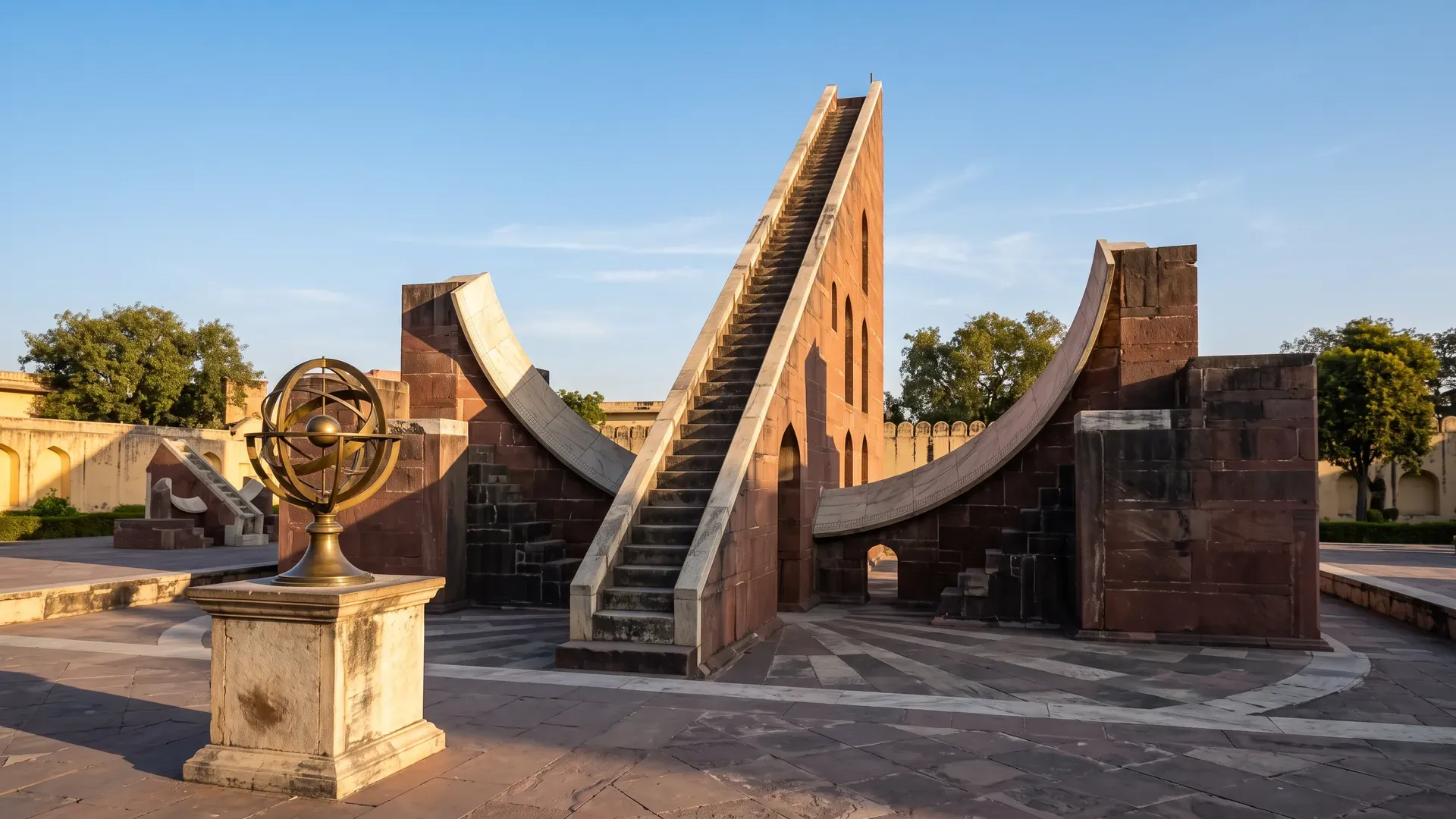
We calculate the SanatanBodh panchang ourselves. The positions of the Sun and Moon come from astronomy-engine, the Lahiri ayanamsha is applied for nakshatra, yoga and rashi, and a day’s tithi is the one running at sunrise in that city. Dates and times are checked against Drik Panchang; if a date differs, or a time is off by more than 5 minutes, that part is not published.
Where the Sun and Moon are
The five limbs of the panchang come from where the Sun and Moon are in the sky. We compute their positions with astronomy-engine, an open-source (MIT licence) astronomy library. Its author states that it is accurate to within ±1 arcminute and tests it against standard sources such as NOVAS and NASA-JPL Horizons.
The Moon takes about two minutes to gain one arcminute on the Sun, so even one arcminute in position becomes about two minutes in a tithi’s end time. The same calculation also runs in your browser, which is why the times change as soon as you pick another city.
Ayanamsha: from tropical to sidereal
Modern astronomy measures the zodiac from the spring equinox (tropical, sayana), while Indian panchangs use signs fixed to the stars (sidereal, nirayana). The difference is the ayanamsha; because the Earth’s axis slowly turns (precession), it grows by about 50 arcseconds a year.
We use the Lahiri (Chitrapaksha) ayanamsha, the one most widely used in India. It is named after the astronomer Nirmal Chandra Lahiri, a member of the Government of India’s (CSIR) Calendar Reform Committee (1952–55, chaired by Meghnad Saha). Its value in the year 2000 was about 23°51′50″. We use exactly the value Drik Panchang prints on its daily panchang (24.2374° on 30 September 2026).
Tithi and karana depend only on the distance between the Sun and Moon, so the ayanamsha does not affect them. Nakshatra, yoga, rashi and sankranti (and so the month’s name) do depend on it.
The five limbs
| Limb | How it is found | Count |
|---|---|---|
| Tithi | Each 12° by which the Moon is ahead of the Sun | 30 (15 Shukla, 15 Krishna) |
| Nakshatra | Each 13°20′ of the Moon’s sidereal longitude | 27 |
| Yoga | The sum of the Sun’s and Moon’s sidereal longitudes, each 13°20′ | 27 |
| Karana | Half a tithi (6°); seven movable karanas in turn, four fixed ones around Amavasya | 60 slots, 11 karanas |
| Vaar | The day from one sunrise to the next | 7 |
Udaya tithi: a day’s tithi, nakshatra, yoga and karana are the ones running at sunrise in that city. Their end times are given too, because a day often holds two tithis.
Fasts and festivals can follow other rules. A shraddh falls on the day its tithi runs in the Aparahna, and Diwali’s Lakshmi Puja on the evening when Amavasya runs through Pradosh kaal. Each festival’s rule is on its page, with sources.
Sunrise, sunset and moonrise
Sunrise is the moment the upper edge of the Sun appears on the horizon, with the standard correction of 34 arcminutes for atmospheric refraction. We calculate for the city centre’s latitude and longitude, at sea level. For moonrise and moonset we take the Moon’s centre at the horizon, without refraction; with this rule our moonrise times agree with Drik Panchang within a minute.
The city matters a lot: on 28 September 2026 the Sun rises at 5:13 in Guwahati and at 6:30 in Ahmedabad. Hills, tall buildings, your height and the weather can shift the sunrise you see by a minute or two.
Month: Amanta and Purnimanta
A lunar month runs from one Amavasya to the next (Amanta). It is named by the sign the Sun enters during it (sankranti): the month in which the Sun enters Mesha is Chaitra. A lunar month with no sankranti is an Adhik (extra) month.
In North India the month changes at Purnima (Purnimanta), so there the Krishna paksha carries the name of the next Amanta month. Maharashtra, Gujarat, Karnataka, Andhra Pradesh and Telangana follow Amanta. Our panchang pages give both names.
Muhurat rules
The day runs from sunrise to sunset and the night from sunset to the next sunrise; each is divided into 15 muhurtas.
- Rahu kaal, Yamaganda, Gulika
- One of the eight equal parts of the day (sunrise to sunset), fixed for each weekday
- Choghadiya
- Eight parts each of the day and the night; the day’s first belongs to the weekday’s lord
- Abhijit and Vijay muhurat
- The 8th and the 11th of the day’s 15 muhurtas
- Brahma muhurta
- The 14th of the 15 muhurtas of the night that ends at sunrise
- Kutup, Rohina, Aparahna
- The day’s 8th and 9th muhurtas; Aparahna is the 4th of five parts of the day
- Pradosh and Nishita kaal
- Pradosh is the first fifth of the night after sunset; Nishita is the 8th of the night’s 15 muhurtas
Checked against Drik Panchang
Every new festival page and muhurat rule is checked against Drik Panchang for New Delhi, and some festivals for Mumbai and Varanasi as well. So far sunrise, sunset and moonrise agree within a minute; our tithi end times come about 2 minutes after Drik’s.
If a festival date differs from Drik, or any time is more than 5 minutes off, that part is not published until the cause is found.
Why panchangs differ
- Method: panchangs made with traditional formulas (vakya or the older siddhanta texts) can differ from those based on modern astronomical positions (drik).
- Ayanamsha: another ayanamsha moves the nakshatra, yoga and sankranti times.
- Sunrise: some panchangs take the Sun’s centre, others its upper edge; some leave out refraction.
- Place: every time depends on the city.
- Tradition and region: Smarta and Vaishnava Ekadashi sometimes fall on different days, and regional customs differ; in Tamil Nadu, for example, Deepavali is celebrated on the morning of Naraka Chaturdashi.
For fasts, sankalp and samskaras, follow your family purohit or your local panchang. We do not offer horoscopes or predictions; the panchang here is information about dates and times only.
Frequently asked questions
Which ayanamsha does the SanatanBodh panchang use?
The Lahiri (Chitrapaksha) ayanamsha, the one most widely used in India. It affects nakshatra, yoga, rashi and sankranti; tithi and karana do not depend on it.
How is today’s tithi decided?
It is the tithi running at sunrise in your city (udaya tithi). Its end time is shown too, because a second tithi often begins during the day.
Why do SanatanBodh and Drik Panchang differ by a minute or two?
Small differences in the models for the Sun and Moon and in how the ayanamsha is applied. Sunrise, sunset and moonrise agree within a minute; our tithi end times come about 2 minutes later than Drik’s. We do not publish a time that differs by more than 5 minutes.
Is the panchang different for each city?
Yes. Sunrise, sunset and every muhurat depend on the city’s latitude and longitude, and the day’s tithi can change with the sunrise time. The site has panchang pages for 66 cities; times are in Indian Standard Time.
Sources
- astronomy-engine (Don Cross), github.com/cosinekitty/astronomy: MIT licence; accurate to ±1 arcminute, tested against NOVAS and JPL Horizons
- Report of the Calendar Reform Committee (Government of India, CSIR, 1955), archive.org
- CSIR: “Saga of Indian Calendar and IST”, csir.res.in (the committee’s members, including N. C. Lahiri)
- Drik Panchang (drikpanchang.com): tithi, sunrise, moonrise and festival muhurat compared for New Delhi, Mumbai and Varanasi, 2026–27
Something wrong? Report a mistake