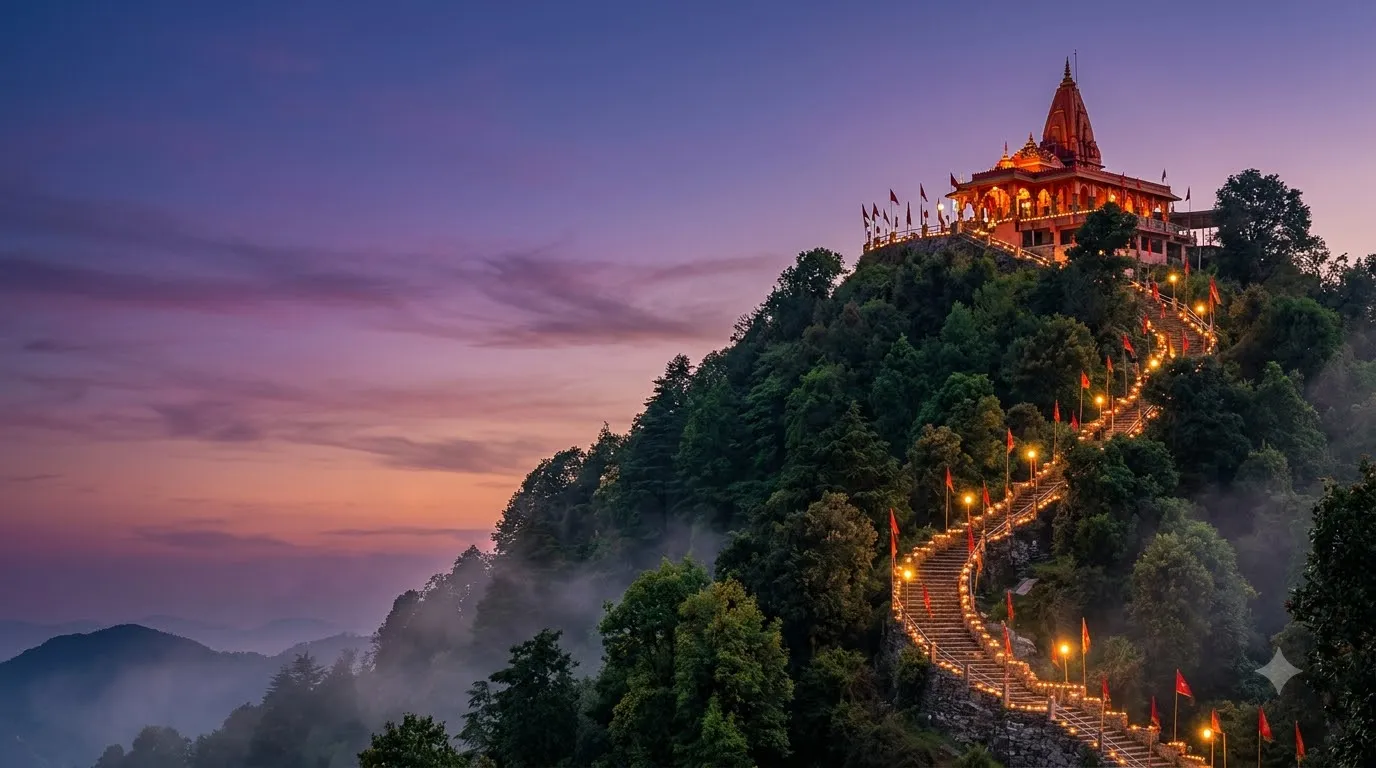
The temple of Hinglaj Mata is in Balochistan, Pakistan, on the bank of the Hingol river in Hingol National Park, Lasbela district. It is taken to be Hingula, the first pitha of the Pithanirnaya’s list: by the text the crown of Sati’s head (brahmarandhra) fell here, and the goddess is Kottari and the Bhairava Bhimalochana.
Each morning the tithi, Rahu Kaal and coming festivals, in one short WhatsApp message.Follow the channel
At a glance
- Tradition
- Shakta
- Place
- Bank of the Hingol river, Hingol National Park, Lasbela district
- Region
- Balochistan, Pakistan
- List
- The 51 Shakti Peethas 1/51
What the texts say
The Pithanirnaya (the list of 51 pithas given in the Tantrachudamani) begins with Hingula. By the text, after Daksha’s sacrifice the limbs of Sati, cut by Vishnu’s discus, made a pitha wherever they fell, and each pitha has a Bhairava beside the goddess. At Hingula the brahmarandhra, the crown of the head, fell; the goddess here is Kottari and the Bhairava Bhimalochana. The historian D. C. Sircar identifies Hingula with Hinglaj in Balochistan.
In 2016 the Government of Pakistan’s Directorate General of Archaeology submitted the "Hingol Cultural Landscape" for UNESCO’s Tentative List of World Heritage. The submission records the same belief, that Sati’s head fell in this area when Vishnu cut her body, and adds that the shrine is linked with the Charan tradition of goddess worship.
The cave shrine and its worship
According to the same submission there is no built temple here: in a natural cave beside a stream that runs to the Hingol river there is a low mud altar, and a small stone is worshipped as the goddess. The cave mouth is marked by coloured flags and an undying flame. Pilgrims go deep into the cave and leave by its narrow openings, and completing this round is held to be like being born again.
According to the submission, pilgrims climb the Chandragup and Khandewari mud volcanoes on the way, singing hymns, and offer coconuts into the bubbling mud at the top. Local Muslims also revere the place, call it "Nani Mandar" and serve as custodians of the cave temple.
The yearly yatra
According to the Pakistani newspaper Dawn, a fair and pilgrimage of three or four days is held here every spring (in recent years in April), and many people, some on foot, come from Tharparkar, Umerkot and Sanghar in Sindh. In 2026 it began on 17 April and lasted three days. Pilgrims bathe in the Hingol river, make offerings at the Chandragup mud volcano on the way, and then have darshan in the cave temple.
Dawn also calls it the temple of "Hinglaj Nani". According to the description of Jürgen Schaflechner’s book "Hinglaj Devi" (Oxford University Press, 2018), the yearly festival has grown in roughly the last three decades, partly because of the Makran Coastal Highway.
How to reach Hinglaj Mata
From Karachi by the Makran Coastal Highway; according to Dawn (2019) the distance is about 250 km, a drive of about four hours.
According to the Government of Pakistan’s UNESCO submission the shrine is on the Makran coast of the Arabian Sea, about 190 km west of Karachi. Pilgrims reach the cave on foot, over rocky ground and between steep cliffs along the Hingol river.
Main festivals
Where the sources differ
- Sources differ on the distance from Karachi: Dawn (2019) says about 250 km, the Government of Pakistan’s UNESCO submission about 190 km west, and the publisher’s description of Schaflechner’s book about 200 km west.
- The date of the fair has varied (late March in 2022, 26-28 April in 2024, from 17 April in 2026); no reliable source we found gives its calendar rule.
- Dawn prints the temple committee’s name two ways: "Hinglaj Mata Welfare and Development Society" and "Shri Hinglaj Mata Welfare Mandli". No official website of the temple was found.
- The count of pithas depends on the text: the Pithanirnaya lists 51, some Bengali lists 52, the Devi Bhagavata (7.30) gives 108 places with names of the goddess, and the early Tantras name only four (Sircar).
Map
Related tirthas
Frequently asked questions
Where is the Hinglaj Mata temple?
In Balochistan, Pakistan, in a hill cave near the Hingol river in Hingol National Park, Lasbela district. It is reached from Karachi by the Makran Coastal Highway.
Which part of Sati fell at Hinglaj?
By the Pithanirnaya, the brahmarandhra, the crown of the head; Dawn’s report also gives the belief that Sati’s head fell here.
When is the Hinglaj yatra?
Every spring, in recent years in April, for three or four days; in 2026 for three days from 17 April (Dawn).
What is worshipped in the Hinglaj cave?
According to the Government of Pakistan’s UNESCO submission the cave has no image and no built temple; a small stone on a low mud altar is worshipped as the goddess.
Which lists of tirthas include Hinglaj Mata?
The 51 Shakti Peethas (number 1 of 51 in the list).
How to reach Hinglaj Mata?
From Karachi by the Makran Coastal Highway; according to Dawn (2019) the distance is about 250 km, a drive of about four hours. According to the Government of Pakistan’s UNESCO submission the shrine is on the Makran coast of the Arabian Sea, about 190 km west of Karachi. Pilgrims reach the cave on foot, over rocky ground and between steep cliffs along the Hingol river.
Sources
- D. C. Sircar, The Śākta Pīṭhas (Journal of the Royal Asiatic Society of Bengal 1948; Motilal Banarsidass, 1973): table of the Pithanirnaya pp. 35-37, note on this pitha p. 43 (archive.org)
- Vachaspatyam (Taranatha Tarkavachaspati), "pitha": the list of pithas quoted from the Tantrachudamani (Cologne Digital Sanskrit Dictionaries, sanskrit-lexicon.uni-koeln.de)
- Government of Pakistan (Directorate General of Archaeology), UNESCO World Heritage Centre Tentative List: "Hingol Cultural Landscape", 12 April 2016 (whc.unesco.org/en/tentativelists/6109; Wayback Machine copy of 2018)
- Dawn (dawn.com), 26 August 2019: the temple in Hingol National Park, distance from Karachi, the April pilgrimage
- Dawn, 26 March 2022 (the "Hinglaj Nani" temple festival); 5 May 2025 (bath, Chandragup, committee); 20 April 2026 (the three-day festival from 17 April 2026)
- Al Jazeera, 28 April 2024: the Hinglaj yatra (photo report)
- Jürgen Schaflechner, Hinglaj Devi (Oxford University Press, 2018): the publisher’s description
- Wikidata Q2722882 (Hinglaj Mata): map coordinates
Something wrong? Report a mistake