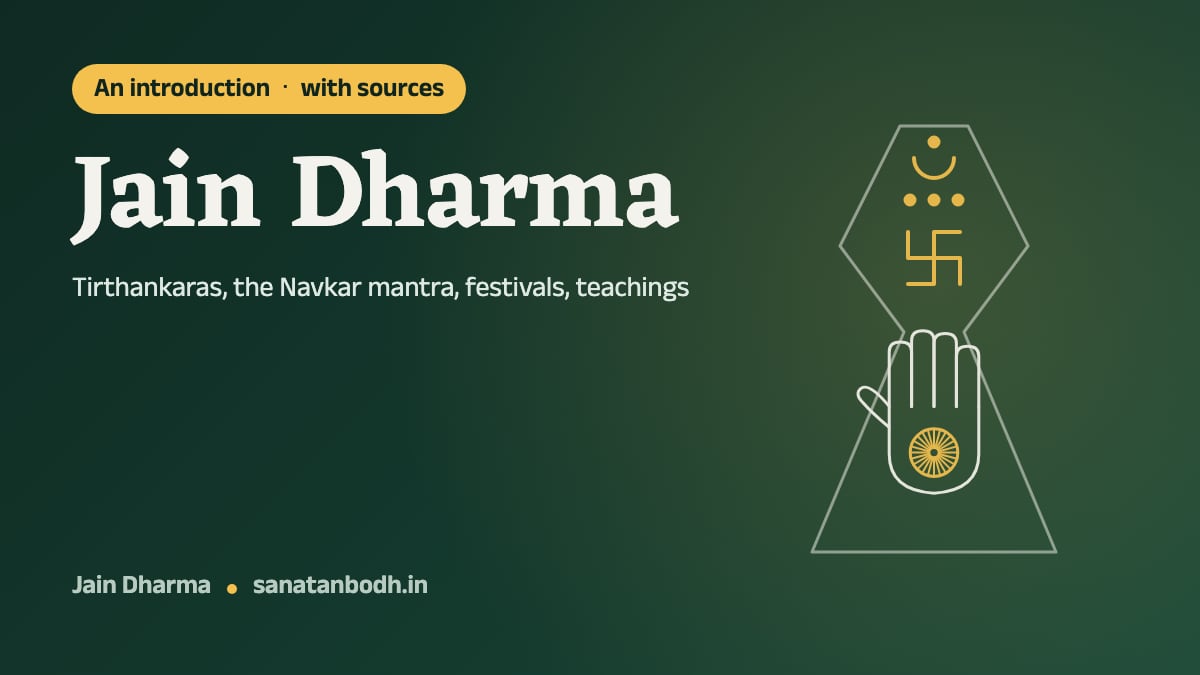
Jain dharma is a religion of its own, not a part of Sanatan (Hindu) dharma: it has its own scriptures (the Agamas, the Shatkhandagama, the Tattvartha Sutra), its own twenty-four Tirthankaras, its own orders of monks and nuns and its own calendar (the Vira Nirvana Samvat). By a notification of 27 January 2014 (S.O. 267(E)) the Government of India notified the Jain community as a minority community under the National Commission for Minorities Act, 1992. By the Tattvartha Sutra (1.1), right faith, right knowledge and right conduct together are the path to liberation. On SanatanBodh this section presents Jain dharma separately and with respect, in the words of its own texts and traditions; where the two traditions share names and stories, they are on a page of their own, with the sources of both.
Pages in this section
- Mahavir Nirvan and Diwali 2026: Vira Nirvana Samvat 2553Nirvan Ladoo on 9 November 2026; Vira Nirvana Samvat 2553 from 10 November; the nirvana and the lamps in the Kalpa Sutra
- Gyan Panchami 2026: the worship of knowledge and scriptureSaturday 14 November 2026; the Shwetambar Gyan Panchami and the Digambar Shruta Panchami
- Kartik Purnima 2026 and the Shatrunjaya (Palitana) yatraTuesday 24 November 2026; the Shatrunjaya yatra reopens after the chaturmas
- The 24 Tirthankaras: names, symbols and placesRishabhdev to Mahavir: symbol, birthplace, place of nirvana, from both traditions
- The Navkar (Namokar) Mantra: text and meaningThe five lines and the chulika, compared in editions of both traditions, with meaning and variants
- Jain and Vedic traditions: a shared heritageRishabhdev, Rama, the Ikshvaku line, Ayodhya and Diwali in the texts of both traditions
Coming Jain observances and tithis
| Date | Observance | Tithi |
|---|---|---|
| Sunday, 8 November 2026 | Kartik Amavasya: Mahavir’s Nirvana Kalyanak and DiwaliNirvan Ladoo on the morning of Monday 9 November (Jain Tithi Darpan, Songadh) | Amavasya from 11:28 am on 8 November to 12:32 pm on 9 November |
| Tuesday, 10 November 2026 | Vira Nirvana Samvat 2553 begins | Kartik Shukla Pratipada |
| Saturday, 14 November 2026 | Gyan Panchami | Kartik Shukla Panchami (Shwetambar tradition) |
| Tuesday, 24 November 2026 | Kartik Purnima: the Shatrunjaya yatra reopens | Kartik Shukla Purnima |
Tithis for sunrise at New Delhi, checked against Drik Panchang. Your city and your sangh’s panchang may differ by a day.
A religion of its own
In the Jain tradition twenty-four Tirthankaras taught the dharma in this cycle of time, the first Rishabhdev and the last (twenty-fourth) Mahavir. By Jaini a Tirthankara is one who attained omniscience, preached the way to liberation and made a “ford” (tirtha) across the ocean of suffering; he is not the founder of a new religion but one who renews a tradition carried by twenty-four Tirthankaras in every cycle of time. Tradition says that the Tirthankara “established” the fourfold tirtha (sangha) of monks, nuns, laymen and laywomen. Jaini also writes that shramana traditions such as the Jain do not accept the scriptural authority of the Vedas, Brahmanas, Upanishads, Mahabharata, Ramayana and Dharmashastras.
A notification of the Ministry of Minority Affairs, Government of India, of 27 January 2014 (S.O. 267(E)) notified the Jain community as a minority community under section 2(c) of the National Commission for Minorities Act, 1992; the Reserve Bank of India’s circular of 18 February 2015 cites the same notification. The 2011 Census counted 4,451,753 Jains in India, 0.37 per cent of the population; about 80 per cent of them live in towns and cities.
The three jewels: the path to liberation
Umasvati’s Tattvartha Sutra, accepted by both Shwetambars and Digambars, says in its very first sutra: “samyag-darśana-jñāna-cāritrāṇi mokṣa-mārgaḥ” (1.1): right faith, right knowledge and right conduct together are the path to liberation. These three are called the three jewels (ratnatraya); the three dots of the Jain symbol stand for them (Jaini).
The five vows and ahimsa
By the Tattvartha Sutra (7.1) a vow is abstaining from violence, falsehood, stealing, unchastity and possessiveness; so there are five vows: ahimsa, truth, not stealing, brahmacharya and non-possession. The next sutra (7.2) says that partial abstinence is an anuvrata and complete abstinence a mahavrata: monks and nuns take the great vows, householders the lesser ones. Ahimsa is the first of them.
Anekantavada and syadvada
Anekantavada is the teaching that a thing has many aspects and no single statement can say all of it. Its way of speaking is syadvada: by Jaini “syat” means “in some respect” and “eva” “in fact”, as in “in some respect, namely that of substance and not of its modes, the soul is in fact eternal.” From this comes the sevenfold predication, the saptabhangi.
Shwetambar and Digambar
Jain dharma has two main traditions, the Shwetambar (“white-clad”) and the Digambar (“sky-clad”). By Jaini their main differences are these:
| Question | Digambar | Shwetambar |
|---|---|---|
| Clothing of monks | Nudity required of monks | They wear clothes; nudity not required |
| Women and liberation | A woman must be reborn as a man for liberation | A woman too can be liberated; the nineteenth Tirthankara, Malli, was a woman |
| The omniscient | Does not eat; teaches through a divine sound | Lives in the ordinary way |
| Alms | In the hands, once a day | In bowls, two or three times a day |
| Canon | The original Anga texts did not survive in authentic form; texts such as the Shatkhandagama | Murtipujaks hold 45 Agamas; Sthanakvasis and Terapanthis 32 |
Among Shwetambars, besides the Murtipujaks, two traditions do not worship images: the Sthanakvasis, who grew out of Lonka Shah’s movement and wear the mouth-cloth, and the Terapanth, founded in the eighteenth century by the Sthanakvasi monk Bhikshu (Bhikhanji) (Jaini; Dundas).
The Jain symbol
By Jaini the Jain symbol was officially adopted in the 2,500th year of Mahavir’s nirvana (1974–75). Its outline is the shape of the loka (the universe); on the palm is a wheel with the word “ahimsa”; the svastika stands for the four states of existence, the three dots for the three jewels, and the crescent and dot for the abode of the liberated (siddhashila). Below it is written the Tattvartha Sutra’s “parasparopagraho jīvānām” (5.21): souls render service to one another.
Frequently asked questions
Is Jain dharma a part of Hinduism?
No. Jain dharma is a separate religion with its own scriptures, Tirthankaras, orders of monks and calendar, and it does not accept the Veda as authority. The Government of India notified the Jain community as a minority community on 27 January 2014. Some names and stories are shared by the two traditions, such as Rishabhdev and Rama; we have set them out on a page of their own with the sources of both.
What are the three jewels of Jain dharma?
Right faith, right knowledge and right conduct, which together are the path to liberation (Tattvartha Sutra 1.1).
What are the five vows of Jain dharma?
Ahimsa, truth, not stealing, brahmacharya and non-possession (Tattvartha Sutra 7.1). Monks take them in full as great vows, householders in part as lesser vows (7.2).
What is the difference between Shwetambar and Digambar?
The main differences concern the clothing of monks, the liberation of women, whether the omniscient eats, and the canon: Digambar monks wear no clothes and hold that the original Anga texts were lost; Shwetambar monks wear white and hold that a woman too can be liberated (Jaini).
How many Jains are there in India?
The 2011 Census counted 4,451,753, or 0.37 per cent of the population.
Sources
- Government of India, Ministry of Minority Affairs, notification S.O. 267(E), 27 January 2014, as cited in the Reserve Bank of India’s circular RBI/2014-15/473 (18 February 2015)
- Umasvati, Tattvartha Sutra 1.1, 5.21, 7.1, 7.2 (Nathmal Tatia’s translation, That Which Is, 1994)
- Padmanabh S. Jaini, The Jaina Path of Purification (Motilal Banarsidass), pp. 1–2 and note 2, 35–36, 38–41, 49, 90–97, 309–316
- Paul Dundas, The Jains, 2nd edition (Routledge, 2002), ch. 3
- Census of India 2011, table C-1 (population by religious community), India
Something wrong? Report a mistake