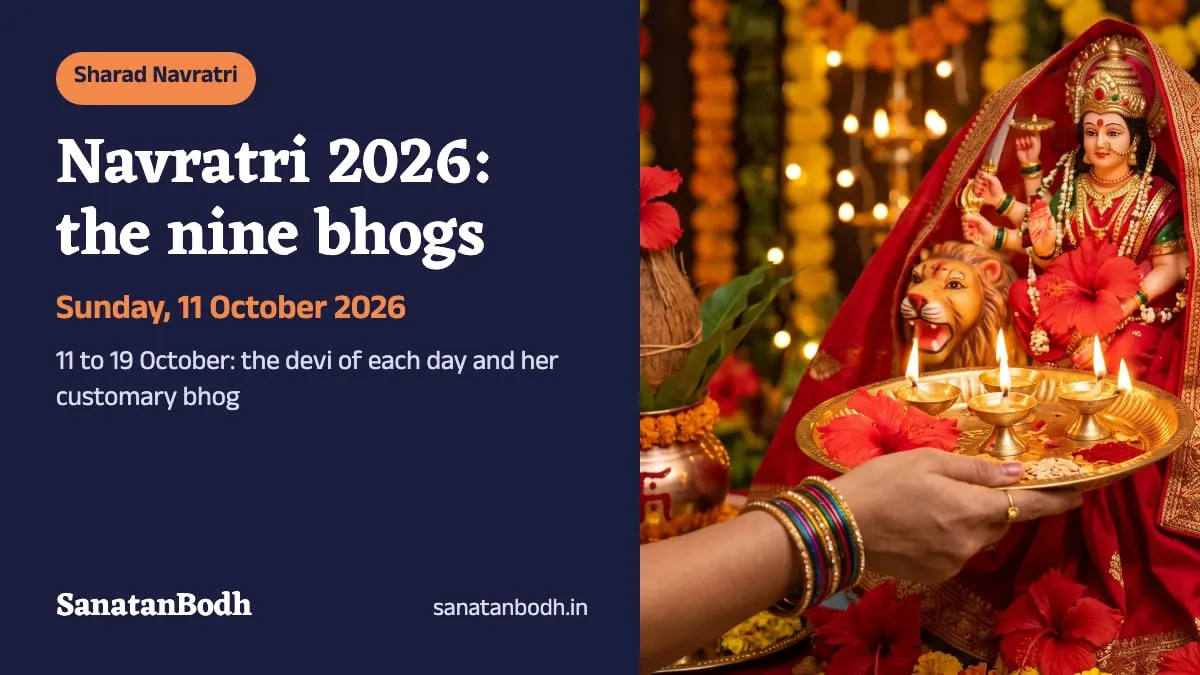
By popular tradition, on the first day of Navratri 2026, 11 October, Maa Shailputri is offered ghee; then, day by day, sugar or mishri, milk or kheer, malpua, banana, honey, jaggery and coconut, and on the ninth day halwa, puri and chana, or sesame. This year the worship of the eighth and ninth days, of Maa Mahagauri and Maa Siddhidatri, both falls on 19 October.
Each morning the tithi, Rahu Kaal and coming festivals, in one short WhatsApp message.Follow the channel
Nine days, nine devis and their bhog
- Day 1 (11 October), Maa Shailputri: ghee
- Day 2 (12 October), Maa Brahmacharini: sugar or mishri
- Day 3 (13 October), Maa Chandraghanta: milk or kheer
- Day 4 (14 October), Maa Kushmanda: malpua
- Day 5 (15 October), Maa Skandamata: banana
- Day 6 (16 October), Maa Katyayani: honey
- Day 7 (17 October), Maa Kalaratri: jaggery (gur)
- Day 8 (19 October), Maa Mahagauri: coconut
- Day 9 (19 October), Maa Siddhidatri: halwa, puri and chana, or sesame (til)
18 and 19 October
This year Saptami holds at sunrise on both 17 and 18 October, so Drik Panchang names no separate devi for 18 October. On 19 October Ashtami ends in the morning and Navami begins, and both Maa Mahagauri and Maa Siddhidatri are worshipped that day, so both bhogs fall on it. Families who keep Navami on 20 October follow their own custom.
Where the list comes from
In the 24th chapter of the eighth book of the Devi Bhagavata Purana, Narayana tells Narada how the Devi is worshipped, and gives an offering for each tithi: ghee on Pratipada, sugar on Dwitiya, milk on Tritiya, apūpa (a sweet cake, the pua) on Chaturthi, banana on Panchami, honey on Shashthi, jaggery on Saptami, coconut on Ashtami, lāja (puffed paddy) on Navami and black sesame on Dashami; after the offering the same thing is given to a brahmin. The Purana gives these by tithi, not by the names of the nine forms. The days of Navratri are the tithis from Pratipada to Navami, so the popular list matches it for the first eight days; for the ninth day the lists differ.
For the ninth day most newspaper lists give halwa, puri, chana and kheer, the food also made for Kanya Puja; some give sesame, which the Purana gives for Dashami. Every home offers bhog in its own way; if your family’s custom differs, follow it.
The akhand jyoti
Akhand means unbroken. In many homes a large lamp is lit before the Devi at Ghatasthapana and kept burning day and night until Navratri ends; this is the akhand jyoti. Not every home keeps one: families with the custom, or who have taken a sankalpa for it, do.
By custom a ghee lamp stands to the Devi’s right and an oil lamp to her left, on a chowki or plate, with a glass chimney against the wind, and someone stays at home through the nine days. If the jyoti goes out, one asks the Devi’s forgiveness and lights it again. The full details are on the Navratri page.
Sources
- Bhog: popular tradition; the lists of Webdunia, Amar Ujala, Punjab Kesari, ETV Bharat, Navbharat Live and the Free Press Journal (compared: docs/checks/navratri-bhog.md)
- Devi Bhagavata Purana, book 8, chapter 24 (offerings by tithi; Sanskrit text from sanskritdocuments.org)
- Dates: Drik Panchang, Sharad Navratri 2026, New Delhi (compared: docs/checks/drik-navratri-2026.md)
- Akhand jyoti: popular custom; Patrika, Zee News Hindi, Times Now Navbharat, India TV and The Art of Living
Something wrong? Report a mistake
