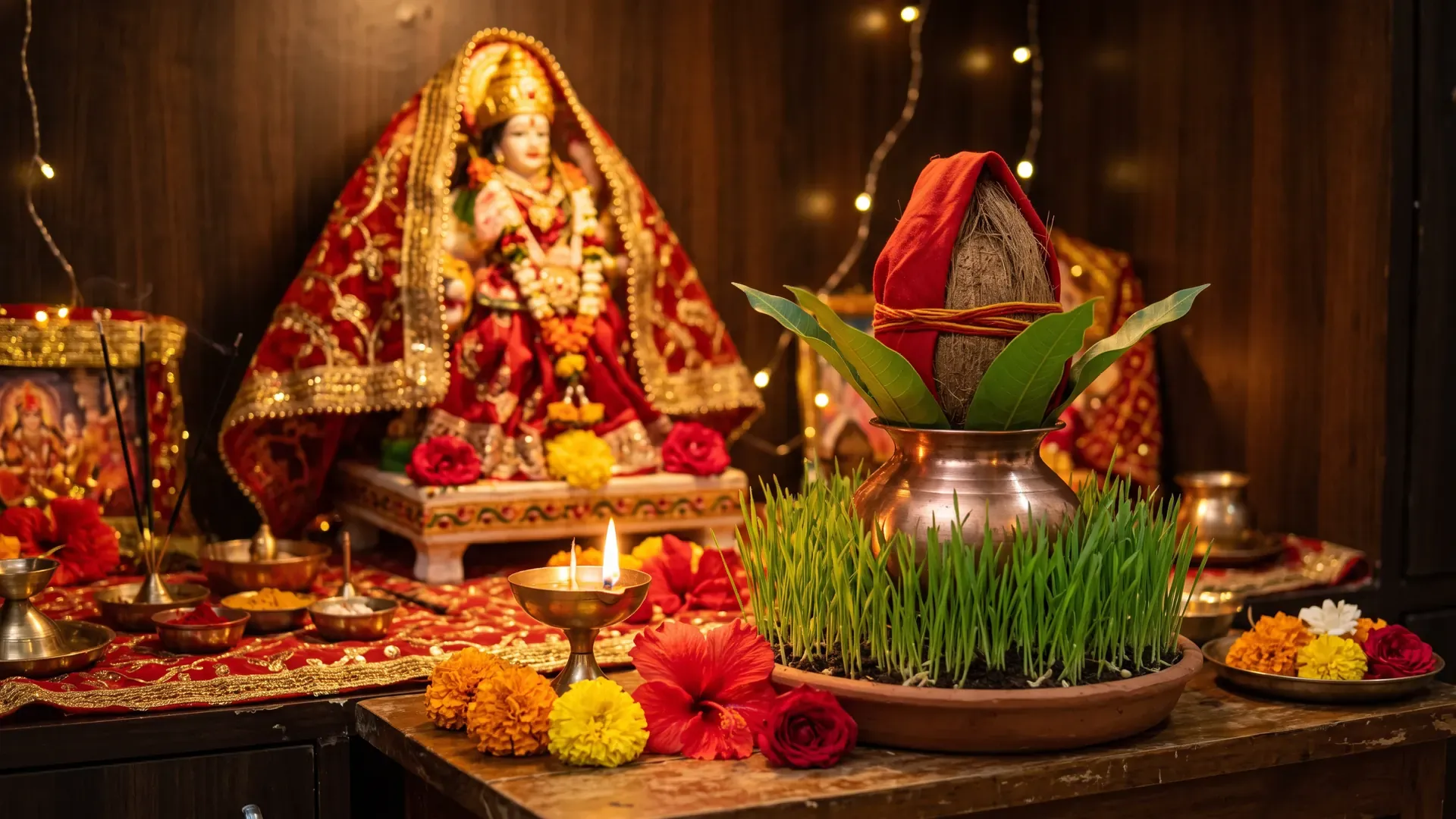
Sharad Navratri 2026 runs from Sunday, 11 October to Monday, 19 October. It begins with Ghatasthapana on Ashwin Shukla Pratipada, and for nine days the nine forms of Goddess Durga are worshipped; after that, Vijayadashami (Dussehra) is celebrated on Dashami. See the Ghatasthapana muhurat for your city’s sunrise below.
Each morning the tithi, Rahu Kaal and coming festivals, in one short WhatsApp message.Follow the channel
City-wise times: Ghatasthapana
Pick your city for its full timings, nearby cities and common questions.
- New Delhi6:19–10:12 AM
- Varanasi5:54–9:48 AM
- Mumbai6:31–10:27 AM
- Kolkata5:31–9:26 AM
- Chennai5:59–9:57 AM
- Bengaluru6:09–10:07 AM
- Hyderabad6:08–10:05 AM
- Ahmedabad6:35–10:29 AM
- Jaipur6:24–10:17 AM
- Lucknow6:03–9:56 AM
- Patna5:46–9:39 AM
- Bhopal6:16–10:10 AM
- Ujjain6:22–10:16 AM
- Haridwar6:16–10:08 AM
- Pune6:27–10:23 AM
- Guwahati5:20–9:13 AM
- Noida6:19–10:11 AM
- Gurugram6:20–10:12 AM
- Ghaziabad6:19–10:11 AM
- Faridabad6:19–10:11 AM
- Chandigarh6:22–10:14 AM
- Ludhiana6:26–10:18 AM
- Amritsar6:31–10:22 AM
- Jammu6:31–10:22 AM
- Dehradun6:17–10:09 AM
- Rishikesh6:16–10:08 AM
- Shimla6:21–10:12 AM
- Agra6:15–10:08 AM
- Mathura6:17–10:10 AM
- Prayagraj5:59–9:53 AM
- Kanpur6:06–9:59 AM
- Ayodhya5:58–9:51 AM
- Gorakhpur5:54–9:47 AM
- Meerut6:18–10:10 AM
- Bareilly6:10–10:03 AM
- Jodhpur6:35–10:28 AM
- Udaipur6:31–10:25 AM
- Kota6:23–10:16 AM
- Ajmer6:28–10:22 AM
- Indore6:22–10:16 AM
- Gwalior6:14–10:07 AM
- Jabalpur6:05–10:00 AM
- Raipur5:58–9:53 AM
- Gaya5:46–9:40 AM
- Muzaffarpur5:45–9:39 AM
- Bhagalpur5:38–9:32 AM
- Darbhanga5:43–9:36 AM
- Ranchi5:44–9:38 AM
- Jamshedpur5:40–9:35 AM
- Dhanbad5:40–9:34 AM
- Bhubaneswar5:40–9:36 AM
- Puri5:40–9:36 AM
- Siliguri5:34–9:27 AM
- Surat6:33–10:28 AM
- Vadodara6:32–10:27 AM
- Rajkot6:42–10:36 AM
- Nagpur6:08–10:03 AM
- Nashik6:28–10:24 AM
- Panaji6:26–10:23 AM
- Visakhapatnam5:49–9:46 AM
- Tirupati6:03–10:00 AM
- Mysuru6:13–10:11 AM
- Kochi6:13–10:12 AM
- Thiruvananthapuram6:10–10:09 AM
- Coimbatore6:11–10:10 AM
- Madurai6:06–10:05 AM
At a glance
- Tithi
- Ashwin Shukla Pratipada to Navami
- Duration
- Nine nights; Vijayadashami on the tenth day
- Worshipped
- The nine forms of Goddess Durga (Navadurga)
- First day
- Ghatasthapana (Kalash Sthapana)
- Main text
- Durga Saptashati (Devi Mahatmya)
- Ashtami and Navami
- Kanya Pujan, Sandhi Puja
- In a year
- Four Navratris; Sharad Navratri is the most widely celebrated
Navadurga: nine days, nine forms
The Devi Kavach gives the nine forms in this order, and during Navratri one form is worshipped each day. The forms are described as in the traditional dhyana shlokas (meditation verses).
Day 1: Shailaputri
Daughter of Himalaya, king of the mountains. She rides a bull and holds a trident and a lotus.
Day 2: Brahmacharini
The goddess in tapas (austerity). She holds a japa mala (prayer beads) and a kamandalu (water pot).
Day 3: Chandraghanta
A bell-shaped crescent moon on her forehead. She rides a lion, in a form ready for battle.
Day 4: Kushmanda
By tradition, the one whose gentle smile brought the universe into being.
Day 5: Skandamata
Mother of Skanda (Kartikeya); the child Skanda sits in her lap.
Day 6: Katyayani
By tradition, she appeared in the ashram of the sage Katyayana; worshipped as Mahishasuramardini, the slayer of Mahishasura.
Day 7: Kalaratri
Dark as the night, fearsome in form; she destroys the fears of her devotees.
Day 8: Mahagauri
Very fair in complexion, dressed in white; she rides a bull.
Day 9: Siddhidatri
The giver of all siddhis (spiritual powers); seated on a lotus.
Ghatasthapana: when and how
On the first day of Navratri, barley is sown in soil, a kalash filled with water is placed on it, and the goddess is invoked into it. According to the nirnaya texts (works that settle ritual timing), Ghatasthapana should be done during Pratipada tithi, in the first third of the day after sunrise; if that is not possible, then at midday in the Abhijit Muhurat. Avoiding Chitra nakshatra and Vaidhriti yoga is advised, but Ghatasthapana is not considered forbidden during them.
Durga Saptashati
The 700 verses of chapters 81 to 93 of the Markandeya Purana are called the Durga Saptashati; it is also known as the Devi Mahatmya and the Chandi Path. In its three episodes (charitras), the goddess slays Madhu and Kaitabha, Mahishasura, and Shumbha and Nishumbha. It is recited especially during Navratri.
The bhog of the nine days
By popular tradition; follow your family’s custom. It is a popular custom to offer a different bhog to the devi of each day. With the dates of 2026:
| Day | Devi | Bhog |
|---|---|---|
| Day 1Sunday, 11 October | Maa Shailputri | GheePure ghee, or something made with it, such as halwa. |
| Day 2Monday, 12 October | Maa Brahmacharini | Sugar or mishriSome lists add panchamrit. |
| Day 3Tuesday, 13 October | Maa Chandraghanta | Milk or kheerMilk, or a sweet made from milk. |
| Day 4Wednesday, 14 October | Maa Kushmanda | Malpua |
| Day 5Thursday, 15 October | Maa Skandamata | Banana |
| Day 6Friday, 16 October | Maa Katyayani | HoneySome lists add a sweet paan. |
| Day 7Saturday, 17 October | Maa Kalaratri | Jaggery (gur)Jaggery, or a sweet made with it. |
| Day 8Monday, 19 October | Maa Mahagauri | CoconutCoconut, or a coconut sweet. |
| Day 9Monday, 19 October | Maa Siddhidatri | Halwa, puri and chana, or sesame (til)Most lists give halwa, puri, chana and kheer, the food also made for Kanya Puja; some give sesame (til). |
In 2026 Saptami holds at sunrise on both 17 and 18 October; Drik Panchang names no separate devi for 18 October. Maa Mahagauri and Maa Siddhidatri are both worshipped on 19 October, so both bhogs fall on that day. Families who keep Navami on 20 October follow their own custom.
Offerings by tithi in the Devi Bhagavata Purana
In the 24th chapter of the eighth book of the Devi Bhagavata Purana, Narayana tells Narada how the Devi is worshipped, and gives an offering for each tithi: ghee on Pratipada, sugar on Dwitiya, milk on Tritiya, apūpa (a sweet cake, the pua) on Chaturthi, banana on Panchami, honey on Shashthi, jaggery on Saptami, coconut on Ashtami, lāja (puffed paddy) on Navami and black sesame on Dashami; after the offering the same thing is given to a brahmin. The Purana gives these by tithi, not by the names of the nine forms. The days of Navratri are the tithis from Pratipada to Navami, so the popular list matches it for the first eight days; for the ninth day the lists differ.
Checked against these sources and written in our own words: Devi Bhagavata Purana 8.24, Sanskrit text (sanskritdocuments.org); The same chapter in Swami Vijnanananda’s English translation (wisdomlib.org); Webdunia; Amar Ujala (March 2026); Punjab Kesari (October 2026); ETV Bharat (March 2026); Free Press Journal (September 2025)
Akhand jyoti: keeping the lamp for nine days
Akhand means unbroken. In many homes a large lamp is lit before the Devi at Ghatasthapana and kept burning day and night until Navratri ends; this is the akhand jyoti. Not every home keeps one: families with the custom, or who have taken a sankalpa for it, do.
Ghee or oil
Pure ghee, or sesame or mustard oil. By custom a ghee lamp stands to the Devi’s right and an oil lamp to her left.
Where it stands
Not on the bare floor: on a chowki or a plate, over a heap of rice or wheat. A glass chimney or cover keeps the wind off.
Lamp and wick
A lamp large enough to hold ghee or oil for long, and a long, thick wick of cotton or kalawa (mauli).
Looking after it
Add ghee or oil from time to time; by custom this is done after bathing, with clean hands. Someone stays at home through the nine days so the lamp is never left alone.
A small lamp beside it
Before trimming the wick or refilling, light a small lamp from the flame, so the jyoti can be lit again from it if needed.
Safety
Keep the lamp away from curtains, cloth and the reach of children.
If the jyoti goes out
If the jyoti goes out, from wind, the wick or the ghee running low, there is no cause for worry. By custom one asks the Devi’s forgiveness and lights it again, and the puja goes on as before. Homes differ in their rules; follow your own purohit or the elders of your family.
When Navratri ends
When Navratri is over the jyoti is not blown out; by custom it is left to go out by itself.
These customs were checked against these sources and written in our own words: Patrika (March 2025); Zee News Hindi (October 2023); Times Now Navbharat (March 2026); India TV (September 2025); The Art of Living; Amar Ujala (September 2026)
Navratri puja samagri list (Kalash Sthapana)
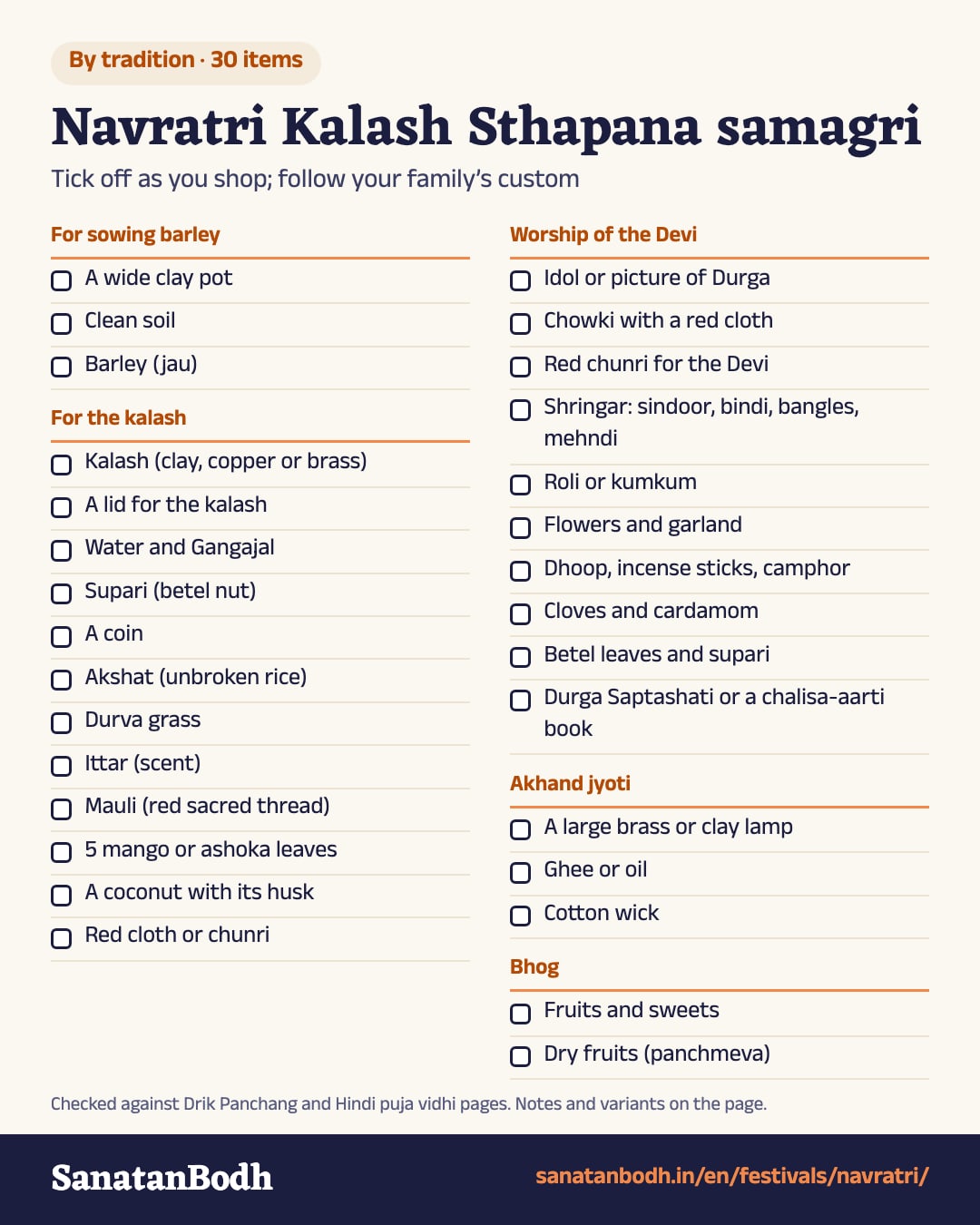
By tradition; follow your family’s custom. What homes usually keep ready for Ghatasthapana (Kalash Sthapana) on the first day and the puja of the nine days. 30 items in all; tick them off as you shop.
For sowing barley
For the kalash
Worship of the Devi
Akhand jyoti
For homes that keep a lamp burning all nine days
Bhog
How homes and regions differ
- In Drik Panchang’s vidhi, supari, scent, durva, akshat and a coin go into the kalash water, five leaves are set at its mouth before the lid, and a coconut wrapped in red cloth goes on top; then the five-part (panchopachara) puja: scent, flowers, dhoop, lamp and food.
- Homes that do a havan during Navratri also need a havan kund, mango wood and havan samagri.
- The food and dakshina for Kanya Puja (Ashtami or Navami) follow the family’s custom.
Checked against these sources and written in our own words; only items named by at least two of them are listed: Drik Panchang: Ghatasthapana Puja Vidhi; Webdunia: Kalash Sthapana vidhi and samagri; India TV: Navratri puja samagri (2024); Times Now Hindi: Sharad Navratri puja samagri (2025); Amar Ujala: Navratri puja samagri (2026); Sri Mandir: Navratri puja samagri
How to perform the puja
- Step 1
Bath and sankalpa
On Pratipada, after bathing, take a sankalpa (resolve) for nine days of puja or fasting.
- Step 2
Sowing barley and Kalash Sthapana
Sow barley in an earthen pot. Place the kalash on it with water, a betel nut and a coin inside, mango leaves at its mouth and a coconut on top.
- Step 3
The lamp
Many families keep an akhand deepak (unbroken lamp) burning for all nine days; follow your own tradition.
- Step 4
Daily puja
Worship the goddess’s form for that day, and recite the Durga Saptashati or the Devi Kavach.
- Step 5
Kanya Pujan
On Ashtami or Navami, as per your family tradition, offer a meal to young girls and give them dakshina.
- Step 6
Parana and visarjan
On Navami or Dashami, as per tradition, break the fast (parana) and immerse the kalash (visarjan).
Mahishasuramardini
According to the middle episode (Madhyama Charitra) of the Durga Saptashati, Mahishasura defeated the devas and seized heaven. Then, from the radiance of Brahma, Vishnu, Shiva and all the devas, a goddess appeared. The devas gave her their own weapons. The goddess destroyed Mahishasura’s army and finally slew Mahishasura himself, and so she came to be called Mahishasuramardini.
Durga Saptashati, chapters 2–3Read the full kathaVerses
प्रथमं शैलपुत्री च द्वितीयं ब्रह्मचारिणी।तृतीयं चन्द्रघण्टेति कूष्माण्डेति चतुर्थकम्॥पञ्चमं स्कन्दमातेति षष्ठं कात्यायनीति च।सप्तमं कालरात्रीति महागौरीति चाष्टमम्॥नवमं सिद्धिदात्री च नवदुर्गाः प्रकीर्तिताः॥या देवी सर्वभूतेषु शक्तिरूपेण संस्थिता।नमस्तस्यै नमस्तस्यै नमस्तस्यै नमो नमः॥Sharad Navratri: relations
See in the knowledge graphDeities, figures and sages 11
- Durga · Deity worshippedDevi Bhagavata Purana, Skandha 3
- Saraswati · Deity worshipped (Saraswati Puja)Tradition
- Shailputri · Goddess of the first dayThe order of the Devi Kavacha (verses 3-5); tradition
- Brahmacharini · Goddess of the second dayThe order of the Devi Kavacha (verses 3-5); tradition
- Chandraghanta · Goddess of the third dayThe order of the Devi Kavacha (verses 3-5); tradition
- Kushmanda · Goddess of the fourth dayThe order of the Devi Kavacha (verses 3-5); tradition
- Skandamata · Goddess of the fifth dayThe order of the Devi Kavacha (verses 3-5); tradition
- Katyayani · Goddess of the sixth dayThe order of the Devi Kavacha (verses 3-5); tradition
- Kalaratri · Goddess of the seventh dayThe order of the Devi Kavacha (verses 3-5); tradition
- Mahagauri · Goddess of the eighth dayThe order of the Devi Kavacha (verses 3-5); tradition
- Siddhidatri · Goddess of the ninth dayThe order of the Devi Kavacha (verses 3-5); tradition
Festivals 1
- Dussehra · Closing festival (Dashami)Tradition
Frequently asked questions
What are the dates of Sharad Navratri 2026?
From Sunday, 11 October to Monday, 19 October. After it, Vijayadashami (Dussehra) is celebrated on Dashami.
What is the Ghatasthapana (Kalash Sthapana) muhurat in 2026?
On Sunday, 11 October, during Pratipada: 6:19–10:12 AM in New Delhi; if that is not possible, the Abhijit muhurat, 11:45 AM–12:31 PM. This year Chitra nakshatra and Vaidhriti yoga run through the whole Ghatasthapana window. It is advised to avoid them, but Ghatasthapana is not forbidden during them. See the time for your city above.
What is the best time for Ghatasthapana?
The first third of the day after sunrise, while Pratipada tithi lasts. If that is not available, the Abhijit Muhurat. See the time for your city above.
What are the nine forms of Navadurga?
Shailaputri, Brahmacharini, Chandraghanta, Kushmanda, Skandamata, Katyayani, Kalaratri, Mahagauri and Siddhidatri.
Should Kanya Pujan be done on Ashtami or Navami?
Both are common. Follow your family tradition.
How many Navratris are there in a year?
Four: the Navratris of Chaitra and Ashwin (Sharad), and the Gupt Navratris of Magha and Ashadha. Of these, Sharad Navratri is the most widely celebrated.
What samagri is needed for the Navratri Kalash Sthapana?
By tradition: a wide clay pot, clean soil and barley for sowing; a kalash (clay, copper or brass) with a lid, water, Gangajal, supari, a coin, akshat, durva, mauli, five mango or ashoka leaves, a coconut with its husk and a red cloth or chunri to wrap it. For the Devi’s puja: a chunri, shringar, flowers, dhoop, a lamp and bhog. The full list is on this page.
Which bhog is offered on which day of Navratri?
By popular tradition: day 1 (Shailputri) ghee, day 2 (Brahmacharini) sugar or mishri, day 3 (Chandraghanta) milk or kheer, day 4 (Kushmanda) malpua, day 5 (Skandamata) banana, day 6 (Katyayani) honey, day 7 (Kalaratri) jaggery (gur), day 8 (Mahagauri) coconut, day 9 (Siddhidatri) halwa, puri and chana, or sesame (til). The Devi Bhagavata Purana (8.24) gives nearly the same offerings for the first eight tithis (for Chaturthi, apūpa, the pua). If your family’s custom differs, follow it.
What if the akhand jyoti goes out?
By custom one asks the Devi’s forgiveness and lights it again. When refilling or trimming the wick, keep a small lamp lit from the same flame beside it, to relight from if needed. Homes differ in their rules; follow your purohit or your family’s custom.
Sources
- Markandeya Purana, chapters 81–93 (Durga Saptashati)
- Devi Kavach
- Devi Bhagavata Purana, Skandha 3 (the Navratri vrat)
- Dharmasindhu and Nirnayasindhu (rules for Ghatasthapana)
- Muhurat and moonrise: SanatanBodh panchang calculation, checked against Drik Panchang (New Delhi, 2026–27)
- Bhog: Devi Bhagavata Purana, book 8, chapter 24 (offerings by tithi); popular lists: Webdunia, Amar Ujala, Punjab Kesari, ETV Bharat, Free Press Journal
- Akhand jyoti: popular custom; Patrika, Zee News Hindi, Times Now Navbharat, India TV, The Art of Living, Amar Ujala
Something wrong? Report a mistake