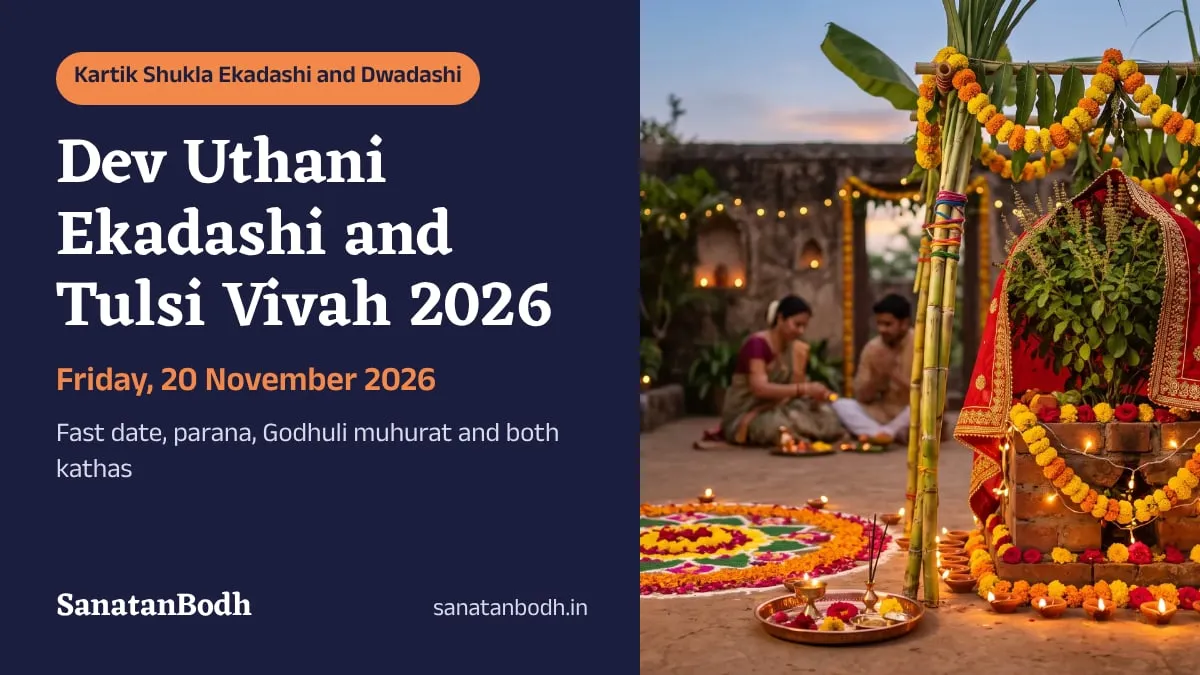
The Dev Uthani Ekadashi fast is on Friday, 20 November 2026 (Drik Panchang, New Delhi). In New Delhi the fast is broken the next day, Saturday 21 November, between 1:11 PM and 3:18 PM. On the same day, 21 November, Kartik Shukla Dwadashi, is Tulsi Vivah; the evening Godhuli muhurat runs from 5:25 to 5:52 PM (New Delhi).
Each morning the tithi, Rahu Kaal and coming festivals, in one short WhatsApp message.Follow the channel
Tithi, parana and the Vaishnava date
In New Delhi the Ekadashi tithi runs from 7:17 AM on 20 November to 6:33 AM on 21 November (Drik: 7:15 AM to 6:31 AM). The fast is kept on the day Ekadashi holds at sunrise, so the Smarta fast is on 20 November. Parana is done during Dwadashi, after Hari Vasara (the first quarter of Dwadashi); on 21 November Hari Vasara lasts until 12:09 PM, so the parana is from 1:11 PM to 3:18 PM. Drik gives the Vaishnava (Gauna) Ekadashi on Saturday, 21 November, with parana on 22 November from 6:49 AM to 8:56 AM. Those keeping a one-day fast take the first date, or follow their own tradition. The parana for other cities is on the Dev Uthani Ekadashi page.
- Smarta fast: Friday, 20 November
- Parana: 21 November, 1:11 PM to 3:18 PM (New Delhi)
- Vaishnava (Gauna) Ekadashi: Saturday, 21 November; parana 22 November, 6:49 AM to 8:56 AM
- Tulsi Vivah: Saturday, 21 November, Godhuli 5:25 to 5:52 PM (New Delhi)
What is done on Dev Uthani Ekadashi
This is Kartik Shukla Ekadashi, also called Prabodhini and Devotthana Ekadashi. By tradition the four months of Vishnu’s sleep that begin on Ashadha Shukla Ekadashi (Devshayani), the Chaturmas, end on this day. The Gita Press book Ekadashi-vrat ka Mahatmya (based on the Padma Purana) praises the night vigil, hearing Vishnu’s stories and worship with tulsi on this night.
- Waking the Lord in the evening with conch, bell and lamp (“dev jagana”) and a small mandap of sugarcane: folk custom.
- A fast by day, by tradition without grains or rice; without water or with fruit, by family custom and health.
- The five-day Bhishma Panchaka vow runs from this day to Kartik Purnima (Padma Purana, Uttara Khanda 124).
- By tradition auspicious events such as weddings resume after this day; a wedding date is still fixed by a proper muhurat from the panchang.
Both kathas in two lines
Dev Uthani Ekadashi: in the folk katha a servant cooks by a river on Ekadashi and calls God with a sincere heart, and God himself comes to eat with him. The Gita Press book has no separate story for this Ekadashi, only its praise; the full account is on the katha page.
Tulsi Vivah: in the common telling Vishnu breaks by a trick the vow of Vrinda, Jalandhara’s faithful wife; Vrinda curses him to become stone, so he becomes the Shaligram, and tulsi grows from her ashes. In the Puranas the curse of stone belongs to the story of Tulsi and Shankhachuda (Shiva Purana, Yuddha Khanda 41; Devi Bhagavata 9.24).
How and when Tulsi Vivah is held
Drik Panchang gives Tulsi Vivah 2026 on Saturday, 21 November; in New Delhi the Dwadashi tithi runs from 6:33 AM on 21 November to 4:58 AM on 22 November (Drik: 6:31 AM to 4:56 AM). Many families hold the wedding on the Ekadashi evening (20 November), and in many places on any day from Ekadashi to Kartik Purnima; choose the day by your own tradition. Tulsi is married to a Shaligram stone or an image of Vishnu or Krishna, with wedding rites such as haldi, kanyadaan and the rounds; this is custom, not a scriptural rule.
Sources
- Drik Panchang: Prabodhini Ekadashi 2026, Tulsi Vivah 2026 and the panchang of 21 November, New Delhi (date, tithi, parana, Hari Vasara and Godhuli compared, 5 November 2026; docs/checks/growth-ekadashi-nov.md)
- Gita Press, Ekadashi-vrat ka Mahatmya (based on the Padma Purana): Shayani and Prabodhini Ekadashi; Padma Purana, Uttara Khanda 124 (Bhishma Panchaka)
- Shiva Purana, Rudra Samhita, Yuddha Khanda 23 and 41; Devi Bhagavata Purana 9.24 (the Vrinda and Tulsi stories; docs/checks/katha/tulsi-vivah.md)
- Folk kathas and customs: Webdunia, Bhakti Bharat, Aaj Tak, Drik Panchang (as given on the Dev Uthani and Tulsi Vivah pages)
- Times: SanatanBodh panchang calculation (astronomy-engine, Lahiri ayanamsha)
Something wrong? Report a mistake
