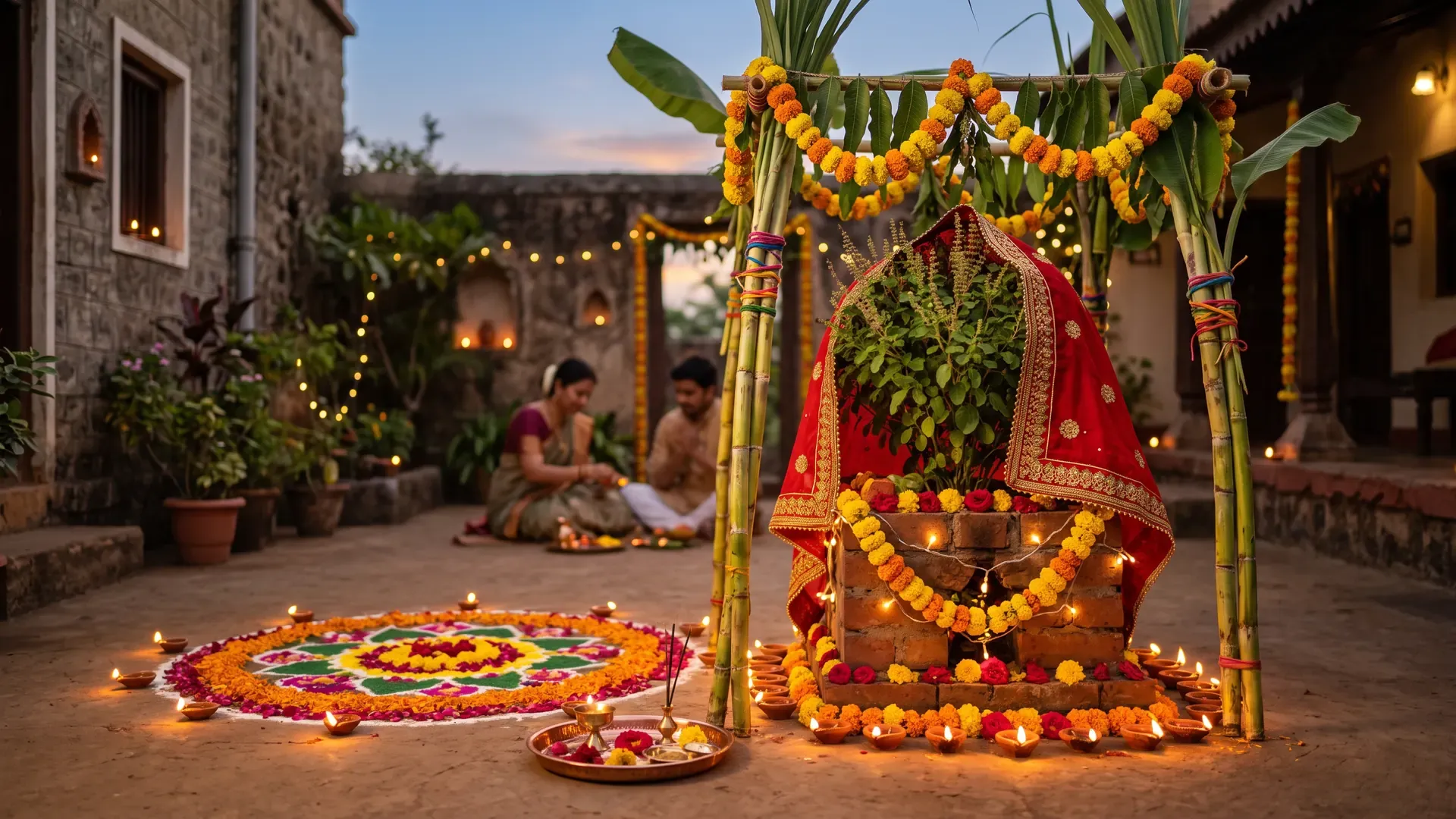
Tulsi Vivah 2026 is on Saturday, 21 November. Drik Panchang gives it on Kartik Shukla Dwadashi; this year Dwadashi tithi runs from 6:33 AM on 21 November to 4:58 AM on 22 November. Many families hold the wedding a day earlier, on the evening of Dev Uthani Ekadashi (20 November). By tradition, in the evening the Tulsi plant is married to a Shaligram, or to an image of Vishnu or Shri Krishna, with the full rites of a wedding. See the Godhuli muhurat for your city below.
Each morning the tithi, Rahu Kaal and coming festivals, in one short WhatsApp message.Follow the channel
City-wise times
The Dwadashi tithi is the same moment in every city; the Godhuli muhurat and sunset change with the city. For another city, pick it in the box above.
| City | Godhuli muhurat | Sunset |
|---|---|---|
| New Delhi | 5:25–5:52 PM | 5:25 PM |
| Mumbai | 5:59–6:25 PM | 5:59 PM |
| Kolkata | 4:52–5:18 PM | 4:52 PM |
| Chennai | 5:39–6:04 PM | 5:39 PM |
| Bengaluru | 5:50–6:15 PM | 5:50 PM |
| Hyderabad | 5:40–6:05 PM | 5:40 PM |
| Ahmedabad | 5:54–6:20 PM | 5:54 PM |
| Jaipur | 5:34–6:01 PM | 5:34 PM |
| Lucknow | 5:14–5:40 PM | 5:14 PM |
| Patna | 4:59–5:26 PM | 4:59 PM |
| Varanasi | 5:08–5:35 PM | 5:08 PM |
| Pune | 5:56–6:22 PM | 5:56 PM |
At a glance
- Tithi
- Kartik Shukla Dwadashi (Drik Panchang); in many families, the evening of Dev Uthani Ekadashi
- In 2026
- Saturday, 21 November; Dev Uthani Ekadashi on Friday, 20 November
- Bride
- The Tulsi plant (Tulsi Devi)
- Groom
- A Shaligram stone, or an image of Vishnu or Shri Krishna
- Time
- Evening, at Godhuli (by tradition)
- Other days
- In many places, any day from Ekadashi to Kartik Purnima
- Also called
- Tulasi Kalyanam (Andhra Pradesh, Telangana), Tulsi-Shaligram Vivah
- After this
- In many homes, wedding muhurats are held to begin only after Tulsi Vivah
Tulsi Vivah 2026: Ekadashi or Dwadashi?
Drik Panchang gives Tulsi Vivah 2026 on Saturday, 21 November, the day of Kartik Shukla Dwadashi. For New Delhi, Drik has Dwadashi tithi from 6:31 AM on 21 November to 4:56 AM on 22 November (by our calculation 6:33 AM to 4:58 AM, about 2 minutes later), so at sunrise on 21 November (6:48 AM) it is Dwadashi. The day before, Friday 20 November, is the Dev Uthani Ekadashi fast; Ekadashi tithi runs from 7:15 AM on 20 November to 6:31 AM on 21 November (Drik; ours 7:17 AM to 6:33 AM). Many families hold Tulsi Vivah on the evening of Dev Uthani Ekadashi itself, so for them the day is 20 November. Drik Panchang also notes that some texts give Kartik Shukla Navami, and some hold the days from Prabodhini Ekadashi to Kartik Purnima (24 November this year) auspicious for it; in Andhra Pradesh and Telangana, Tulasi Kalyanam is usually held on Dwadashi (Ksheerabdhi Dwadashi). Follow your family’s custom.
The story of Tulsi Vivah
As the story is commonly told, the asura king Jalandhara, born in the ocean from the fire of Shiva’s energy, was very mighty, and his wife Vrinda, daughter of the asura Kalanemi, was so faithful that while her faithfulness held, no one could defeat him. Jalandhara took Shiva’s form to deceive Parvati; she saw through him and told Lord Vishnu. Vishnu then came before Vrinda in a forest, disguised as an ascetic. By his illusion two monkeys brought Jalandhara’s severed head and body, and at Vrinda’s plea the ascetic brought him back to life, but Vishnu himself was in that body. Vrinda took him for her husband, her vow was broken, and Jalandhara lost his battle with Shiva. Learning the truth, Vrinda cursed Vishnu to become stone. Vishnu accepted the curse and became the Shaligram stone. The balance of creation began to fail, so at the gods’ prayer Vrinda took back the curse and gave up her body in fire. Where her ashes fell, a tulsi plant grew. The Lord said that for her faithfulness Vrinda was dearer to him than even Lakshmi, that as Tulsi she would always be with him, and that whoever married Tulsi to his Shaligram form would win fame in this world and the next. This is held to be why Tulsi Vivah is celebrated every year in Kartik.
The story in the Puranas
The common telling above joins two separate stories of the Puranas: that of Vrinda and Jalandhara, and that of Tulasi and Shankhachuda. The curse of stone (the Shaligram) belongs to the second. Below is what we checked in these chapters, in translation and in the text.
Shiva Purana: Vrinda’s curse
In the Shiva Purana Vrinda curses Vishnu not with stone but with separation from his wife: the two demons she had seen will become rakshasas and carry off Vishnu’s wife, and Vishnu will wander, parted from her, with Shesha, who had posed as his disciple; the translation’s notes link this to Rama, Sita and Lakshmana. Then Vrinda enters the fire and her light merges into Parvati.
Shiva Purana, Rudra Samhita, Yuddha Khanda, chapter 23Shiva Purana: how the tulsi grew
Vishnu sat by Vrinda’s pyre, lost in delusion. The gods then prayed to Mula-Prakriti, and from the seeds she gave grew the amla (dhatri), the malati and the tulsi; after this Vishnu’s delusion ended.
Shiva Purana, Rudra Samhita, Yuddha Khanda, chapter 26Padma Purana: Vrinda
In the Padma Purana too, Vrinda’s curse is the carrying off of Vishnu’s wife: someone in the guise of an ascetic will take her. In the same passage the tulsi is said to arise in the forest from Vrinda’s sweat.
Padma Purana, Uttara Khanda, chapter 15The curse of stone: Tulasi and Shankhachuda
Tulasi was the wife of the asura Shankhachuda. During the war between Shiva and Shankhachuda, Vishnu, disguised as a Brahmin, took Shankhachuda’s armour and then went to Tulasi in Shankhachuda’s form. Learning the truth, Tulasi cursed him to become stone. She was then told that her body would become the river Gandaki, she herself would become the tulsi plant, and Vishnu would dwell on the Gandaki’s banks as the Shaligram stone; in the Shiva Purana Shiva says this, in the Devi Bhagavata Hari himself.
Shiva Purana, Rudra Samhita, Yuddha Khanda, chapter 41; Devi Bhagavata Purana 9.24The hint of a marriage
In the Devi Bhagavata, Hari tells Tulasi that in a divine body she will be his wife. The next chapter counts Vrinda and Vrindavani among Tulasi’s eight names (see the verse below) and gives Tulasi’s festival on Kartik Purnima. We did not find the rite of Tulsi Vivah laid down in the chapters we checked; Drik Panchang gives its method on the basis of the Vrat Parichay.
Devi Bhagavata Purana 9.24–9.25Other tellings
Some tell that during the war Vrinda sat in worship for her husband’s victory; Vishnu came in Jalandhara’s form, she rose from her worship on seeing him, and her vow was broken (Aaj Tak). In Webdunia’s telling the curse is not taken back: Vrinda curses Vishnu and becomes sati.
Folk traditionHow the wedding is done: custom
Tulsi Vivah follows the rites of a wedding: Tulsi is the bride, and a Shaligram or an image of Vishnu or Krishna the groom. The rite comes down through tradition and varies by region and family; the method below is the common one given by Drik Panchang, Bhakti Bharat and Navbharat Live, and the regional customs are from Drik Panchang and Wikipedia (and the books it cites). In many homes, wedding muhurats are held to begin only after Tulsi Vivah.
Braj (Mathura, Vrindavan)
After a day-long fast the wedding is held in the evening, and in Krishna temples the wedding of Tulsi and Shri Krishna has every rite: haldi, mehndi, jaimala, the pheras and the baraat.
Drik Panchang; Bhakti BharatMaharashtra
Mangalashtak verses are recited with an antarpat (a white cloth) held between bride and groom, and the cloth is removed as akshat is showered. In many places a childless couple acts as Tulsi’s parents and gives her away; the prasad is sugarcane, coconut, fruit and groundnuts.
Drik Panchang; Wikipedia (Tulasi Vivaha)Andhra Pradesh and Telangana
At Tulasi Kalyanam an amla branch is placed beside the Tulsi as Vishnu; Tulsi is dressed as a bride, and a shodashopachara puja and the wedding follow.
Drik Panchang; Wikipedia (Tulasi Vivaha)Bihar (Saunja, Prabhu Dham)
A three-day festival from Kartik Shukla Ekadashi to Trayodashi: a reading of the Ramayana or Ramcharitmanas on the first day, a procession on the second, and the tilak and the wedding on the third, with chhappan bhog.
Drik Panchang; Wikipedia (Tulasi Vivaha)How to perform the puja
- Step 1
Fast and preparation
In many families those who hold the wedding fast through the day, and the wedding is in the evening. Place the Tulsi pot on a wooden chowki in the courtyard, on the terrace or in the puja room.
- Step 2
Sugarcane mandap
Build a mandap of sugarcane stalks over the Tulsi and decorate it (folk custom).
- Step 3
The bride
Drape the Tulsi in a red chunri and offer suhag items such as bangles, bindi and sindoor.
- Step 4
The groom
Dress the Shaligram, or an image of Vishnu or Shri Krishna, and place it beside the Tulsi as the groom.
- Step 5
Haldi and puja
Apply haldi to both, then worship with dhoop, a lamp, flowers and naivedya; many homes also offer seasonal fruits and roots.
- Step 6
Kanyadaan and pheras
At Godhuli, with the Mangalashtak recited, the family gives Tulsi away in kanyadaan, and the Shaligram, held in the hands, is taken round the Tulsi (the pheras).
- Step 7
Aarti and prasad
After the aarti of Tulsi and Vishnu, share the prasad; in many places there is a wedding feast.
Verses
वृन्दा वृन्दावनी विश्वपूजिता विश्वपावनी।पुष्पसारा नन्दनी च तुलसी कृष्णजीवनी॥Tulsi: relations
See in the knowledge graphDeities, figures and sages 1
- Vishnu · Bridegroom (as Shaligram)Brahmavaivarta Purana, Prakriti Khanda; folk tradition
Festivals 1
- Dev Uthani Ekadashi · Festival (Tulsi Vivah)Tradition
Frequently asked questions
When is Tulsi Vivah 2026?
On Saturday, 21 November (Drik Panchang), the day of Kartik Shukla Dwadashi. Dwadashi tithi runs from 6:33 AM on 21 November to 4:58 AM on 22 November. Many families hold the wedding a day earlier, on the evening of Dev Uthani Ekadashi (20 November).
Should Tulsi Vivah be done on Ekadashi or Dwadashi?
Both traditions exist. Drik Panchang gives the Dwadashi, 21 November this year; many families hold the wedding on the evening of Dev Uthani Ekadashi (20 November); and in many places any day from Ekadashi to Kartik Purnima (24 November) is chosen. Follow your family’s or your purohit’s custom.
At what time is Tulsi Vivah done?
By tradition, in the evening. In Drik Panchang’s method, Vishnu is worshipped and Tulsi given away at Godhuli; on 21 November the Godhuli muhurat in New Delhi is 5:25 PM to 5:52 PM (sunset 5:25 PM). See the time for your city above.
Whom is Tulsi married to?
To a Shaligram stone, held to be Vishnu in the form of stone; in many homes and temples, to an image of Vishnu or Shri Krishna. In Andhra Pradesh and Telangana an amla branch is placed as Vishnu.
What is the story of Tulsi Vivah?
In the common telling, Vishnu breaks the vow of Vrinda, the faithful wife of Jalandhara, by deceit; she curses him to become stone, so he becomes the Shaligram, and the tulsi grows from her ashes. In the Puranas the curse of stone belongs to the story of Tulasi and Shankhachuda (Shiva Purana, Yuddha Khanda 41; Devi Bhagavata 9.24).
Do weddings begin after Tulsi Vivah?
By tradition Chaturmas ends on Dev Uthani Ekadashi, and in many homes wedding muhurats are held to begin only after Tulsi Vivah. Even so, a wedding date is fixed only from a pure muhurat in the panchang; the vivah muhurats of November 2026 are on a separate page.
Sources
- Shiva Purana, Rudra Samhita, Yuddha Khanda, chapters 23, 26 and 41 (Vrinda’s curse; amla, malati and tulsi; Tulasi and Shankhachuda)
- Devi Bhagavata Purana 9.24–9.25 (Tulasi’s curse, the Gandaki and the Shaligram; Tulasi Namashtak 9.25.32)
- Padma Purana, Uttara Khanda, chapter 15 (Vrinda’s curse)
- Drik Panchang: Tulasi Vivah 2026 (New Delhi), Tulasi Vivah vrat katha, and the panchang of 20–21 November 2026 (Godhuli muhurat)
- The common telling: Webdunia, Bhakti Bharat, Aaj Tak (2024)
- The rite: Drik Panchang (on the basis of the Vrat Parichay), Bhakti Bharat, Navbharat Live (2025), Wikipedia “Tulasi Vivaha” and the books it cites
- Tulasi Namashtak: sa.wikisource (Devi Bhagavata 9.25) and sanskritdocuments.org
- Timings and tithis: SanatanBodh panchang calculation, checked against Drik Panchang (New Delhi, 2026)
Something wrong? Report a mistake