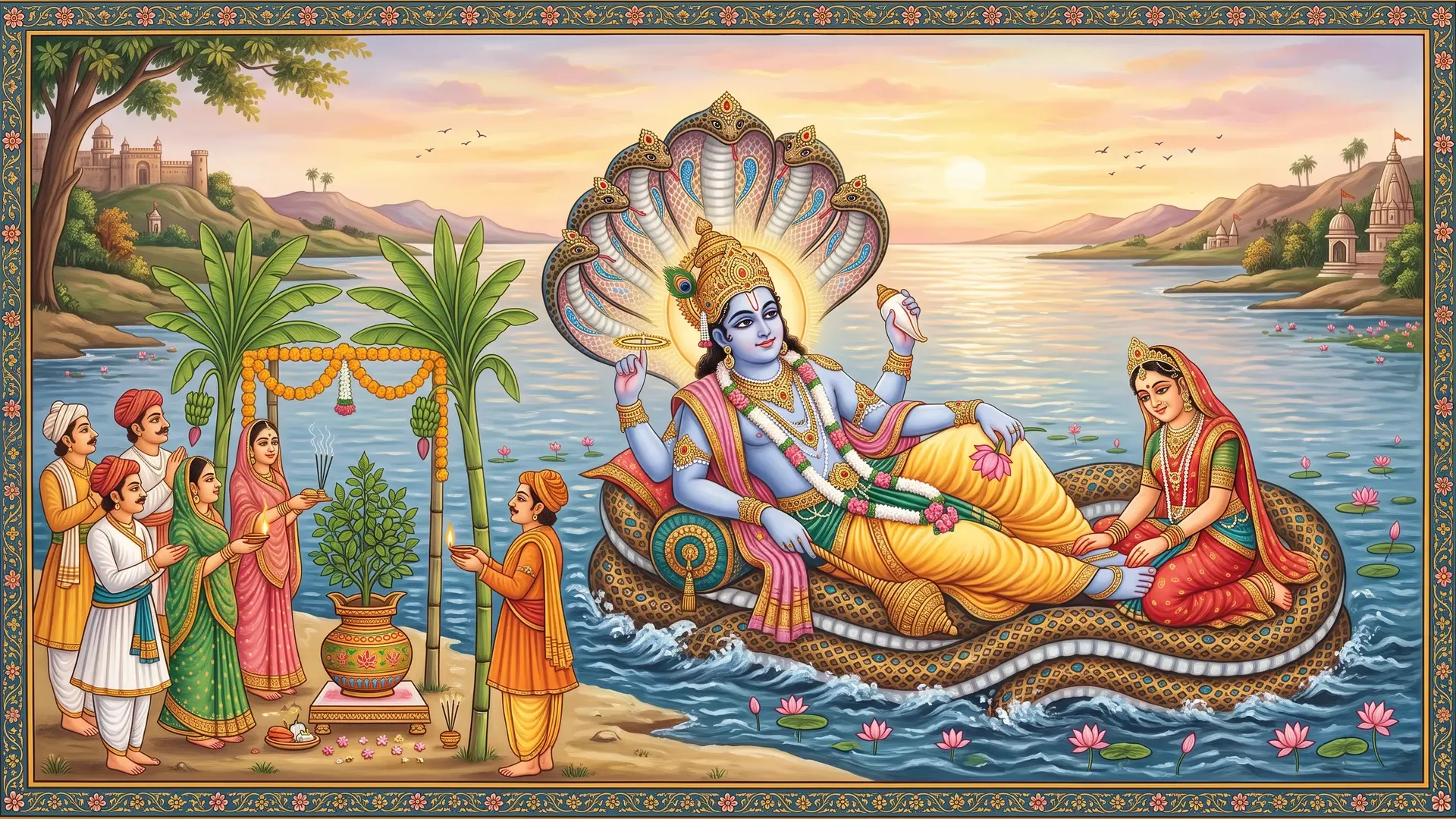
By tradition, on Dev Uthani Ekadashi Lord Vishnu wakes from four months of sleep. The vrat katha heard in homes on this day is a folk tale of a servant who cooks by a river on Ekadashi and calls God with a sincere heart, and God himself comes to eat with him. Tulsi Vivah falls in these same days, so the story of Tulsi and Shaligram is told as well.
Each morning the tithi, Rahu Kaal and coming festivals, in one short WhatsApp message.Follow the channel
Dev Uthani Ekadashi is Kartik Shukla Ekadashi, also called Prabodhini, Haribodhini and Devotthana Ekadashi. The roughly four months of Vishnu’s sleep that begin on Ashadha Shukla Ekadashi (Devshayani), called Chaturmas, end on this day. The fast is broken the next day, on Dwadashi; the time for your city is on the Dev Uthani Ekadashi page.
In the Gita Press book Ekadashi-vrat ka Mahatmya, whose stories are given on the basis of the Padma Purana, Krishna tells Yudhishthira, for Prabodhini Ekadashi, the praise of it that Brahma told Narada. It praises the fast, the night vigil, hearing Vishnu’s stories and worship with tulsi, but it has no separate story; Drik Panchang gives the same mahatmya. The stories told in homes are folk kathas. Below come first Vishnu’s sleep as the Gita Press book gives it, then two folk kathas, and last the story of Tulsi.
How the vrat and katha are kept
- On the Ekadashi evening the Lord is woken with conch, bell and lamp (“dev jagana”), and many homes build a small mandap of sugarcane stalks, often three. This is a folk custom.
- The Gita Press mahatmya speaks of a vigil this night, with songs, music and Vishnu’s stories before the Lord, and of offering arghya to Janardana during the vigil with water, fruit and other things. The Padma Purana (Uttara Khanda 124) also describes singing, music, reading of the Puranas and lamps on this night.
- Worshipping Vishnu with tulsi leaves in Kartik, and on this day above all, is praised at length (the Gita Press mahatmya; Padma Purana, Uttara Khanda 105).
- Tulsi is married to a Shaligram with the usual wedding rites, such as haldi, kanyadan and the pheras. The day follows family custom: the Ekadashi, the Dwadashi, or any day from Ekadashi to Kartik Purnima; Drik Panchang also notes Kartik Shukla Navami, by some texts.
- The five-day Bhishma Panchaka vow runs from this day to Kartik Purnima (Padma Purana, Uttara Khanda 124). By tradition, weddings, mundan and housewarmings begin again after this day.
Vishnu’s four months of sleep
Gita Press, Ekadashi-vrat ka Mahatmya (based on the Padma Purana), the Shayani and Prabodhini Ekadashi sections.
Telling the glory of Ashadha Shukla Ekadashi, the Shayani Ekadashi, Krishna says to Yudhishthira that from that day one form of his stays with King Bali, and the other sleeps on the bed of Shesha in the ocean of milk. This sleep lasts until the coming Kartik Shukla Ekadashi.
So these months are called a time to live by dharma with special care. The same passage gives the rules of the four months: while the Lord sleeps, sleep on the ground; give up greens in Shravan, curd in Bhadrapada, milk in Ashvin and dal in Kartik; or keep brahmacharya through these months.
The sleep ends on Kartik Shukla Ekadashi, which is why it is called Prabodhini, the Ekadashi of awakening. In the Gita Press Prabodhini mahatmya Narada calls it the Ekadashi on which Lord Govinda wakes.
Folk tradition also tells the Vamana story behind this sleep: after the gift of three steps of land, the Lord came to live with King Bali; then Lakshmi tied a protective thread on Bali, made him her brother and asked for the Lord back, and since then the Lord spends four months of every year with Bali. Lakshmi and the thread are not in this passage of the Gita Press book.
The servant who ate with God
A folk katha, given by Webdunia, Bhakti Bharat, India TV and News24. It is not in the Padma-based Gita Press book or on Drik Panchang.
In the kingdom of a righteous king everyone kept the Ekadashi fast. On that day no one in the kingdom was given grain; in Bhakti Bharat’s telling, not even the animals.
One day a man from another kingdom came to the king asking for work. The king said, “You shall have work, but on one condition: on Ekadashi there will be no grain, only fruit and fasting food.” The man agreed.
When Ekadashi came he was given fruit and fasting food, but his hunger was not eased. He pleaded with the king, “Maharaj, fruit does not fill my stomach; please give me grain.” At his plea the king gave him flour, dal and rice.
He took it to the river bank, bathed and cooked. Then he called out to God, “Come, Bhagwan, the food is ready.” At his call the four-armed Lord came, dressed in yellow. The two sat and ate together, and then the Lord vanished. The man went back to his work.
When the next Ekadashi came he asked the king for twice as much. The king asked why, and he said, “Maharaj, God eats with me too.” The king did not believe him and decided to go and see for himself.
The king hid quietly behind a tree. The man bathed and cooked as before and called God, but this time God did not come. He called again and again, and still God did not come.
At last he said, “Bhagwan, if you do not come, I will jump into this river and give up my life.” The moment he said this, God appeared. He sat and ate with him, and then took him in His vimana to His own abode.
Seeing all this, the king understood that the true fruit of a vrat comes from a pure heart and sincere feeling, not from the outward rule alone. After that he too kept the fast with a pure mind, and in the end he reached heaven.
The king tested by God as a beautiful woman
The second folk katha, told briefly: given by Webdunia (2015 and 2021) and News24.
In another king’s realm, too, no one ate grain on Ekadashi. To test him, God took the form of a beautiful, helpless woman and sat by the road. The king was charmed and wished to make her his queen.
She set a condition: all power over the kingdom would be hers, and the king would do as she said. He agreed. On Ekadashi she had grain dishes cooked and told the king to eat; if he refused, she said, the eldest prince would be beheaded.
Then the elder queen said to the king, “A son can be had again, but dharma once lost does not return.” The prince too was ready to give his head for his father’s dharma.
Then God appeared in His true form, praised the king’s devotion to dharma and offered a boon. The king asked for liberation, handed the kingdom to his son and left this world in a vimana.
Tulsi and Shaligram: two stories that became one
Shiva Purana, Rudra Samhita, Yuddha Khanda 2.5.23, 2.5.26 and 2.5.41; Devi Bhagavata 9.24–25; Padma Purana, Uttara Khanda 15 (checked in English translation on wisdomlib.org). The folk telling is from Webdunia and Bhakti Bharat.
The story most often told at Tulsi Vivah goes like this: Vrinda, wife of Jalandhara, was so faithful that no one could defeat him. Lord Vishnu took Jalandhara’s form, and Vrinda’s vow was broken. Vrinda cursed him to become stone; at the plea of Lakshmi or the gods the curse was taken back or softened, and Vrinda gave up her life in the fire. Tulsi grew from her ashes, and the Lord said his Shaligram form would be worshipped with Tulsi and he would accept no offering without tulsi leaves. That is why Tulsi and Shaligram are married every year in Kartik.
In the Puranas these are two separate stories that folk tradition has joined into one. The first is of Vrinda and Jalandhara. By the Shiva Purana, Jalandhara was born in the ocean from the fire of Shiva’s anger, and his wife Vrinda was the daughter of the asura Kalanemi. Vrinda’s faithfulness made Jalandhara unbeatable. Vishnu worked an illusion: first, as an ascetic, he showed her a vision of her husband slain, then came to her in Jalandhara’s form. Vrinda’s vow was broken, and Jalandhara fell.
Learning the truth, Vrinda cursed Vishnu. In the Shiva Purana the curse is that his wife will be carried off and monkeys will be his helpers, pointing ahead to the Rama avatar; in the Padma Purana, that someone disguised as an ascetic will carry off his wife. In neither does Vrinda curse Vishnu to become stone. Then Vrinda gave up her body in fire.
By the Shiva Purana, Vishnu then sat by Vrinda’s ashes, lost in grief. The gods prayed to Mula-Prakriti; from the seeds she gave grew the amla (dhatri), the malati and the tulsi, and Vishnu’s delusion ended. In the same episode of the Padma Purana, tulsi is said to arise in the forest from Vrinda’s sweat.
The curse of stone (Shaligram) belongs to the second story, of Tulasi and Shankhachuda (Shiva Purana 2.5.41, Devi Bhagavata 9.24). Tulasi was married to the asura Shankhachuda, and his power held as long as her faithfulness held. While Shiva was fighting Shankhachuda, Vishnu went to Tulasi in Shankhachuda’s form, and her vow was broken.
Learning the truth, Tulasi cursed Vishnu to become a rock. In the Shiva Purana Shiva then tells her that her body will become the Gandaki river, she herself will become the tulsi plant, and Vishnu will dwell on the Gandaki’s banks as the Shalagrama stones; the Devi Bhagavata gives the same outcome. Tulasi remained ever dear to Vishnu.
The Devi Bhagavata (9.25) counts Vrinda and Vrindavani among Tulasi’s eight names, and puts Tulasi’s birth festival on the Kartik full moon, the day Vishnu first worshipped her. We did not find the rite of Tulsi Vivah described in the chapters we checked; the rite comes down through tradition.
Other tellings
- In the servant’s story, Webdunia (2015) and India TV say it is Vishnu who comes to eat, while Webdunia (2021) and Bhakti Bharat say Krishna; so we say “God” above. The yellow garments are in Webdunia (2015).
- In Webdunia’s 2015 telling the next Ekadashi comes fifteen days later and the servant calls God until evening; other sources give no times.
- News24 frames these stories as told by Krishna to Yudhishthira. That frame is like the Padma-style Ekadashi mahatmyas, but we did not find these stories in any text. In the story of the king’s test, Webdunia names Vishnu and News24 names Krishna.
- Another reason for Vishnu’s sleep is told in folk tradition: that he slew Shankhasura on Ashadha Shukla Ekadashi and, tired, went to sleep. We found no text for this; it is a different story from that of Tulasi’s husband Shankhachuda.
- The waking verse “uttishtha govinda tyaja nidram jagatpate…” is widely printed, but we did not find the text it comes from.
- Some websites credit the Vrinda story to the Devi Bhagavata, but the Devi Bhagavata has the story of Tulasi and Shankhachuda, not of Vrinda and Jalandhara. Webdunia (2021) credits the story of Shankhasura and Tulsi to the Shiva Mahapurana, which is right (in Shiva Purana 2.5.41 he is named Shankhachuda). Drik Panchang credits the Vrinda–Jalandhara story to the Padma Purana; it is there (Uttara Khanda 15), but without the curse of stone.
After the katha
The puja to wake the Lord, the aarti and Tulsi Vivah follow family custom. The time to break the fast in your city is on the Dev Uthani Ekadashi page.
Om Jai Jagdish HareFrequently asked questions
What is the Dev Uthani Ekadashi katha?
The story most told in homes is a folk tale of a servant: given grain on Ekadashi, he cooks by a river and calls God, and God eats with him; seeing this, the king understands that the heart of a vrat is a pure mind. It is a folk tale; the Padma-based Gita Press mahatmya has no separate story for this Ekadashi, only its praise.
Why does Vishnu sleep for four months?
By the Padma-based Gita Press book, from Devshayani Ekadashi one form of the Lord stays with King Bali and the other sleeps on Shesha in the ocean of milk until Kartik Shukla Ekadashi. Folk tradition also explains it with the story of Vamana and Lakshmi’s protective thread.
Did Vrinda curse Vishnu to become stone?
In the Shiva Purana and the Padma Purana, Vrinda’s curse is that Vishnu’s wife will be carried off. The curse to become stone (Shaligram) is given in the Shiva Purana (2.5.41) and the Devi Bhagavata (9.24) by Tulasi, wife of the asura Shankhachuda. The folk telling joins the two stories into one.
When is Tulsi Vivah performed?
By family custom, on Dev Uthani Ekadashi, on the Dwadashi after it, or on any day from Ekadashi to Kartik Purnima (Drik Panchang, Wikipedia). Drik Panchang also notes Kartik Shukla Navami, by some texts.
Sources
- Gita Press, Gorakhpur: Ekadashi-vrat ka Mahatmya (26 stories based on the Padma Purana; Shayani and Prabodhini Ekadashi), archive.org
- Shiva Purana, Rudra Samhita, Yuddha Khanda 2.5.23, 2.5.26 and 2.5.41 (J. L. Shastri’s English translation, wisdomlib.org)
- Devi Bhagavata Purana 9.24 and 9.25 (wisdomlib.org)
- Padma Purana, Uttara Khanda 15, 105 and 124 (wisdomlib.org)
- wisdomlib.org: Vrinda (in the Shiva Purana)
- Drik Panchang: Prabodhini Ekadashi Vrat Katha; Tulasi Vivah
- Webdunia: the Dev Uthani Ekadashi vrat katha (2015); three kathas of Dev Uthani Ekadashi (2021); the Tulsi Vivah katha
- Bhakti Bharat (bhaktibharat.com): Dev Uthani Ekadashi vrat katha; the Tulsi Vivah katha
- India TV Hindi (2025) and News24 Hindi: the Dev Uthani Ekadashi katha
- ETV Bharat (Shahdol): Dev Uthani Ekadashi, sugarcane and Tulsi Vivah
- Hindi Wikipedia: Devshayani Ekadashi; English Wikipedia: Tulasi Vivaha, Chaturmasya, Prabodhini Ekadashi
Something wrong? Report a mistake