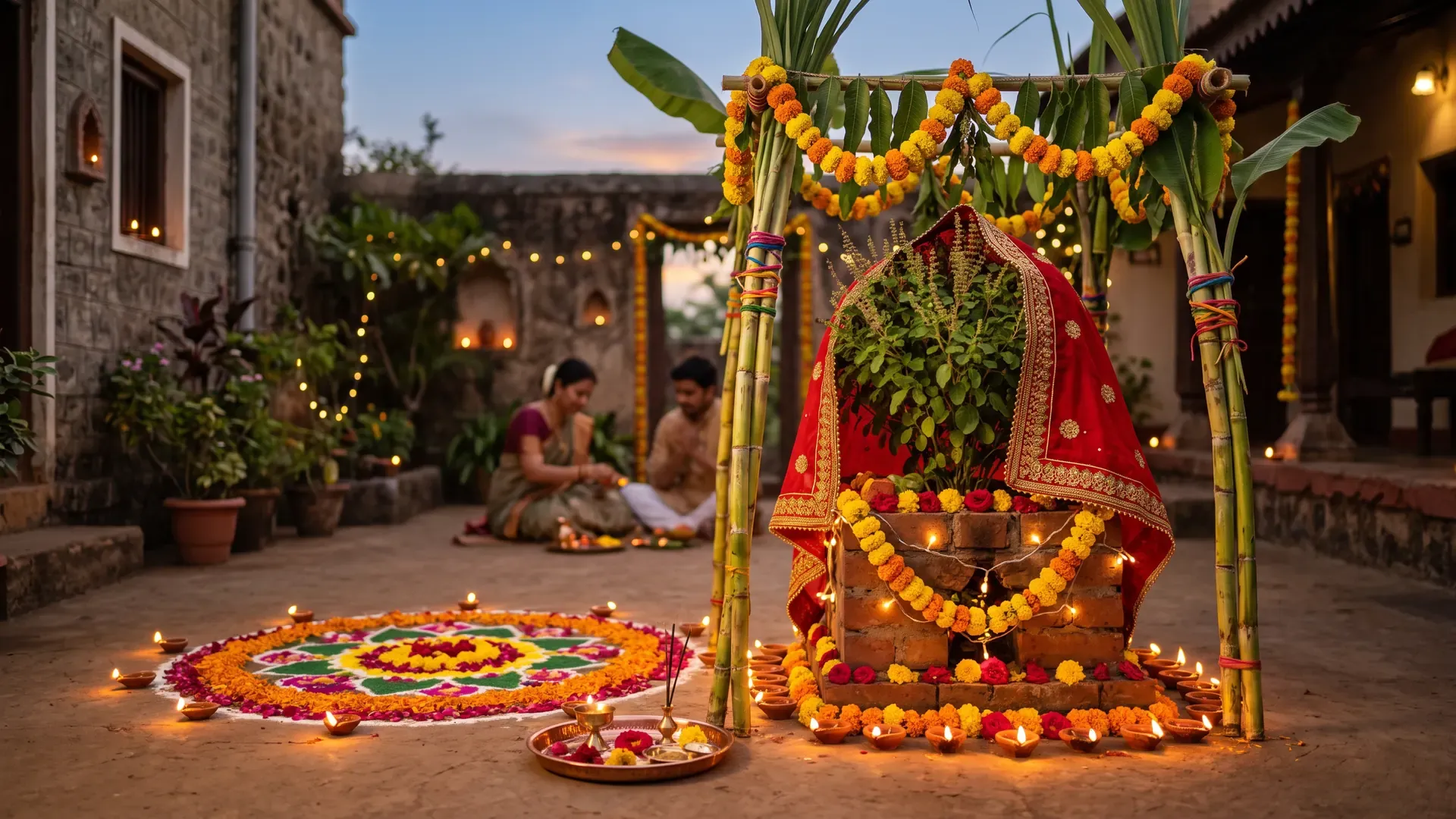
Dev Uthani Ekadashi 2026 is on Friday, 20 November. It is Kartik Shukla Ekadashi, also called Prabodhini or Devutthana Ekadashi. By tradition, Lord Vishnu, who entered Yoga Nidra on Devshayani Ekadashi, wakes on this day, and the four months of Chaturmas come to an end. The fast is broken (parana) the next morning on Dwadashi; see the time for your city below.
Each morning the tithi, Rahu Kaal and coming festivals, in one short WhatsApp message.Follow the channel
At a glance
- Tithi
- Kartik Shukla Ekadashi
- Also called
- Prabodhini, Devutthana, Hari Prabodhini, Kartiki Ekadashi
- Worshipped
- Lord Vishnu (also in his Shaligram form)
- Significance
- Vishnu wakes from Yoga Nidra; Chaturmas ends
- Fast
- No grains on Ekadashi; parana the next day, on Dwadashi
- Tulsi Vivah
- On Dwadashi in many traditions, on Ekadashi in some
- After this
- Muhurats for weddings and other auspicious events begin again
- Maharashtra
- The Kartiki Ekadashi yatra to Vitthal at Pandharpur
Chaturmas: waking from Yoga Nidra
Ashadha Shukla Ekadashi is called Devshayani (Harishayani) Ekadashi. By tradition, on that day Lord Vishnu goes into Yoga Nidra on the bed of the serpent Shesha in the Ocean of Milk (Kshirasagara), and he wakes on Kartik Shukla Ekadashi. The roughly four months in between are called Chaturmas. In North Indian tradition, auspicious events such as weddings, griha pravesh (entering a new home) and mundan (first haircut) are not held in this period, and sannyasis stay in one place for their spiritual practice. With Dev Uthani Ekadashi, this period comes to an end.
Vishnu reclining on Shesha
The first chapter of the Durga Saptashati describes how, at the end of a kalpa, when the world had become a single ocean, Lord Vishnu lay in Yoga Nidra with Shesha spread beneath him (see the verse below).
Durga Saptashati, chapter 1The glory of the month of Kartik
The Kartik Mahatmya in the Uttara Khanda of the Padma Purana calls Kartik the best month for bathing, offering lamps and worshipping Vishnu. Prabodhini Ekadashi falls in the bright fortnight of this month.
Padma Purana, Uttara Khanda (Kartik Mahatmya)Tulsi Vivah
Dev Uthani Ekadashi also brings the time of Tulsi Vivah. In it, the Tulsi plant is married to a Shaligram (the stone form of Vishnu) or an image of Shri Krishna with the full rites of a wedding: a mandap, kanyadaan, the pheras and a feast. In many traditions it is held on Kartik Shukla Dwadashi, in some on Ekadashi itself, and in many places on any day between Ekadashi and Kartik Purnima. In many regions the mandap is made of sugarcane, and many households consider wedding muhurats to begin only after Tulsi Vivah.
The Ekadashi vrat and parana
On the Ekadashi vrat, grains, especially rice, are not eaten; many people keep a fast without water or with fruit only. The fast is broken (parana) the next day, during Dwadashi tithi, after sunrise. According to popular panchangs, the first quarter of Dwadashi (Hari Vasar) is avoided for parana, and the parana should be done before Dwadashi ends. Sometimes the Smarta and Vaishnava Ekadashis fall on different days; keep the vrat according to your own tradition.
King Ambarisha’s Dwadashi vrat
According to the Bhagavata Purana, on the day of parana the sage Durvasa arrived as a guest and went off to bathe. Dwadashi was about to end, so on the advice of the brahmins King Ambarisha broke his fast with only a sip of water, so that he neither slighted his guest nor broke his vow. This story is linked to the importance of doing the parana within Dwadashi.
Bhagavata Purana 9.4–9.5How to perform the puja
- Step 1
Sankalpa
On the morning of Ekadashi, bathe and take the sankalpa (resolve) for the vrat; a fast without water or with fruit only, according to your capacity and health.
- Step 2
Vishnu puja
Worship Lord Vishnu or the Shaligram: a bath with panchamrit, yellow cloth, Tulsi leaves, flowers, incense and lamp, and naivedya (food offering).
- Step 3
Waking the Lord
In the evening, draw a chowk in the courtyard or puja place and set out seasonal produce such as sugarcane, water chestnuts and sweet potatoes; blowing the conch and ringing bells or striking a thali, wake the Lord with prabodhan (waking) mantras and folk songs such as "Utho Dev" (folk tradition, especially in North India).
- Step 4
Lamps and jagran
Light lamps in the house and beside the Tulsi; many families keep a night vigil (jagran) with bhajans and kirtan.
- Step 5
Tulsi Vivah
According to your tradition, hold the wedding of Tulsi and Shaligram on the same day or on Dwadashi.
- Step 6
Parana
The next morning, on Dwadashi, after Hari Vasar has passed, break the fast within the parana time given above.
Tulsi and the Shaligram
According to the story in the Prakriti Khanda of the Brahmavaivarta Purana, Tulsi, the daughter of King Dharmadhvaja, performed tapas to have Lord Narayana as her husband, but she was first married to the asura Shankhachuda. Because of Tulsi’s faithfulness to her husband, no one could defeat Shankhachuda. Then Lord Vishnu took Shankhachuda’s form and broke Tulsi’s vow, and Shiva slew Shankhachuda. When she learned the truth, Tulsi cursed Vishnu to become a stone. Vishnu accepted the curse and said that Tulsi’s body would become the river Gandaki, her hair would become the sacred Tulsi plant, and he himself would dwell on the banks of the Gandaki as the Shaligram stone; Tulsi would always be dear to him. In folk tradition, the same story is also told of Vrinda, the wife of Jalandhara. The custom of marrying Tulsi to the Shaligram comes from this bond.
Brahmavaivarta Purana, Prakriti Khanda; folk traditionRead the full kathaVerses
योगनिद्रां यदा विष्णुर्जगत्येकार्णवीकृते।आस्तीर्य शेषमभजत्कल्पान्ते भगवान् प्रभुः॥शान्ताकारं भुजगशयनं पद्मनाभं सुरेशंविश्वाधारं गगनसदृशं मेघवर्णं शुभाङ्गम्।लक्ष्मीकान्तं कमलनयनं योगिभिर्ध्यानगम्यंवन्दे विष्णुं भवभयहरं सर्वलोकैकनाथम्॥Dev Uthani Ekadashi: relations
See in the knowledge graphDeities, figures and sages 3
- Vishnu · Deity worshippedTradition (Kartik Shukla Ekadashi)
- Tulsi · Deity worshippedTradition
- Khatu Shyam · Birth festival on this dayTradition of Khatu
Festivals 1
- Kartik Purnima · Last day of Bhishma PanchakTradition
Frequently asked questions
When is Dev Uthani Ekadashi 2026?
On Friday, 20 November. The fast will be broken (parana) the next morning, on Dwadashi.
Is Dev Uthani Ekadashi on 20 November or 21 November?
The fast is on Friday, 20 November (Drik Panchang’s Smarta date), and the parana on 21 November, 1:11–3:18 PM in New Delhi. Families of the Vaishnava tradition keep the Gauna Ekadashi on 21 November. Ekadashi tithi runs from 7:17 AM on 20 November to 6:33 AM on 21 November. Tulsi Vivah is on Saturday, 21 November (Drik Panchang).
When should the parana be done?
The next day, during Dwadashi tithi, after sunrise and once Hari Vasar (the first quarter of Dwadashi) has passed. See the parana time for your city above.
When is Tulsi Vivah?
In 2026, on Saturday, 21 November by Drik Panchang; in some traditions on Ekadashi (20 November) itself. In many places Tulsi Vivah is held on any day from Ekadashi to Kartik Purnima.
What is Chaturmas?
The roughly four months (about five when an Adhik Maas falls in between) from Devshayani Ekadashi (Ashadha Shukla) to Dev Uthani Ekadashi (Kartik Shukla), when, by tradition, Lord Vishnu remains in Yoga Nidra.
Do weddings begin after Dev Uthani Ekadashi?
Yes, in tradition, wedding muhurats begin again after Chaturmas. But a wedding date is fixed only after checking the panchang for a proper muhurat.
What is not eaten on the Ekadashi vrat?
Grains, especially rice. Fruit, milk and foods eaten during fasts can be taken; keep a fast without water only according to your capacity and health.
Sources
- Durga Saptashati, chapter 1 (Vishnu’s Yoga Nidra)
- Padma Purana, Uttara Khanda (Kartik Mahatmya)
- Brahmavaivarta Purana, Prakriti Khanda (the story of Tulsi and Shankhachuda)
- Bhagavata Purana 9.4–9.5 (Ambarisha’s Dwadashi vrat)
- Folk tradition
- Muhurat and moonrise: SanatanBodh panchang calculation, checked against Drik Panchang (New Delhi, 2026–27)
Something wrong? Report a mistake