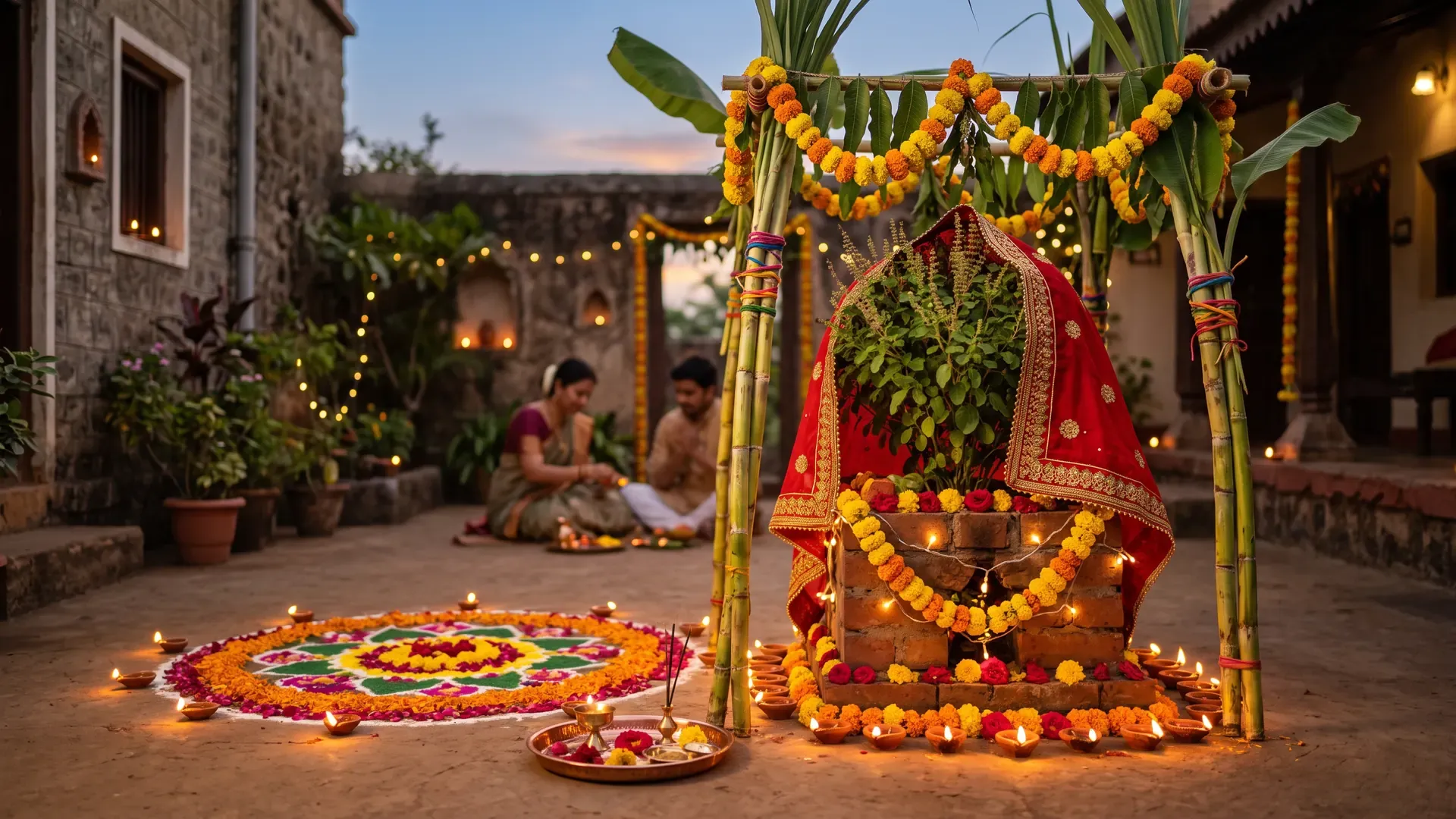
The waking mantra the texts give for Dev Uthani Ekadashi is ‘Uttishthottishtha Govinda tyaja nidram jagatpate. Tvayi supte jagannatha jagat suptam bhavedidam’, with ‘Utthite cheshtate sarvam uttishthottishtha Madhava …’ and ‘Brahmendra-rudragni-kubera-surya …’ (in the Nirnaya Sindhu and Gita Press’s Vrat-Parichay). Dev Uthani Ekadashi is on Friday, 20 November 2026. ‘Utho dev baitho dev’ is a set of folk lines, not a mantra of the texts.
When to say them
Dev Uthani Ekadashi is on Friday, 20 November 2026. By the Nirnaya Sindhu and Gita Press’s Vrat-Parichay the Lord is woken on the night of Ekadashi; the fast is broken the next morning, on Dwadashi. New Delhi: Parana (breaking the fast): 1:11–3:18 PM (21 Nov).
- Parana (breaking the fast)On Dwadashi, after Hari Vasara
- 1:11–3:18 PM (21 Nov)
- Hari Vasara ends
- 12:09 PM (21 Nov)
- Ekadashi tithi
- 7:17 AM to 6:33 AM (21 Nov)
- Dwadashi ends
- 4:58 AM (22 Nov)
New Delhi, Indian Standard Time; SanatanBodh panchang calculation, checked against Drik Panchang. Your city’s time and the full page
1The first waking mantra: Brahmendra-rudragni-kubera-surya …
ॐ ब्रह्मेन्द्ररुद्राग्निकुबेरसूर्यसोमादिभिर्वन्दित वन्दनीय।बुध्यस्व देवेश जगन्निवास मन्त्रप्रभावेण सुखेन देव॥
When: When the Lord is raised (utthapana), after the conch and bell
Meaning: O lord of the gods, abode of the world! O worshipful one, honoured by Brahma, Indra, Rudra, Agni, Kubera, Surya, Soma and the rest: wake in comfort, O God, by the power of this mantra.
Source: Nirnaya Sindhu (Kamalakara Bhatta), second paricheda, Prabodhini (Devotthana) Ekadashi, ‘the mantras are given in the Varaha Purana’ (both editions; around p. 161 of the 1901 edition); Gita Press, Vrat-Parichay p. 171 (‘Prabodh-ekadashi-kritya’, from the Madanaratna)
Variant: Gita Press (following the Madanaratna) also counts ‘Varuna’ among these gods, but does not print this line; the Nirnaya Sindhu’s text is given above. The Nirnaya Sindhu assigns these mantras to the Varaha Purana; we did not check them in the Varaha Purana.
2Iyam tu dvadashi deva prabodhartham vinirmita
इयं तु द्वादशी देव प्रबोधार्थं विनिर्मिता।त्वयैव सर्वलोकानां हितार्थं शेषशायिना॥
When: With the waking mantras; in the Gita Press method the same verse comes again after the aarti and pushpanjali
Meaning: O God, this Dwadashi was made for your awakening; O one who rests on Shesha, you yourself made it for the good of all the worlds.
Source: Nirnaya Sindhu (Kamalakara Bhatta), second paricheda, Prabodhini (Devotthana) Ekadashi, ‘the mantras are given in the Varaha Purana’ (both editions; around p. 161 of the 1901 edition); Gita Press, Vrat-Parichay p. 171 (‘Prabodh-ekadashi-kritya’, from the Madanaratna)
Variant: Gita Press prints ‘prabodhaya vinirmita’, the Nirnaya Sindhu ‘prabodhartham’. The sense is the same.
3Uttishthottishtha Govinda tyaja nidram jagatpate
उत्तिष्ठोत्तिष्ठ गोविन्द त्यज निद्रां जगत्पते।त्वयि सुप्ते जगन्नाथ जगत् सुप्तं भवेदिदम्॥
When: Said again and again while waking the Lord
Meaning: Arise, Govinda, arise; O lord of the world, give up sleep. O Jagannatha, when you sleep this whole world is as if asleep.
Source: Nirnaya Sindhu (Kamalakara Bhatta), second paricheda, Prabodhini (Devotthana) Ekadashi, ‘the mantras are given in the Varaha Purana’ (both editions; around p. 161 of the 1901 edition); Gita Press, Vrat-Parichay p. 171 (‘Prabodh-ekadashi-kritya’, from the Madanaratna)
Variant: This verse is the one usually said and printed with ‘utho dev’; the two sources have the same words. We have now found where it comes from: the Nirnaya Sindhu (under the Varaha Purana) and Gita Press’s Vrat-Parichay (from the Madanaratna). Our katha page used to say the source had not been found.
4Uttishthottishtha Govinda uttishtha Garudadhvaja
उत्तिष्ठोत्तिष्ठ गोविन्द उत्तिष्ठ गरुडध्वज।उत्तिष्ठ कमलाकान्त त्रैलोक्यं मङ्गलं कुरु॥
When: The same waking verse in another form; this is the one most often printed
Meaning: Arise, Govinda, arise; arise, O bearer of the Garuda banner; arise, O husband of Kamala (Lakshmi), and bring well-being to the three worlds.
Source: The last verse of the Prabodhana Stotra (11 verses, from the ‘Vratachudamani’), sanskritdocuments.org; shlokam.org gives it as a verse of the Venkatesa Suprabhatam. The words are the same in both. (The Nirnaya Sindhu and Gita Press have the form above, not this one)
Variant: The other ten verses of the sanskritdocuments.org Prabodhana Stotram each wake one avatar and each end ‘trailokyam mangalam kuru’; we found them in one text only, so they are not printed here.
5Utthite cheshtate sarvam: the second waking verse
उत्थिते चेष्टते सर्वमुत्तिष्ठोत्तिष्ठ माधव।गता मेघा वियच्चैव निर्मलं निर्मला दिशः॥शारदानि च पुष्पाणि गृहाण मम केशव॥
When: After waking; the Nirnaya Sindhu closes it with ‘this is the mantra for raising Vishnu’
Meaning: When you rise everything stirs; arise, O Madhava. The clouds are gone, the sky and all the quarters are clear. O Keshava, accept these autumn flowers of mine.
Source: Nirnaya Sindhu (Kamalakara Bhatta), second paricheda, Prabodhini (Devotthana) Ekadashi, ‘the mantras are given in the Varaha Purana’ (both editions; around p. 161 of the 1901 edition); Gita Press, Vrat-Parichay p. 171 (‘Prabodh-ekadashi-kritya’, from the Madanaratna)
Variant: The Nirnaya Sindhu’s print shows ‘grahana’; Gita Press has ‘grihana’. We keep ‘grihana’.
6Prayer closing the Chaturmasya vow: Idam vratam maya deva
इदं व्रतं मया देव कृतं प्रीत्या तव प्रभो।न्यूनं सम्पूर्णतां यातु त्वत्प्रसादाज्जनार्दन॥
When: After raising the Lord and the pushpanjali, as the prayer that completes the four months’ vow
Meaning: O God, O Lord, I have kept this vow for love of you. O Janardana, by your grace may whatever was lacking in it be made complete.
Source: Nirnaya Sindhu (the mantra ascribed to Sanatkumara in the ‘Nirnayamrita’); Gita Press, Vrat-Parichay p. 171 (the prayer after the pushpanjali)
Variant: Gita Press prints ‘pritye’, the Nirnaya Sindhu a reading like ‘pritya’; we keep ‘pritya’.
About these texts
Every text was compared word by word in at least two separate sources: printed editions, Gita Press books and Sanskrit text sites. Mantras that only devotional sites give, with no scripture named, are marked ‘in common use’, not as a Purana’s. The meanings are our own, in plain words. Take the method and the count of repetitions from your own family or purohit.
Aartis and chalisas
Frequently asked questions
When is Dev Uthani Ekadashi 2026?
On Friday, 20 November 2026. New Delhi: Parana (breaking the fast): 1:11–3:18 PM (21 Nov). See the festival page for your city’s time.
What is the mantra for waking the Lord on Dev Uthani Ekadashi?
The waking mantra in the texts is ‘Uttishthottishtha Govinda tyaja nidram jagatpate. Tvayi supte jagannatha jagat suptam bhavedidam’, with ‘Utthite cheshtate sarvam uttishthottishtha Madhava …’ and ‘Brahmendra-rudragni-kubera-surya …’. The Nirnaya Sindhu assigns them to the Varaha Purana and Gita Press’s Vrat-Parichay gives them from the Madanaratna. The ‘uttishtha Garudadhvaja’ form is also very common. All are above with meaning.
What is ‘utho dev baitho dev’, and is it in a text?
These are folk lines sung on the day, such as ‘utho deva, baitho deva, anguriya chatkao deva’ (Navbharat Live and Bharatkosh print parts in this form). The whole song differs from region to region and home to home and we found no printed text of it, so we have not printed it in full. The mantras that are in the texts are above; the two are said together.
Is it necessary to say a mantra on Dev Uthani Ekadashi?
By Gita Press’s Vrat-Parichay the Lord is woken at night with recitation of hymns, listening to stories, bhajans, bell, conch and drum, dance and play, and these mantras are said with it. It is done by local usage (deshachara); the Nirnaya Sindhu too says its arrangement is by local usage. Follow your family’s or purohit’s practice.
Sources
- Nirnaya Sindhu (Kamalakara Bhatta), second paricheda, Prabodhini (Devotthana) Ekadashi, ‘the mantras are given in the Varaha Purana’ (both editions; around p. 161 of the 1901 edition); Gita Press, Vrat-Parichay p. 171 (‘Prabodh-ekadashi-kritya’, from the Madanaratna)
- Gita Press, Vrat-Parichay (Pt Hanuman Sharma, 2073)
- sanskritdocuments.org: Prabodhanastotram or Dashavatara Suprabhatam (Shree Devi Kumar; opening lines from the ‘Vratachudamani’)
- shlokam.org, ‘Utthishto Utthishta Govinda’
- Navbharat Live, ‘Devuthani Ekadashi 2025’ (1407203), and Bharatkosh, ‘Devotthana Ekadashi’ (the folk lines)
Something wrong? Report a mistake