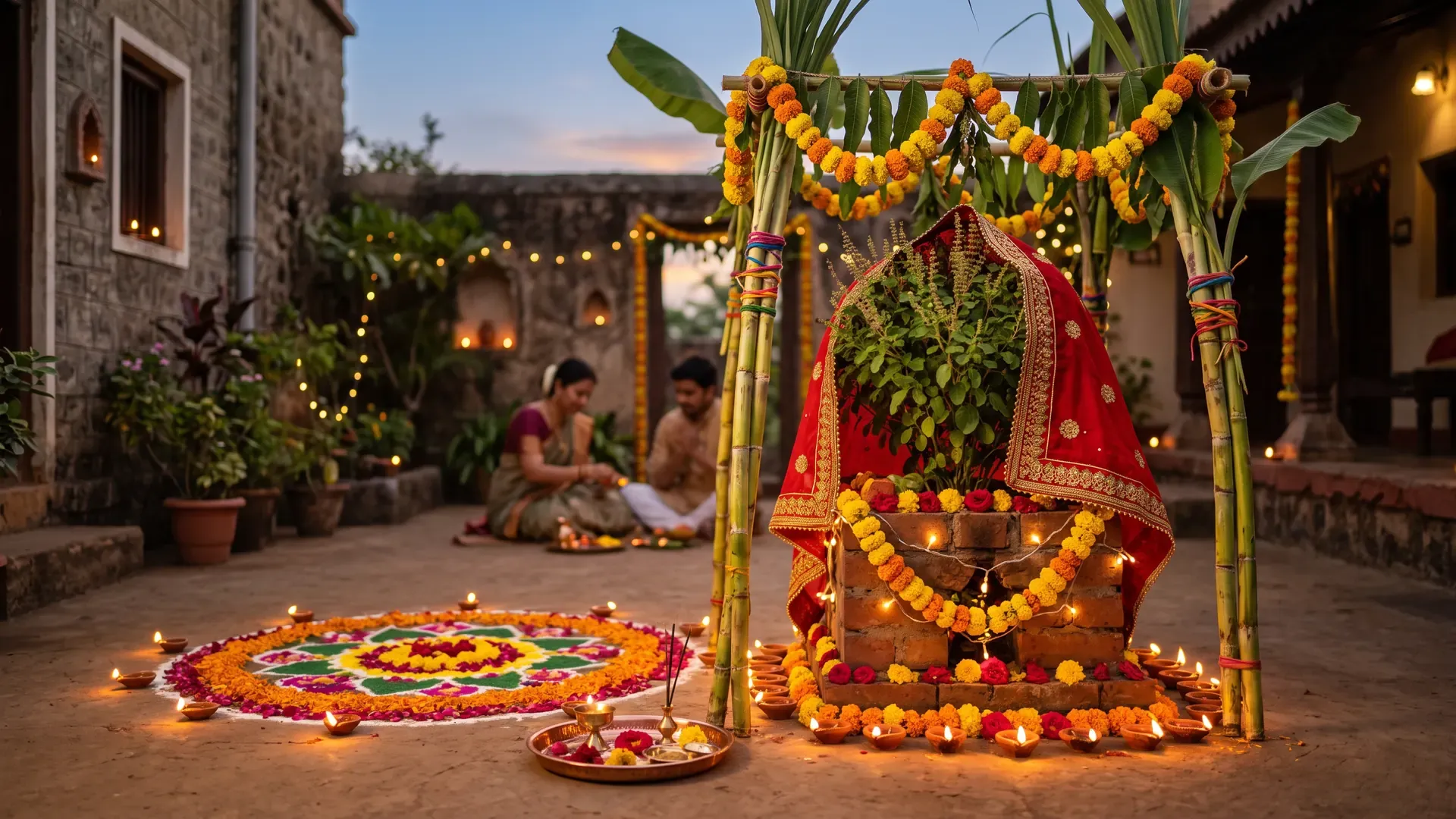
In the common telling, Vrinda, wife of the asura king Jalandhara, was so faithful that no one could defeat him while she lived. Vishnu broke her vow by deceit and Jalandhara fell to Shiva. Learning the truth, Vrinda cursed Vishnu to become stone; he became the Shaligram, at the gods’ plea the curse was taken back and Vrinda entered the fire. Tulsi grew from her ashes, and Vishnu said he would be worshipped with Tulsi, which is why Tulsi and the Shaligram are married every year in Kartik. In the Puranas this is not one story but two, of Vrinda and Jalandhara and of Tulasi and Shankhachuda; the curse of stone belongs to the second.
In one minute
- Who Vrinda, the faithful wife of the asura Jalandhara, and Lord Vishnu.
- The story Vishnu breaks Vrinda’s vow by deceit, she curses him to become stone and he becomes the Shaligram; tulsi grows from her ashes. This is the common form; in the Puranas the curse of stone is in the story of Tulasi and Shankhachuda.
- When Kartik Shukla Dwadashi; next on Saturday, 21 November 2026
Hindi in Roman letters: a reading aid, made by a program. The Devanagari text is the original.
The other language could not be loaded. Keep reading here, or try again.
Vrinda and Jalandhara: the common Tulsi Vivah katha
As told in Drik Panchang and Bhakti Bharat (read again on 31 October 2026); Webdunia and Aaj Tak differ a little, as set out below in ‘Other tellings’.
A child was born in the ocean from Shiva’s energy and grew up to be the asura king Jalandhara. He married Vrinda, daughter of the asura Kalanemi. Vrinda was so faithful to her husband that, by the strength of her vow, no one could defeat Jalandhara in battle.
Proud of his strength, Jalandhara went to Parvati in the form of Shiva. Parvati saw through him, vanished, and told Vishnu everything. Vishnu understood that Jalandhara would not fall while Vrinda’s vow held.
Vishnu came before Vrinda in the forest, disguised as an ascetic, when she was alone. Two demons began to frighten her, and the ascetic burned them to ashes in an instant. Moved, Vrinda asked about her husband, who was then fighting Shiva. By illusion the ascetic produced two monkeys, one holding Jalandhara’s head and the other his body. Vrinda fainted.
When she came to, she begged the ascetic to bring her husband back to life. The ascetic joined the head to the body, but Vishnu himself entered that body. Vrinda went on taking him for her husband, and her vow was broken. Meanwhile Shiva defeated Jalandhara in the battle.
Learning the truth, Vrinda in her anger cursed Vishnu to become stone. Vishnu accepted the curse and became the Shaligram stone. With the preserver of the world turned to stone, the balance of creation began to fail, and the gods begged Vrinda to take the curse back. According to Drik Panchang, Bhakti Bharat and Aaj Tak, Vrinda took the curse back and then entered the fire and gave up her body.
Where Vrinda’s ashes fell, a plant grew: tulsi. Vishnu said that by her faithfulness Vrinda was dearer to him than Lakshmi, that as Tulsi she would stay with him always, and that whoever married Tulsi to his Shaligram form would gain fame in this world and the next.
From this promise comes the tradition of marrying Tulsi and the Shaligram every year in Kartik. The katha places the wedding on Dev Uthani Ekadashi (Drik Panchang, Bhakti Bharat); in the panchang Drik Panchang gives it on the Dwadashi day, and different regions keep different days from Ekadashi to Purnima.
Vrinda in the Shiva Purana and the Padma Purana
Shiva Purana, Rudra Samhita, Yuddha Khanda 2.5.23 and 2.5.26; Padma Purana, Uttara Khanda 15 (checked in English translation on wisdomlib.org).
In the Shiva Purana (2.5.23) Jalandhara meets his end at Shiva’s hands, and Vishnu comes before Vrinda as an ascetic: two monkeys bring the severed head and body, the ascetic revives him, and later Vrinda realises the ascetic was Vishnu.
But Vrinda’s curse here is not of stone. She says that the two demons she had seen will become rakshasas and carry off Vishnu’s wife, and that Vishnu will wander parted from his wife, with Shesha beside him as a disciple. The translator’s notes link this to the Rama avatar (Ravana, Maricha, Sita, Lakshmana and the monkeys). Then Vrinda enters the fire and her light merges into Parvati.
Further on in the Shiva Purana (2.5.26), Vishnu sat deluded by Vrinda’s pyre. The gods then praised Mula-Prakriti, from the seeds she gave grew the amla (dhatri), the malati and the tulasi, and Vishnu’s delusion ended.
In the Padma Purana (Uttara Khanda 15) too Vrinda’s curse is the abduction of Vishnu’s wife: someone disguised as an ascetic will carry her off. The same passage speaks of tulsi arising in the forest from Vrinda’s sweat.
Tulasi and Shankhachuda: where the curse of stone is
Shiva Purana, Rudra Samhita, Yuddha Khanda 2.5.41; Devi Bhagavata Purana 9.24 and 9.25 (checked in English translation on wisdomlib.org).
The curse of stone in the common telling belongs, in the Puranas, to another story, of Tulasi and Shankhachuda. Tulasi was the wife of the asura Shankhachuda, and his power held as long as her faithfulness held. While Shiva fought Shankhachuda, Vishnu first took the armour from him in the guise of a brahmin, then went to Tulasi in Shankhachuda’s form, and her vow was broken.
Learning the truth, Tulasi cursed Vishnu to become a rock (Shiva Purana 2.5.41, Devi Bhagavata 9.24). In the Shiva Purana it is Shiva, and in the Devi Bhagavata Hari himself, who tells her that her body will become the Gandaki river, that she will become the tulasi plant (in the Devi Bhagavata: her hair will become the tulasi tree), and that Vishnu will dwell on the Gandaki’s banks as the Shalagrama stones. In the Devi Bhagavata Hari adds that she will be his wife in a divine body.
The Devi Bhagavata (9.25) counts eight names of Tulasi, among them Vrinda and Vrindavani, and puts her festival on the Kartik full moon, the day Vishnu first worshipped her. We did not find the rite of Tulsi Vivah described in the chapters we checked; it comes down through tradition.
Other tellings
- Taking the curse back: in the tellings of Drik Panchang, Bhakti Bharat and Aaj Tak, Vrinda takes back the curse at the gods’ plea. Webdunia’s telling has no withdrawal: Vrinda gives the curse and becomes sati.
- In Aaj Tak’s telling Vrinda sits in worship for Jalandhara’s victory; Vishnu comes in Jalandhara’s form and, seeing him, she rises from the puja, which breaks her vow. We found this form in one source only, so it is told as a separate form.
- In the tellings of Drik Panchang, Bhakti Bharat and Webdunia, Jalandhara first fights to win Lakshmi, and Lakshmi, born from the ocean, accepts him as her brother. The three pages share one outline and we did not find this episode in a Purana, so it is not in the telling above.
- Some websites credit the story of Vrinda to the Devi Bhagavata (Webdunia names the ‘Devi Bhagavat’). The Devi Bhagavata 9.24 has the story of Tulasi and Shankhachuda, not of Vrinda and Jalandhara. The katha pages of Drik Panchang and Bhakti Bharat name no Purana (read on 31 October 2026).
- The day of the wedding: the katha puts Tulsi Vivah on Dev Uthani Ekadashi, in the panchang Drik Panchang gives it on Dwadashi, and in Andhra Pradesh and Telangana it is Kshirabdhi Dwadashi. The date and the muhurat of both days are on the vidhi page.
After the katha
After the katha the aarti of Tulsi and Vishnu is sung and the prasad is shared. The date, the Godhuli muhurat (for 12 cities), the samagri and the whole order of the wedding are on the Tulsi Vivah vidhi page.
Each morning the tithi, Rahu Kaal and coming festivals, in one short WhatsApp message.Follow the channel
Tulsi Vivah is kept on Kartik Shukla Dwadashi (Drik Panchang), and many families hold the wedding on the evening of Dev Uthani Ekadashi. On this day Tulsi is married to the Shaligram, or to an image of Vishnu or Krishna, and this katha is the background to it. The date, the Godhuli muhurat, the samagri and the order of the wedding are on the Tulsi Vivah vidhi page.
The story is told almost alike in Drik Panchang, Bhakti Bharat and Webdunia, and with small differences in Aaj Tak; none of these pages names a Purana. In the Puranas the story of Vrinda and Jalandhara and the story of Tulasi and Shankhachuda are in separate chapters. We have read them in translations of the Shiva Purana, the Devi Bhagavata and the Padma Purana; the common telling comes first, then the forms in the Puranas.
How the vrat and katha are kept
- The fast is kept through the day and the wedding is in the evening at Godhuli (Drik Panchang, Wikipedia). The sources we read give no fixed time for the katha; it can be read or heard during the day’s fast or before the wedding, as family custom directs.
- After the katha, or at the end of the wedding, the aarti of Tulsi and Vishnu is sung and the prasad is shared (Bhakti Bharat, Navbharat Live).
Frequently asked questions
What is the Tulsi Vivah katha?
In the common telling Vishnu breaks the vow of Vrinda, the faithful wife of Jalandhara, by deceit; Vrinda curses him to become stone, so he becomes the Shaligram, and tulsi grows from her ashes. Vishnu promises to be worshipped with Tulsi, which is why Tulsi and the Shaligram are married. In the Puranas the curse of stone is in the story of Tulasi and Shankhachuda.
Who was Vrinda and who was Jalandhara?
Jalandhara was an asura king born in the ocean from Shiva’s energy; Vrinda, daughter of the asura Kalanemi, was his wife (Drik Panchang, Bhakti Bharat; in the Shiva Purana too she is Kalanemi’s daughter). Vrinda’s faithfulness made Jalandhara unbeatable.
Did Vrinda curse Vishnu to become stone?
In the common telling, yes. But in the Shiva Purana (2.5.23) and the Padma Purana (Uttara Khanda 15) Vrinda’s curse is the abduction of Vishnu’s wife, not stone. The curse of stone (the Shaligram) is given by Tulasi, wife of the asura Shankhachuda, in the Shiva Purana (2.5.41) and the Devi Bhagavata (9.24). Folk telling has joined the two stories into one.
Why is Tulsi Vivah performed?
By the katha Vishnu told Vrinda that as Tulsi she would stay with him always and that whoever married Tulsi to his Shaligram form would gain fame in this world and the next; the tradition is held to come from this promise. The Devi Bhagavata (9.25) puts Tulasi’s festival on Kartik Purnima, but we did not find the wedding rite in the chapters we checked; it comes down through tradition.
In which Purana is the Tulsi Vivah katha?
We did not find the common form in any one Purana; the katha pages of Drik Panchang and Bhakti Bharat name none. Its parts are in the Shiva Purana (2.5.23, 2.5.26, 2.5.41), the Padma Purana (Uttara Khanda 15) and the Devi Bhagavata (9.24–25) in different forms; the chapter is given with each form above.
What is the Shaligram?
The Shaligram is a stone from the banks of the Gandaki river, taken to be Vishnu’s stone form. According to the Shiva Purana (2.5.41) and the Devi Bhagavata (9.24), after Tulasi’s curse Vishnu dwells on the Gandaki’s banks as the Shalagrama stones.
Sources
- Drik Panchang: Tulasi Vivah vrat katha; Tulasi Vivah 2026 (New Delhi)
- Bhakti Bharat (bhaktibharat.com): the Tulsi Vivah katha; Tulsi Vivah
- Webdunia: the Tulsi Vivah katha
- Aaj Tak (13 November 2024): Tulsi Vivah, the Tulsi-Shaligram Vivah katha
- Shiva Purana, Rudra Samhita, Yuddha Khanda 2.5.23, 2.5.26 and 2.5.41 (J. L. Shastri’s English translation, wisdomlib.org)
- Devi Bhagavata Purana 9.24 and 9.25 (wisdomlib.org)
- Padma Purana, Uttara Khanda 15 (wisdomlib.org)
- wisdomlib.org: Vrinda (in the Shiva Purana)
- English Wikipedia: Tulasi Vivaha
- Navbharat Live: how to do Tulsi Vivah at home (2 November 2025)
Something wrong? Report a mistake
