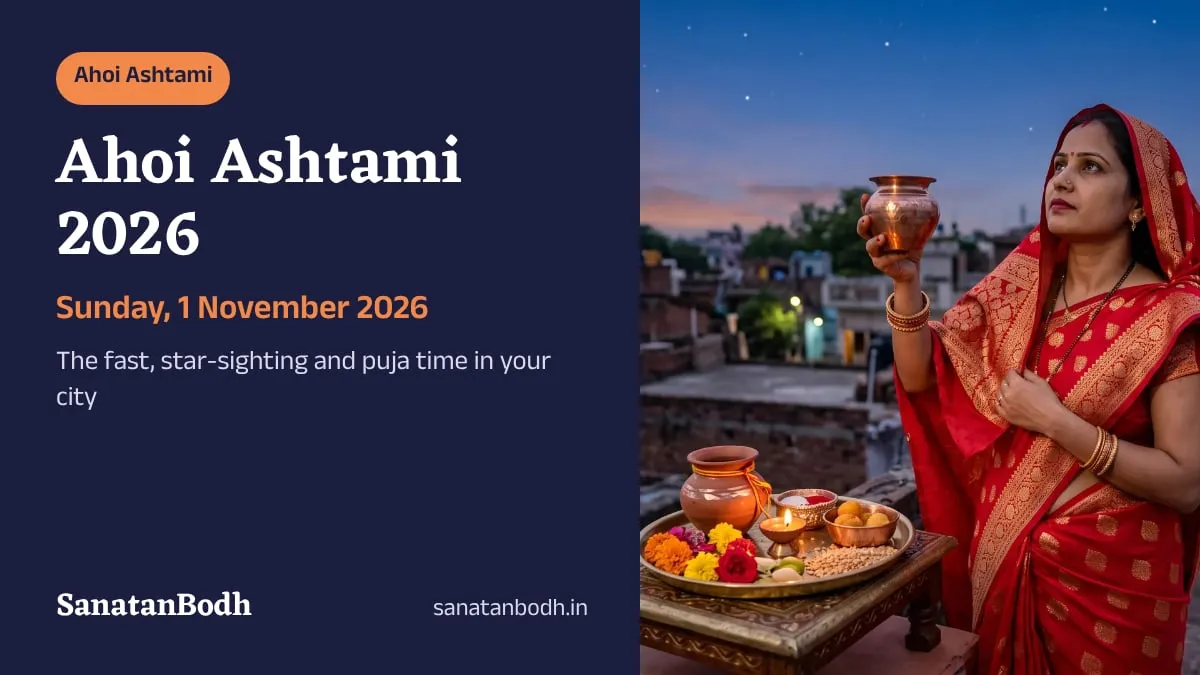
The Ahoi Ashtami fast is on Sunday, 1 November 2026. In New Delhi the evening puja muhurat is 5:36 PM to 6:54 PM, and the stars begin to show at about 6:01 PM; most families break the fast after offering them arghya. For those who offer arghya to the moon, moonrise is at 11:40 PM.
Each morning the tithi, Rahu Kaal and coming festivals, in one short WhatsApp message.Follow the channel
Why 1 November
Ahoi Ashtami falls on Kartik Krishna Ashtami (Purnimanta; Ashwin in the Amanta calendar), and the Ashtami taken is the one that holds at the evening puja. In New Delhi the Ashtami tithi runs from 2:53 PM on 1 November to 1:12 PM on 2 November. It holds on the evening of 1 November and not on the evening of 2 November, so the fast is on 1 November. Drik Panchang gives the same date (its Ashtami: 2:51 PM to 1:10 PM; our tithi times come about 2 minutes later).
Stars and puja in other cities
The stars show a little after sunset, so the time changes with the city. A few cities (1 November 2026, computed; compared with Drik Panchang, within a minute):
- Kolkata: stars 5:22 PM, puja 4:59–6:15 PM
- Lucknow: stars 5:47 PM, puja 5:24–6:41 PM
- Jaipur: stars 6:08 PM, puja 5:44–7:01 PM
- Mumbai: stars 6:28 PM, puja 6:05–7:21 PM
What is done on the day
This fast comes not from a Purana but from folk tradition and the vrat katha, so the customs vary a little by region and family.
- Mothers fast from sunrise until the stars appear for the long life and wellbeing of their children, traditionally without water. Today many families keep it for sons and daughters alike.
- A picture of Ahoi Mata with the syahu (porcupine) and her young is drawn on the wall in geru or on paper, or a printed one is put up; a kalash filled with water is set before it.
- In the evening muhurat, puja with roli, akshat, flowers and a lamp, the bhog and the katha; when the stars appear, water is offered to them and the fast is broken. Some families wait for moonrise.
- At Radha Kund near Govardhan in Mathura district, a midnight bath on this night is a local Braj tradition, kept by those who wish for children.
- In pregnancy, illness or while on medicine, choose the form of the fast according to your health.
The katha in two lines
In the popular vrat katha a moneylender’s wife digs earth in the forest to plaster her house before Diwali, and her spade kills a porcupine cub by accident; soon her seven sons die one after another. On the advice of the village elders she worships Ahoi Mata on Kartik Krishna Ashtami, asks forgiveness for her mistake, and is blessed with children again. The second katha, of the youngest daughter-in-law and the cow Surahi, is on the katha page.
Sources
- Drik Panchang: Ahoi Ashtami 2026, New Delhi, Lucknow, Jaipur, Mumbai and Kolkata (puja muhurat, star-sighting time, moonrise and tithi compared, 18 October 2026)
- Customs and katha: folk tradition and the popular Ahoi Ashtami vrat katha (Drik Panchang, Hindi Wikipedia)
- Braj tradition: the Radha Kund snan (Drik Panchang, Radha Kunda Snan)
- Times and tithi: SanatanBodh panchang calculation (astronomy-engine, Lahiri ayanamsha)
Something wrong? Report a mistake
