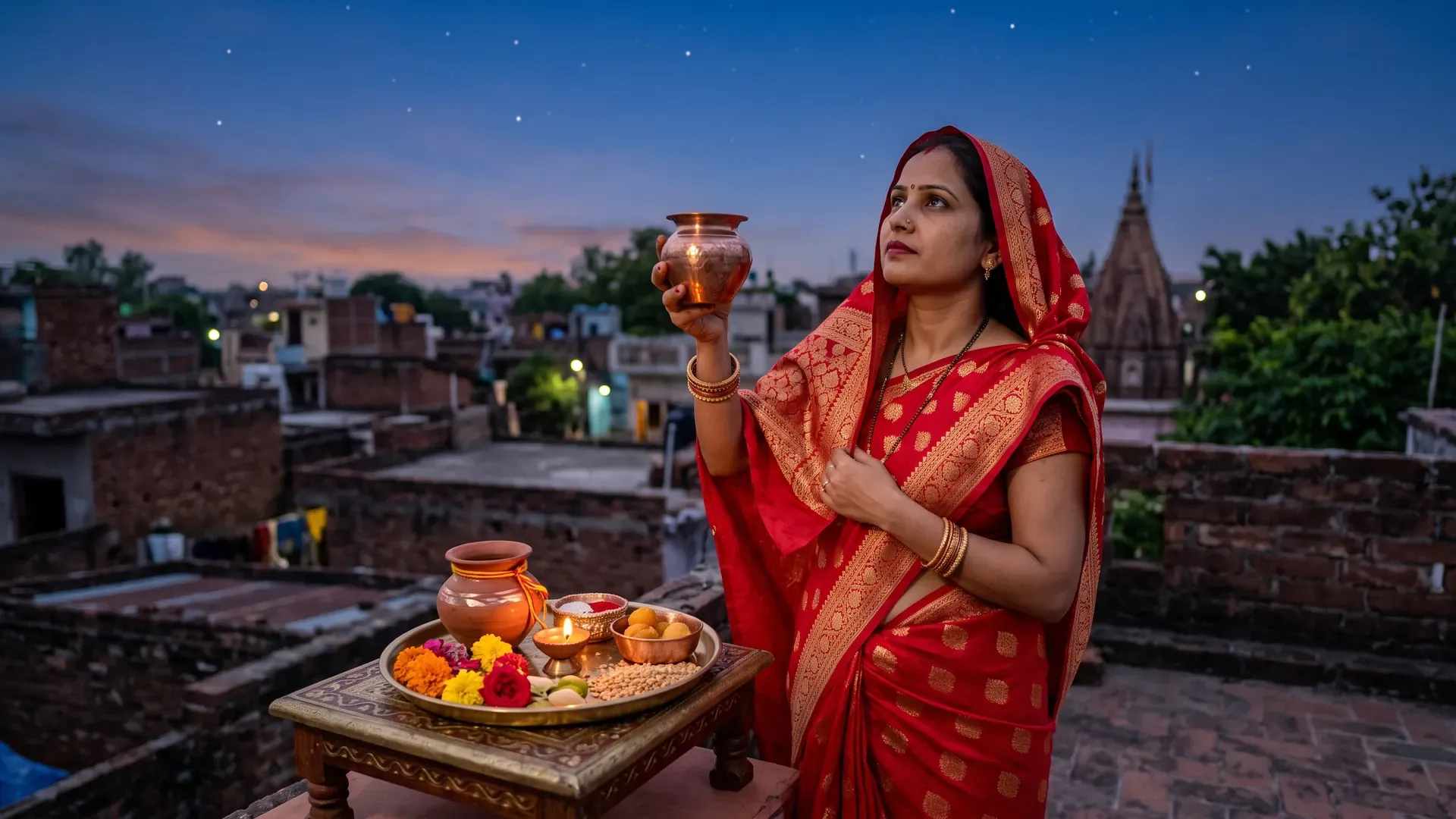
Ahoi Ashtami 2026 is on Sunday, 1 November. It falls on Kartik Krishna Ashtami (Purnimanta), after Karva Chauth and about a week before Diwali. Mothers fast through the day for the wellbeing of their children, worship Ahoi Mata in the evening, and break the fast on seeing the stars. See the time for your city below.
Each morning the tithi, Rahu Kaal and coming festivals, in one short WhatsApp message.Follow the channel
City-wise times: Stars appear
Pick your city for its full timings, nearby cities and common questions.
- New Delhi5:36–6:54 PM
- Varanasi5:17–6:34 PM
- Mumbai6:05–7:21 PM
- Kolkata4:59–6:15 PM
- Chennai5:42–6:56 PM
- Bengaluru5:53–7:07 PM
- Hyderabad5:45–7:00 PM
- Ahmedabad6:02–7:18 PM
- Jaipur5:44–7:01 PM
- Lucknow5:24–6:41 PM
- Bhopal5:42–6:59 PM
- Ujjain5:49–7:05 PM
- Haridwar5:31–6:49 PM
- Pune6:02–7:17 PM
- Noida5:36–6:53 PM
- Gurugram5:37–6:55 PM
- Ghaziabad5:35–6:53 PM
- Faridabad5:36–6:54 PM
- Chandigarh5:35–6:53 PM
- Ludhiana5:39–6:57 PM
- Amritsar5:41–7:00 PM
- Jammu5:40–6:59 PM
- Dehradun5:31–6:49 PM
- Rishikesh5:30–6:48 PM
- Shimla5:33–6:51 PM
- Agra5:35–6:52 PM
- Mathura5:36–6:53 PM
- Prayagraj5:22–6:39 PM
- Kanpur5:27–6:44 PM
- Ayodhya5:19–6:36 PM
- Gorakhpur5:14–6:31 PM
- Meerut5:34–6:52 PM
- Bareilly5:28–6:45 PM
- Jodhpur5:56–7:13 PM
- Udaipur5:55–7:12 PM
- Kota5:46–7:03 PM
- Ajmer5:49–7:06 PM
- Indore5:49–7:05 PM
- Gwalior5:35–6:53 PM
- Jabalpur5:32–6:48 PM
- Surat6:03–7:19 PM
At a glance
- Tithi
- Kartik Krishna Ashtami (Purnimanta)
- Also called
- Ahoi Aathe
- Worshipped
- Ahoi Mata (in folk tradition, a form of Parvati)
- Fast
- Kept by mothers for their children’s wellbeing and long life
- Fasting time
- From sunrise until the stars appear, traditionally without water
- Breaking the fast
- With arghya to the stars; in some families, after moonrise
- Mathura
- Midnight bath in Radha Kund
- Especially in
- Uttar Pradesh, Delhi, Haryana, Rajasthan
The Ahoi Ashtami fast
This fast comes not from any Purana but from folk tradition and the vrat katha, so its rituals vary a little by region and family.
For whom
Mothers fast for the long life and wellbeing of their children. Traditionally it was kept for sons; today many families keep it for sons and daughters alike.
Folk traditionThe picture of Ahoi Mata
For the puja, a picture of Ahoi Mata is drawn on the wall with geru (red ochre) or on paper. It usually also shows a syahu (porcupine) and her young, who come from the vrat katha. Printed pictures are also common today.
Folk traditionBreaking the fast on seeing the stars
On Krishna Ashtami the moon rises around midnight, so most families break the fast in the evening when the stars appear, offering them arghya. Some families wait for moonrise.
Folk traditionThe Radha Kund snan
At Radha Kund, near Govardhan in Mathura district, there is a tradition of bathing at midnight on Ahoi Ashtami. In Braj belief Radha Kund is Shri Radha’s own pond, and couples who wish for children bathe here on this night. This is a local tradition of Braj.
How to perform the puja
- Step 1
Sankalpa
In the morning, after bathing, take a sankalpa (resolve) to fast for your children’s wellbeing.
- Step 2
Fasting through the day
Traditionally without water; if you are pregnant, unwell or taking medication, decide according to your health.
- Step 3
The picture of Ahoi Mata
Draw Ahoi Mata and the syahu on the wall with geru or on paper, or put up a printed picture. Place a kalash filled with water in front of it.
- Step 4
Evening puja and katha
During the puja muhurat, worship Ahoi Mata with roli, akshat (unbroken rice), flowers and a lamp, offer bhog and listen to the Ahoi Ashtami katha.
- Step 5
Arghya and parana
When the stars appear, offer them arghya with water and break the fast; in some families, the fast is broken after moonrise by offering arghya to the moon.
The moneylender’s wife and the syahu
According to the popular vrat katha, a moneylender’s wife had seven sons. Before Diwali, she went to the forest to fetch earth for plastering the house. While she was digging, her spade accidentally killed the cub of a syahu (porcupine). Within a short time, her seven sons died one after another. The grieving woman told the elderly women of the village everything. They told her to draw the syahu and her cubs on Kartik Krishna Ashtami, worship Ahoi Mata and ask forgiveness for her mistake. She did so, and by the Mother’s grace she was blessed with children again. The story is told in many versions.
Folk vrat kathaRead the full kathaAhoi Ashtami: relations
See in the knowledge graphDeities, figures and sages 1
- Ahoi Mata · Deity worshippedFolk tradition
Tirths and places 1
- Radha Kund · Place of the midnight bathBraj tradition
Festivals 1
- Karva Chauth · Fast four tithis earlierPanchang (Kartik Krishna Chaturthi and Ashtami)
Frequently asked questions
When is Ahoi Ashtami 2026?
On Sunday, 1 November.
Is Ahoi Ashtami on 1 November or 2 November?
On 1 November (Sunday). Ashtami tithi runs from 2:53 PM on 1 November to 1:12 PM on 2 November. Ahoi Mata is worshipped in the evening and the fast ends when the stars appear, so the day taken is the one whose evening has Ashtami: the evening of 1 November.
What time will the stars appear on Ahoi Ashtami, 1 November?
The stars appear on Sunday, 1 November 2026: New Delhi 6:01 PM, Lucknow 5:47 PM, Jaipur 6:08 PM, Chandigarh 6:00 PM, Indore 6:12 PM, Mumbai 6:28 PM, Kolkata 5:22 PM, Bengaluru 6:15 PM. Puja muhurat in New Delhi: 5:36–6:54 PM. Stars show only in a clear sky. Other cities are in the list above.
When is the Ahoi Ashtami fast broken?
In the evening, when the stars appear, by offering them arghya. Some families break it after moonrise, which comes late at night on this day. See the time for your city above.
Who is Ahoi Mata?
In folk tradition, a goddess who protects children, regarded as a form of Parvati. Along with her picture, a syahu (porcupine) and her cubs are also drawn.
Is the Ahoi Ashtami fast only for sons?
Traditionally it was kept for sons, but today many families keep this fast for both sons and daughters.
What is the Radha Kund snan?
A tradition of bathing at midnight on Ahoi Ashtami in Radha Kund, near Govardhan in Mathura district, done with the wish for children. It is a local tradition of Braj.
Sources
- Folk tradition and the Ahoi Ashtami vrat katha
- Braj tradition (Radha Kund snan)
- Muhurat and moonrise: SanatanBodh panchang calculation, checked against Drik Panchang (New Delhi, 2026–27)
Something wrong? Report a mistake