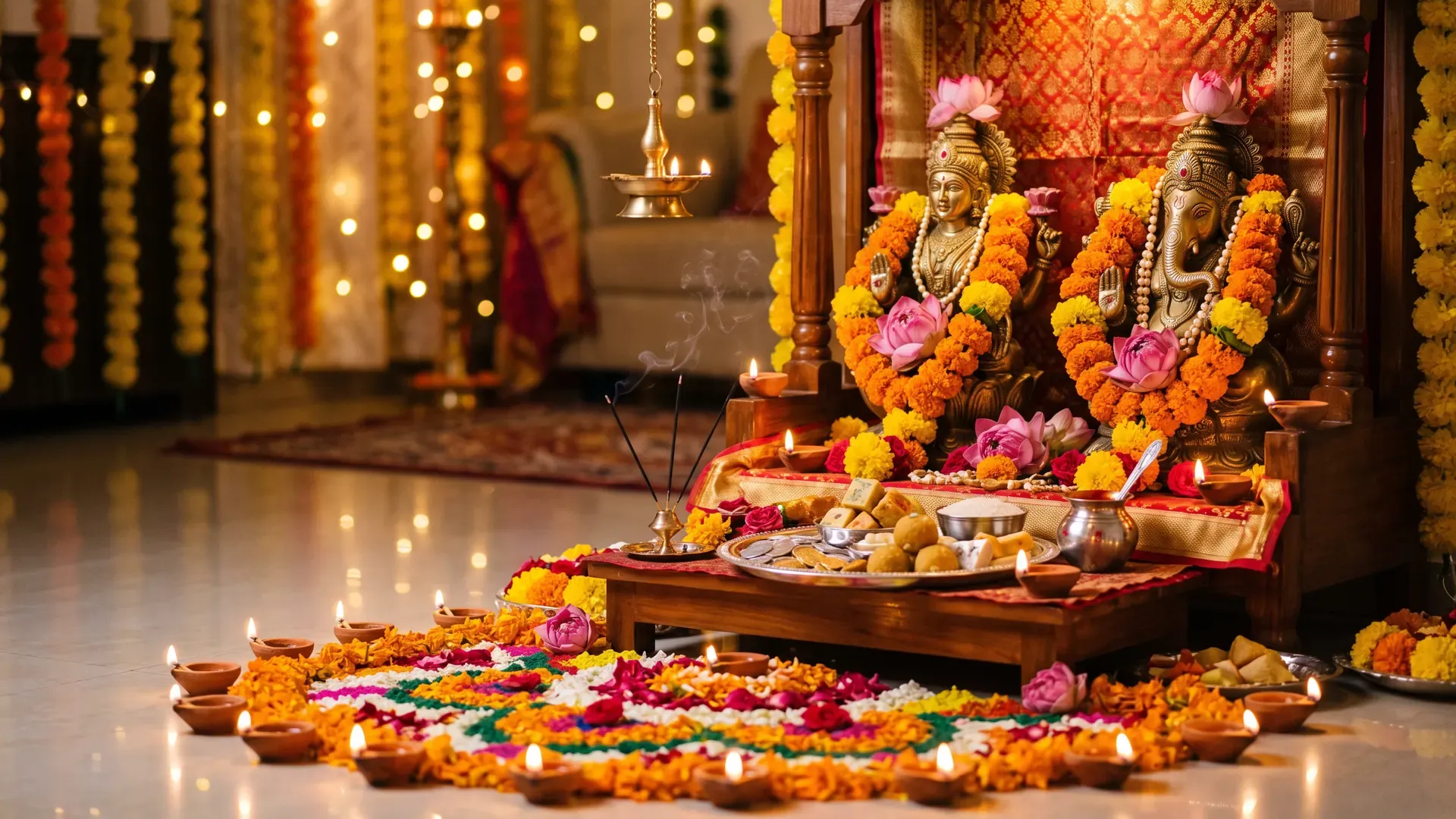
Diwali 2026 is on Sunday, 8 November. It is celebrated on Kartik Amavasya. The main Lakshmi Puja is done in the evening during Pradosh Kaal, while the fixed (Vrishabha) lagna lasts and Amavasya tithi is running. See the muhurat for your city below. The Deepotsav lasts five days, from Dhanteras to Bhai Dooj.
Each morning the tithi, Rahu Kaal and coming festivals, in one short WhatsApp message.Follow the channel
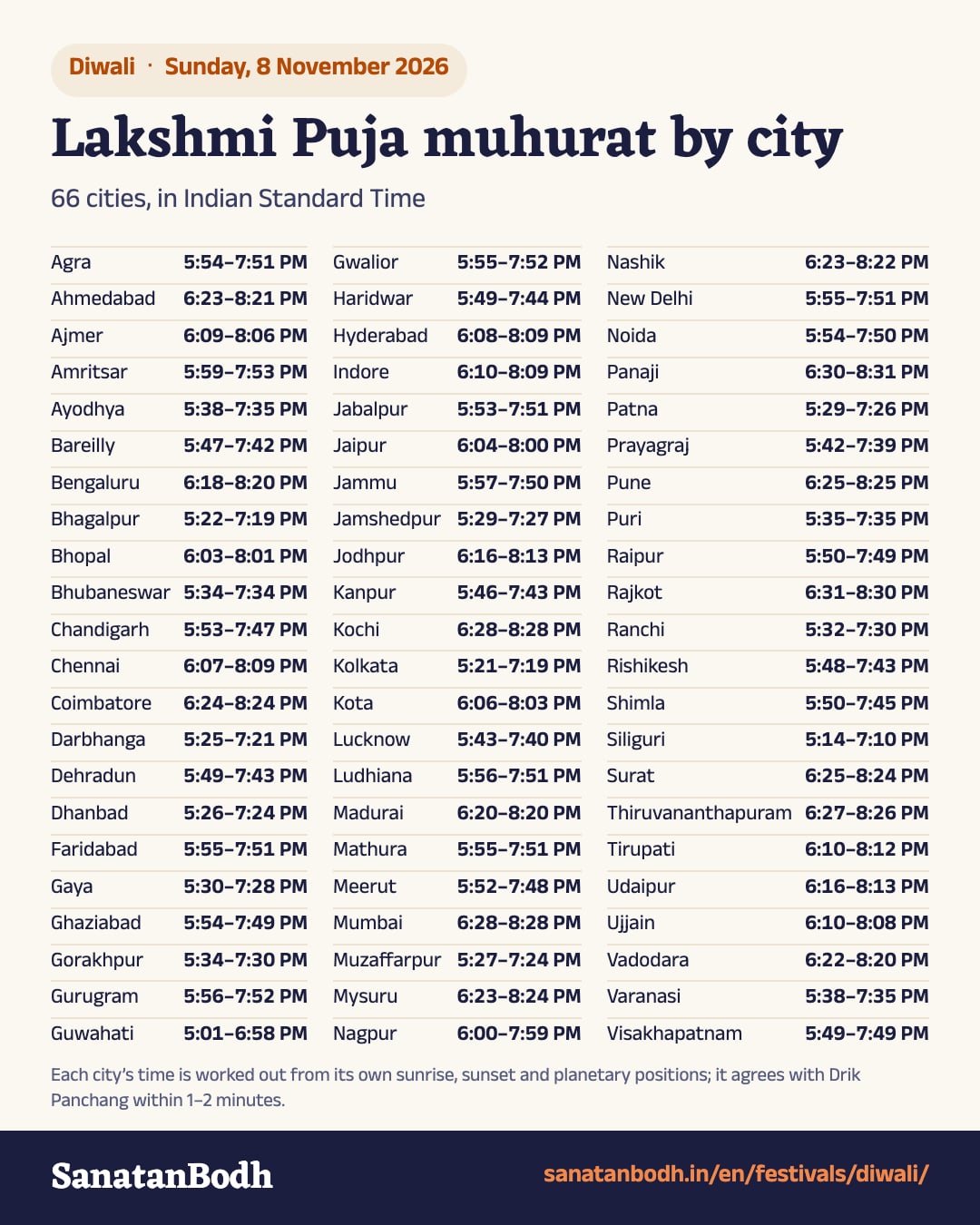
City-wise times: Lakshmi Puja
Pick your city for its full timings, nearby cities and common questions.
- New Delhi5:55–7:51 PM
- Varanasi5:38–7:35 PM
- Mumbai6:28–8:28 PM
- Kolkata5:21–7:19 PM
- Chennai6:07–8:09 PM
- Bengaluru6:18–8:20 PM
- Hyderabad6:08–8:09 PM
- Ahmedabad6:23–8:21 PM
- Jaipur6:04–8:00 PM
- Lucknow5:43–7:40 PM
- Patna5:29–7:26 PM
- Bhopal6:03–8:01 PM
- Ujjain6:10–8:08 PM
- Haridwar5:49–7:44 PM
- Pune6:25–8:25 PM
- Guwahati5:01–6:58 PM
- Noida5:54–7:50 PM
- Gurugram5:56–7:52 PM
- Ghaziabad5:54–7:49 PM
- Faridabad5:55–7:51 PM
- Chandigarh5:53–7:47 PM
- Ludhiana5:56–7:51 PM
- Amritsar5:59–7:53 PM
- Jammu5:57–7:50 PM
- Dehradun5:49–7:43 PM
- Rishikesh5:48–7:43 PM
- Shimla5:50–7:45 PM
- Agra5:54–7:51 PM
- Mathura5:55–7:51 PM
- Prayagraj5:42–7:39 PM
- Kanpur5:46–7:43 PM
- Ayodhya5:38–7:35 PM
- Gorakhpur5:34–7:30 PM
- Meerut5:52–7:48 PM
- Bareilly5:47–7:42 PM
- Jodhpur6:16–8:13 PM
- Udaipur6:16–8:13 PM
- Kota6:06–8:03 PM
- Ajmer6:09–8:06 PM
- Indore6:10–8:09 PM
- Gwalior5:55–7:52 PM
- Jabalpur5:53–7:51 PM
- Raipur5:50–7:49 PM
- Gaya5:30–7:28 PM
- Muzaffarpur5:27–7:24 PM
- Bhagalpur5:22–7:19 PM
- Darbhanga5:25–7:21 PM
- Ranchi5:32–7:30 PM
- Jamshedpur5:29–7:27 PM
- Dhanbad5:26–7:24 PM
- Bhubaneswar5:34–7:34 PM
- Puri5:35–7:35 PM
- Siliguri5:14–7:10 PM
- Surat6:25–8:24 PM
- Vadodara6:22–8:20 PM
- Rajkot6:31–8:30 PM
- Nagpur6:00–7:59 PM
- Nashik6:23–8:22 PM
- Panaji6:30–8:31 PM
- Visakhapatnam5:49–7:49 PM
- Tirupati6:10–8:12 PM
- Mysuru6:23–8:24 PM
- Kochi6:28–8:28 PM
- Thiruvananthapuram6:27–8:26 PM
- Coimbatore6:24–8:24 PM
- Madurai6:20–8:20 PM
Diwali 2026 dates: Dhanteras 6 November to Bhai Dooj 11 November
| Date | Festival | Time (New Delhi) |
|---|---|---|
| 6 November Friday | Dhanteras | 6:03–7:58 PM Puja muhurat |
| 7 November Saturday, night | Kali Chaudas | 11:39 PM–12:31 AM Nishita Kaal |
| 8 November Sunday, dawn | Narak Chaturdashi | 5:41–6:38 AM Abhyang Snan |
| 8 November Sunday, evening | Diwali | 5:55–7:51 PM Lakshmi Puja |
| 10 November Tuesday | Govardhan Puja | 6:40–8:50 AM Pratahkala |
| 11 November Wednesday | Bhai Dooj | 1:10–3:20 PM Tilak (Aparahna) |
Times for New Delhi, by our calculation (checked against Drik Panchang); your city’s time is on each festival’s page. Amavasya lasts until 12:33 PM on 9 November, so Govardhan Puja is on 10 November.
Diwali 2026 choghadiya muhurat
The good choghadiyas (Amrit, Shubh, Labh and Char) of the day and night of Sunday, 8 November 2026 while Amavasya lasts are below, grouped into morning, afternoon, evening, night and early-morning muhurats the way Drik Panchang gives them. In Gujarat the Diwali Lakshmi Puja is also called Chopda Puja, the worship of new account books; Drik Panchang says it is done in Rajasthan and Maharashtra too, and the choghadiya muhurat is used for it. For Lakshmi Puja at home Drik Panchang advises the Pradosh Kaal muhurat with a fixed (Vrishabha) lagna, given above, rather than the choghadiya.
Sunday, 8 November 2026New Delhi
| Muhurat | Time | Choghadiya |
|---|---|---|
| Morning | 11:29 AM–12:05 PM | Amrit Vaar Vela |
| Afternoon | 1:26–2:48 PM | Shubh |
| Evening | 5:31–10:27 PM | Shubh 5:31–7:10 PMAmrit 7:10–8:48 PMChar 8:48–10:27 PM |
| Night | 1:44–3:22 AM9 November | Labh Kaal Ratri |
| Early morning | 5:00–6:39 AM9 November | Shubh |
Amavasya: 11:29 AM, 8 November to 12:33 PM, 9 November (New Delhi). On ordinary days panchangs advise against starting auspicious work in Vaar Vela, Kaal Vela and Kaal Ratri; Drik Panchang keeps these choghadiyas in its list for this festival, so they are shown here with a mark.
Full panchang for 8 November: all 16 choghadiyas of the day and night · Choghadiya today
Source: Drik Panchang, “Auspicious Choghadiya Muhurat for Diwali Lakshmi Puja” and Chopda Puja (drikpanchang.com); times from SanatanBodh’s calculation, checked against Drik Panchang for New Delhi, Mumbai, Kolkata and Jaipur (within 2 minutes).
At a glance
- Tithi
- Kartik Amavasya
- Main puja
- Lakshmi and Ganesha Puja
- Puja time
- Fixed (Vrishabha) lagna in Pradosh Kaal, while Amavasya lasts
- Night
- Mahalakshmi and Kali Puja in Nishita Kaal (in many traditions)
- Five days
- Dhanteras, Naraka Chaturdashi, Diwali, Govardhan Puja, Bhai Dooj
- Stories
- Lakshmi’s appearance from the Samudra Manthan; Shri Rama’s return to Ayodhya
How the Lakshmi Puja muhurat is set
The first fifth of the night after sunset is called Pradosh Kaal. When Vrishabha lagna is rising during this time, that is a fixed (sthira) lagna; it is believed that puja done in a fixed lagna makes Lakshmi stay in the home for good. The muhurat is the time when Pradosh Kaal, Vrishabha lagna and Amavasya tithi all coincide. The lagna rises at a different time in each city, so choose your city above.
The five-day Deepotsav
Dhanteras
Kartik Krishna Trayodashi: worship of Dhanvantari, Lakshmi and Kubera, and Yama Deepdaan.
Naraka Chaturdashi (Chhoti Diwali)
Kartik Krishna Chaturdashi: remembering Shri Krishna’s slaying of Narakasura; abhyanga snan (ritual oil bath) in the morning.
Bhagavata Purana 10.59Diwali
Kartik Amavasya: Lakshmi and Ganesha Puja, and the lighting of lamps.
Govardhan Puja
Kartik Shukla Pratipada: remembering Shri Krishna lifting Mount Govardhan; Annakut.
Bhagavata Purana 10.24–25Bhai Dooj
Kartik Shukla Dwitiya (Yama Dwitiya): a festival of brothers and sisters.
Folk traditionWhy it is celebrated
Lakshmi’s appearance
According to the Bhagavata Purana, Lakshmi emerged from the Samudra Manthan and chose Lord Vishnu as her husband. On Diwali, Lakshmi is worshipped with a prayer for prosperity.
Bhagavata Purana 8.8Shri Rama’s return to Ayodhya
In North Indian tradition, Diwali is celebrated as the return of Shri Rama to Ayodhya after slaying Ravana, when the people of the city lit lamps.
Folk traditionDiwali puja samagri list (Lakshmi Puja)
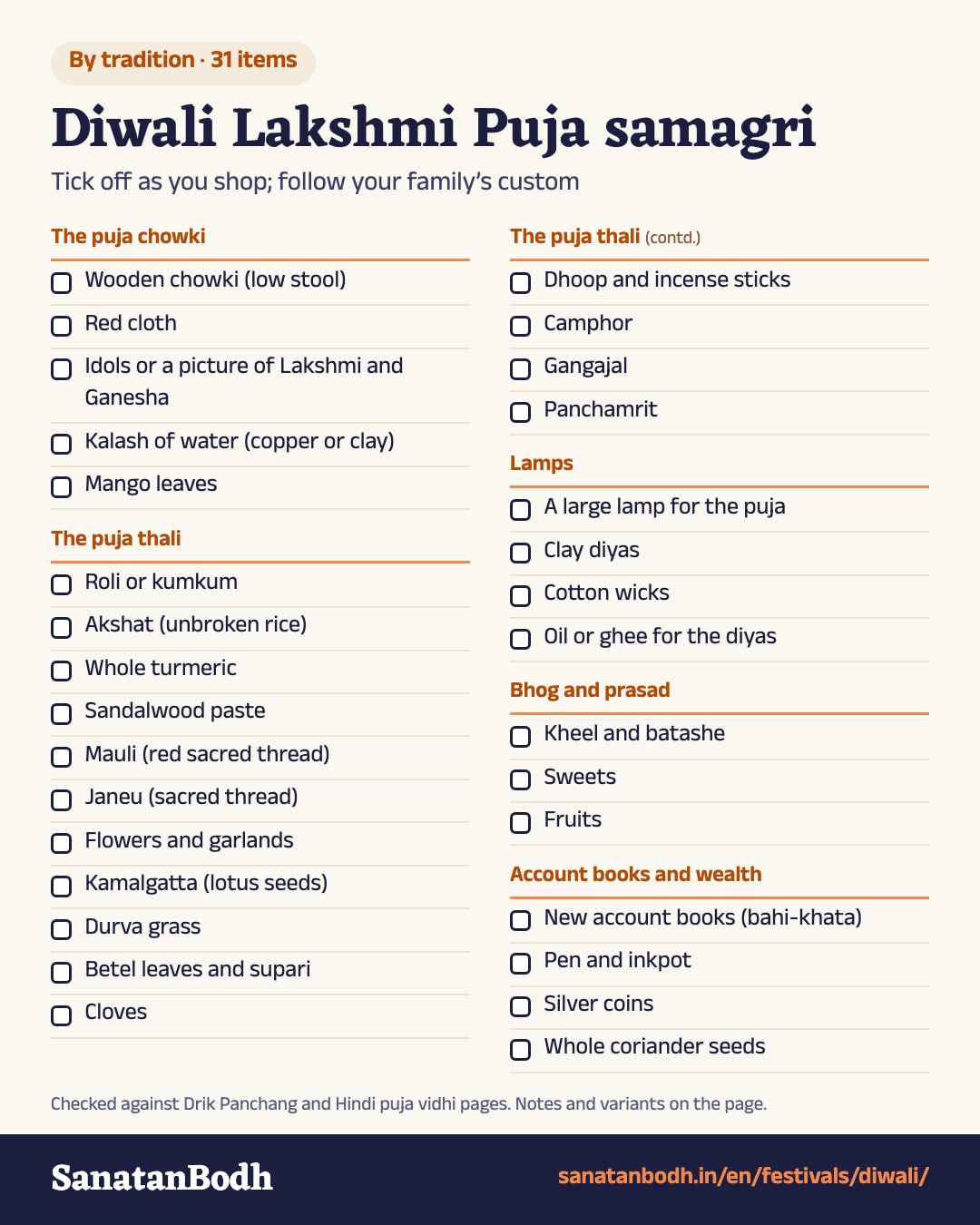
By tradition; follow your family’s custom. What homes usually keep ready for the Lakshmi-Ganesha puja. 31 items in all; tick them off as you shop.
The puja chowki
The puja thali
Lamps
Bhog and prasad
Account books and wealth
How homes and regions differ
- A full shastric puja done by a purohit also uses sapta-mrittika (earth from seven places), sarvaushadhi (herbs), pancha-pallava (five kinds of leaves), sapta-dhanya and pancha-ratna; they are in the longer lists of Drik Panchang and Webdunia.
- According to Drik Panchang, if an item cannot be found, akshat may be offered in its place.
- Many families also worship Kubera, Saraswati and Mahakali in this puja. In Bengal this night is Kali Puja; this list is for the Lakshmi-Ganesha puja.
Checked against these sources and written in our own words; only items named by at least two of them are listed: Drik Panchang: Lakshmi Puja items; Drik Panchang: Diwali Puja Vidhi; Webdunia: Diwali puja samagri list; Webdunia: Lakshmi puja vidhi; Times Now Hindi: Diwali puja samagri (2025)
How to perform the puja
- Step 1
Preparation
Clean the house, make a rangoli, and put a toran and lamps at the door.
- Step 2
The puja place
On a chowki (low stool), an idol or picture of Lakshmi and Ganesha, a kalash filled with water, and a lamp.
- Step 3
Puja in the muhurat
After the sankalpa, worship Ganesha first and then Lakshmi; recite the Shri Suktam or a Lakshmi stotra.
- Step 4
Bahi-khata puja
In business families, the new account books (bahi-khata) and the safe are worshipped.
- Step 5
Deepdaan
After the puja, light lamps throughout the house, courtyard and doorway.
Lakshmi from the churning of the ocean
To obtain amrita, the devas and asuras churned the Ocean of Milk (Kshirasagara), using Mount Mandarachala as the churning rod and the serpent Vasuki as the rope. Many treasures came out of the churning, and among them was Lakshmi, seated on a lotus. After looking at all the devas, Lakshmi placed the bridal garland around Lord Vishnu’s neck, and Vishnu gave her a place on his chest.
Bhagavata Purana 8.7–8.8Read the full kathaVerses
हिरण्यवर्णां हरिणीं सुवर्णरजतस्रजाम्।चन्द्रां हिरण्मयीं लक्ष्मीं जातवेदो म आवह॥Diwali: relations
See in the knowledge graphDeities, figures and sages 3
Festivals 4
- Dhanteras · First day of DeepotsavTradition
- Naraka Chaturdashi · Second day of DeepotsavTradition
- Govardhan Puja · Fourth day of DeepotsavTradition
- Bhai Dooj · Last day of DeepotsavTradition
Frequently asked questions
When is Diwali 2026?
On Sunday, 8 November.
Is Diwali on 8 November or 9 November?
On 8 November (Sunday). Amavasya tithi runs from 11:29 AM on 8 November to 12:33 PM on 9 November. Lakshmi Puja is done in the evening, in Pradosh Kaal while Amavasya lasts, and that evening is 8 November (Lakshmi Puja in New Delhi: 5:55–7:51 PM). On 9 November Amavasya holds at sunrise, so panchangs list that day as Kartika Amavasya; Drik Panchang gives the Diwali snan and devpuja that morning.
When is the Diwali 2026 choghadiya muhurat?
In New Delhi on Sunday, 8 November 2026, the good choghadiya muhurats while Amavasya lasts are: morning (Amrit) 11:29 AM–12:05 PM, afternoon (Shubh) 1:26–2:48 PM, evening (Shubh, Amrit, Char) 5:31–10:27 PM, night (Labh) 1:44–3:22 AM (9 November) and early morning (Shubh) 5:00–6:39 AM (9 November). For Lakshmi Puja itself Drik Panchang advises the Pradosh Kaal muhurat with a fixed (Vrishabha) lagna rather than the choghadiya. For your city, choose it in the choghadiya muhurat section above.
What is the Lakshmi Puja muhurat on Diwali, 8 November?
On Sunday, 8 November 2026, when Pradosh Kaal, Vrishabha lagna and Amavasya tithi all coincide: New Delhi 5:55–7:51 PM, Lucknow 5:43–7:40 PM, Jaipur 6:04–8:00 PM, Patna 5:29–7:26 PM, Chandigarh 5:53–7:47 PM, Indore 6:10–8:09 PM, Mumbai 6:28–8:28 PM, Kolkata 5:21–7:19 PM, Bengaluru 6:18–8:20 PM. Other cities are in the list above.
What is the Nishita Kaal puja?
When the night is divided into 15 muhurats, the eighth is Nishita Kaal. In many traditions, especially in Bengal, Mahalakshmi and Kali Puja is performed at this time.
How many days does Diwali last?
Five days: Dhanteras, Naraka Chaturdashi, Diwali, Govardhan Puja and Bhai Dooj.
When are the five days of Diwali 2026?
Dhanteras on 6 November (Friday), the Narak Chaturdashi abhyang snan at dawn and Diwali in the evening of 8 November (Sunday), Govardhan Puja on 10 November (Tuesday) and Bhai Dooj on 11 November (Wednesday). The Kali Chaudas night puja is on 7 November (Drik Panchang).
What samagri is needed for the Diwali Lakshmi Puja?
By tradition: a red cloth on the chowki, idols or a picture of Lakshmi and Ganesha, a kalash of water and mango leaves; on the thali roli, akshat, turmeric, mauli, flowers and garlands, durva, betel leaves and supari, dhoop and camphor; a large lamp for the puja and clay diyas; and for bhog kheel-batashe, sweets and fruits. Business families add new account books and a pen. The full list is on this page.
Sources
- Bhagavata Purana 8.7–8.8 (Samudra Manthan and Lakshmi)
- Bhagavata Purana 10.59 (the slaying of Narakasura) and 10.24–25 (Govardhan)
- Shri Suktam (Rigveda Khila Sukta)
- Folk tradition
- Muhurat and moonrise: SanatanBodh panchang calculation, checked against Drik Panchang (New Delhi, 2026–27)
Something wrong? Report a mistake