जय अहोई माता, जय अहोई माता।
तुमको निसदिन ध्यावत, हर विष्णु विधाता॥
Jay ahoee mata, jay ahoee mata.
Tumko nisdin dhyavat, har Vishnu vidhata ||
Victory to you, Mother Ahoi. Shiva (Har), Vishnu and Brahma (Vidhata) meditate on you day and night.
Verse 2
ब्रह्माणी, रुद्राणी, कमला, तू ही है जगमाता।
सूर्य-चन्द्रमा ध्यावत, नारद ऋषि गाता॥
Brahmani, rudrani, kamla, too hi hai jagmata.
Soorya-chandrama dhyavat, narad rishi gata ||
You are Brahmani, Rudrani and Kamala (Lakshmi); you alone are the mother of the world. The sun and the moon meditate on you, and the sage Narada sings your praise.
Verse 3
माता रूप निरंजन, सुख-सम्पत्ति दाता।
जो कोई तुमको ध्यावत, नित मंगल पाता॥
Mata roop niranjan, sukh-sampatti data.
Jo koee tumko dhyavat, nit mangal pata ||
Mother, your form is spotless, and you give happiness and wealth. Whoever meditates on you always finds what is auspicious.
Verse 4
तू ही पाताल बसंती, तू ही है शुभदाता।
कर्म-प्रभाव प्रकाशक, जगनिधि से त्राता॥
Too hi patal basanti, too hi hai shubhdata.
Karma-prabhav prakashak, jagnidhi se trata ||
You dwell even in the netherworld, and you alone grant what is auspicious. You bring the effects of actions to light and rescue beings from the ocean of the world.
Verse 5
जिस घर थारो वासा, वाहि में गुण आता।
कर न सके सोई कर ले, मन नहीं धड़काता॥
Jis ghar tharo vasa, vahi mein gun aata.
Kar na sake soee kar le, man nahin dhadkata ||
The home where you dwell (tharo: your) is filled with every virtue. There a person can do even what they could not do before, and the heart does not pound with fear.
Verse 6
तुम बिन सुख न होवे, न कोई पुत्र पाता।
खान-पान का वैभव, तुम बिन नहीं आता॥
Tum bin sukh na hove, na koee putra pata.
Khan-pan ka vaibhav, tum bin nahin aata ||
Without you there is no happiness, and no one is blessed with a son (a child). Without you, even plenty of food and drink does not come. The Ahoi Ashtami vrat is kept for the wellbeing of one’s children.
Verse 7
शुभ गुण सुंदर युक्ता, क्षीर निधि जाता।
रतन चतुर्दश तोकू, कोई नहीं पाता॥
You are endowed with fine and auspicious qualities, and you were born of the ocean of milk. Without you (toku: you) no one obtains the fourteen jewels. These lines match the Lakshmi aarti, where they speak of the fourteen jewels that came from the churning of the ocean.
Verse 8
श्री अहोई माँ की आरती, जो कोई गाता।
उर उमंग अति उपजे, पाप उतर जाता॥
Shri ahoee man ki aarti, jo koee gata.
Ur umang ati upje, pap utar jaata ||
The aarti says that whoever sings this aarti of Shri Ahoi Maa feels great joy rise in the heart, and their sins fall away.
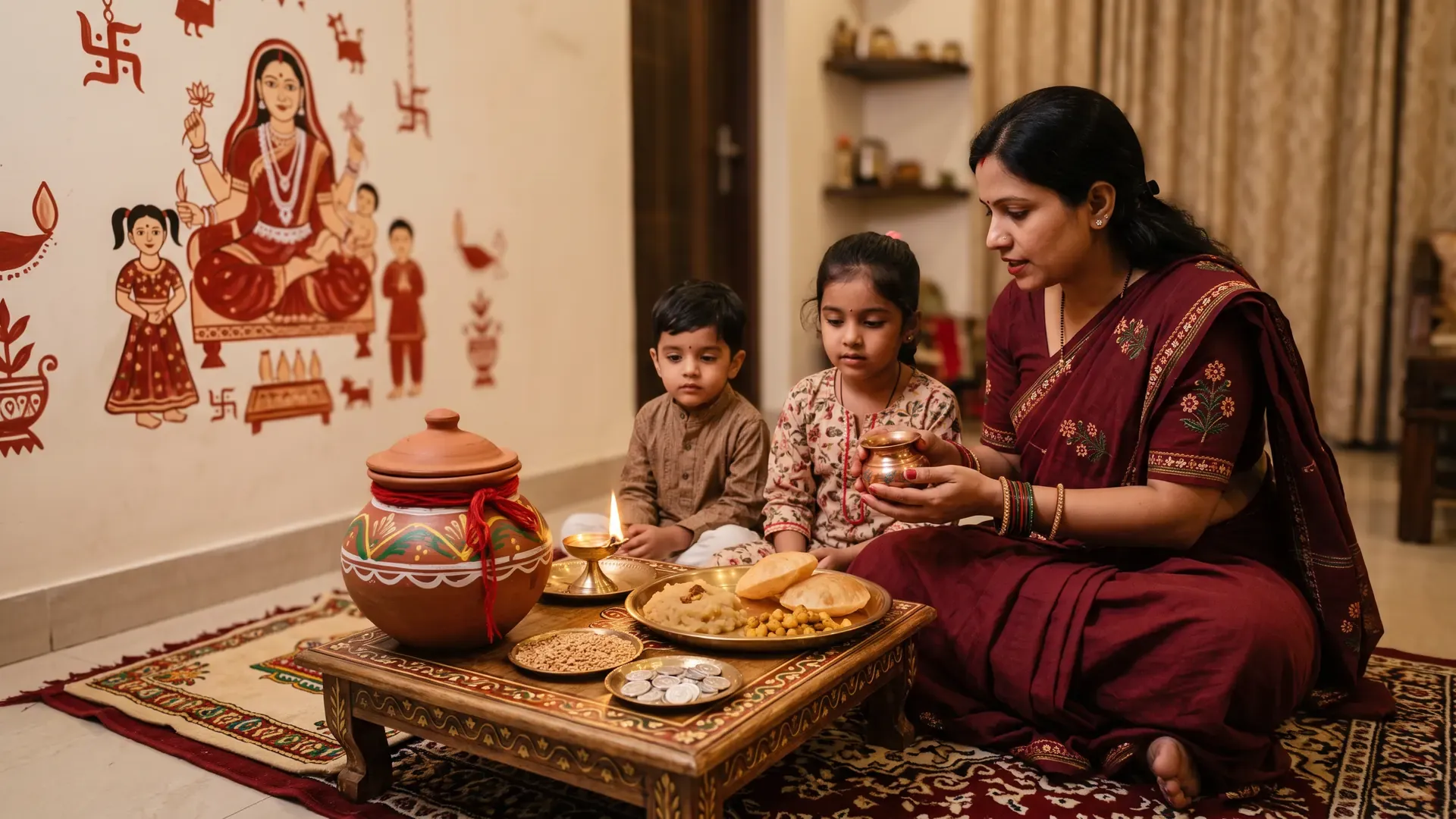
“Jai Ahoi Mata” is the folk aarti of Ahoi Mata sung on Ahoi Ashtami (Kartik Krishna Ashtami). Mothers fast through the day for the wellbeing of their children, and in the evening sing this aarti after the worship of Ahoi Mata and the vrat katha. Many of its lines match the Lakshmi aarti “Om Jai Lakshmi Mata”. The wording varies a little by region.
This is a folk aarti, and its wording varies by region. The most widely printed form is given here. Some versions read ‘man nahin ghabrata’ in place of ‘man nahin dhadkata’ in verse 5, and, in verse 2, the spelling ‘ब्राह्मणी’ in place of ‘ब्रह्माणी’ (Brahmani). Many of its lines resemble the aarti “Om Jai Lakshmi Mata”, such as ‘Har Vishnu Vidhata’, ‘kshir nidhi jata’ and ‘ratan chaturdash’. When sung, the first verse (the refrain) is repeated after every verse; in many places the refrain is sung as ‘Om Jai Ahoi Mata, Maiya Jai Ahoi Mata’.
Each morning the tithi, Rahu Kaal and coming festivals, in one short WhatsApp message.Follow the channel
Frequently asked questions
When is the Ahoi Mata aarti sung?
On the evening of Ahoi Ashtami (Kartik Krishna Ashtami, four days after Karva Chauth), after the worship of Ahoi Mata and the vrat katha. After this, mothers look at the stars, offer arghya and end their fast.
Why does this aarti sound like the Lakshmi aarti?
Many of its lines match “Om Jai Lakshmi Mata” almost word for word, such as ‘Har Vishnu Vidhata’, ‘Surya-Chandrama dhyavat, Narad rishi gata’ and ‘ratan chaturdash’. Both are also sung to the same tune.
Who wrote this aarti?
The author is not known. It is a folk aarti, and its last verse does not carry any poet’s name.
What do ‘tharo’ and ‘toku’ mean?
They are words of the spoken dialects: ‘tharo’ means your, ‘vahi’ means that very one, and ‘toku’ means to you. The language of the aarti mixes Hindi with a flavour of Braj and Rajasthani.
Add SanatanBodh to your phone as an appToday’s panchang and choghadiya in one tap. Free, no app store needed.Tap the Share button below, then “Add to Home Screen”. How?