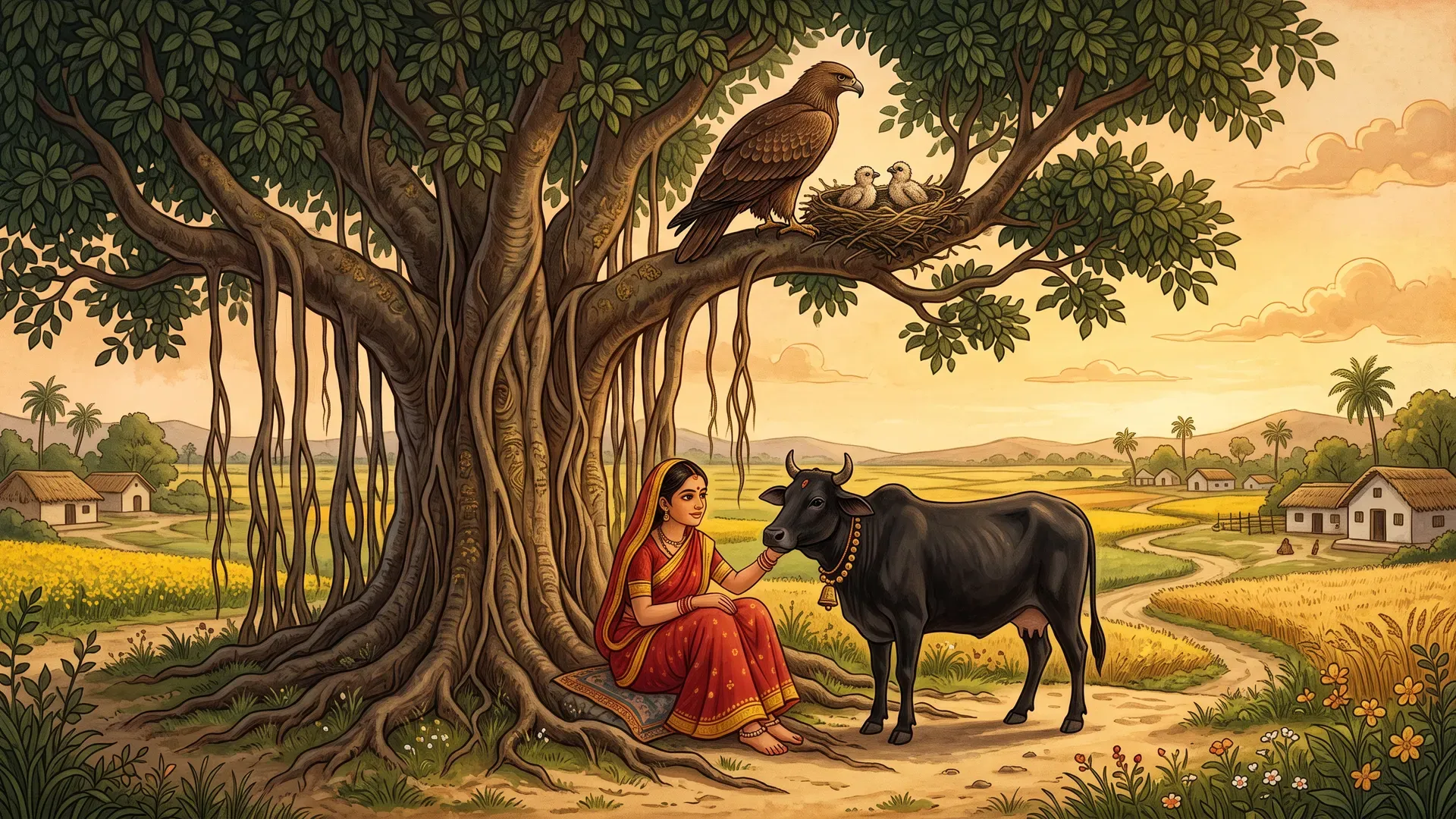
Two kathas are most often told on Ahoi Ashtami. In the first, a moneylender’s wife digging earth kills a porcupine cub by accident and loses her seven sons; she owns her mistake, worships Ahoi Mata and is blessed with children again. In the second, the youngest daughter-in-law takes on the curse meant for her sister-in-law and, by serving the cow Surahi, gets Syahu Mata to lift it.
Each morning the tithi, Rahu Kaal and coming festivals, in one short WhatsApp message.Follow the channel
Ahoi Ashtami falls on Kartik Krishna Ashtami (Purnimanta calendar), four days after Karva Chauth. Mothers fast through the day for their children’s long life and wellbeing; in the evening they draw Ahoi Mata and the syahu (porcupine) with her young on the wall, worship them, hear the katha, and break the fast after offering water to the stars.
These are folk vrat kathas told in homes; we did not find them in any Purana. The Narada Purana (Purva Bhaga, chapter 117) prescribes a “Karaka vrata” on Kartik Krishna Ashtami for those who wish for a son, with water offered at moonrise, but it has no story of Ahoi or the syahu. The kathas below are told as they are most often printed and heard; where the sources differ, it is noted at the end.
How the vrat and katha are kept
- The puja is in the evening. Ahoi Mata is drawn on the wall in red ochre, often with eight compartments, together with the syahu and her young; many homes put up a printed picture instead.
- In many families a small silver syahu is worshipped with roli and rice.
- The katha is heard after the puja. Halwa, puri and sweets are offered, and in many homes a share is given to the mother-in-law to receive her blessing.
- The fast is broken after offering water to the stars when they appear; some families wait for moonrise.
The moneylender’s wife and the porcupine cub
This telling is given by Drik Panchang, Bhakti Bharat, Sri Mandir and Bharatkosh.
Long ago a moneylender’s wife lived in a village. She had seven sons and a house full of plenty. The month of Kartik came, Diwali was near, and earth was needed to plaster the house. She took a spade and went outside the village to the place where people dug earth.
As she dug, her spade struck a burrow where the young of a porcupine lay, and one of them was killed by the blow. She had not meant it, but seeing the little creature dead her heart trembled. Sorrowful, she carried the earth home.
Within that year her seven sons died one after another. The house fell silent. Day and night she wept, wondering what wrong she had done to deserve this.
One day she told the elder women of the village everything: how the porcupine cub had died by her hand while she dug. The old women comforted her. “You have owned your mistake before everyone,” they said, “and that has already lifted half of it. Now take refuge in Bhagavati Ahoi on Kartik Krishna Ashtami. Fast that day, draw the porcupine and her young on the wall, worship them, and ask forgiveness from the heart.”
She did just that. On the Ashtami she fasted all day, drew the picture in the evening, worshipped Ahoi Mata and asked forgiveness for her mistake. After that she kept the fast every year.
By the Mother’s grace her days of sorrow ended and her home was filled with children again. Since then mothers keep the Ahoi Ashtami fast for the wellbeing of their children. According to Drik Panchang, Ahoi Bhagavati is held to be a form of the goddess Parvati.
The youngest daughter-in-law, the cow Surahi and Syahu Mata
This longer telling is given by Hindi Wikipedia, Webdunia, Amar Ujala and the Art of Living.
A moneylender had seven sons, seven daughters-in-law and one daughter. Before Diwali the seven daughters-in-law went to the forest to fetch earth for plastering the house, and the daughter, their sister-in-law, went with them.
Where they were digging lived a syahu, a porcupine, with her young. As the sister-in-law cut the earth, her trowel killed one of the syahu’s young by accident. The syahu was filled with anger and said, “I will bind your womb.”
The sister-in-law was frightened. One by one she begged her brothers’ wives to take the curse on themselves in her place. The six elder ones refused. The youngest thought that if she too refused, their mother-in-law would be hurt, so she let her own womb be bound instead.
After that, every child born to the youngest daughter-in-law died on the seventh day. It happened seven times. In her grief she asked a pandit for a remedy. “Serve the cow Surahi,” he said. “Surahi is the syahu’s friend; if she asks, the syahu can open your womb.”
From that day the youngest daughter-in-law rose before everyone and quietly swept and cleaned Surahi’s place. Surahi wondered who came every morning to serve her. One day she woke early and saw her. Pleased, Surahi said, “Ask for what you want.” The young woman said, “Syahu Mata has bound my womb and my children do not live. Please ask her to open it.”
Surahi set out with her to the syahu, who lived beyond the seven seas. The sun was hot on the way, so they rested under a big tree. In that tree was the nest of a garud pankhni, a great eagle, with her chicks. Just then a snake began to climb up to bite them. The young woman killed the snake and hid it to one side.
When the eagle returned she saw blood on the ground, thought the woman had killed her chicks, and swooped on her. Then the young woman showed her the dead snake and told her everything. Learning the truth, the eagle was overjoyed. “You saved my children,” she said. “Tell me what I can do for you.” Surahi said they had to reach the syahu beyond the seven seas, and the eagle carried them both on her back to the syahu’s home.
The syahu welcomed Surahi like a sister she had not seen in a long time. As they talked she said her hair was full of lice, and the young woman picked them all out with a fine needle. The syahu was pleased and blessed her: “May you have seven sons and seven daughters-in-law.”
The young woman folded her hands. “Mother, I have not a single son. It is you who bound my womb.” The syahu understood that she was now bound by her own blessing. Having given her word she had to keep it, and she opened the young woman’s womb.
When she came home she found her house full of seven sons and seven daughters-in-law. Joyfully she drew seven Ahois, worshipped them and made seven udyapans. Her elder sisters-in-law wondered why she was not weeping this time; the children ran to tell them that their aunt was cooking festive food. They hurried over to ask how her womb had been opened, and she told them the whole story.
The katha ends with a prayer: O Syahu Mata, as you opened the youngest daughter-in-law’s womb, open everyone’s, and keep all children happy.
Chandrabhan and Chandrika
This short katha is given by Bhakti Bharat and Bharatkosh; both call it a folk tale and name the place differently.
A rich moneylender named Chandrabhan lived with his virtuous wife Chandrika; one telling places them near Jhansi, another in Datia. Their children kept dying young. Broken by grief, they left their wealth and went away to the forest.
They came to a pool near Badrikashram and sat there, giving up food and water. On the seventh day a voice from the sky told them their sorrow came from past deeds, and that if Chandrika kept the fast of Ahoi Mata on Kartik Krishna Ashtami, the Mother’s grace would give them children.
Chandrika kept the Ahoi fast with devotion, and Ahoi Mata, pleased, blessed them with long-lived children. In Bhakti Bharat’s telling the voice also tells them to bathe in Radha Kund.
Other tellings
- In the first katha the animal is called seh, sehi or sahi (porcupine); in some tellings one cub dies, in others several. In Drik Panchang’s Hindi telling the mother porcupine curses the woman; other sources do not mention a curse.
- At the end of the first katha some sources say the same seven sons came back alive (Drik Panchang); others say she later had seven sons again (Bhakti Bharat, Sri Mandir, Bharatkosh).
- At Radha Kund near Mathura, couples wishing for a child bathe together at midnight on Ahoi Ashtami (Drik Panchang). The story of Krishna slaying Arishtasura and the making of Radha Kund is told behind it; we did not find this boon in any text we could check.
After the katha
After the katha the aarti of Ahoi Mata is sung, and the fast is broken with water offered to the stars when they appear. The time the stars appear and the moonrise for your city are on the Ahoi Ashtami page.
Ahoi Mata Aarti: Jai Ahoi MataFrequently asked questions
When is the Ahoi Ashtami katha heard?
In the evening, after the puja of Ahoi Mata and before water is offered to the stars.
Who is Syahu Mata?
The syahu (porcupine) is the creature whose young one dies by accident in the kathas. In the second katha she is called Mother and, pleased, opens the young woman’s womb. In the puja the syahu and her young are drawn on the wall with Ahoi Mata, and many homes worship a small silver syahu.
Which Purana has the Ahoi Ashtami katha?
They are folk vrat kathas; we did not find them in any Purana. The Narada Purana (Purva Bhaga, chapter 117) prescribes a Karaka vrata on Kartik Krishna Ashtami for a son, with water offered at moonrise, but without this story.
What is kept at hand while hearing the katha?
The picture of Ahoi Mata, roli, rice, a lamp and the offering (halwa-puri or sweets); in many homes a silver syahu too. It varies with family custom.
Sources
- Drik Panchang: Ahoi Ashtami Vrat Katha (Hindi and English) and Radha Kund Snan, drikpanchang.com
- Hindi Wikipedia: Ahoi Ashtami
- Webdunia (hindi.webdunia.com): Ahoi Ashtami vrat ki kahani
- Amar Ujala: Ahoi Ashtami vrat katha (22 October 2024)
- Bhakti Bharat (bhaktibharat.com): Ahoi Ashtami vrat katha; the Ahoi Ashtami and Radha Kund katha
- Bharatkosh (bharatdiscovery.org): Ahoi Ashtami, both stories given as folk tales
- Art of Living (artofliving.org): Ahoi Ashtami vrat vidhi
- Sri Mandir (srimandir.com): Ahoi Ashtami vrat katha
- Narada Purana, Purva Bhaga 1.117.78–80 (Karaka vrata), checked in the English translation on wisdomlib.org
Something wrong? Report a mistake