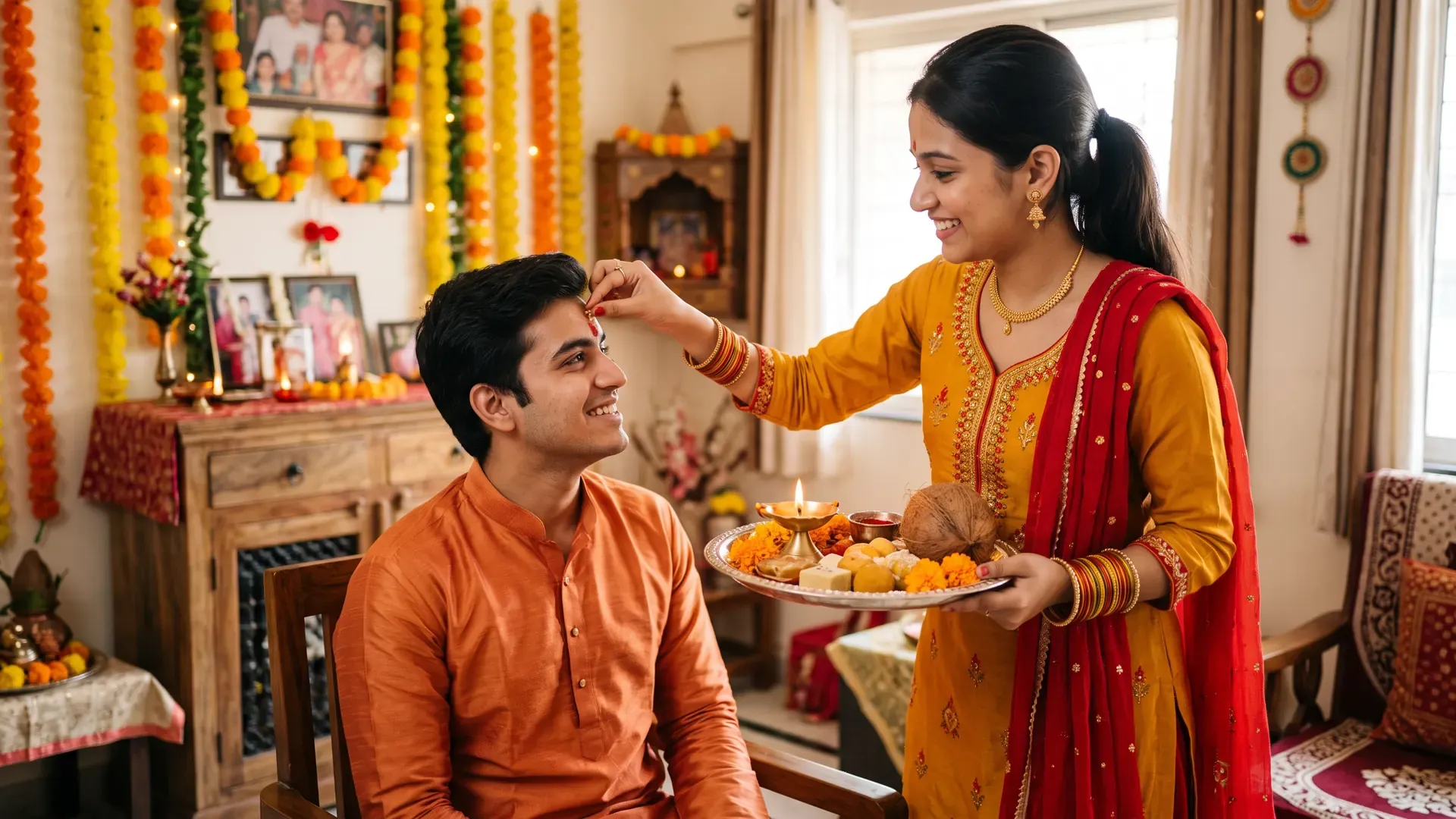
Bhai Dooj 2026: Wednesday, 11 November. Below are 7 verses to send with your Bhai Dooj greetings, the first ‘कार्तिके शुक्लपक्षस्य द्वितीयायां युधिष्ठिर’ (Nirnaya Sindhu (Kamalakara Bhatta), the section on Yama Dvitiya (Kartik Shukla Dvitiya), quoted under the name of the Bhavishya Purana). Each verse has its source and a plain meaning in our own words; ‘Make a card’ puts the verse on a picture card with your name.
Make a Bhai Dooj greeting card
Advertisement
1कार्तिके शुक्लपक्षस्य द्वितीयायां युधिष्ठिर
कार्तिके शुक्लपक्षस्य द्वितीयायां युधिष्ठिर।यमो यमुनया पूर्वं भोजितः स्वगृहेऽर्चितः॥अतो यमद्वितीयेयं त्रिषु लोकेषु विश्रुता॥
Source: Nirnaya Sindhu (Kamalakara Bhatta), the section on Yama Dvitiya (Kartik Shukla Dvitiya), quoted under the name of the Bhavishya Purana
Meaning: O Yudhishthira, on the second day of the bright half of Kartik, Yamuna once honoured Yama in her own home and fed him. That is why this day is known in the three worlds as Yama Dvitiya.
2स्नेहेन भगिनीहस्ताद्भोक्तव्यं पुष्टिवर्धनम्
स्नेहेन भगिनीहस्ताद्भोक्तव्यं पुष्टिवर्धनम्।दानानि च प्रदेयानि भगिनीभ्यो विधानतः॥
Source: Nirnaya Sindhu (Kamalakara Bhatta), the section on Yama Dvitiya (Kartik Shukla Dvitiya), in the same quotation
Meaning: On this day one should eat lovingly from a sister’s hand, which brings strength and nourishment, and give gifts to one’s sisters as the custom prescribes.
Just before this, the text says that on this day one should not eat at home; it goes on to ask that all sisters be honoured with gold ornaments, clothes and food.
3यस्यां तिथौ यमुनया यमराजदेवः
यस्यां तिथौ यमुनया यमराजदेवःसंभोजितः प्रतिजगत्स्वसृसौहृदेन।तस्यां स्वसुः करतलादिह यो भुनक्तिप्राप्नोति रत्नसुखधान्यमनुत्तमं सः॥
Source: Nirnaya Sindhu (Kamalakara Bhatta), the section on Yama Dvitiya (Kartik Shukla Dvitiya), quoted in the same section
Meaning: On the day when Yamuna, with a sister’s love, fed Yamaraja, whoever eats from his own sister’s hand, says the verse, gains the finest of jewels, happiness and grain.
4एह्येहि मार्तण्डज पाशहस्त यमान्तकालोकधरामरेश
एह्येहि मार्तण्डज पाशहस्त यमान्तकालोकधरामरेश।भ्रातृद्वितीयाकृतदेवपूजां गृहाण चार्घ्यं भगवन्नमस्ते॥
Source: Nirnaya Sindhu (Kamalakara Bhatta), the section on Yama Dvitiya (Kartik Shukla Dvitiya): the verse of the Gauda (Bengal) authorities for offering arghya to Yama
Meaning: Come, come, son of the Sun, noose in hand, O Yama, O ender of life, upholder of the worlds, lord among the gods: accept this worship offered on Bhratri Dvitiya, and this arghya. Salutations to you, O lord.
According to the Nirnaya Sindhu, in the Gauda tradition Yama, Chitragupta and Yama’s messengers are worshipped on this day, and brother and sister together offer arghya to Yama.
5भ्रातस्तवानुजाताहं भुङ्क्ष्व भक्तमिदं शुभम्
भ्रातस्तवानुजाताहं भुङ्क्ष्व भक्तमिदं शुभम्।प्रीतये यमराजस्य यमुनायां विशेषतः॥
Source: Nirnaya Sindhu (Kamalakara Bhatta), the section on Yama Dvitiya (Kartik Shukla Dvitiya): the sister’s words as she serves the meal
Meaning: Brother, I am your younger sister. Eat this auspicious meal, for the pleasure of Yamaraja and above all of Yamuna.
The Nirnaya Sindhu adds that, according to the Smartas, an elder sister says ‘agrajataham’ (I am your elder sister) in place of ‘anujataham’.
6ऊर्जे शुक्ले द्वितीयायां पूजितस्तर्पितो यमः
ऊर्जे शुक्ले द्वितीयायां पूजितस्तर्पितो यमः।वेष्टितः किन्नरैर्हृष्टैस्तस्मै यच्छति वाञ्छितम्॥
Source: Nirnaya Sindhu (Kamalakara Bhatta), the section on Yama Dvitiya (Kartik Shukla Dvitiya), quoted by Hemadri from the Skanda Purana
Meaning: The verse says: worshipped and offered water on the bright second day of Kartik (Urja), Yama, surrounded by joyful kinnaras, grants the worshipper what he wishes.
7भ्रातुरन्तकस्य पत्तनेऽभिपत्तिहारिणी
भ्रातुरन्तकस्य पत्तनेऽभिपत्तिहारिणीप्रेक्षयातिपापिनोऽपि पापसिन्धुतारिणी।नीरमाधुरीभिरप्यशेषचित्तबन्धिनीमां पुनातु सर्वदारविन्दबन्धुनन्दिनी॥
Source: Shri Yamunashtakam, verse 1 (from the Stavamala of Shri Rupa Gosvami)
Meaning: She who keeps us from reaching the city of her brother Antaka (Yama), who by a single sight carries even great sinners across the ocean of sin, whose sweet waters hold every heart: may Yamuna, daughter of the Sun, friend of the lotus, ever purify me.
Jiva Gosvami’s commentary explains ‘bhratur antakasya’ as Dharmaraja Yama, Yamuna’s elder brother.
Advertisement
About these verses
Every text was checked word by word in at least two separate editions. Where the editions differ, the ‘Variant’ line says so. Verse numbers are those of the edition named in the source; other editions may number a little differently. The meanings are our own, in plain words.
Frequently asked questions
Why is Bhai Dooj called Yama Dvitiya?
The Nirnaya Sindhu, quoting the Bhavishya Purana, says that on Kartik Shukla Dvitiya Yamuna honoured her brother Yama in her home and fed him, so the day is called Yama Dvitiya. The whole verse with meaning is above.
What does the sister say as she serves the meal on Bhai Dooj?
The Nirnaya Sindhu gives these words: ‘bhrātas tavānujātāhaṃ bhuṅkṣva bhaktam idaṃ śubham, prītaye yamarājasya yamunāyāṃ viśeṣataḥ’ (brother, I am your younger sister; take this good meal). An elder sister says ‘agrajātāhaṃ’ instead of ‘anujātāhaṃ’.
When is Bhai Dooj 2026?
Bhai Dooj is on Wednesday, 11 November 2026. In New Delhi the Aparahna kaal (the time for the tilak) is 1:09 PM to 3:19 PM; see your city’s times on the Bhai Dooj page, or when you make a card.
Sources
- Nirnaya Sindhu (Kamalakara Bhatta): Nirnaya Sagar Press, Mumbai 1901, and Khemraj Shrikrishnadas, Mumbai 1927 (archive.org)
- Stavamala of Shri Rupa Gosvami with Jiva Gosvami’s commentary, Kavyamala, Nirnaya Sagar Press (archive.org), and sanskritdocuments.org: yamunAShTakam10
Something wrong? Report a mistake