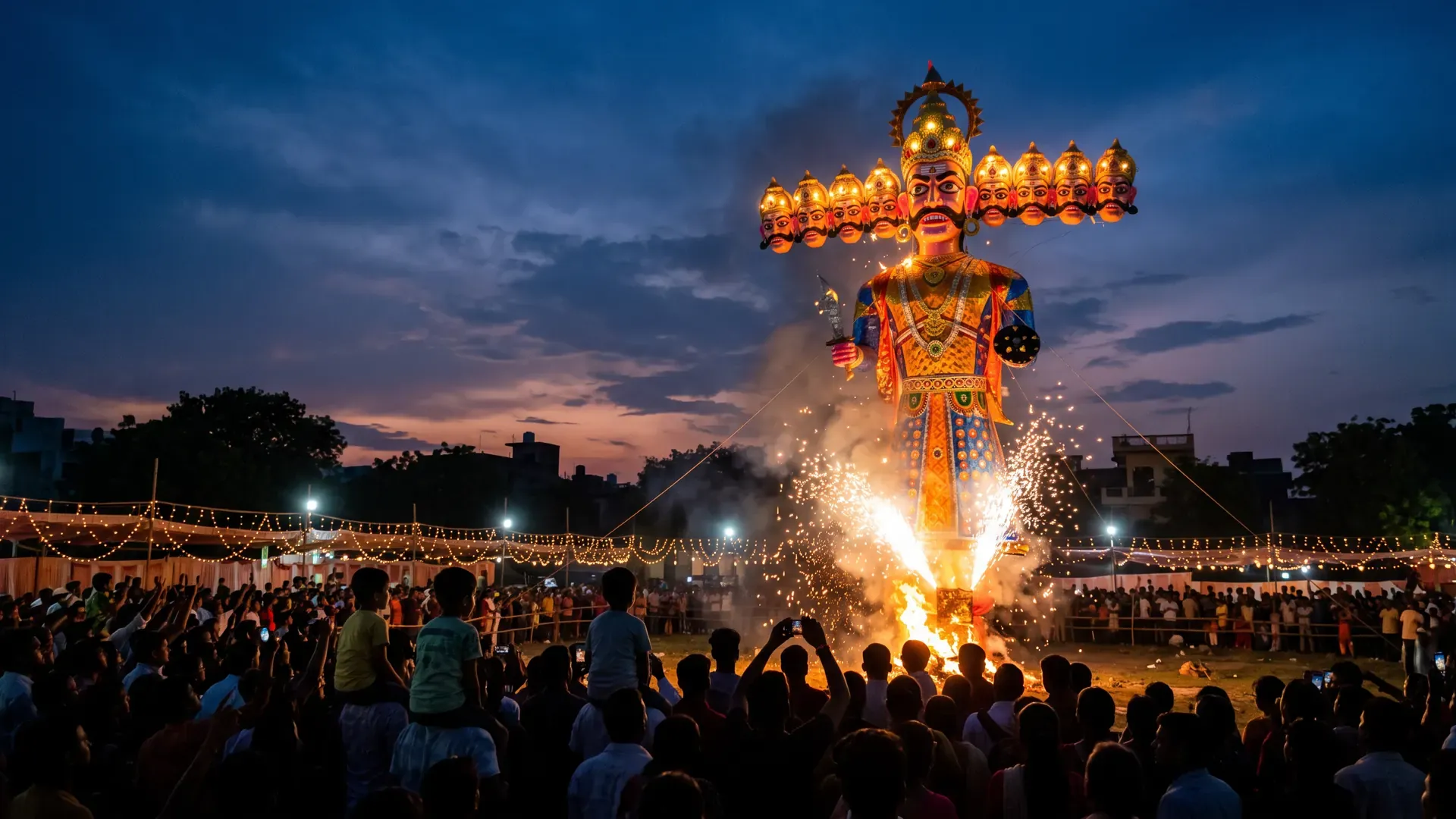
Vijayadashami 2026: Tuesday, 20 October. Below are 11 verses to send with your Dussehra greetings, the first ‘शमी शमयते पापं शमी लोहितकण्टका’ (The Shami puja prayer: Nirnaya Sindhu, the section on Vijayadashami, which quotes it from the Bhavishya Purana). Each verse has its source and a plain meaning in our own words; ‘Make a card’ puts the verse on a picture card with your name.
1शमी शमयते पापं शमी लोहितकण्टका
शमी शमयते पापं शमी लोहितकण्टका।धारिण्यर्जुनबाणानां रामस्य प्रियवादिनी॥करिष्यमाणयात्रायां यथाकालं सुखं मया।तत्र निर्विघ्नकर्त्री त्वं भव श्रीरामपूजिते॥
Source: The Shami puja prayer: Nirnaya Sindhu, the section on Vijayadashami, which quotes it from the Bhavishya Purana
Meaning: The shami calms sin; the shami has red thorns. You held Arjuna’s arrows and spoke kindly to Rama. O shami worshipped by Shri Rama, let the journey I am about to make go well, in good time and without obstacles.
The Nirnaya Sindhu gives it for the worship of the shami tree on Dussehra. By the story, the Pandavas kept their weapons in a shami tree during their year in hiding.
Variant: Cards and websites often give another form: ‘śamī śamayate pāpaṃ śamī śatruvināśinī, arjunasya dhanurdhārī rāmasya priyadarśinī’. We did not find it in a text, so we give the Nirnaya Sindhu reading.
2रामो राजमणिः सदा विजयते रामं रमेशं भजे
रामो राजमणिः सदा विजयते रामं रमेशं भजेरामेणाभिहता निशाचरचमू रामाय तस्मै नमः।रामान्नास्ति परायणं परतरं रामस्य दासोऽस्म्यहंरामे चित्तलयः सदा भवतु मे भो राम मामुद्धर॥
Source: Shri Ramraksha Stotra (of the sage Budhakaushika), verse 37
Meaning: Rama, the jewel among kings, is ever victorious; I worship Rama, the lord of Lakshmi. By Rama the army of the night-roamers was struck down; salutations to that Rama. There is no refuge higher than Rama; I am Rama’s servant. May my mind always rest in Rama; O Rama, lift me up.
3रामाय रामभद्राय रामचन्द्राय वेधसे
रामाय रामभद्राय रामचन्द्राय वेधसे।रघुनाथाय नाथाय सीतायाः पतये नमः॥
Source: Shri Ramraksha Stotra (of the sage Budhakaushika), verse 27
Meaning: Salutations to Rama, to Ramabhadra, to Ramachandra, the ordainer, the lord of the Raghus, the master, the husband of Sita.
4लोकाभिरामं रणरङ्गधीरं
लोकाभिरामं रणरङ्गधीरंराजीवनेत्रं रघुवंशनाथम्।कारुण्यरूपं करुणाकरं तंश्रीरामचन्द्रं शरणं प्रपद्ये॥
Source: Shri Ramraksha Stotra (of the sage Budhakaushika), verse 32
Meaning: Delight of the world, steady in battle, lotus-eyed, lord of the Raghu line, compassion itself and a store of compassion: I take refuge in that Shri Ramachandra.
5आपदामपहर्तारं दातारं सर्वसम्पदाम्
आपदामपहर्तारं दातारं सर्वसम्पदाम्।लोकाभिरामं श्रीरामं भूयो भूयो नमाम्यहम्॥
Source: Shri Ramraksha Stotra (of the sage Budhakaushika), verse 35
Meaning: To Shri Rama, who takes away misfortune and gives every kind of wealth, the delight of the world, I bow again and again.
6सौरज धीरज तेहि रथ चाका। सत्य सील दृढ़ ध्वजा पताका
सौरज धीरज तेहि रथ चाका। सत्य सील दृढ़ ध्वजा पताका॥बल बिबेक दम परहित घोरे। छमा कृपा समता रजु जोरे॥
Source: Shri Ramcharitmanas (Goswami Tulsidas), Lanka Kand, the third chaupai after doha 79
Meaning: Seeing Ravana on a chariot and Rama without one, Vibhishana worries. Rama then describes the chariot that wins: courage and patience are its wheels, truth and good conduct its firm flag and banner; strength, discernment, self-control and the good of others are its horses, yoked with the reins of forgiveness, kindness and equanimity.
This is the passage of the ‘chariot of dharma’. Rama goes on to say that for one who has such a chariot there is no enemy anywhere left to conquer, and doha 80 (ka) adds that he can conquer even the unconquerable foe, the world of birth and death.
7मंगल भवन अमंगल हारी
मंगल भवन अमंगल हारी।द्रवउ सो दसरथ अजिर बिहारी॥
Source: Shri Ramcharitmanas, Bal Kand, the second chaupai after doha 111 (second half)
Meaning: May he who is the home of all good and the remover of all ill, the child Rama who played in Dasharatha’s courtyard, be kind to me.
Variant: Gita Press prints द्रवउ, the Vijaya commentary (Vijayananda Tripathi) द्रवौ; both mean ‘may he be kind’.
8यदा यदा हि धर्मस्य ग्लानिर्भवति भारत
यदा यदा हि धर्मस्य ग्लानिर्भवति भारत।अभ्युत्थानमधर्मस्य तदात्मानं सृजाम्यहम्॥
Source: Bhagavad Gita 4.7
Meaning: Krishna says: O Bharata (Arjuna), whenever dharma declines and adharma rises, then I bring myself forth.
9परित्राणाय साधूनां विनाशाय च दुष्कृताम्
परित्राणाय साधूनां विनाशाय च दुष्कृताम्।धर्मसंस्थापनार्थाय सम्भवामि युगे युगे॥
Source: Bhagavad Gita 4.8
Meaning: To protect the good, to destroy those who do evil and to set dharma firmly in place again, I come into being age after age.
10यत्र योगेश्वरः कृष्णो यत्र पार्थो धनुर्धरः
यत्र योगेश्वरः कृष्णो यत्र पार्थो धनुर्धरः।तत्र श्रीर्विजयो भूतिर्ध्रुवा नीतिर्मतिर्मम॥
Source: Bhagavad Gita 18.78 (the last verse of the Gita, spoken by Sanjaya)
Meaning: Sanjaya says: where Krishna, the lord of yoga, is, and where Arjuna the archer is, there are fortune, victory, prosperity and firm right conduct; that is my conviction.
11सत्यमेव जयते नानृतं
सत्यमेव जयते नानृतंसत्येन पन्था विततो देवयानः।येनाक्रमन्त्यृषयो ह्याप्तकामायत्र तत्सत्यस्य परमं निधानम्॥
Source: Mundaka Upanishad 3.1.6 (third Mundaka, first section, mantra 6)
Meaning: Truth alone wins, not untruth. By truth is laid the path of the gods, by which the sages whose desires are fulfilled go to where the highest treasure of truth is.
‘Satyameva jayate’ is the national motto of India.
Variant: sanskritdocuments.org also notes the reading ‘jayati’ for ‘jayate’ in the first line.
About these verses
Every text was checked word by word in at least two separate editions. Where the editions differ, the ‘Variant’ line says so. Verse numbers are those of the edition named in the source; other editions may number a little differently. The meanings are our own, in plain words.
Frequently asked questions
What is the Shami puja prayer of Dussehra?
The Nirnaya Sindhu gives it from the Bhavishya Purana: ‘śamī śamayate pāpaṃ śamī lohitakaṇṭakā, dhāriṇyarjunabāṇānāṃ rāmasya priyavādinī’, followed by a prayer for a journey free of obstacles. The whole prayer with meaning is above.
Where is ‘satyameva jayate’ from?
From the sixth mantra of the first section of the third Mundaka of the Mundaka Upanishad (3.1.6). It is India’s national motto.
When is Dussehra 2026?
Vijayadashami is on Tuesday, 20 October 2026. See the Vijay muhurat for your city on the Dussehra page, or when you make a card.
Sources
- Nirnaya Sindhu (Kamalakara Bhatta): Nirnaya Sagara Press, Mumbai 1901, and Khemraj Shrikrishnadas, Mumbai 1927 (archive.org)
- Gita Press: Stotraratnavali (Shri Ramraksha Stotra), and sanskritdocuments.org: rraksha
- Gita Press: Shri Ramcharitmanas, and the Vijaya commentary of Vijayananda Tripathi (archive.org)
- Gita Press: Shrimad Bhagavad Gita, and sanskritdocuments.org: bhagvadnew
- sanskritdocuments.org: Mundakopanishat; Wikipedia: Satyameva Jayate (Mundaka 3.1.6)
Something wrong? Report a mistake