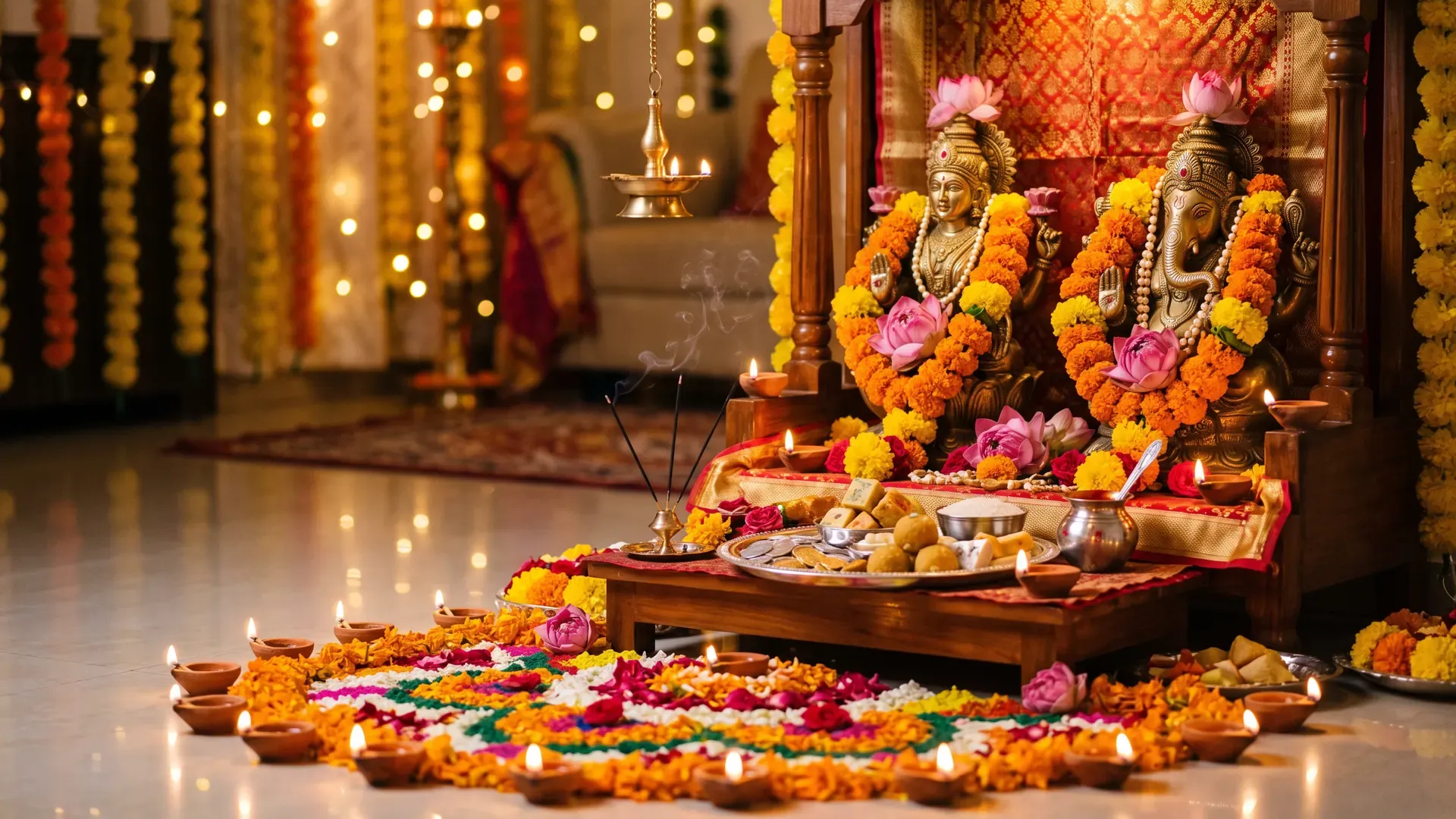
Diwali 2026: Sunday, 8 November. Below are 12 verses to send with your Diwali greetings, the first ‘हिरण्यवर्णां हरिणीं सुवर्णरजतस्रजाम्’ (Shri Sukta (a khila hymn of the Rigveda), verse 1). Each verse has its source and a plain meaning in our own words; ‘Make a card’ puts the verse on a picture card with your name.
Advertisement
1हिरण्यवर्णां हरिणीं सुवर्णरजतस्रजाम्
हिरण्यवर्णां हरिणीं सुवर्णरजतस्रजाम्।चन्द्रां हिरण्मयीं लक्ष्मीं जातवेदो म आवह॥
Source: Shri Sukta (a khila hymn of the Rigveda), verse 1
Meaning: O Agni (Jataveda), bring to me Lakshmi, golden in colour, graceful as a doe, wearing garlands of gold and silver, gladdening as the moon, made as of gold.
In the Gita Press Diwali Mahalakshmi puja this verse comes with the dhyana of Lakshmi, and each later offering is paired with the next verse of the Shri Sukta.
Variant: In worship ‘Om’ is put before it; Gita Press prints ‘ma ā vaha’ as separate words. The words are the same.
2मनसः काममाकूतिं वाचः सत्यमशीमहि
मनसः काममाकूतिं वाचः सत्यमशीमहि।पशूनां रूपमन्नस्य मयि श्रीः श्रयतां यशः॥
Source: Shri Sukta (a khila hymn of the Rigveda), verse 10
Meaning: May we see the wish and the resolve of the mind fulfilled, and find truth in our speech. May the wealth of cattle and of food, fortune and good name, come to rest in me.
In the Gita Press Diwali puja this verse goes with the offering of flowers and garlands.
3कर्दमेन प्रजाभूता मयि सम्भव कर्दम
कर्दमेन प्रजाभूता मयि सम्भव कर्दम।श्रियं वासय मे कुले मातरं पद्ममालिनीम्॥
Source: Shri Sukta (a khila hymn of the Rigveda), verse 11
Meaning: In the Shri Sukta tradition the sage Kardama is Lakshmi’s son, and through him she is called a mother. O Kardama, come and dwell with me, and settle in my family Mother Lakshmi, who wears a garland of lotuses.
The verse naming Kardama as Lakshmi’s son (‘ānandaḥ kardamaḥ śrīdaś ciklīta iti viśrutāḥ’) is among the verses read with the Shri Sukta. In the Gita Press Diwali puja this verse goes with the offering of incense.
Variant: Gita Press prints ‘prajā bhūtā’ as two words and ‘saṃbhava’; the words are the same.
4सरसिजनिलये सरोजहस्ते धवलतरांशुकगन्धमाल्यशोभे
सरसिजनिलये सरोजहस्ते धवलतरांशुकगन्धमाल्यशोभे।भगवति हरिवल्लभे मनोज्ञे त्रिभुवनभूतिकरि प्रसीद मह्यम्॥
Source: Among the verses read with the Shri Sukta; also in the Kanakadhara Stotra ascribed to Adi Shankaracharya (verse 15)
Meaning: O you who dwell in the lotus and hold a lotus, radiant in the whitest garments, with sandal and garlands; O Bhagavati, beloved of Hari, lovely one, who brings prosperity to the three worlds, be gracious to me.
In the Gita Press Diwali Mahalakshmi puja this verse is said at the end, after the prayer for forgiveness, before the final bow.
Variant: The Kanakadhara Stotra (sanskritdocuments.org and Gita Press) reads ‘dhavalatamāṃśuka’ (the whitest garments) for ‘dhavalatarāṃśuka’ (very white garments).
5नमस्तेऽस्तु महामाये श्रीपीठे सुरपूजिते
नमस्तेऽस्तु महामाये श्रीपीठे सुरपूजिते।शङ्खचक्रगदाहस्ते महालक्ष्मि नमोऽस्तु ते॥
Source: Mahalakshmi Ashtakam (the praise spoken by Indra), verse 1
Meaning: Salutations to you, O Mahamaya, seated on the seat of Shri, worshipped by the gods. You who hold the conch, the discus and the mace, O Mahalakshmi, salutations to you.
The closing verses of the hymn (verses 9–11) say that reading it once a day destroys great sins, and that one who reads it twice a day is blessed with wealth and grain.
6नमस्ये सर्वलोकानां जननीमब्जसम्भवाम्
नमस्ये सर्वलोकानां जननीमब्जसम्भवाम्।श्रियमुन्निद्रपद्माक्षीं विष्णुवक्षःस्थलस्थिताम्॥
Source: Vishnu Purana, book 1, chapter 9, verse 117 (Indra’s praise of Lakshmi)
Meaning: I bow to Shri, mother of all the worlds, born of the lotus, with eyes like a lotus in bloom, who dwells on the chest of Vishnu.
By the Purana, Indra spoke this praise after Lakshmi rose from the churning of the ocean and he had his throne in heaven again. At its end Lakshmi says she will not turn away from whoever praises her with this hymn morning and evening (verse 139).
Variant: The Wikisource text of the Vishnu Purana counts this as verse 116 and reads ‘sarvabhūtānāṃ’ (of all beings) for ‘sarvalokānāṃ’ and ‘viṣṇor vakṣaḥsthalasthitām’.
7त्वं माता सर्वलोकानां देवदेवो हरिः पिता
त्वं माता सर्वलोकानां देवदेवो हरिः पिता।त्वयैतद्विष्णुना चाम्ब जगद्व्याप्तं चराचरम्॥
Source: Vishnu Purana, book 1, chapter 9, verse 126 (Indra’s praise of Lakshmi)
Meaning: Indra says: you are the mother of all the worlds, and Hari, god of gods, is the father. O mother, this whole world, moving and unmoving, is filled by you and by Vishnu.
Variant: The Wikisource text counts this as verse 124 and reads ‘sarvabhūtānāṃ’, and ‘cādya’ (now) for ‘cāmba’ (O mother).
8मा नः कोशं तथा गोष्ठं मा गृहं मा परिच्छदम्
मा नः कोशं तथा गोष्ठं मा गृहं मा परिच्छदम्।मा शरीरं कलत्रं च त्यजेथाः सर्वपावनि॥
Source: Vishnu Purana, book 1, chapter 9, verse 127 (Indra’s praise of Lakshmi)
Meaning: O purifier of all, never leave our treasury, our cowshed, our home, our household goods, our body or our wife.
In the next verse (128) Indra asks the same for his sons, friends, cattle and ornaments.
Variant: The Wikisource text counts this as verse 125; the words are the same.
9दीपो ज्योतिः परं ब्रह्म दीपो ज्योतिर्जनार्दनः
दीपो ज्योतिः परं ब्रह्म दीपो ज्योतिर्जनार्दनः।दीपो हरतु मे पापं सांध्यदीप नमोऽस्तु ते॥
Source: The verse for the evening lamp, by tradition (Gita Press, Nityakarma-Pujaprakash, in the daily routine); we did not find a source text with chapter and verse
Meaning: The light of the lamp is the supreme Brahman; the light of the lamp is Janardana (Vishnu). May the lamp take away my sin; O evening lamp, salutations to you.
Gita Press says to light a lamp at sunset and bow to it with these verses, seeing it as Brahman in the form of light; the book says this brings Lakshmi. It is a verse for every evening, not only for Diwali.
Variant: The sanskritdocuments.org verse collections give the first line as ‘dīpajyotiḥ parabrahma dīpajyotir janārdanaḥ’ and end with ‘sandhyādīpa namo ’stu te’ or ‘dīpajyotir namo ’stu te’. The sense is the same.
10शुभं करोतु कल्याणमारोग्यं सुखसम्पदम्
शुभं करोतु कल्याणमारोग्यं सुखसम्पदम्।शत्रुबुद्धिविनाशं च दीपज्योतिर्नमोऽस्तु ते॥
Source: The verse for the evening lamp, by tradition (Gita Press, Nityakarma-Pujaprakash); we did not find a source text with chapter and verse
Meaning: O light of the lamp, bring what is good: welfare, health, and the wealth of happiness, and wipe out the spirit of enmity; salutations to you.
Gita Press gives it with ‘dīpo jyotiḥ paraṃ brahma’ among the verses for the evening lamp.
Variant: It is most often sent in this form, which is also the one in the sanskritdocuments.org verse collection: ‘śubhaṃ karoti kalyāṇam ārogyaṃ dhanasampadā, śatrubuddhivināśāya dīpajyotir namo ’stu te’ (‘karoti’ = it brings, ‘dhanasampadā’ = wealth, ‘vināśāya’ = for the destruction of). We give the Gita Press reading.
11असतो मा सद्गमय
असतो मा सद्गमय।तमसो मा ज्योतिर्गमय।मृत्योर्मामृतं गमय॥
Source: Brihadaranyaka Upanishad 1.3.28
Meaning: Lead me from the unreal to the real, from darkness to light, from death to immortality. (The Upanishad itself explains that the unreal and darkness are death, the real and light are immortality: ‘make me immortal’.)
Diwali is the festival of lamps, so this ‘from darkness to light’ line is widely sent on the day. The Upanishad does not link it to Diwali; there it is muttered when the saman chant of a sacrifice begins.
Variant: The third line is also printed ‘mṛtyor mā ’mṛtaṃ gamaya’ (with avagraha); the words are the same.
12वक्रतुण्ड महाकाय सूर्यकोटि समप्रभ
वक्रतुण्ड महाकाय सूर्यकोटि समप्रभ।निर्विघ्नं कुरु मे देव सर्वकार्येषु सर्वदा॥
Source: Verse to Ganesha, by tradition; we did not find a source text with chapter and verse
Meaning: O Lord with the curved trunk and mighty body, shining like ten million suns, keep all my work free of obstacles, always.
In the Diwali puja Ganesha is worshipped before Lakshmi (Gita Press), so a verse to Ganesha is often sent with the greeting too.
Variant: Gita Press (Nityakarma-Pujaprakash, mangala-path) prints the first line as ‘vakratuṇḍa mahākāya koṭisūryasamaprabha’: the same words in another order, with the same meaning.
Advertisement
About these verses
Every text was checked word by word in at least two separate editions. Where the editions differ, the ‘Variant’ line says so. Verse numbers are those of the edition named in the source; other editions may number a little differently. The meanings are our own, in plain words.
Frequently asked questions
Which Sanskrit verse can I send for Diwali?
The lamp verse ‘śubhaṃ karotu kalyāṇam ārogyaṃ sukhasampadam’ (most often sent as ‘śubhaṃ karoti kalyāṇam’), the first verse of the Shri Sukta ‘hiraṇyavarṇāṃ hariṇīṃ’, or the Upanishad line ‘tamaso mā jyotir gamaya’. Each has its source and meaning above.
Where is ‘asato mā sad gamaya’ from?
From the Brihadaranyaka Upanishad (1.3.28), where it is muttered as the saman chant of a sacrifice begins. The Upanishad does not tie it to Diwali, but for its ‘from darkness to light’ it is widely sent on the day.
When is Diwali 2026?
Diwali is on Sunday, 8 November 2026. In New Delhi the Lakshmi Puja muhurat is 5:55 PM to 7:51 PM; see your city’s on the Diwali page, or when you make a card.
Sources
- Gita Press, Gorakhpur: Nityakarma-Pujaprakash (the Mahalakshmi puja, the evening lamp, the mangala-path) (archive.org)
- sanskritdocuments.org: Shri Sukta (s-sukta), Mahalakshmi Ashtakam, Kanakadhara Stotra, Dipalakshmi Stotra, verse collections, Brihadaranyaka Upanishad
- Shri Sukta with the commentaries of Vidyaranya and others, ed. Dhundhiraja Shastri, Chowkhamba, Kashi 1923 (archive.org)
- Gita Press: Stotraratnavali (Mahalakshmi Ashtakam) (archive.org)
- Gita Press: Shri Vishnu Purana with Hindi translation (Munilal Gupta) (archive.org); Wikisource: Vishnu Purana, book 1, chapter 9
- Gita Press: Brihadaranyaka Upanishad with Shankara’s commentary (archive.org)
Something wrong? Report a mistake