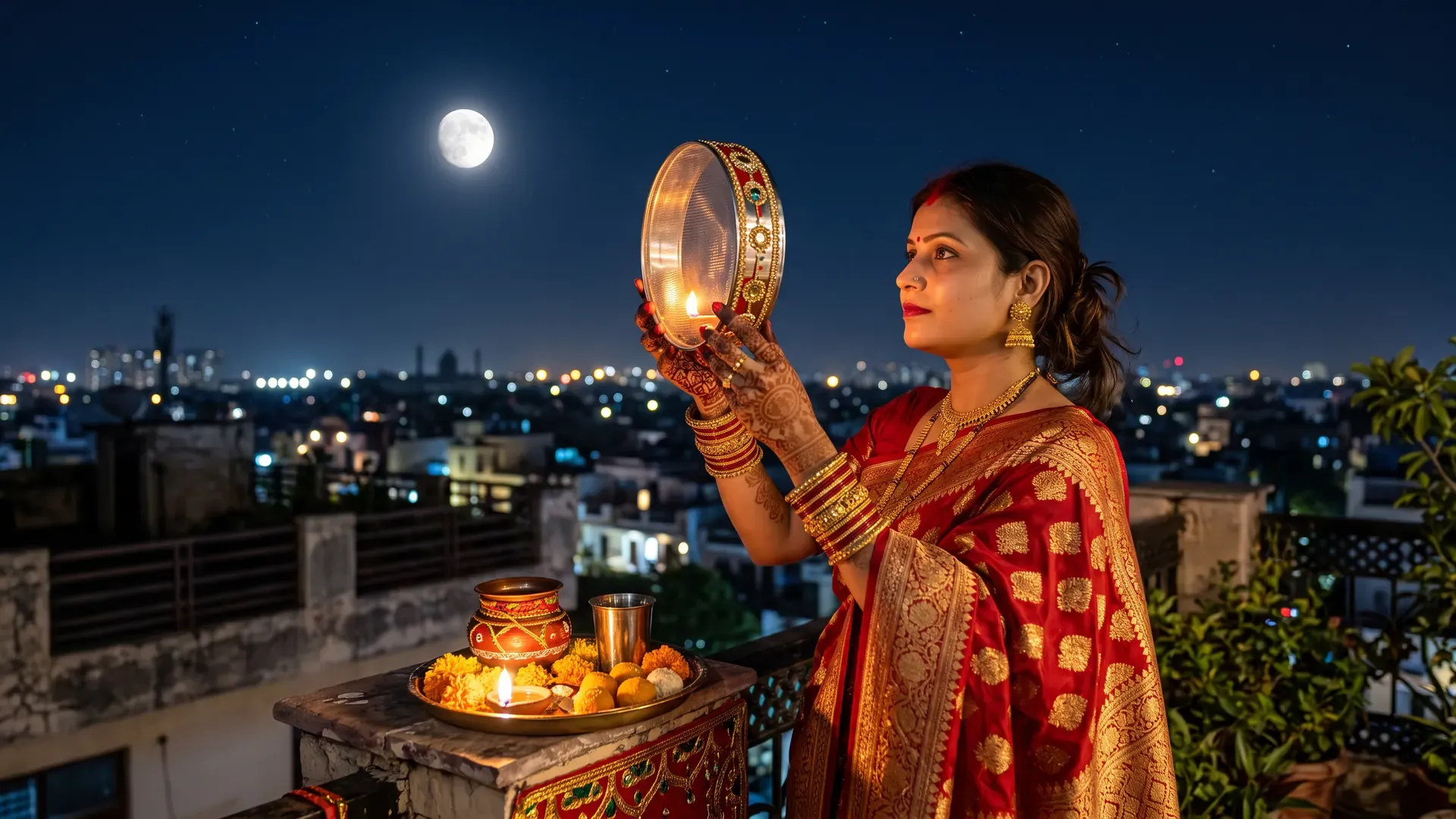
Karva Chauth 2026: Thursday, 29 October. Below are 10 verses to send with your Karva Chauth greetings, the first ‘नमः शिवायै शर्वाण्यै सौभाग्यं संततिं शुभाम्’ (Vrataraja of Vishvanatha, the Karaka Chaturthi vrata, where the passage is given under the name of the Vamana Purana: the verse for the worship of Gauri). Each verse has its source and a plain meaning in our own words; ‘Make a card’ puts the verse on a picture card with your name.
Make a Karva Chauth greeting card
Advertisement
1नमः शिवायै शर्वाण्यै सौभाग्यं संततिं शुभाम्
नमः शिवायै शर्वाण्यै सौभाग्यं संततिं शुभाम्।प्रयच्छ भक्तियुक्तानां नारीणां हरवल्लभे॥
Source: Vrataraja of Vishvanatha, the Karaka Chaturthi vrata, where the passage is given under the name of the Vamana Purana: the verse for the worship of Gauri
Meaning: O Shiva, O Sharvani, beloved of Shiva: grant good fortune and fine children to the women who worship you with devotion.
According to the Vrataraja, on the evening of Karva Chauth Gauri is drawn together with Shiva, Ganesha and Kartikeya and worshipped with this verse; the Gita Press Vrat-Parichay gives the same verse. The critical edition of the Vamana Purana (1967) notes that this passage is not found in the known manuscripts of that Purana, so we name the Vrataraja as its source.
2करकं क्षीरसम्पूर्णं तोयपूर्णमथापि वा
करकं क्षीरसम्पूर्णं तोयपूर्णमथापि वा।ददामि रत्नसंयुक्तं चिरं जीवतु मे पतिः॥
Source: Vrataraja of Vishvanatha, the Karaka Chaturthi vrata, where the passage is given under the name of the Vamana Purana, verses 39–40 of the katha (the verse for giving the karva)
Meaning: I give this karva, filled with milk or else with water, together with a jewel: may my husband live long.
The katha ends by saying that the karvas are given to a brahmin with this verse, and that karvas are given to married women and taken from them as well.
3नमः शिवाभ्यां नवयौवनाभ्यां
नमः शिवाभ्यां नवयौवनाभ्यांपरस्पराश्लिष्टवपुर्धराभ्याम्।नगेन्द्रकन्यावृषकेतनाभ्यांनमो नमः शङ्करपार्वतीभ्याम्॥
Source: Uma-Maheshvara Stotra, verse 1 (ascribed by tradition to Shri Shankaracharya)
Meaning: Salutations to the auspicious pair, ever young, their bodies joined to each other: the daughter of the king of mountains and the lord whose banner bears the bull. Again and again, salutations to Shankara and Parvati.
4स्तोत्रं त्रिसन्ध्यं शिवपार्वतीयं
स्तोत्रं त्रिसन्ध्यं शिवपार्वतीयंभक्त्या पठेद् द्वादशकं नरो यः।स सर्वसौभाग्यफलानि भुङ्क्तेशतायुरन्ते शिवलोकमेति॥
Source: Uma-Maheshvara Stotra, verse 13 (ascribed by tradition to Shri Shankaracharya), the closing verse on its fruit
Meaning: The hymn says: whoever reads these twelve verses to Shiva and Parvati with devotion at dawn, noon and dusk enjoys every fruit of good fortune, lives a hundred years and at the end reaches the world of Shiva.
Variant: sanskritdocuments.org reads ‘shivaparvatibhyam’ in the first line; Gita Press reads ‘shivaparvatiyam’.
5चाम्पेयगौरार्धशरीरकायै कर्पूरगौरार्धशरीरकाय
चाम्पेयगौरार्धशरीरकायै कर्पूरगौरार्धशरीरकाय।धम्मिल्लकायै च जटाधराय नमः शिवायै च नमः शिवाय॥
Source: Ardhanarishvara (Ardhanarinateshvara) Stotra, verse 1
Meaning: Half the body golden like the champak flower, half white like camphor; on one side braided hair, on the other matted locks. Salutations to Shiva the goddess, and salutations to Shiva.
sanskritdocuments.org ascribes this hymn to Shri Shankaracharya; the Gita Press Shiv Stotra Ratnakar names no author.
6एतत्पठेदष्टकमिष्टदं यो भक्त्या स मान्यो भुवि दीर्घजीवी
एतत्पठेदष्टकमिष्टदं यो भक्त्या स मान्यो भुवि दीर्घजीवी।प्राप्नोति सौभाग्यमनन्तकालं भूयात्सदा तस्य समस्तसिद्धिः॥
Source: Ardhanarishvara (Ardhanarinateshvara) Stotra, verse 9, the closing verse on its fruit
Meaning: The hymn says: whoever reads these eight wish-granting verses with devotion is honoured in the world and lives long; he gains good fortune for endless time, and may every success be always his.
7वागर्थाविव संपृक्तौ वागर्थप्रतिपत्तये
वागर्थाविव संपृक्तौ वागर्थप्रतिपत्तये।जगतः पितरौ वन्दे पार्वतीपरमेश्वरौ॥
Source: Raghuvamsha (the poet Kalidasa), canto 1, verse 1 (the opening invocation)
Meaning: To Parvati and Parameshvara, the mother and father of the world, joined as a word is joined to its meaning, I bow, that I may rightly grasp word and meaning.
Mallinatha’s commentary explains ‘pitarau’ as ‘mother and father’; the unbreakable bond of Shiva and Parvati is told here through the likeness of a word and its meaning.
8जय जय गिरिबरराज किसोरी। जय महेस मुख चंद चकोरी
जय जय गिरिबरराज किसोरी। जय महेस मुख चंद चकोरी॥जय गजबदन षडानन माता। जगत जननि दामिनि दुति गाता॥
Source: Shri Ramcharitmanas (Goswami Tulsidas), Bal Kand, the third chaupai after doha 234
Meaning: Victory, victory to you, daughter of the king of mountains; victory to you who gaze on Shiva’s moon-like face as the chakori bird gazes on the moon. Victory to the mother of Ganesha and of six-faced Kartikeya, mother of the world, whose body shines like lightning.
The garden scene at Janakpur: Sita goes to the temple of Gauri (Bhavani) and offers this praise.
Variant: The scanned Vijaya commentary (Vijayananda Tripathi) reads ‘girivararaj’ and ‘gajavadan’ (va for ba); the meaning is the same.
9पतिदेवता सुतीय महुँ मातु प्रथम तव रेख
पतिदेवता सुतीय महुँ मातु प्रथम तव रेख।महिमा अमित न सकहिं कहि सहस सारदा सेष॥
Source: Shri Ramcharitmanas (Goswami Tulsidas), Bal Kand, doha 235
Meaning: O Mother, among good women who hold their husband as their god, your name is written first. Your boundless glory could not be told even by a thousand Sarasvatis and Sheshas.
From the same prayer of Sita to Gauri.
10सेवत तोहि सुलभ फल चारी। बरदायनी पुरारि पिआरी
सेवत तोहि सुलभ फल चारी। बरदायनी पुरारि पिआरी॥देबि पूजि पद कमल तुम्हारे। सुर नर मुनि सब होहिं सुखारे॥
Source: Shri Ramcharitmanas (Goswami Tulsidas), Bal Kand, the first chaupai after doha 235
Meaning: O giver of boons, beloved of Shiva, the foe of Tripura: by serving you the four aims of life come easily. O Devi, by worshipping your lotus feet gods, men and sages all find happiness.
Advertisement
About these verses
Every text was checked word by word in at least two separate editions. Where the editions differ, the ‘Variant’ line says so. Verse numbers are those of the edition named in the source; other editions may number a little differently. The meanings are our own, in plain words.
Frequently asked questions
What is the Karva Chauth puja verse?
The Vrataraja gives this verse for the worship of Gauri on Karaka Chaturthi (Karva Chauth): ‘namaḥ śivāyai śarvāṇyai saubhāgyaṃ santatiṃ śubhām, prayaccha bhaktiyuktānāṃ nārīṇāṃ haravallabhe’; the Gita Press Vrat-Parichay gives it too. The meaning and source are above.
Which verse is said when giving the karva?
At the end of the katha in the Vrataraja: ‘karakaṃ kṣīrasampūrṇaṃ toyapūrṇam athāpi vā, dadāmi ratnasaṃyuktaṃ ciraṃ jīvatu me patiḥ’: I give this karva filled with milk or water; may my husband live long.
When is Karva Chauth 2026, and when does the moon rise?
Karva Chauth is on Thursday, 29 October 2026. In New Delhi the puja muhurat is 5:39 PM to 6:56 PM and the moon rises at 8:17 PM; see your city’s times on the Karva Chauth page, or when you make a card.
Sources
- Vrataraja of Vishvanatha, Khemraj Shrikrishnadas, Mumbai 1897; Vamana Purana, critical edition (ed. A. S. Gupta, All-India Kashiraj Trust 1967), appendix; Gita Press: Vrat-Parichay (archive.org)
- Gita Press: Shiv Stotra Ratnakar (Uma-Maheshvara Stotra, Ardhanarinateshvara Stotra), and sanskritdocuments.org: umamaheshvara, ardhanAri
- Raghuvamsha with Mallinatha’s Sanjivini (ed. Kashinath Pandurang Parab, Nirnaya Sagar Press), and sanskritdocuments.org: raghuvansha1
- Gita Press: Shri Ramcharitmanas, and the Vijaya commentary of Vijayananda Tripathi (archive.org)
Something wrong? Report a mistake