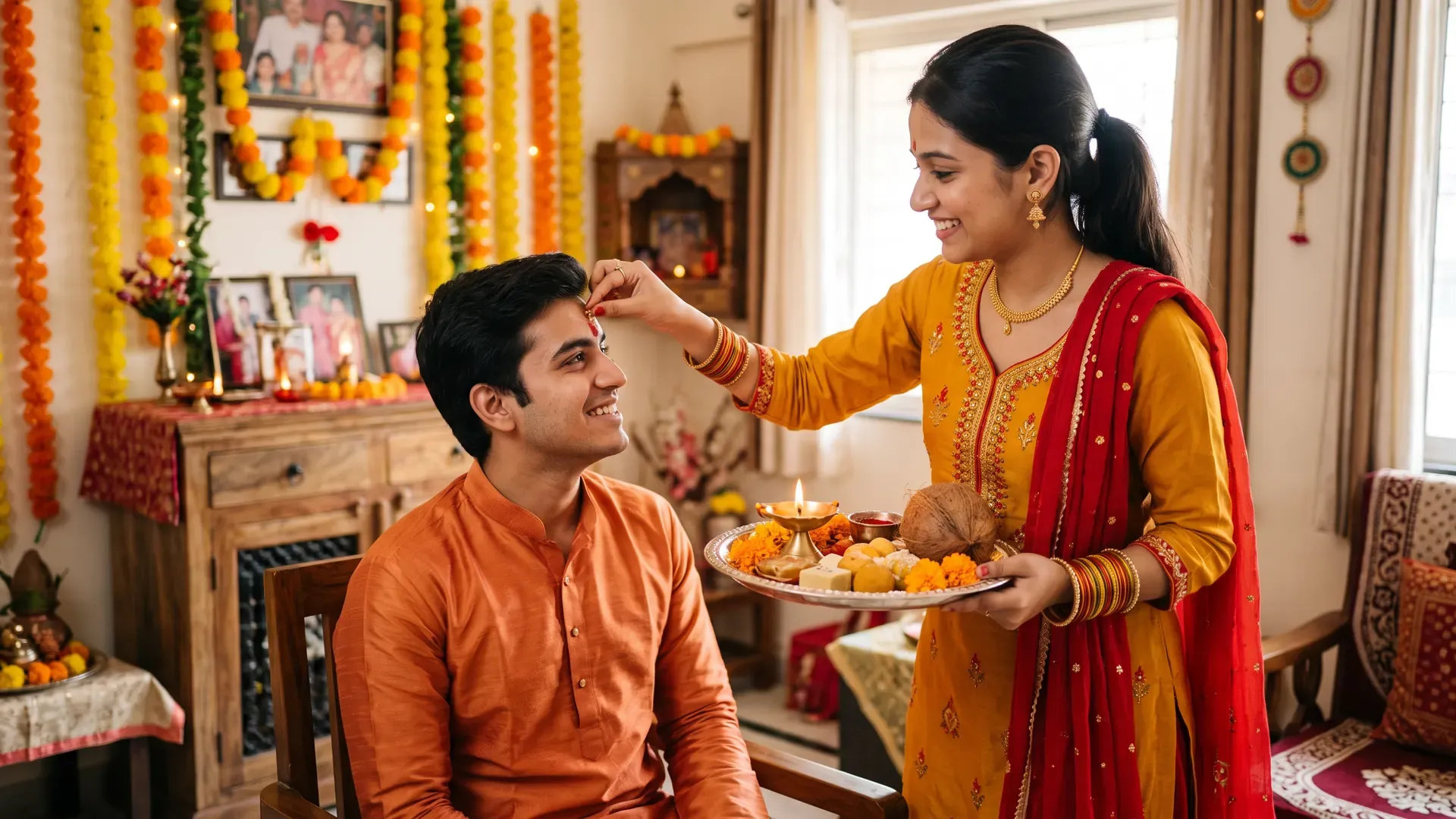
Bhai Dooj 2026 is on Wednesday, 11 November (tilak muhurat (Aparahna) in New Delhi: 1:10–3:20 PM), because the tilak is applied in the Aparahna while Dwitiya lasts; the whole Aparahna of 11 November falls in Dwitiya, while on 10 November Dwitiya begins only at 2:01 PM, in the middle of the Aparahna. It falls on Kartik Shukla Dwitiya, the last day of the five-day Deepotsav, and is also called Yama Dwitiya. The Holi Bhai Dooj, kept after Holi, is a different festival; the next one is on Wednesday, 24 March 2027. Sisters apply a tilak to their brothers, pray for their long life and feed them a meal. By tradition, the tilak is applied in the Aparahna Kaal; see the time for your city below.
Diwali week 2026:Rama Ekadashi Thursday 5 November Dhanteras Friday 6 November Kali Chaudas (night) Saturday 7 November Narak Chaturdashi and Diwali Sunday 8 November Govardhan Puja Tuesday 10 November Bhai Dooj Wednesday 11 November. Full table with times Diwali rangoli designs
Each morning the tithi, Rahu Kaal and coming festivals, in one short WhatsApp message.Follow the channel
Diwali week 2026, the 5-day schedule: Dhanteras 6 November to Bhai Dooj 11 November
| Date | Festival | Time (New Delhi) |
|---|---|---|
| 6 November Friday | Dhanteras and Yama Deepdaan, after sunset | 6:03–7:58 PM Puja muhurat |
| 7 November Saturday, night | Kali Chaudas | 11:39 PM–12:31 AM Nishita Kaal |
| 8 November Sunday, dawn | Narak Chaturdashi (Chhoti Diwali) | 5:41–6:38 AM Abhyang Snan |
| 8 November Sunday, evening | Diwali (Lakshmi Puja) | 5:55–7:51 PM Lakshmi Puja muhurat |
| 10 November Tuesday | Govardhan Puja (Annakut) | 6:40–8:50 AM Pratahkala |
| 11 November Wednesday | Bhai Dooj (Yama Dwitiya) | 1:10–3:20 PM Tilak (Aparahna) |
| After Diwali | ||
| 15 November Sunday, evening | Chhath Puja: Sandhya Arghya | 5:28 PM Sunset |
| 16 November Monday, dawn | Chhath Puja: Usha Arghya | 6:44 AM Sunrise |
Times for New Delhi, by our calculation (checked against Drik Panchang); your city’s time is on each festival’s page. Amavasya lasts until 12:33 PM on 9 November, so Govardhan Puja is on 10 November.
Getting ready: Diwali rangoli designs 2026: 17 easy designs from dots
At a glance
- Tithi
- Kartik Shukla Dwitiya
- Also called
- Yama Dwitiya, Bhratri Dwitiya, Bhau Beej, Bhai Phonta, Bhai Tika
- Tilak time
- Aparahna Kaal, while Dwitiya tithi lasts
- Main rites
- The sister’s tilak, aarti and meal for her brother
- Story
- Yama eats a meal at the home of his sister Yamuna
- On the same day
- Chitragupta Puja (Kayastha tradition), bath in the Yamuna at Mathura
- Deepotsav
- Last day of the five-day festival
One festival, many names
Among the children of Surya, Yama and Yami are brother and sister, and in tradition Yami is regarded as the river Yamuna. This is why one name of Kartik Shukla Dwitiya is Yama Dwitiya. This festival of love between brothers and sisters is celebrated under different names across India and Nepal.
North India: Bhai Dooj, Bhaiya Dooj
Sisters apply a tilak of roli and akshat to their brothers, perform aarti and feed them a meal; the brother gives his sister a gift.
Folk traditionMaharashtra and Gujarat: Bhau Beej, Bhai Bij
"Beej" is the name for the Dwitiya tithi. Sisters perform aarti for their brothers and feed them a meal.
Folk traditionBengal: Bhai Phonta
Sisters put a phonta (tilak) on their brothers’ foreheads and, in a folk rhyme, wish for thorns to fall at Yama’s door, meaning that death should not threaten the brother.
Folk traditionNepal: Bhai Tika
The fifth and last day of the Tihar festival. Sisters put a coloured tika on their brothers and pray for their long life.
Folk traditionWhy the tilak is done in the Aparahna
In Hindu timekeeping, the day from sunrise to sunset has five parts; the fourth is called Aparahna. Popular panchangs keep Bhai Dooj on the day when Dwitiya tithi prevails during the Aparahna Kaal, and they also give this Aparahna Kaal as the time for the tilak and the meal. Even so, many families do the tilak in the morning; follow your own family tradition.
Chitragupta Puja and the bath in the Yamuna
Chitragupta Puja
In tradition, Chitragupta keeps the record of the deeds of all beings in Yama’s court. On Yama Dwitiya, the Kayastha community worships Chitragupta, and the pen and inkpot are also worshipped.
Kayastha traditionBath in the Yamuna at Mathura
On this day, brothers and sisters bathe together in the Yamuna at Vishram Ghat in Mathura. It is believed that bathing in the Yamuna on Yama Dwitiya removes the fear of Yama.
Folk traditionHow to perform the puja
- Step 1
Preparing the thali
The sister prepares the puja thali: roli or kumkum, akshat, a lamp, sweets and kalava (sacred thread); in many regions, a dried coconut (gola) as well.
- Step 2
A seat for the brother
Seat the brother on an asana or a low stool; in many families, a chowk (a square pattern) is drawn with flour or rice.
- Step 3
Tilak and aarti
In the Aparahna Kaal, apply a tilak of roli and akshat on the brother’s forehead, tie the kalava and perform aarti with the lamp.
- Step 4
The meal
Feed the brother sweets with your own hand and serve him a meal; according to the story, the meal at the sister’s home is the main rite of this festival.
- Step 5
Gifts
The brother gives his sister a gift, and both pray for each other’s happiness and long life.
Yama at Yamuna’s home
According to the popular story, Yamuna, the daughter of Surya, loved her brother Yama dearly and kept inviting him to her home for a meal. Busy with his duties, Yama kept putting it off. At last, on Kartik Shukla Dwitiya, he arrived at Yamuna’s home. Yamuna welcomed him, applied a tilak and lovingly served him a meal. Pleased, Yama asked her to choose a boon. Yamuna asked that any brother who goes to his sister’s home on this day and accepts her hospitality should have no fear of Yama. Yama granted the boon; this is why the day came to be called Yama Dwitiya. The story is told in many versions.
Folk vrat kathaRead the full kathaBhai Dooj: relations
See in the knowledge graphDeities, figures and sages 3
- Yama · Deity worshippedFolk tradition
- Yamuna · Deity worshippedFolk tradition
- Chitragupta · Deity worshippedKayastha tradition
Festivals 1
- Diwali · Main festivalTradition
Frequently asked questions
When is Bhai Dooj 2026 (Bhai Phota, Bhau Beej), and on which day and date?
Wednesday, 11 November 2026. Dwitiya tithi runs from 2:01 PM on 10 November to 3:55 PM on 11 November. The tilak muhurat (Aparahna) in New Delhi is 1:10–3:20 PM. The same festival is called Bhau Beej in Maharashtra and Gujarat and Bhai Phota in Bengal (folk tradition). For your city, choose it in the box above.
Is Bhai Dooj on 10 November or 11 November?
On 11 November (Wednesday); Drik Panchang gives the same day. Dwitiya tithi runs from 2:01 PM on 10 November to 3:55 PM on 11 November. The tilak is applied in the Aparahna while Dwitiya lasts: the whole Aparahna of 11 November (1:10–3:20 PM in New Delhi) falls in Dwitiya, while on 10 November Dwitiya begins at 2:01 PM, in the middle of the Aparahna, and only 79 minutes of that day’s Aparahna have it. 10 November is also asked about because Dwitiya begins that day, but the full Aparahna for the tilak is on 11 November.
Bhai Dooj 2026: how is the Diwali Bhai Dooj different from the Holi Bhai Dooj?
The Diwali Bhai Dooj falls on Kartik Shukla Dwitiya, the fifth day of the Deepotsav; it is also called Yama Dwitiya, and in 2026 it is on Wednesday, 11 November. The Holi Bhai Dooj is kept in some regions after Holi, on Chaitra Krishna Dwitiya; according to Drik Panchang, treatises such as the Dharma Sindhu, Nirnaya Sindhu and Vratraj do not mention it. 2026’s Holi Bhai Dooj was on 5 March (Thursday) and the next is on Wednesday, 24 March 2027 (Drik Panchang, New Delhi). The tilak times on this page are for the Diwali Bhai Dooj.
When is Bhai Phonta (Bhai Phota) 2026 (bhai phota kab hai)?
Wednesday, 11 November 2026, the same day as Bhai Dooj: Bhai Phonta is Bengal’s Bhai Dooj, on Kartik Shukla Dwitiya. Drik Panchang gives the same day for Bhai Dooj in Kolkata too. In Kolkata the Aparahna tilak muhurat is 12:27–2:41 PM and Dwitiya tithi runs from 2:01 PM on 10 November to 3:55 PM on 11 November. The time in a home can vary with the family’s custom.
What is the auspicious time for the Bhai Dooj tilak on 11 November?
Traditionally the Aparahna Kaal, while Dwitiya tithi is running. On Wednesday, 11 November 2026: New Delhi 1:10–3:20 PM, Lucknow 12:56–3:07 PM, Jaipur 1:16–3:27 PM, Patna 12:39–2:51 PM, Chandigarh 1:11–3:19 PM, Indore 1:17–3:31 PM, Mumbai 1:30–3:46 PM, Kolkata 12:27–2:41 PM, Bengaluru 1:13–3:32 PM. For your city, choose it in the box above.
Why is Bhai Dooj called Yama Dwitiya?
According to the story, on this tithi Yama went to the home of his sister Yamuna for a meal and granted her a boon.
What is the difference between Bhai Dooj and Raksha Bandhan?
Raksha Bandhan falls on Shravan Purnima, when a sister ties a rakhi on her brother’s wrist. Bhai Dooj falls on Kartik Shukla Dwitiya, when a sister applies a tilak to her brother and feeds him a meal.
Why is Chitragupta worshipped on Bhai Dooj?
In tradition, Chitragupta keeps the record of deeds in Yama’s court, so he is worshipped on Yama Dwitiya, especially by the Kayastha community.
Diwali week 2026: when are the five days of Diwali?
Dhanteras on 6 November (Friday), the Narak Chaturdashi abhyang snan at dawn and Diwali in the evening of 8 November (Sunday), Govardhan Puja on 10 November (Tuesday) and Bhai Dooj on 11 November (Wednesday). The Kali Chaudas night puja is on 7 November (Drik Panchang).
Sources
- Vishnu Purana, Book 3, Chapter 2 (the children of Surya: Manu, Yama and Yami)
- Folk tradition and the Yama Dwitiya vrat katha
- Kayastha tradition (Chitragupta Puja)
- Muhurat and moonrise: SanatanBodh panchang calculation, checked against Drik Panchang (New Delhi, 2026–27)
- Drik Panchang, Bhai Dooj, New Delhi 2026 (read on 27 October 2026): Wednesday 11 November, Aparahna tilak time, Dwitiya start and end
Something wrong? Report a mistake
