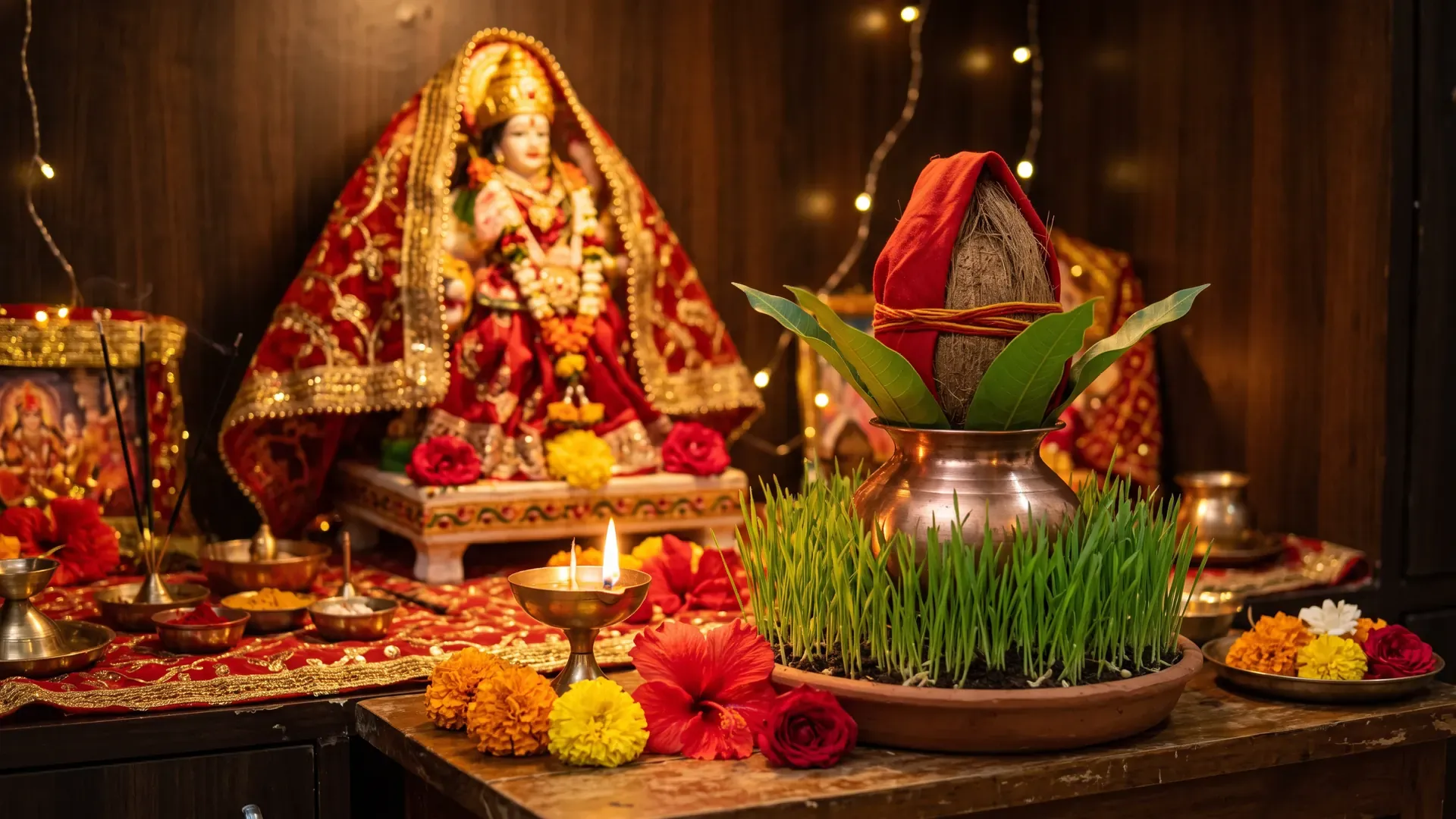
Sharad Navratri 2026: 11 to 19 October. Below are 13 verses to send with your Navratri greetings, the first ‘सर्वमङ्गलमाङ्गल्ये शिवे सर्वार्थसाधिके’ (Durga Saptashati (Markandeya Purana), chapter 11, the Narayani Stuti, verse 10). Each verse has its source and a plain meaning in our own words; ‘Make a card’ puts the verse on a picture card with your name.
1सर्वमङ्गलमाङ्गल्ये शिवे सर्वार्थसाधिके
सर्वमङ्गलमाङ्गल्ये शिवे सर्वार्थसाधिके।शरण्ये त्र्यम्बके गौरि नारायणि नमोऽस्तु ते॥
Source: Durga Saptashati (Markandeya Purana), chapter 11, the Narayani Stuti, verse 10
Meaning: O Narayani, you are the good in all that is good, Shiva the kindly one, who brings every right aim to fulfilment. You are the refuge, the three-eyed Gauri; salutations to you.
2सृष्टिस्थितिविनाशानां शक्तिभूते सनातनि
सृष्टिस्थितिविनाशानां शक्तिभूते सनातनि।गुणाश्रये गुणमये नारायणि नमोऽस्तु ते॥
Source: Durga Saptashati (Markandeya Purana), chapter 11, the Narayani Stuti, verse 11
Meaning: O eternal Narayani, you are the power that creates, sustains and dissolves. The three gunas rest on you and you are made of them; salutations to you.
4सर्वस्वरूपे सर्वेशे सर्वशक्तिसमन्विते
सर्वस्वरूपे सर्वेशे सर्वशक्तिसमन्विते।भयेभ्यस्त्राहि नो देवि दुर्गे देवि नमोऽस्तु ते॥
Source: Durga Saptashati (Markandeya Purana), chapter 11, the Narayani Stuti, verse 24
Meaning: You are in every form, the ruler of all, holding every power. O Devi Durga, protect us from fear; salutations to you.
5रोगानशेषानपहंसि तुष्टा
रोगानशेषानपहंसि तुष्टारुष्टा तु कामान् सकलानभीष्टान्।त्वामाश्रितानां न विपन्नराणांत्वामाश्रिता ह्याश्रयतां प्रयान्ति॥
Source: Durga Saptashati (Markandeya Purana), chapter 11, the Narayani Stuti, verse 29
Meaning: The gods’ hymn says: pleased, you remove every illness; displeased, you take away all that is wished for. Those who rest in you meet no calamity, and those who rest in you become a shelter for others.
6सर्वाबाधाप्रशमनं त्रैलोक्यस्याखिलेश्वरि
सर्वाबाधाप्रशमनं त्रैलोक्यस्याखिलेश्वरि।एवमेव त्वया कार्यमस्मद्वैरिविनाशनम्॥
Source: Durga Saptashati (Markandeya Purana), chapter 11, the Narayani Stuti, verse 39
Meaning: O ruler of all, keep calming every trouble of the three worlds in this way, and keep destroying our foes. (This is the gods’ prayer; tradition also reads the foes as the ones within, such as desire and anger.)
Variant: A Gita Press footnote also gives the reading ‘sarvabādhā’.
7दुर्गे स्मृता हरसि भीतिमशेषजन्तोः
दुर्गे स्मृता हरसि भीतिमशेषजन्तोःस्वस्थैः स्मृता मतिमतीव शुभां ददासि।दारिद्र्यदुःखभयहारिणि का त्वदन्यासर्वोपकारकरणाय सदार्द्रचित्ता॥
Source: Durga Saptashati, chapter 4 (the hymn of Indra and the gods), verse 17
Meaning: O Durga, remembered, you take away the fear of every being; remembered by the calm, you give a mind most good. Remover of poverty, sorrow and fear, who but you has a heart always soft with kindness to help all?
8या देवी सर्वभूतेषु शक्तिरूपेण संस्थिता
या देवी सर्वभूतेषु शक्तिरूपेण संस्थिता।नमस्तस्यै नमस्तस्यै नमस्तस्यै नमो नमः॥
Source: Durga Saptashati, chapter 5 (the Aparajita Stuti), verses 32–34
Meaning: To the Devi who dwells in all beings as power: salutations, salutations, salutations again and again.
In this hymn the same line returns with twenty-one forms: consciousness, intellect, peace, Lakshmi, mother and others.
9या देवी सर्वभूतेषु मातृरूपेण संस्थिता
या देवी सर्वभूतेषु मातृरूपेण संस्थिता।नमस्तस्यै नमस्तस्यै नमस्तस्यै नमो नमः॥
Source: Durga Saptashati, chapter 5 (the Aparajita Stuti), verses 71–73
Meaning: To the Devi who dwells in all beings as mother: salutations, salutations, salutations again and again.
10या देवी सर्वभूतेषु शान्तिरूपेण संस्थिता
या देवी सर्वभूतेषु शान्तिरूपेण संस्थिता।नमस्तस्यै नमस्तस्यै नमस्तस्यै नमो नमः॥
Source: Durga Saptashati, chapter 5 (the Aparajita Stuti), verses 47–49
Meaning: To the Devi who dwells in all beings as peace: salutations, salutations, salutations again and again.
11जयन्ती मङ्गला काली भद्रकाली कपालिनी
जयन्ती मङ्गला काली भद्रकाली कपालिनी।दुर्गा क्षमा शिवा धात्री स्वाहा स्वधा नमोऽस्तु ते॥
Source: Argala Stotra (read before the Durga Saptashati), first verse
Meaning: Jayanti (victorious over all), Mangala, Kali, Bhadrakali, Kapalini, Durga, Kshama, Shiva, Dhatri (who upholds all), Svaha and Svadha: Devi of these names, salutations to you.
Variant: The sanskritdocuments.org text reads ‘durgā śivā kṣamā dhātrī’ (the names in another order) and counts it as the second verse. We follow Gita Press.
12देहि सौभाग्यमारोग्यं देहि मे परमं सुखम्
देहि सौभाग्यमारोग्यं देहि मे परमं सुखम्।रूपं देहि जयं देहि यशो देहि द्विषो जहि॥
Source: Argala Stotra (read before the Durga Saptashati), verse 12
Meaning: Give me good fortune and health, give me the highest happiness. Give beauty, give victory, give renown, and drive away the foes. (The Gita Press translation reads the foes as desire, anger and the like.)
Variant: The sanskritdocuments.org text reads ‘dehi devi paraṃ sukham’ and counts it as verse 13.
About these verses
Every text was checked word by word in at least two separate editions. Where the editions differ, the ‘Variant’ line says so. Verse numbers are those of the edition named in the source; other editions may number a little differently. The meanings are our own, in plain words.
Frequently asked questions
Which Sanskrit verse can I send for Navratri?
The most sent is ‘sarvamaṅgalamāṅgalye śive sarvārthasādhike’. It is the tenth verse of the Narayani Stuti in chapter 11 of the Durga Saptashati, which calls the Devi the good in all that is good.
Where is ‘yā devī sarvabhūteṣu’ from?
From the gods’ hymn (the Aparajita Stuti) in chapter 5 of the Durga Saptashati. The same line comes with twenty-one forms such as consciousness, intellect, power, peace and mother.
When is Navratri 2026?
Sharad Navratri runs from Sunday, 11 October to 19 October; Dussehra is on 20 October. See the Navratri page for the Ghatasthapana muhurat in your city.
Sources
- Gita Press, Gorakhpur: Shri Durga Saptashati with Hindi translation (archive.org: shri-durga-saptashati-hindi)
- sanskritdocuments.org: Devi Mahatmyam / Durga Saptashati (durga700) and the Argala Stotra (argalaastotra)
- Devi Kavach: the checks of our Durga Kavach page (Gita Press, sanskritdocuments.org, Wikisource)
Something wrong? Report a mistake