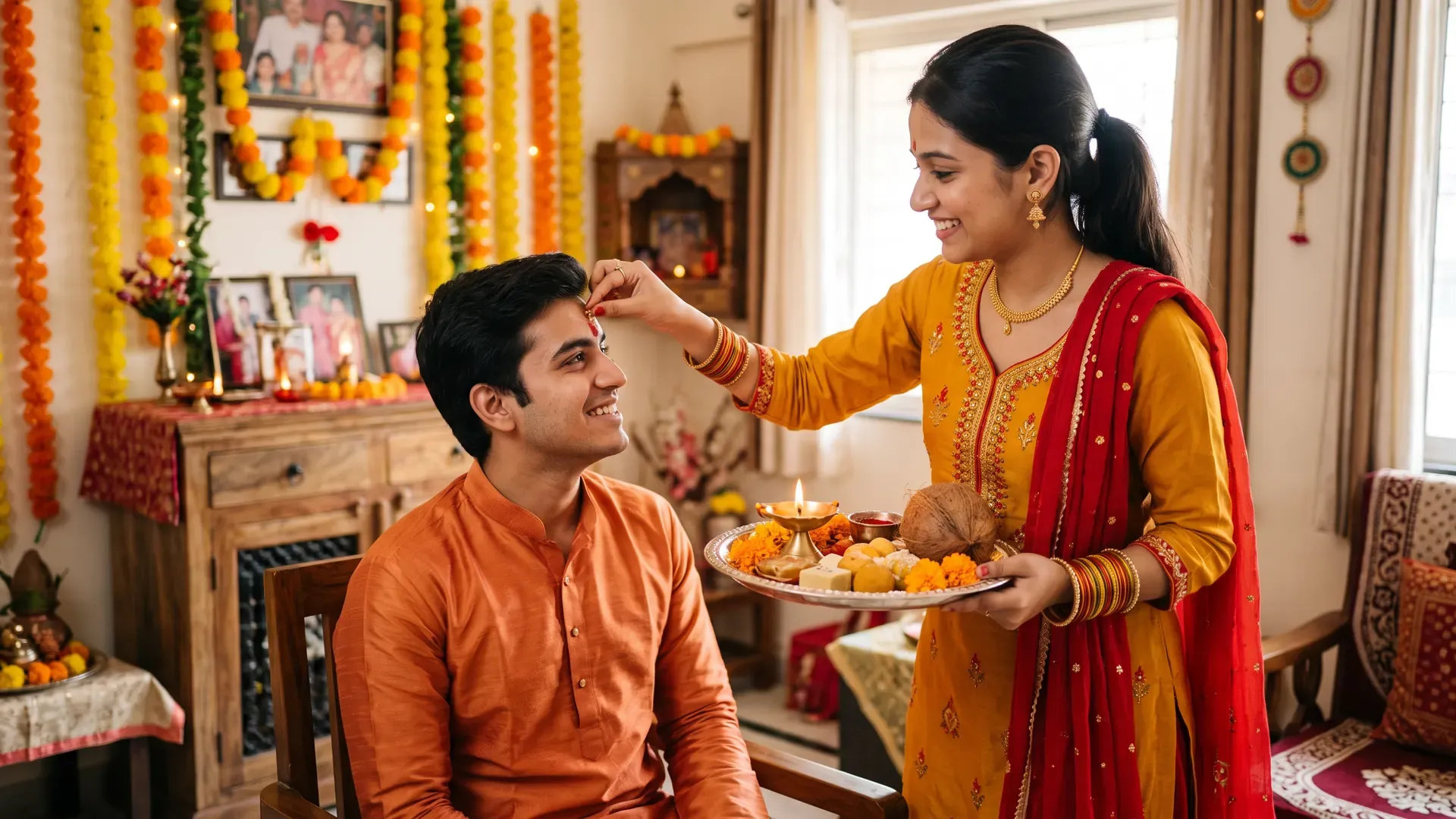
Bhai Dooj is on Wednesday, 11 November 2026. The tilak and the meal are by tradition in the Aparahna; in New Delhi the Aparahna muhurat is 1:10–3:20 PM and the Dwitiya tithi 2:01 PM (10 Nov) to 3:55 PM. The order: the sister lays the thali, seats her brother and applies the tilak, waves the aarti, and gives him sweets and a meal; the brother gives a gift. In the evening a four-wick lamp outside the house in Yamaraja’s name. Below are the steps, the thali list and the gist of the katha.
New Delhi: Tilak muhurat, 11 November
- Aparahna muhuratFourth fifth of the day
- 1:10–3:20 PM
- Dwitiya tithi
- 2:01 PM (10 Nov) to 3:55 PM
In Indian Standard Time, SanatanBodh panchang calculation, checked against Drik Panchang. Muhurat for your city
At a glance: the order of the day
- Morning: both brother and sister bathe; by Drik Panchang a bath in the Yamuna if possible, otherwise an oil bath at home.
- Afternoon, Aparahna muhurat 1:10–3:20 PM: the tilak, aarti, sweets and meal. Gita Press and Drik Panchang both prefer the Aparahna.
- The brother goes to his sister’s house and eats from her hand (Drik Panchang, Gita Press); he gives her clothes, money or a gift.
- Evening: before lighting the lights of the house, a four-wick lamp outside the house in Yamaraja’s name (Drik Panchang; Navbharat Live: facing south).
Dwitiya tithi: 2:01 PM (10 Nov) to 3:55 PM. The tilak is done in the Aparahna, so the day on which Dwitiya covers the whole Aparahna is the day taken; any doubt about the date is answered in the FAQ below.
The order of the tilak, step by step
This is the traditional order; the steps differ a little by home and region, and each step names its source.
- Seat: the sister seats her brother on a clean seat (Gita Press). Navbharat Live: on a chowk drawn with rice paste, the brother facing east or north.
- Washing and worship: the sister has his hands and feet washed and worships him with sandal and the like (Gita Press).
- Tilak: on the forehead roli (or sindoor), sandal and akshat (Navbharat Live, Aaj Tak; Drik Panchang: the kalava on the wrist after the tilak).
- Aarti: the sister waves the aarti (Drik Panchang, Aaj Tak, Navbharat Live).
- Sweets and coconut: she sweetens his mouth and gives him a coconut (Aaj Tak, Navbharat Live).
- The meal: good dishes as one can afford, such as dal, rice, phulka, kadhi, sira, puri, churma or laddu, jalebi, ghevar (Gita Press). The verse below is said as the meal is served.
- The gift: the brother gives his sister grain, clothes, ornaments or money and receives her blessing (Gita Press). The Skanda and Padma Puranas speak of clothes and ornaments.
भ्रातस्तवानुजाताहं भुङ्क्ष्व भक्तमिदं शुभम्।प्रीतये यमराजस्य यमुनाया विशेषतः॥Bhraatastavaanujaataaham bhunkshva bhaktamidam shubham | Preetaye yamaraajasya yamunaayaa visheshatah ||
Custom / belief: This custom of the chowk, the roli-sandal tilak, the kalava, the coconut and the aarti comes from news sources and tradition; the Skanda Purana’s story does not name the tilak or the aarti. If the sister is elder, the brother touches her feet (Skanda Purana 11.24, Tagare’s translation).
The thali
The full list to tick off is lower on this page: for the tilak roli, akshat, sandal, kalava; for the thali flowers, betel leaf and supari, a coconut, sweets; and the lamp for the aarti.
Yama Dwitiya: worship of Yama, Yamuna and Chitragupta
When
- Gita Press: by Hemadri’s view this Dwitiya is best covering midday and mixed with the previous tithi; the Smarta view prefers the fifth part of the day; by Skanda’s word covering the Aparahna is better, and ‘this is right’. That is why the tilak is in the Aparahna.
- The Nirnaya Sindhu quotes, through Hemadri, a verse of the Skanda: on Kartik Shukla Dwitiya worship Yama in the Aparahna, after bathing in the Bhanuja (Yamuna).
The order of the worship (Gita Press, pp. 163–164)
- After the morning bath, the resolve: to worship Yama for his pleasure, and to worship the brother for his long life and one’s own good fortune.
- Worship Ganesha, then Yama, Chitragupta, the Yamadutas and Yamuna.
- Offer Yama arghya with water, flowers, sandal and akshat in a conch or copper vessel (mantra below).
एह्येहि मार्तण्डज पाशहस्त यमान्तकालोकधरामरेश।भ्रातृद्वितीयाकृतदेवपूजां गृहाण चार्घ्यं भगवन्नमोऽस्तु ते॥Ehyehi maartandaja paashahasta yamaantakaalokadharaamaresha | Bhraatridviteeyaakritadevapoojaam grihaana chaarghyam bhagavannamostu te ||
The lamp and the bath
- In the evening a four-wick lamp outside the house in Yamaraja’s name, before the lamps are lit indoors (Drik Panchang). Navbharat Live: facing south.
- The bath in the Yamuna: in the Skanda Purana (Kartika Mahatmya 11.52–53) Yama says that whoever bathes in the Yamuna this day, offers water to the forefathers and the gods and eats at his sister’s house will not see the gate of his realm. Drik Panchang too gives the Yamuna bath special importance.
Customs
- Pen and inkpot: by Gita Press business-minded Vaishyas worship the inkpot, pen and seal on this day, so it is also called ‘Kalamdan puja’.
- Chitragupta puja: in the Kayastha community Chitragupta is worshipped on this day (Hindi Wikipedia).
The katha in brief: Yama and Yamuna
After the Skanda Purana (Vaishnava Khanda, Kartika Masa Mahatmya, chapter 11); the Padma Purana (Uttara Khanda 122) states it briefly. The full katha is on its own page.
- Yamuna invited her brother Yama to a meal every day; every day he put it off with ‘not today, tomorrow’, since he was absorbed in his duty.
- One day, on Kartik Shukla Dwitiya, he came at her insistence, having first set free all the beings in hell.
- Yamuna anointed and bathed him, gave him clothes, ornaments, sandal and garlands, and fed him from vessels of gold. Yama in turn gave his sister clothes and ornaments.
- Yama asked her to choose a boon. Yamuna asked: come every year on this day, and let those who eat from their sister’s hand today be happy.
- Yama said whoever bathes in the Yamuna and eats at his sister’s house today will not see the gate of his realm. That is how the tithi came to be called Yama Dwitiya.
Custom / belief: Today’s tellings add Yamuna’s tilak and aarti; they are not in the Skanda Purana’s account. By the Vishnu Purana 3.2 the mother is Sanjna; some news articles say Chhaya.
If there is no sister
- Gita Press: if there is no sister of one’s own, eat at the house of the paternal uncle’s daughter, the maternal uncle’s daughter or a friend’s sister, whichever there is.
- Drik Panchang: in that case honour a maternal or paternal cousin or a friend’s sister with clothes and money.
- The Skanda Purana (11.62–65) goes further in order: an elder sister, the paternal uncle’s daughter, the mother’s sister, the maternal uncle’s daughter, a woman regarded as a sister, and finally a cow, a river or a forest. For one who cannot go, hearing the story is said to give the benefit (11.71–73).
Bhai Dooj, Bhau Beej and Bhai Phota
- By Drik Panchang the same day is also called Bhau Beej, Bhai Dooj, Bhatra Dwitiya, Bhai Dwitiya and Bhathru Dwithiya, and Yama Dwitiya.
- In Maharashtra and Gujarat it is called Bhau Beej and in Bengal Bhai Phota (folk tradition). We have not checked the Bengal rite or its timing against a Bengal panchang; the Aparahna time by city is on the main Bhai Dooj page.
- A ‘Holi Bhai Dooj’ is also kept after Holi, on Chaitra Krishna Dwitiya; this page is about the Kartik Bhai Dooj.
The Bhai Dooj tilak thali: what to put in it
By tradition; follow your family’s custom. What a sister’s thali usually holds. 9 items in all; tick them off as you shop.
sanatanbodh.in/en/festivals/bhai-dooj/vidhi/
For the tilak
To lay on the thali and offer
For the aarti
How homes and regions differ
- Some lists also have a silver coin, a flower garland, durva grass and a banana, and the custom of Bihar and Jharkhand has rice paste, honey, ghee and roasted makhana; each of these is in one source only, so it is not counted above. In many homes a chowk is drawn with rice paste for the brother to sit on (Navbharat Live).
- Keep a four-wick lamp aside for the evening: Drik Panchang and Navbharat Live both say to light it outside the house in Yamaraja’s name.
- Business families also worship the pen and inkpot on this day (Gita Press, ‘Kalamdan puja’); its items are separate.
Checked against these sources and written in our own words; only items named by at least two of them are listed: Drik Panchang: Bhai Dooj; Drik Panchang: About Bhai Dooj; Aaj Tak: Bhai Dooj 2024, tilak time and thali samagri; Navbharat Live: Bhai Dooj rules; Hindi Wikipedia: Bhai Dooj; Gita Press, Vrat-Parichay, pp. 163–165 (Yama Dwitiya)
Aartis and chalisas
Frequently asked questions
When is Bhai Dooj 2026, 10 November or 11 November?
On Wednesday, 11 November 2026; Drik Panchang gives the same day (read on 8 November 2026). Dwitiya tithi runs 2:01 PM (10 Nov) to 3:55 PM: it begins at 2:01 PM on 10 November, so only about 79 minutes of that day’s Aparahna (1:10–3:20 PM) have Dwitiya, while the whole Aparahna of 11 November (1:10–3:20 PM) has it. The tilak is done in the Aparahna, so Bhai Dooj is on 11 November.
What is the Bhai Dooj 2026 tilak muhurat?
Wednesday, 11 November 2026: the Aparahna muhurat is 1:10–3:20 PM in New Delhi (the fourth fifth of the day). Checked against Drik Panchang on 8 November 2026: Aparahna 1:10–3:20 PM, the same. Dwitiya tithi runs 2:01 PM (10 Nov) to 3:55 PM, so the muhurat lies wholly within Dwitiya. Other cities’ times are on the main Bhai Dooj page.
What goes in the Bhai Dooj thali?
Roli or sindoor, akshat, sandal, kalava, flowers, betel leaf and supari, a coconut, sweets and a lamp for the aarti. Keep a four-wick lamp aside for the evening. Every name on the list was seen in at least two sources; the full list is above.
How is the Bhai Dooj tilak applied, and in what order?
By tradition: the sister seats her brother on a seat (in many places a chowk of rice paste), has his hands and feet washed and worships him with sandal, applies the roli-sandal-akshat tilak on his forehead, ties the kalava, waves the aarti, gives him sweets and a coconut and feeds him; the brother gives a gift. This is custom; the order changes a little from home to home.
If one has no sister, who applies the tilak on Bhai Dooj?
By Gita Press and Drik Panchang eat at the house of a paternal or maternal uncle’s daughter or a friend’s sister and honour her with clothes or money. The Skanda Purana’s order goes on to a cow, a river or a forest.
What is Yama Dwitiya, and how does it relate to Bhai Dooj?
Yama Dwitiya is the same Kartik Shukla Dwitiya. By the Skanda Purana Yama came to his sister Yamuna’s house for a meal on this day, so it has this name and the custom of the brother eating at his sister’s house began. The worship of Yama, Chitragupta and Yamuna and a four-wick lamp in the evening are also in the tradition.
What is the difference between Bhai Dooj, Bhau Beej and Bhai Phota?
They are regional names of one festival: Bhai Dooj in North India, Bhau Beej in Maharashtra and Gujarat, Bhai Phota in Bengal (folk tradition). Drik Panchang names Bhau Beej as this day. We have not checked the timing of the Bengal rite against a Bengal panchang.
Sources
- Drik Panchang: Bhai Dooj (tilak time, New Delhi, 2026), About Bhai Dooj, Yama Dwitiya Vrat Katha
- Gita Press, Vrat-Parichay (Pt. Hanuman Sharma), pp. 163–165: Yama Dwitiya (the pen-and-ink worship, the worship of Yama, the sister’s welcome); archive.org/details/610-vrat-parichay
- Nirnaya Sindhu (Kamalakara Bhatta), second paricheda, p. 150: Yama Dwitiya, the verses of the Skanda and the Bhavishya, Yama’s arghya mantra and the sister’s verse (1927 edition, OCR)
- Skanda Purana, Vaishnava Khanda, Kartika Masa Mahatmya, chapter 11 ‘The Efficacy of Yamadvitiya’ (Tagare’s English translation, wisdomlib.org); Padma Purana, Uttara Khanda 122; Vishnu Purana 3.2 (the mother’s name)
- Aaj Tak (2 November 2024) and Navbharat Live: the Bhai Dooj thali and the rules of the tilak; Hindi Wikipedia: Bhai Dooj
- Muhurat: SanatanBodh panchang calculation, checked against Drik Panchang (New Delhi, 2026)
Something wrong? Report a mistake