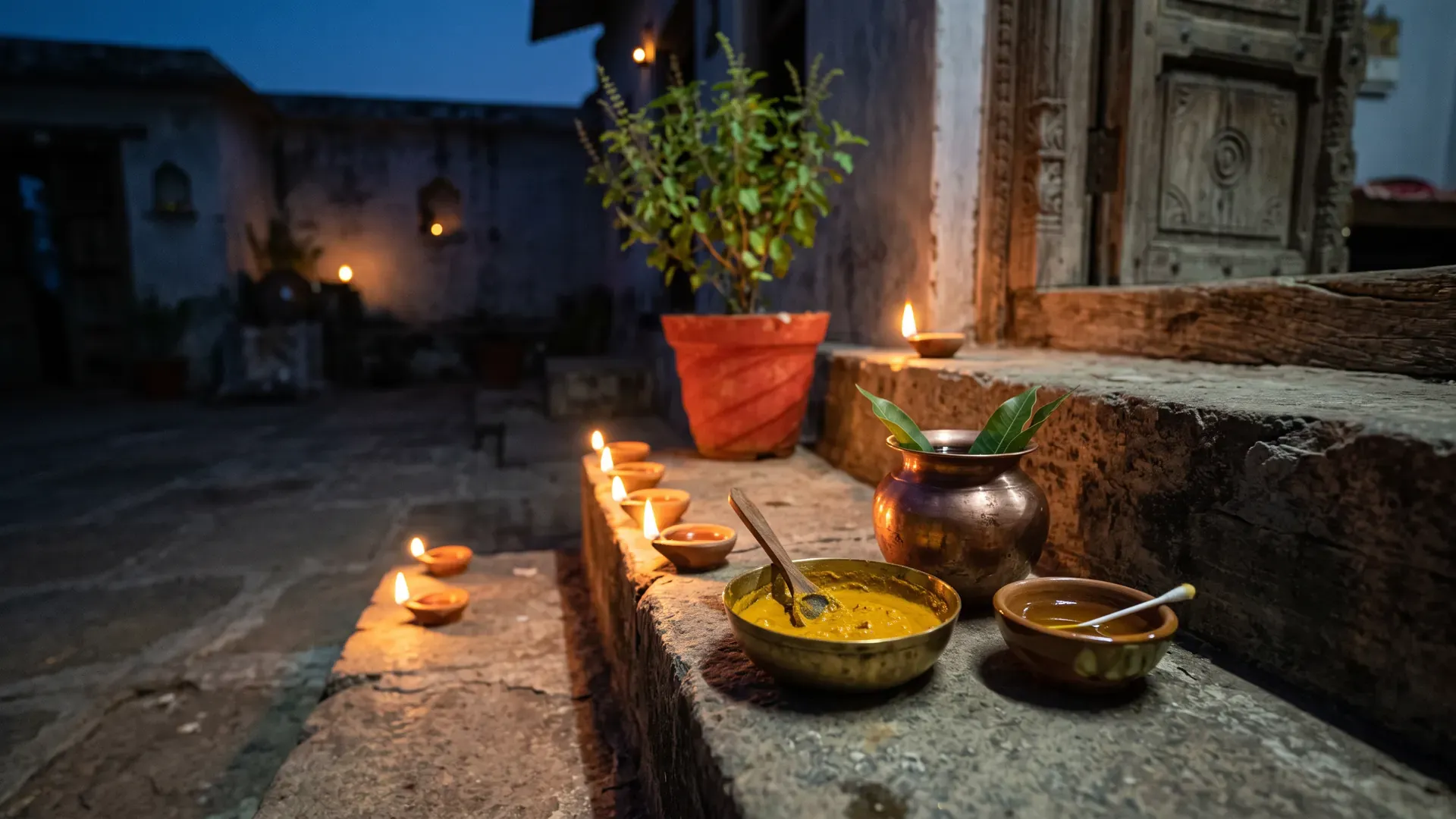
Naraka Chaturdashi (Choti Diwali) is on Sunday, 8 November 2026, and the abhyang snan muhurat in New Delhi is 5:41–6:38 AM: from moonrise 5:41 AM to sunrise 6:38 AM, while Chaturdashi lasts. The bath is taken after rubbing sesame oil and ubtan on the body, with apamarga moved round the head; then comes the tarpana with Yama’s fourteen names, and in the evening a four-wick lamp for Yama. Every part of the vidhi is below, with its custom and source named.
New Delhi: Abhyang Snan muhurat, 8 November
- Abhyang SnanMoonrise to sunrise, during Chaturdashi
- 5:41–6:38 AM
- Moonrise
- 5:41 AM
- Sunrise
- 6:38 AM
- Chaturdashi tithi
- 10:49 AM (7 Nov) to 11:29 AM
In Indian Standard Time, SanatanBodh panchang calculation, checked against Drik Panchang. Muhurat for your city
At a glance: from dawn to evening
- At dawn, 5:41–6:38 AM: after moonrise and before sunrise, while Chaturdashi is running.
- Oil and ubtan: sesame oil and ubtan on the body.
- Apamarga: move it over the head again and again during the bath.
- Yama tarpana: offer water with Yama’s fourteen names (Drik Panchang: after the bath).
- Worship: of the deity of your tradition, such as Krishna, Hanuman or Mahakali.
- In the evening, in Pradosh: a four-wick lamp for Yama outside the house, then lamps in the home.
Muhurat (New Delhi): abhyang snan 5:41–6:38 AM; Chaturdashi tithi 10:49 AM (7 Nov) to 11:29 AM. For other cities see the main Narak Chaturdashi page.
How the abhyang snan is done
Which day and when
- The day on which Chaturdashi is present at moonrise; at dawn, after brushing the teeth and the like (Gita Press, Vrat-Parichay p. 156).
- The muhurat is between moonrise and sunrise, while Chaturdashi lasts (Drik Panchang).
- If Chaturdashi is present at moonrise on two days, bathe in the fourth prahar of Chaturdashi (Gita Press).
Steps
- Sankalpa: by Gita Press, before the bath one resolves in the spirit ‘I shall take the abhyang bath, wishing not to have to see Yama’s world’. (The Sanskrit wording was found in one source only, so it is not printed here.)
- Rub sesame oil on the body; by Drik Panchang the ubtan too is made with sesame oil.
- Rub the body with ubtan.
- Bathe moving apamarga over the head again and again. By Gita Press a clod of earth turned up by the plough and a bottle gourd are moved too, with the apamarga; Drik Panchang names apamarga and ‘chakbak’.
- Yama tarpana: after the bath, offer water reciting Yama’s fourteen names three times each (below).
- Clean clothes and worship, as your tradition has it.
For those who keep the Kartik bath
- By Gita Press oil massage is forbidden in Kartik, but on the authority of a shastra verse there is no fault in the oil bath on Naraka Chaturdashi (Roop Chaturdashi).
Custom and belief
Custom / belief: It is believed that this bath removes the fear of Naraka (Drik Panchang, Gita Press). The name Roop Chaudas goes with the ubtan bath. This is a matter of faith; we promise no result.
By Drik Panchang the abhyang bath is advised on three days of Diwali (Chaturdashi, Amavasya and Pratipada), and the Chaturdashi bath is the most significant.
Yama tarpana
- Offer water reciting Yama’s fourteen names, each with ‘namah’, three times (Drik Panchang, Gita Press).
- Along with it three handfuls of water for Pitamaha Bhishma; this is for those whose fathers are alive too (Drik Panchang; Nirnaya Sindhu: ‘jivatpitapi kurvita tarpanam yamabhishmayoh’).
- By Gita Press: in the evening, facing south, with water, black and white sesame and kusha, by the devatirtha, the sacred thread worn like a necklace. Drik Panchang says after the bath. The two differ on the time; follow your family’s custom or ask your purohit.
यमाय नमः। धर्मराजाय नमः। मृत्यवे नमः।अन्तकाय नमः। वैवस्वताय नमः। कालाय नमः।सर्वभूतक्षयाय नमः। औदुम्बराय नमः। दध्नाय नमः।नीलाय नमः। परमेष्ठिने नमः। वृकोदराय नमः।चित्राय नमः। चित्रगुप्ताय नमः॥Yamaaya namah | dharmaraajaaya namah | mrityave namah | Antakaaya namah | vaivasvataaya namah | kaalaaya namah | Sarvabhootakshayaaya namah | audumbaraaya namah | dadhnaaya namah | Neelaaya namah | parameshthine namah | vrikodaraaya namah | Chitraaya namah | chitraguptaaya namah ||
The evening lamps
The lamp for Yama (Drik Panchang)
- In the evening light first, outside the house, a lamp of four wicks for Yama; the four wicks stand for dharma, artha, kama and moksha.
- Then light lamps in the cowshed, under sacred trees, in the kitchen, in the bathroom and the like.
- After the deepdaan, the daily puja.
दत्तो दीपश्चतुर्दश्यां नरकप्रीतये मया।चतुर्वर्तिसमायुक्तः सर्वपापापनुत्तये॥Datto deepashchaturdashyaam narakapreetaye mayaa | Chaturvartisamaayuktah sarvapaapaapanuttaye ||
Fourteen lamps (Gita Press, from the Krityachandrika)
- In Pradosh light fourteen lamps filled with sesame oil, and after worshipping them, with a resolve, place them in temples, gardens, stepwells, lanes, stables and other empty places as fits; Yamaraja is said to be pleased by them.
How it differs from the Dhanteras lamp
- The Yama deepdaan of Dhanteras (Trayodashi) is given facing south; by Gita Press the four-wick lamp of Chaturdashi is given facing east.
The story and the names (tradition)
- Story: by the Bhagavata Purana (10.59), Narakasura (Bhaumasura), king of Pragjyotishapura, had seized the earrings of Aditi, mother of the gods, and the umbrella of Varuna. Krishna went with Satyabhama, slew Mura and Narakasura and freed the captive princesses.
- The bath: Drik Panchang says the legends tell that after the slaying Krishna took an oil bath in Brahma muhurta, hence the weight given to this bath before sunrise. This is a tradition from legend, not a verse of the Bhagavata.
- Names: Choti Diwali, Roop Chaudas or Roop Chaturdashi, Narak Chaudas (North India); in Maharashtra the day is also known as Abhyang Snan; in Tamil Nadu and Karnataka this morning is kept as Deepavali (Drik Panchang).
- Kali Chaudas (Gujarat) is a separate festival, held on the day Chaturdashi covers midnight (Mahanisha); so it can fall one day before Naraka Chaturdashi (Drik Panchang).
- Hanuman’s birth: Gita Press’s Vrat-Parichay also names this day (Krishna Chaturdashi of Ashvin in the amanta reckoning) for the Hanuman birth festival; the same book also gives Chaitra Shukla Purnima as his birth.
Frequently asked questions
What is the Choti Diwali 2026 abhyang snan time?
Sunday, 8 November 2026: 5:41–6:38 AM in New Delhi, that is moonrise 5:41 AM to sunrise 6:38 AM, while Chaturdashi lasts (Chaturdashi 10:49 AM (7 Nov) to 11:29 AM). Checked against Drik Panchang (New Delhi) on 31 October 2026: the bath window is the same, the tithi time two minutes later on our side (the usual offset). Moonrise and sunrise differ in other cities; the main page has a city table.
When is Choti Diwali 2026, and is Diwali on the same day?
On Sunday, 8 November 2026. By Drik Panchang it usually falls one day before the Lakshmi Puja; when the tithis shift the two can fall on one day.
How is the abhyang snan taken?
At dawn, after moonrise and before sunrise: rub sesame oil and ubtan on the body and bathe, moving apamarga over the head again and again; then the tarpana with Yama’s fourteen names (Drik Panchang, Gita Press).
What is apamarga and why is it moved over the head in the bath?
Apamarga (called chirchita or unga in Hindi) is a plant. Both Gita Press and Drik Panchang say to move it over the head again and again during the bath; by Drik this removes the fear of Naraka, which is a belief.
How and facing which direction is the Yama lamp given on Naraka Chaturdashi?
By Drik Panchang, in the evening light first a four-wick lamp for Yama outside the house, then lamps in the cowshed, under sacred trees, in the kitchen and the bathroom. Gita Press gives this four-wick lamp facing east, and the Yama tarpana facing south; the Yama deepdaan of Trayodashi (Dhanteras) is also facing south.
May those keeping the Kartik bath use oil on this day?
Yes, by Gita Press’s Vrat-Parichay: oil massage is forbidden in Kartik, but on Naraka Chaturdashi (Roop Chaturdashi) there is no fault in it. Ask your purohit too.
What is the difference between Roop Chaudas and Naraka Chaturdashi?
By Drik Panchang, Naraka Chaturdashi is the day called Choti Diwali, Roop Chaturdashi and Roop Chaudas in North India; they are names of one day. Kali Chaudas (Gujarat) is a separate festival and can fall a day earlier.
Sources
- Drik Panchang: Naraka Chaturdashi Puja Vidhi (apamarga, the 14 names for the tarpana, the four-wick lamp), About Naraka Chaturdashi, and the Abhyang Snan muhurat (New Delhi, 2026)
- Gita Press, Vrat-Parichay (Pt. Hanuman Sharma), pp. 156–159: Roop-Chaturdashi, Yama-tarpana (Krityatattvarnava), deepdaan (Krityachandrika), Naraka Chaturdashi (Linga Purana); archive.org/details/610-vrat-parichay
- Nirnaya Sindhu (Kamalakara Bhatta), second paricheda, 1927 edition, pp. 146–147: Naraka Chaturdashi, the names for the tarpana, the lamps (OCR text)
- Srimad Bhagavata Mahapurana 10.59 (the slaying of Narakasura)
- Drik Panchang: Kali Chaudas, New Delhi, 2026 (Mahanisha time)
- Muhurat: SanatanBodh panchang calculation (moonrise, sunrise, tithi), checked against Drik Panchang (New Delhi, 2026)
Something wrong? Report a mistake