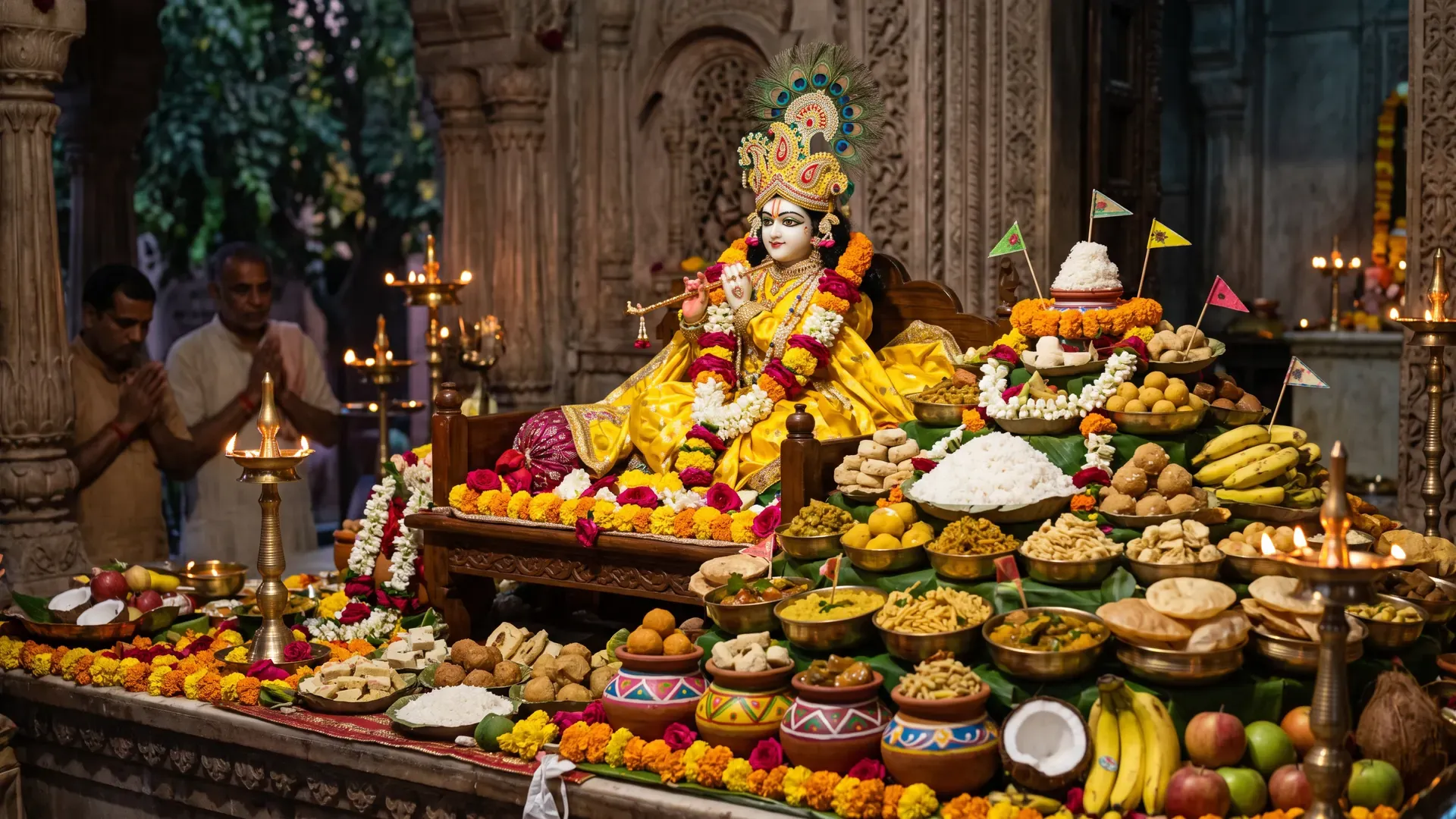
Govardhan Puja is on Tuesday, 10 November 2026. By tradition the puja is done in the morning (Pratahkala) while Pratipada lasts; in New Delhi the Pratahkala muhurat is 6:40–8:50 AM and the Pratipada tithi 12:33 PM (9 Nov) to 2:01 PM. The order: worship of the cows, worship of the cow-dung Govardhan with the circumambulation, then the Annakut offering. Below is every step, a samagri list to tick off, and the gist of the katha.
New Delhi: Puja muhurat, 10 November
- Pratahkala muhuratFirst fifth of the day
- 6:40–8:50 AM
- Pratipada tithi
- 12:33 PM (9 Nov) to 2:01 PM
In Indian Standard Time, SanatanBodh panchang calculation, checked against Drik Panchang. Muhurat for your city
At a glance: the order of the day
- Early morning: a bath after applying oil (Drik Panchang: the oil bath on the morning of Kartik Shukla Pratipada).
- Pratahkala muhurat, 6:40–8:50 AM: worship of the cows, then of the cow-dung Govardhan. This is the first fifth of the day, with Pratipada running.
- After the puja: seven rounds of the Govardhan, with a stream of water and barley.
- Annakut: many dishes offered to the Lord, then the prasad shared with all.
- In many places in the evening: by Drik Panchang the time of the puja follows the regional custom, in some places the morning, in some the afternoon, elsewhere the evening. The worship of the demon-king Bali is also on this day, in the evening.
Pratipada tithi: 12:33 PM (9 Nov) to 2:01 PM. The part of the day in which the puja is done should have Pratipada; that is why questions about the date and time come up. The answer is in the FAQ below.
Worship of the cows
The cow is worshipped too in Govardhan Puja. By Drik Panchang the cow is regarded as a form of Lakshmi, and the cattle wealth (godhan) is worshipped on this day.
The steps
- Bathe and decorate the cow, calf and bull. If there is a cow at home, apply red and yellow colour on her body (Drik Panchang).
- Apply oil and geru on the horns (Drik Panchang); Hindi Wikipedia speaks of ghee on the horns.
- Worship her with flowers, garland, incense, sandal and aarti (Bharatkosh). By Gita Press, invoke the decorated cows and worship them by the rite.
- Give the first portion of the food made at home to the cow (Drik Panchang); Hindi Wikipedia has jaggery and rice. If there is no cow at home, give a portion outside to a cow.
लक्ष्मीर्या लोकपालानां धेनुरूपेण संस्थिता।घृतं वहति यज्ञार्थे मम पापं व्यपोहतु॥Lakshmeeryaa lokapaalaanaam dhenuroopena sansthitaa | Ghritam vahati yagyaarthe mama paapam vyapohatu ||
By the Padma Purana (Uttara Khanda, chapter 122) and the Skanda Purana (Vaishnava Khanda, Kartika Mahatmya, chapter 10), the cows are adorned on this day but not milked, and bulls are not made to carry loads.
Custom / belief: Gita Press (after Hemadri) also gives the custom of letting a cow trample the Govardhan at night. It is a folk custom and not done in every home.
The cow-dung Govardhan: making and worshipping it
How to make it
- In the morning make the Govardhan of cow dung at the door or in the courtyard (Gita Press: on the day after Diwali, in the morning, at the door of the house). Those who do not live near the Govardhan hill make a symbol of cow dung or cooked grain (Drik Panchang).
- Shape: Gita Press says the shastra gives a hill with peaks and tree branches; in many places it is made as a reclining man (Gita Press, Drik Panchang, Bharatkosh).
- In the place of the navel set a small bowl or clay diya (Drik Panchang).
- Decorate with flowers, creepers and leaves; apamarga is placed in it (Drik Panchang, Bharatkosh). By Hindi Wikipedia a murti of Krishna is also set in the middle.
How to worship it
- Worship with sandal, flowers, incense, lamp and naivedya (Gita Press: sandal, flowers and the like; Drik Panchang: padya, arghya, gandha, pushpa, dhupa, dipa, naivedya, achamana, tambula, dakshina, in that order).
- Offer fruit, kheel and batashe (Drik Panchang, Bharatkosh).
- Say the prayer below.
- Pour milk, curd, Gangajal, honey and batashe into the bowl at the navel; share it afterwards as prasad (Drik Panchang, Hindi Wikipedia).
- Seven rounds: one person walks letting a stream of water fall from a lota while another scatters barley, with praise of Govardhan sung (Drik Panchang, Hindi Wikipedia).
गोवर्धन धराधार गोकुलत्राणकारक।बहुबाहुकृतच्छाय गवां कोटिप्रदो भव॥Govardhana dharaadhaara gokulatraanakaaraka | Bahubaahukritachchhaaya gavaam kotiprado bhava ||
Drik Panchang says to chant this mantra ‘according to one’s capacity’. The Padma Purana (Uttara Khanda 122) and the Skanda Purana (Kartika Mahatmya, chapter 10) also have a prayer of this kind to Govardhan in the morning of this day, calling him the support of the earth and protector of Gokula.
Annakut: what is made and how it is offered
What Annakut is
- ‘Annakut’ means a heap of food. Gita Press (under the names of the Bhagavata and the Vratotsava): on Kartik Shukla Pratipada, besides the daily naivedya, offer many dishes made as far as one can afford.
- Drik Panchang: a Govardhan made of food is called Annakut; on this day dishes of wheat and rice, besan kadhi and leafy vegetables are cooked and offered to Krishna.
- Feed the Lord’s devotees in turn and distribute what remains among those who need it (Gita Press). In temples the Annakut is laid out before the deity and everyone shares the prasad.
The groups of Gita Press’s list
- Plain: dal, rice, kadhi, greens.
- Fried and cooked: halwa, puri, kheer.
- Sweets: laddu, peda, barfi, jalebi.
- Fruit: banana, orange, pomegranate, custard apple.
- Savouries: brinjal, radish, greens, raita, bhujia.
- Chutney, murabba, pickle: sour, sweet and spicy.
Custom / belief: The belief behind the 56 bhog (often spoken of with Annakut) is that Yashoda fed Krishna eight times a day and he went without for seven days, so 7 × 8 = 56. It is a popular belief; it is not in the Bhagavata.
In the Bhagavata Purana (10.24) too, at Krishna’s word the things gathered for Indra’s sacrifice are made into dishes, from sweet rice to dal, cakes and many things of milk, curd and ghee, and the brahmins and everyone else are fed. But the word ‘Annakut’ is not in that chapter; the Annakut of many dishes is tradition.
The katha in brief
After the Bhagavata Purana (tenth canto, chapters 24–27); the full katha is on its own page.
- After the rains the cowherds of Vraj offered a sacrifice to Indra every year. Krishna asked Nanda whose worship it was (10.24).
- Krishna said that these things should go to the worship of the cows, the brahmins and the hill Govardhan; everyone did so (10.24).
- The angry Indra sent the clouds of dissolution. Krishna lifted Govardhan with one hand and sheltered Vraj beneath it for seven days (10.25).
- Indra begged forgiveness; the cow Surabhi and Indra bathed Krishna in abhisheka and named him ‘Govinda’ (10.27).
Custom / belief: Popular telling says ‘the hill on the little finger’; the Bhagavata says ‘one hand’.
The Padma and Skanda Puranas prescribe the Govardhan worship on the morning of this day, but they do not say the hill was lifted on this date.
Govardhan Puja and Annakut samagri
By tradition; follow your family’s custom. For making and worshipping the cow-dung Govardhan, for the cow worship and for the Annakut offering. 21 items in all; tick them off as you shop.
sanatanbodh.in/en/festivals/govardhan-puja/vidhi/
To make and decorate the Govardhan
The puja thali
For the worship of the cows
The Annakut offering
As many dishes as can be made; these are the ones that at least two sources name
How homes and regions differ
- Gita Press’s list is longer: among the “raw” dal, rice, kadhi, greens; among the “cooked” halwa, puri, kheer; among the sweets laddu, peda, barfi, jalebi; fruit (banana, orange, pomegranate, custard apple); among the savouries brinjal, radish, raita, bhujia; and chutney, murabba, pickle. All of these are named in one source only, so they are not counted above.
- Some lists add roli, akshat, a kalash, saffron, betel leaf and sugarcane; each of these is in a single source. In Bharatkosh the Annakut is a single dish of bajra, whole moong and all the vegetables mixed together; dishes change from region to region.
- The 56-bhog belief (seven days × eight watches) is a popular belief, not in a text; Drik Panchang gives no such number.
Checked against these sources and written in our own words; only items named by at least two of them are listed: Drik Panchang: Govardhan Puja Vidhi; Drik Panchang: Govardhan Puja (muhurat, mantra); Bharatkosh: Govardhan Puja; Hindi Wikipedia: Govardhan Puja; Gita Press, Vrat-Parichay, pp. 161–162 (Govardhan Puja, Annakut); Srimad Bhagavata 10.24 (the sacrifice to Govardhan in place of Indra, the dishes)
Aartis and chalisas
Frequently asked questions
When is Govardhan Puja 2026, 9 November or 10 November?
On Tuesday, 10 November 2026; Drik Panchang gives the same day (read on 8 November 2026). Pratipada tithi runs 12:33 PM (9 Nov) to 2:01 PM: it begins at 12:33 PM on 9 November, so the morning of 9 November is still Amavasya and the morning of 10 November has Pratipada. Govardhan Puja is traditionally done in the morning during Pratipada, so the puja is on the morning of 10 November, 6:40–8:50 AM in New Delhi. People also ask about 9 November because Pratipada begins that day, but by then the Pratahkala is over. Families who do the puja in the evening should note that Pratipada ends at 2:01 PM on 10 November; ask your priest.
What is the Govardhan Puja 2026 muhurat?
Tuesday, 10 November 2026: the Pratahkala muhurat is 6:40–8:50 AM in New Delhi (the first fifth of the day). Checked against Drik Panchang on 8 November 2026: Pratahkala muhurat 6:40–8:50 AM, the same. Drik gives no separate evening muhurat this year. For an evening puja Pratipada must be running then; see the answer above. Other cities’ times are on the main Govardhan Puja page.
How to make and worship the cow-dung Govardhan?
In the morning make the Govardhan of cow dung at the door or in the courtyard, in many places as a reclining man; set a bowl or diya in the place of the navel and decorate with flowers, leaves and apamarga. Worship with sandal, flowers, incense, lamp and naivedya, pour milk, curd, Gangajal, honey and batashe into the navel, say the prayer and walk seven rounds with a stream of water and barley. The steps above follow Drik Panchang and Gita Press.
What goes into the Annakut?
As many dishes as can be made. The ones that recur in the sources are rice, dal, besan kadhi, greens and leafy vegetables, puri and dishes of wheat, kheer and sweets. Gita Press’s list also has halwa, laddu, jalebi, fruit, raita, chutney and pickle. The naivedya is offered to the Lord and the prasad shared with all.
What is the Govardhan Puja mantra?
‘Govardhana dharadhara gokulatranakaraka. Bahubahukritachchhaya gavam kotiprado bhava’ (the text of Drik Panchang and the Nirnaya Sindhu; Gita Press prints ‘vishnubahukritochchhaya’ in the third pada). After the worship of the cows, ‘Lakshmirya lokapalanam dhenurupena samsthita. Ghritam vahati yajnartha mama papam vyapohatu’ is said. Meanings and sources are above.
Are Govardhan Puja and Annakut on the same day?
Yes. By Drik Panchang Govardhan Puja is also called Annakut Puja: a Govardhan made of food is called Annakut. In Maharashtra the same day is Bali Pratipada (Bali Padva), and most often the Gujarati New Year too.
Can Govardhan Puja be done in a city home without cow dung?
By Drik Panchang those who do not live near the Govardhan hill make a symbolic Govardhan of cow dung or cooked grain; the Govardhan of cooked grain is what is called Annakut. Follow your family’s custom and ask your priest.
Sources
- Drik Panchang: Govardhan Puja Vidhi (cow worship, making the Govardhan, the circumambulation) and the Govardhan Puja page (muhurat, mantras; New Delhi, 2026)
- Gita Press, Vrat-Parichay (Pt. Hanuman Sharma), pp. 161–162: Govardhan Puja (Hemadri), Annakut (Bhagavata and Vratotsava); archive.org/details/610-vrat-parichay
- Nirnaya Sindhu (Kamalakara Bhatta), second paricheda, p. 149: the Govardhan worship and the cow mantra (1927 edition, OCR)
- Bharatkosh: Govardhan Puja; Hindi Wikipedia: Govardhan Puja
- Srimad Bhagavata Mahapurana 10.24–27 (the katha); Padma Purana, Uttara Khanda 122, and Skanda Purana, Vaishnava Khanda, Kartika Mahatmya 10 (the prescription of Govardhan worship on the Pratipada morning)
- Muhurat: SanatanBodh panchang calculation, checked against Drik Panchang (New Delhi, 2026)
Something wrong? Report a mistake
