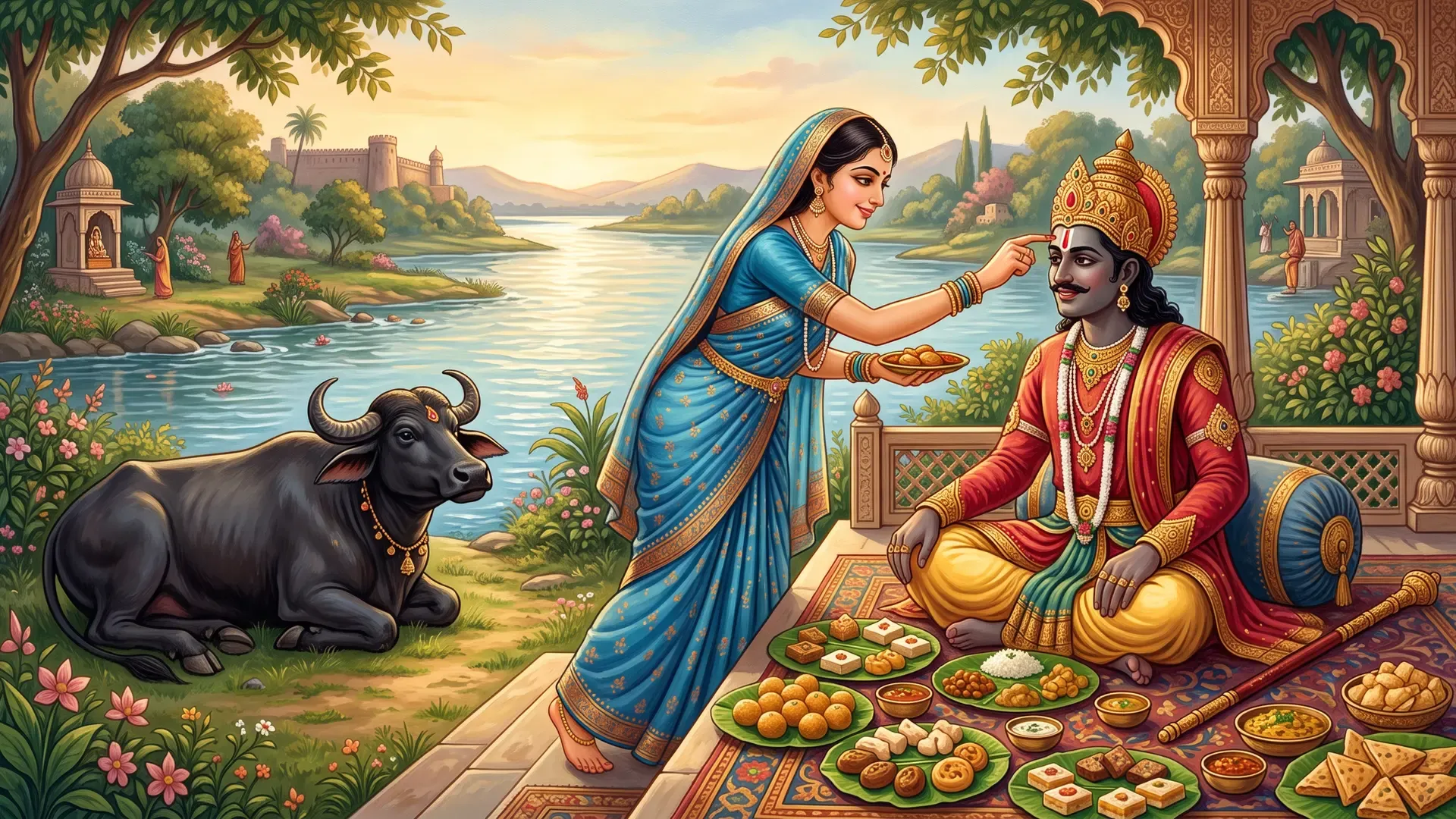
By the Skanda Purana, Yamuna invited her brother Yama home for a meal every day, and on Kartik Shukla Dwitiya he came, after first setting free everyone in hell. Yamuna welcomed him with love and fed him, and asked as her boon that those who eat from their sister’s hand on this day be happy. That is why the day is called Yama Dwitiya and Bhai Dooj.
Each morning the tithi, Rahu Kaal and coming festivals, in one short WhatsApp message.Follow the channel
Bhai Dooj falls on Kartik Shukla Dwitiya, the last day of the five-day festival of lights; it is also called Yama Dwitiya and Bhratri Dwitiya. On this day a brother goes to his sister’s house and eats from her hand, she puts a tilak on his forehead, and he gives her gifts.
The story of Yama and Yamuna is told in full in the Skanda Purana (Vaishnava Khanda, Kartik Masa Mahatmya, chapter 11); the Padma Purana (Uttara Khanda, chapter 122) states it briefly. Below it follows the Skanda Purana’s order. Today’s tellings also have Yamuna apply a tilak and wave the aarti; these are not in the Skanda Purana’s account, but in tradition they are the heart of the day.
How the vrat and katha are kept
- The brother goes to his sister’s house and eats from her hand; where brothers cannot come, in many places sisters go to their brothers’ homes to give the tilak and sweets (printed vrat-katha booklet).
- The sister gives a tilak of roli and rice, waves the aarti and feeds him sweets; the brother gives her a gift or money. The Skanda and Padma Puranas ask the brother to give his sister clothes and ornaments, and the Skanda Purana to touch an elder sister’s feet for her blessing.
- The tilak and the meal are by tradition in the Aparahna, the afternoon (Drik Panchang); the Skanda Purana too says the Dwitiya should last into the afternoon when the brother is fed.
- On this day, especially at Mathura, brothers and sisters bathe in the Yamuna; in the Skanda Purana Yama names the Yamuna bath as a merit of the day.
- The Kayastha community worships Chitragupta on the same day (Hindi Wikipedia).
- In Bihar, Jharkhand and parts of Uttar Pradesh the day has the Godhan custom: sisters shape Yama, Yami, a snake and a scorpion from cow dung and pound them with a pestle, ritually “curse” their brothers, then prick their own tongues with a rengni thorn in penance and give the tilak (Inkhabar, Bhaktvatsal). It is a regional custom.
Yama and Yamuna
As told in the Skanda Purana, Vaishnava Khanda, Kartik Masa Mahatmya, chapter 11, verses 30–66 (G. V. Tagare’s translation); the mother’s name is from the Vishnu Purana 3.2.
By the Vishnu Purana, Sanjna, daughter of Vishvakarma and wife of the Sun god, bore three children: Vaivasvata Manu, Yama and Yami. Yami is the river Yamuna. So Yama and Yamuna are brother and sister.
Yamuna loved her brother dearly. Every day she went to Yama and said, “Brother, come to my house for a meal with your companions.” And every day Yama answered, “Today… tomorrow… the day after.” Those whose minds are absorbed in their duty, the Skanda Purana says, have no leisure.
Once, on Kartik Shukla Dwitiya, Yamuna pressed her invitation so earnestly that this time Yama set out. Before going to his sister’s house he set free every being in hell, and then, with his attendants, he came to Yamuna’s home.
Yamuna welcomed her brother with great love. She rubbed his body with oil and fragrant unguents and bathed him. Then she gave him ornaments, many kinds of clothes, sandal paste and garlands, and seated him with honour on a couch. She cooked many sweet rice dishes in vessels of gold and fed her brother with a happy heart.
After the meal Yama honoured his sister in turn with ornaments and clothes, and said, “Yamuna, ask for a boon.”
Yamuna said, “Come to my house for a meal on this day every year. Let all beings in hell be set free today. And let those who eat from their sister’s hand today be happy. That is all I ask.”
Yama said, “Yamuna, whoever bathes in your waters today and offers water to the forefathers and the gods, and eats at his sister’s house and honours her, will never see the gate of my realm.” Then Yama went back to his city, Samyamini.
By the Skanda Purana, the beings set free that day were fed as well, and they held a great festival in Yama’s realm. That is how the day became known in the three worlds as Yama Dwitiya. The same chapter pictures Yama seated on his buffalo, holding his staff and mallet, surrounded by his joyful attendants.
Other tellings
- The mother: the Vishnu Purana (3.2) names Sanjna, as does Dharmsaar. Amar Ujala and Webdunia call Yama and Yamuna children of the Sun and Chhaya; but in the Vishnu Purana Chhaya’s children are Shani, Savarni Manu and Tapati. In Dharmsaar’s telling Sanjna leaves her shadow, Chhaya, to care for the children, which fits the Vishnu Purana’s story.
- In today’s tellings (Amar Ujala, Webdunia, Times Now Navbharat, Dharmsaar, the printed booklet) Yamuna gives her brother a tilak and waves the aarti; the Skanda Purana speaks of oil, unguents, a bath, clothes, ornaments, garlands and a meal, not a tilak.
- The freeing of the beings in hell is in the Skanda Purana and Hindi Wikipedia; newspaper tellings leave it out, and in Times Now Navbharat Yama arrives at his sister’s house unannounced.
- The words of the boon vary: in newspapers, the brother whom his sister gives a tilak today need not fear death, or will live long; in Drik Panchang, brothers who eat at their sister’s house are freed from Yama’s realm; in the printed booklet, a brother and sister who bathe together in the Yamuna today are spared Yama’s torments.
- Drik Panchang’s English page names Yama’s sister “Varni”; the Skanda and Padma Puranas say Yamuna.
- Drik Panchang gives another story: after slaying Narakasura, Krishna visited his sister Subhadra, who welcomed him with sweets and a tilak. We did not find this story in any text.
- Two folk tales are also told for Bhai Dooj. In one, a brother sets out to visit his sister, and on the way a tree, a river, a snake and a lion each claim his life; his sister follows and saves him from every danger (Hindwi, from A. K. Ramanujan’s “Folktales from India” in Hindi; Sri Mandir tells it for the Bhai Dooj after Holi). In the other, a widow has lost six sons to snakebite at their weddings, and at the seventh son’s wedding his sister guards him from the snake (Dharmsaar, Bhakti Bharat). They are not in the Puranas and we have not yet found them in a printed vrat-katha booklet, so they are not retold here in full.
After the katha
After the katha the sister gives her brother the tilak and feeds him. The Aparahna tilak time for your city is on the Bhai Dooj page. Kayastha families worship Chitragupta on the same day and sing his aarti.
Chitragupta Aarti: Om Jai Chitragupt HareFrequently asked questions
What is the Bhai Dooj katha?
By the Skanda Purana, Yamuna invited her brother Yama for a meal every day, and on Kartik Shukla Dwitiya he went to her house. She welcomed and fed him, and asked as her boon that those who eat from their sister’s hand on this day be happy. Yama said that whoever bathes in the Yamuna on this day, eats at his sister’s house and honours her will never see the gate of his realm.
Who was the mother of Yama and Yamuna?
By the Vishnu Purana (3.2), Sanjna, daughter of Vishvakarma and wife of the Sun. Some newspaper tellings name Chhaya, but in the Vishnu Purana Chhaya’s children are Shani, Savarni Manu and Tapati.
Which Purana has the Bhai Dooj katha?
The Skanda Purana tells it in full (Vaishnava Khanda, Kartik Masa Mahatmya, chapter 11), and the Padma Purana briefly (Uttara Khanda, chapter 122). Hindi Wikipedia also names the Bhavishya Purana; we have not checked that.
What should someone without a sister do on Bhai Dooj?
By the Skanda Purana, one with no sister of his own eats at the home of his father’s sister, his paternal uncle’s daughter, his mother’s sister or his maternal uncle’s daughter; failing them, at the home of a woman he regards as a sister, and failing that, he takes a cow or a river as his sister. For one who is abroad, ill or otherwise unable to reach his sister, the text says hearing this katha brings the same merit. Follow your family’s custom.
Sources
- Skanda Purana, Vaishnava Khanda, Kartik Masa Mahatmya, chapter 11, verses 1–73 (G. V. Tagare’s translation, checked on wisdomlib.org)
- Padma Purana, Uttara Khanda, chapter 122, verses 89–103 (N. A. Deshpande’s translation, wisdomlib.org)
- Vishnu Purana 3.2 (H. H. Wilson’s translation, wisdomlib.org)
- Drik Panchang: Bhai Dooj; Diwali legends
- Amar Ujala: the legend of Bhai Dooj (21 October 2025)
- Webdunia: Yama Dwitiya ki pauranik katha
- Times Now Navbharat: Bhai Dooj vrat katha (3 November 2024)
- Dharmsaar (dharmsaar.com): Bhai Dooj vrat katha; Bhakti Bharat (bhaktibharat.com): Bhaiya Dooj lok katha
- Hindwi (hindwi.org): Bhai Dooj folk tale, from “Bharat ki Lok Kathayen”, ed. A. K. Ramanujan (National Book Trust, 2001); Sri Mandir (srimandir.com): Bhai Dooj katha
- Inkhabar (21 October 2025) and Bhaktvatsal (bhaktvatsal.com): the Godhan custom
- Hindi Wikipedia: Bhai Dooj
- “Vrat Katha” booklet (archive.org, 20240806_20240806_0450): the Bhaiya Dooj katha
Something wrong? Report a mistake