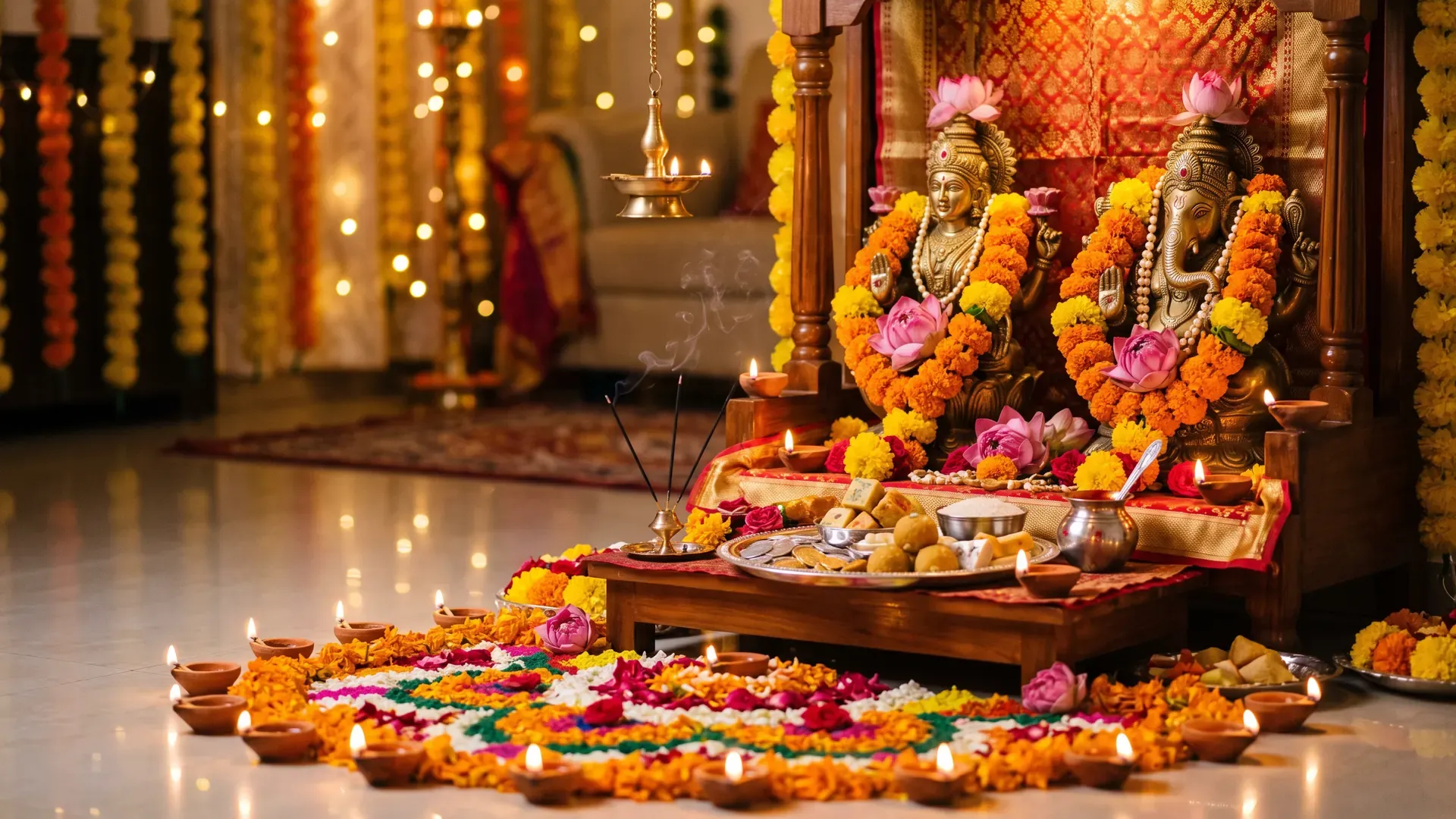
The Diwali 2026 Lakshmi-Ganesh puja is on the evening of Sunday, 8 November 2026; in New Delhi the muhurat is 5:55–7:51 PM, when Pradosh Kaal, the fixed (Vrishabha) lagna and the Amavasya tithi coincide. The order, after Gita Press’s ‘Nityakarma-Pujaprakash’ and Drik Panchang: purification and sankalp, Ganesha first, then the sixteen-part worship of Lakshmi, then Kubera and the account books, the lamps, aarti, the prayer for forgiveness and the farewell. Every step is below, with the mantras whose words the two sources give alike, and a samagri list you can print.
New Delhi: Lakshmi Puja muhurat, 8 November
- Lakshmi Puja muhuratPradosh Kaal + Vrishabha lagna + tithi
- 5:55–7:51 PM
- Pradosh KaalFirst fifth of the night
- 5:31–8:09 PM
- Vrishabha KaalFixed ascendant
- 5:55–7:51 PM
- Nishita KaalEighth muhurat of the night
- 11:39 PM–12:31 AM (9 Nov)
- Amavasya tithi
- 11:29 AM to 12:33 PM (9 Nov)
In Indian Standard Time, SanatanBodh panchang calculation, checked against Drik Panchang. Muhurat for your city
1 Getting ready, before evening
Clean the house and the place of worship, bathe and be clean yourself; in the Gita Press vidhi this puja is done in the evening, with faith. Place new idols or a picture of Lakshmi and Ganesha on a chowki or on a clean cloth seat; according to Gita Press, Lakshmi is placed on Ganesha’s right side.
Near the idols, draw an eight-petalled lotus with saffron-sandal paste in a clean vessel and place ‘dravya-lakshmi’ (money or coins) on it; both are worshipped together (Gita Press). Set the samagri in its place beforehand; the full list is below.
Sit facing east or north; both Gita Press and Drik Panchang say so. According to Drik Panchang a fast is kept on this day as one is able: without water, on fruit, or on milk alone.
2 Purification and achamana
In the Gita Press order you first sip water (achamana), put on the pavitri ring of kusha, sprinkle water and do pranayama, then sprinkle water on yourself and the puja items with the mantra below. Drik Panchang’s atma-shodhan has the same mantra, followed by three sips of water. The two sources give different achamana mantras; use your family’s book or your purohit’s.
ॐ अपवित्रः पवित्रो वा सर्वावस्थां गतोऽपि वा।यः स्मरेत् पुण्डरीकाक्षं स बाह्याभ्यन्तरः शुचिः॥Om apavitrah pavitro vaa sarvaavasthaam gatopi vaa | Yah smaret pundareekaaksham sa baahyaabhyantarah shuchih ||
3 Sankalpa (the resolve)
With water, akshat and a flower in the right hand, state the sankalpa: the place, the samvat year, Kartik month, Krishna paksha, Amavasya tithi, the weekday, your gotra and name, and the purpose of the puja. The Gita Press sankalpa names the purpose as worship of Mahalakshmi for lasting prosperity and her grace, the worship of Kubera and others, and with it the worship of Gauri, Ganapati and the rest. Then let the water fall near Ganesha.
The full Sanskrit sankalpa is in Gita Press (pp. 243–244) and on Drik Panchang’s sankalpa page; their wording differs (Drik adds phrases for a business), so it is not printed here. Families use their own purohit’s form.
4 Ganesha first
Both sources worship Ganesha before Lakshmi. For a new idol, Gita Press first has its prana-pratishtha (Vedic mantras, best done by a purohit), then the sixteen-part puja, as for Lakshmi below. A name-mantra is said with each offering: ‘Om Ganapataye namah’ in Drik Panchang (for example ‘Om Ganapataye namah pushpam samarpayami’); Gita Press worships Ganesha and Gauri together, so there it is ‘Om bhur bhuvah svah Ganeshambikabhyam namah’. Durva grass is offered to Ganesha too (Gita Press).
A full shastric puja then worships the nine planets, the sixteen mothers (shodasha matrika) and the kalash (in both Gita Press and Drik Panchang); many families have a purohit do this part.
वक्रतुण्ड महाकाय सूर्यकोटि समप्रभ।निर्विघ्नं कुरु मे देव सर्वकार्येषु सर्वदा॥Vakratunda mahaakaaya sooryakoti samaprabha | Nirvighnam kuru me deva sarvakaaryeshu sarvadaa ||
5 Lakshmi puja (shodashopachara)
Shodashopachara means worship with sixteen upacharas (services). Both Gita Press and Drik Panchang give longer lists, with sub-steps such as several baths, the worship of the limbs (anga-puja), of the eight siddhis and of the eight Lakshmis; Drik counts 34 steps. Below are the main upacharas in the Gita Press order, each with the short sentence said with it.
Say the name-mantra before each sentence: ‘Om Mahalakshmyai namah’ in Gita Press, ‘Shri Lakshmi-devyai namah’ in Drik Panchang. For anything you do not have, Gita Press says to offer it in the mind, as imagined; Drik Panchang’s samagri list says akshat may be offered in its place.
- DhyanaMeditate with a flower in hand, then offer itध्यानार्थे पुष्पाणि समर्पयामि
- Avahana (invoking)Invite her, offering a flowerमहालक्ष्मीमावाहयामि, आवाहनार्थे पुष्पाणि समर्पयामिDrik Panchang: श्रीलक्ष्मी-देवीम् आवाहयामि
- Asana (seat)A lotus or other flowers for her seatआसनं समर्पयामि
- PadyaWater with sandal and flowers to wash the feetपादयोः पाद्यं समर्पयामिDrik Panchang: पाद्यं समर्पयामि
- ArghyaScented water from the arghya vesselहस्तयोरर्घ्यं समर्पयामिDrik Panchang: अर्घ्यं समर्पयामि
- AchamanaWater to sipआचमनीयं जलं समर्पयामि
- Snana (bath)Water, then milk, curd, ghee, honey and sugar (one by one, or mixed as panchamrit), then water with sandal and clean waterपञ्चामृतस्नानं समर्पयामि। शुद्धोदकस्नानं समर्पयामि
- Vastra (cloth)Cloth, or mauli threadवस्त्रं समर्पयामि
- Abhushana (ornaments)Ornamentsआभूषणानि समर्पयामि
- Gandha (sandal)Saffron-sandal paste with the ring finger, then red sandal, sindoor, kumkumगन्धं समर्पयामिDrik Panchang: चन्दनं समर्पयामि
- AkshataUnbroken rice touched with kumkumअक्षतान् समर्पयामि
- Pushpa (flowers)Flowers and garlands; red lotus where possibleपुष्पं पुष्पमालां च समर्पयामिDrik Panchang: पुष्पं समर्पयामि
- Dhupa (incense)Offer incenseधूपमाघ्रापयामिDrik Panchang: धूपं समर्पयामि
- Dipa (lamp)Show the ghee lamp, then wash the handsदीपं दर्शयामिDrik Panchang: दीपं समर्पयामि
- Naivedya (food)The food offering, then water to drink and to wash hands and mouth; then the season’s fruitनैवेद्यं निवेदयामिDrik Panchang: नैवेद्यं समर्पयामि
- TambulaBetel leaf with cardamom, clove and supariमुखवासार्थे ताम्बूलं समर्पयामि
- DakshinaAn offering of coins or moneyदक्षिणां समर्पयामि
- Nirajana (aarti)The aarti, then let water fall and wash the handsनीराजनं समर्पयामि
- PradakshinaWalking round the deityप्रदक्षिणां समर्पयामि
- Mantra-pushpanjaliRecite with flowers in both hands, then offer themमन्त्रपुष्पाञ्जलिं समर्पयामि
या सा पद्मासनस्था विपुलकटितटी पद्मपत्रायताक्षीगम्भीरावर्तनाभिस्तनभरनमिता शुभ्रवस्त्रोत्तरीया।या लक्ष्मीर्दिव्यरूपैर्मणिगणखचितैः स्नापिता हेमकुम्भैःसा नित्यं पद्महस्ता मम वसतु गृहे सर्वमाङ्गल्ययुक्ता॥Yaa saa padmaasanasthaa vipulakatitatee padmapatraayataakshee Gambheeraavartanaabhistanabharanamitaa shubhravastrottareeyaa | Yaa lakshmeerdivyaroopairmaniganakhachitaih snaapitaa hemakumbhaih Saa nityam padmahastaa mama vasatu grihe sarvamaangalyayuktaa ||
ॐ हिरण्यवर्णां हरिणीं सुवर्णरजतस्रजाम्।चन्द्रां हिरण्मयीं लक्ष्मीं जातवेदो म आवह॥Om hiranyavarnaam harineem suvarnarajatasrajaam | Chandraam hiranmayeem lakshmeem jaatavedo ma aavaha ||
वनस्पतिरसोद्भूतो गन्धाढ्यः सुमनोहरः।आघ्रेयः सर्वदेवानां धूपोऽयं प्रतिगृह्यताम्॥Vanaspatirasodbhooto gandhaadhyah sumanoharah | Aaghreyah sarvadevaanaam dhoopoyam pratigrihyataam ||
Custom: Local custom: according to Gita Press, in some places turmeric or coriander seed is offered to Lakshmi instead of akshat, and jaggery is given as prasad.
6 Kubera, account books, pen and ink
After the Lakshmi puja, Gita Press worships these: the ‘shubh-labh’, swastika and ‘Shri Ganeshaya namah’ written in sindoor on the walls of a shop and the like (Dehli-vinayaka); Mahakali in the inkpot; the pen, with mauli tied round it; Saraswati in the account book, its cloth wrapper and the money bag, each marked with a swastika in roli or saffron-sandal; Kubera, invoked in the tijori or cash box marked with a swastika; and the scales and weights. Drik Panchang too worships Mahakali in the pen and ink, Saraswati in the account books and Kubera in the tijori; without an idol of Kubera, the tijori or jewellery box itself is taken as Kubera, marked with a sindoor swastika and tied with mauli.
According to Gita Press, five turmeric knots, coriander seed, lotus seeds (kamalgatta), akshat, durva and money are put in the money bag for the puja, and after the prayer to Kubera the bag is kept in the tijori. Kubera’s name-mantra: ‘Om Kuberaya namah’ (Gita Press), ‘Om Shri Kuberaya namah’ (Drik Panchang).
आवाहयामि देव त्वामिहायाहि कृपां कुरु।कोशं वर्द्धय नित्यं त्वं परिरक्ष सुरेश्वर॥Aavaahayaami deva tvaamihaayaahi kripaam kuru | Kosham varddhaya nityam tvam pariraksha sureshvara ||
Custom: This part is mainly a custom of business families. According to Drik Panchang, in Gujarat the Diwali Lakshmi Puja is also called Chopda Puja, the worship of new account books; it is done in Rajasthan and Maharashtra too.
7 Worship of the lamps, and lighting them
According to Gita Press, light eleven, twenty-one or more lamps in a vessel, place them near Mahalakshmi and worship the flame. Then, as is your custom, offer oranges, sugarcane, water chestnut (singhara) and puffed paddy (kheel); offer kheel to Ganesha, Mahalakshmi and all the gods. Finally light all the other lamps and adorn the whole house.
In Drik Panchang’s deepmalika vidhi a large mustard-oil lamp sits in the middle of a big plate with eleven, twenty-one, fifty-one or more small lamps round it; after the puja, puffed paddy, sugarcane, coconut, fruit and sweets are offered. According to Drik Panchang, the lamp lit in the Diwali puja should keep burning all night.
8 Aarti
After all the worship comes the main aarti: a swastika drawn on the plate, a ghee wick on a seat of akshat and flowers and camphor in a separate cup, the family standing together, the bell ringing (Gita Press). Gita Press prints the aarti ‘Om Jai Lakshmi Mata’ in this puja. According to Drik Panchang, the Shri Sukta, the Lakshmi Sukta and other hymns to Lakshmi are recited after the puja, with a night vigil (jagaran) if possible.
9 Mantra-pushpanjali, pradakshina and forgiveness
Offer flowers from both hands with the mantra-pushpanjali, walk round and bow fully, then pray for forgiveness with joined hands (Gita Press). Then let water fall with a sentence offering the whole puja to Mahalakshmi, bow to the elders and share the charanamrit and prasad (Gita Press). Drik Panchang also ends by offering the puja to the Goddess; the two sentences differ.
महालक्ष्म्यै च विद्महे विष्णुपत्न्यै च धीमहि।तन्नो लक्ष्मीः प्रचोदयात्॥Mahaalakshmyai cha vidmahe vishnupatnyai cha dheemahi | Tanno lakshmeeh prachodayaat ||
आवाहनं न जानामि न जानामि विसर्जनम्।पूजां चैव न जानामि क्षमस्व परमेश्वरि॥मन्त्रहीनं क्रियाहीनं भक्तिहीनं सुरेश्वरि।यत्पूजितं मया देवि परिपूर्णं तदस्तु मे॥Aavaahanam na jaanaami na jaanaami visarjanam | Poojaam chaiva na jaanaami kshamasva parameshvari || Mantraheenam kriyaaheenam bhaktiheenam sureshvari | Yatpoojitam mayaa devi paripoornam tadastu me ||
10 Farewell (visarjan)
Finally, with akshat in hand, bid farewell to the gods who were invoked. According to Gita Press the new idols of Ganesha and Mahalakshmi are not sent off; all the other gods invoked, installed and worshipped are given farewell with akshat. In Drik Panchang everyone first holds flowers, hails Ganesha, Mahalakshmi, Mahakali, Mahasaraswati and Kubera, and bows.
यान्तु देवगणाः सर्वे पूजामादाय मामकीम्।इष्टकामसमृद्ध्यर्थं पुनरागमनाय च॥Yaantu devaganaah sarve poojaamaadaaya maamakeem | Ishtakaamasamriddhyartham punaraagamanaaya cha ||
Diwali puja samagri list (Lakshmi Puja)
By tradition; follow your family’s custom. What homes usually keep ready for the Lakshmi-Ganesha puja. 31 items in all; tick them off as you shop.
sanatanbodh.in/en/festivals/diwali/puja-vidhi/
The puja chowki
The puja thali
Lamps
Bhog and prasad
Account books and wealth
How homes and regions differ
- A full shastric puja done by a purohit also uses sapta-mrittika (earth from seven places), sarvaushadhi (herbs), pancha-pallava (five kinds of leaves), sapta-dhanya and pancha-ratna; they are in the longer lists of Drik Panchang and Webdunia.
- According to Drik Panchang, if an item cannot be found, akshat may be offered in its place.
- Many families also worship Kubera, Saraswati and Mahakali in this puja. In Bengal this night is Kali Puja; this list is for the Lakshmi-Ganesha puja.
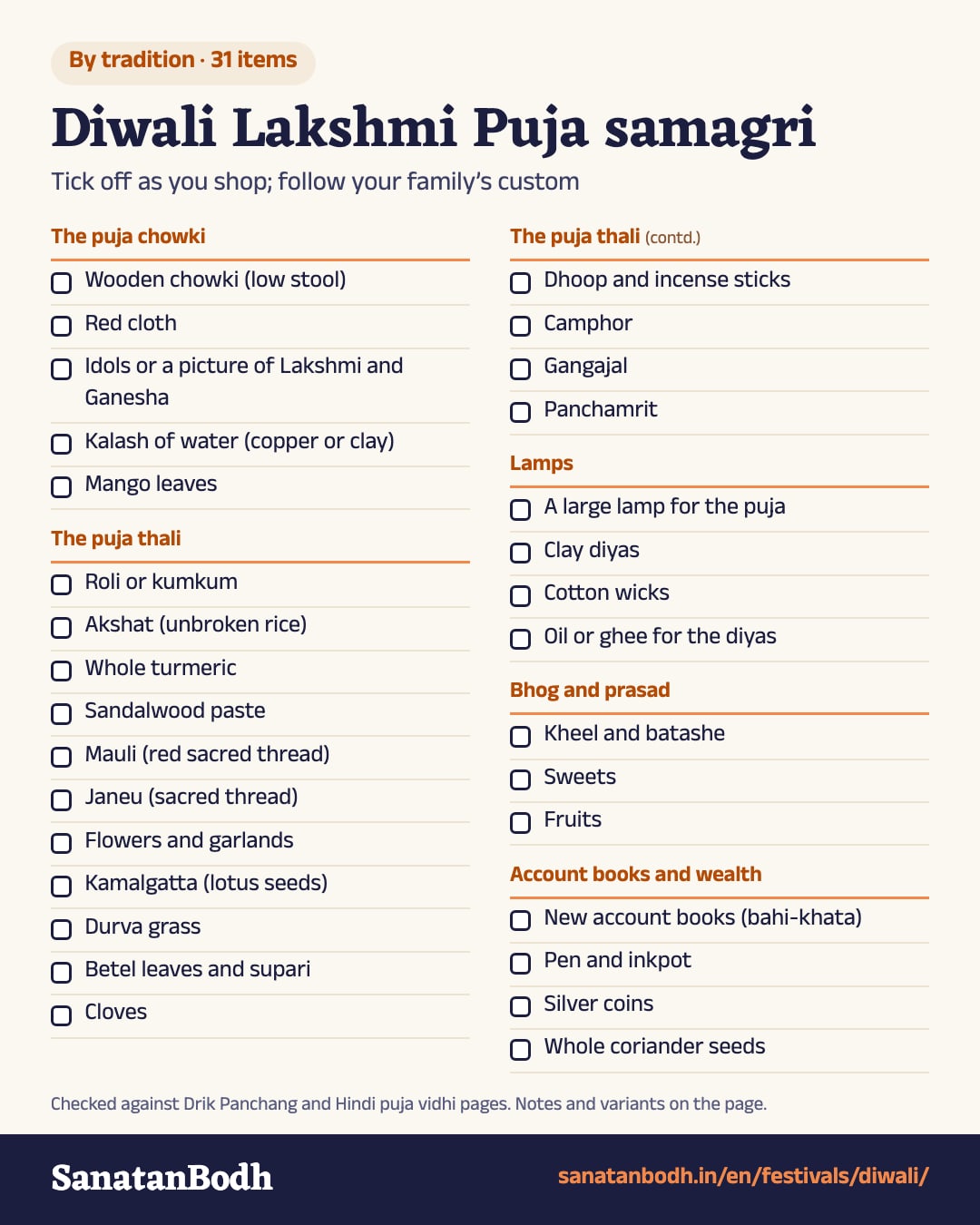
Checked against these sources and written in our own words; only items named by at least two of them are listed: Drik Panchang: Lakshmi Puja items; Drik Panchang: Diwali Puja Vidhi; Webdunia: Diwali puja samagri list; Webdunia: Lakshmi puja vidhi; Times Now Hindi: Diwali puja samagri (2025)
Regional and family forms
- In Bengal the night of Diwali is Kali Puja (Drik Panchang’s Diwali calendar 2026: Kali Puja with Lakshmi Puja on 8 November), and Lakshmi is worshipped there on Kojagari Purnima (Sharad Purnima).
- In several traditions Mahalakshmi is also worshipped at Nishita Kaal, around midnight; its time is in the muhurat box above.
- In Gujarat, Rajasthan and Maharashtra business families do Chopda Puja of new account books and use the choghadiya muhurat for it (Drik Panchang).
- In some places turmeric or coriander seed instead of akshat, and jaggery as bhog (Gita Press); many homes bring new idols of Lakshmi and Ganesha every year, and both sources describe the worship of new idols.
Give first place to your family’s custom and your purohit’s rite; this page sets out the rite of two written sources.
Frequently asked questions
When is Lakshmi Puja on Diwali 2026?
On the evening of Sunday, 8 November 2026. In New Delhi the muhurat is 5:55–7:51 PM (Pradosh Kaal, Vrishabha lagna and Amavasya together). Other cities are on the Diwali page. According to Drik Panchang the full puja takes time, so it can be begun before the muhurat, so that the Lakshmi puja itself falls in it.
On Diwali is Ganesha worshipped first or Lakshmi?
Ganesha first. In both Gita Press and Drik Panchang, the Ganesha puja comes right after the sankalp, then the Lakshmi puja.
On which side of Ganesha is Lakshmi placed?
According to the Gita Press vidhi, on Ganesha’s right side.
How to do the puja without knowing the Sanskrit mantras?
A short sentence is said with each offering, such as ‘Om Mahalakshmyai namah, pushpam samarpayami’ (Gita Press); they are given above with every step. For anything you do not have, Gita Press says to offer it in the mind; Drik Panchang says akshat may be offered in its place. For the full shastric rite, ask your purohit.
Are the new Lakshmi-Ganesha idols immersed?
Not in the Gita Press vidhi: at the end, all the other invoked gods are given farewell, but not the new idols of Ganesha and Mahalakshmi.
What is done after the Lakshmi puja?
According to Gita Press, light lamps throughout the house and share the prasad. According to Drik Panchang, the puja lamp should burn all night, and the Shri Sukta, the Lakshmi Sukta or other hymns to Lakshmi are recited.
Sources
- Gita Press, Gorakhpur: Nityakarma-Pujaprakash (Pt. Ramabhavan Mishra, Lalbihari Mishra), 50th reprint (Samvat 2066): Shri Mahalakshmi-pujan pp. 243–260, mangala-path p. 170; checked against the 60th reprint (Samvat 2070)
- Drik Panchang: Diwali Puja Vidhi, Lakshmi Puja Vidhi, Atma-shodhan, Sankalpa, Ganesha Puja Vidhi, Kuber Puja Vidhi, Deepmalika Puja Vidhi, Visarjan, Lakshmi mantras, Shri Suktam, Durga Saptashati Kshama-prarthana
- Shri Sukta (Rigveda khila hymn)
- Muhurat: SanatanBodh panchang calculation, checked against Drik Panchang (New Delhi, 2026)
Something wrong? Report a mistake
Meanings, sources and city muhurats: sanatanbodh.in/en/festivals/diwali/puja-vidhi/
