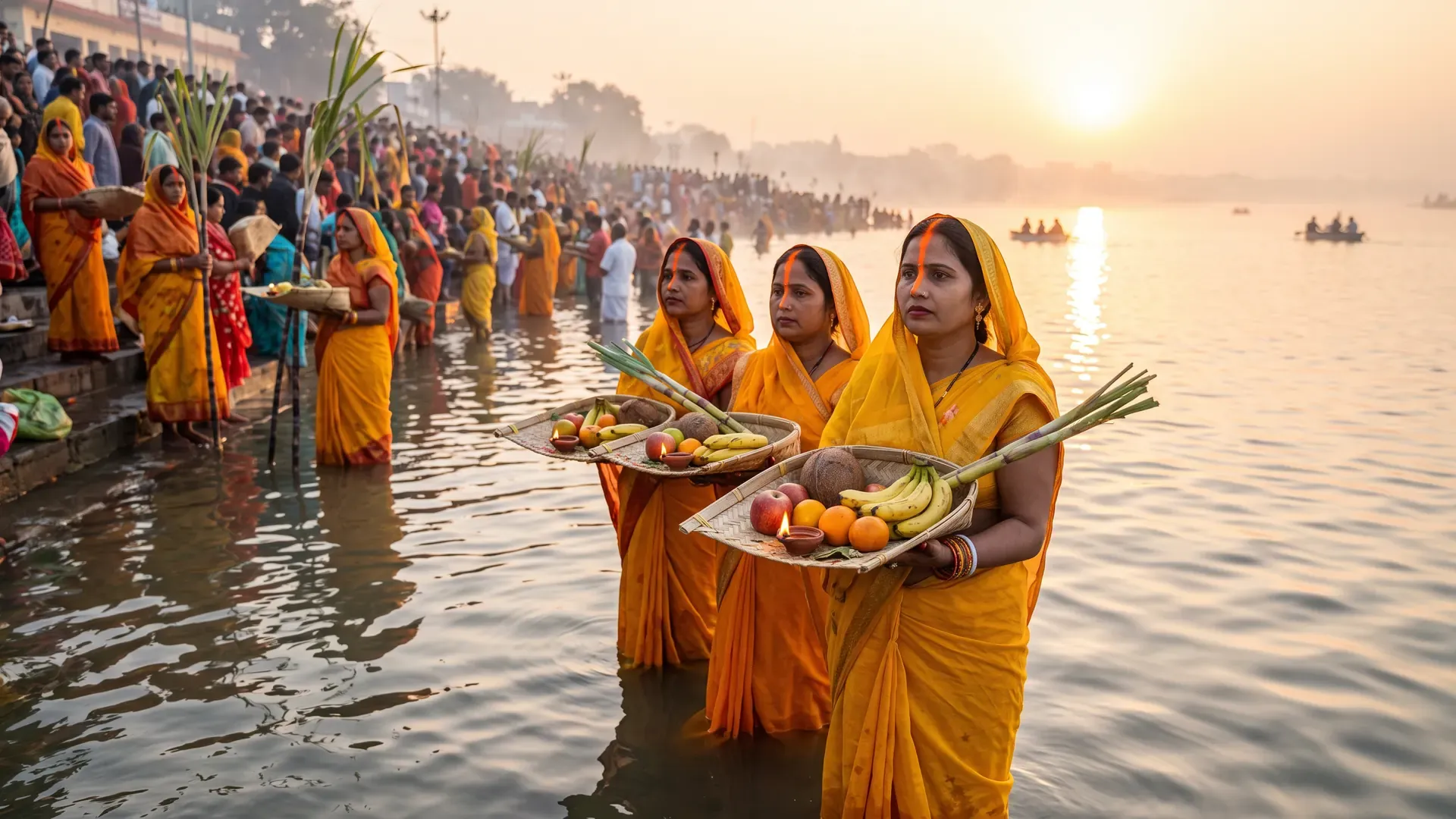
The Chhath Puja 2026 vidhi lasts four days: Nahay-Khay on Friday, 13 November 2026, Kharna on Saturday, 14 November 2026, the Sandhya Arghya on Sunday, 15 November 2026 (sunset 5:28 PM in New Delhi) and the Usha Arghya on Monday, 16 November 2026 (sunrise 6:44 AM), followed by the parana. At the Sandhya Arghya the vrati stands in the water at the ghat and offers water and milk to the setting Sun from a soop holding thekua and fruit; at the Usha Arghya, to the rising Sun, facing east. From the Kharna prasad to the parana the fast is waterless, about 36 hours. The arghya times for twelve cities are in one table below. These rites are folk tradition.
New Delhi: Chhath Puja 2026 times
- Nahay-Khay13 November
- sunrise 6:42 AM
- Kharna14 November, prasad after sunset
- sunset 5:28 PM
- Sandhya Arghya15 November
- sunset 5:28 PM
- Usha Arghya and parana16 November
- sunrise 6:44 AM
- Shashthi tithiour calculation
- 14 November, 11:25 PM – 16 November, 2:02 AM
In Indian Standard Time, SanatanBodh panchang calculation; each city’s time was checked against Drik Panchang.
Sunset on 15 November and sunrise on 16 November: 12 cities
| City | Sandhya Arghya: sunset, 15 November | Usha Arghya: sunrise, 16 November |
|---|---|---|
| Patna | 5:01 PM | 6:07 AM |
| Ranchi | 5:04 PM | 6:03 AM |
| New Delhi | 5:28 PM | 6:44 AM |
| Varanasi | 5:10 PM | 6:16 AM |
| Lucknow | 5:16 PM | 6:26 AM |
| Mumbai | 6:00 PM | 6:46 AM |
| Kolkata | 4:53 PM | 5:50 AM |
| Gorakhpur | 5:06 PM | 6:16 AM |
| Bhagalpur | 4:54 PM | 6:00 AM |
| Muzaffarpur | 4:59 PM | 6:07 AM |
| Darbhanga | 4:57 PM | 6:05 AM |
| Gaya | 5:03 PM | 6:07 AM |
The vratis enter the water a little before sunset and reach the ghat before sunrise for the Usha Arghya (Hindi Wikipedia); at the ghat the Sun may take a few more minutes to clear the horizon. In Indian Standard Time, SanatanBodh panchang calculation; each city’s time was checked against Drik Panchang.
Scripture read in a scripture, with the text and place. Custom a folk or family custom, as the sources describe it; follow your family’s and purohit’s practice.
The vidhi of the four days: Nahay-Khay to the parana
No Purana sets out Chhath’s vidhi; it comes from folk tradition and varies a little by region and family. This is the order that Hindi and English Wikipedia, Webdunia and Drik Panchang describe alike; where only one source has a detail, it is named. For what to eat and what to avoid, see the Chhath rules page.
Day one, Nahay-Khay (Chaturthi): cleaning, a bath and one meal Custom
The house and kitchen are cleaned, and the vratis bathe in a river, a pond or at home. According to Drik Panchang the bath is in a water body, above all the Ganga; Hindi Wikipedia adds that people bring Gangajal home. Then the vow is taken and one sattvik meal is eaten in the day.
The meal is bottle gourd (kaddu), chana or moong dal and arwa rice, cooked with rock salt and ghee; by custom on a clay stove with mango wood. The vratis eat first, then the family. No fried puri or paratha, and no onion or garlic.
Sources: Hindi Wikipedia: Chhath Puja; English Wikipedia: Chhath; Drik Panchang: Chhath Puja calendar 2026
Day two, Kharna or Lohanda (Panchami): a day without water and the kheer prasad Custom
The day is spent without water (Drik Panchang: from sunrise to sunset). After sunset kheer of jaggery and rice and roti with ghee are made; according to Hindi Wikipedia no salt or sugar goes in, and it is first offered to the Sun as naivedya.
According to Hindi Wikipedia the vrati takes the prasad in solitude while the family steps out so that there is no noise; after that the same prasad is shared with family, friends and neighbours. From this prasad until the parana after the Usha Arghya runs the waterless fast of about 36 hours.
Sources: Hindi Wikipedia: Chhath Puja; Webdunia: the four days of Chhath (25 October 2025); Drik Panchang: Chhath Puja calendar 2026
Day three, Sandhya Arghya (Shashthi): setting the soop and the arghya to the setting sun Custom
The day goes in preparing the prasad: thekua, rice laddus (kasar, kachvaniya) and fruit, which are laid in bamboo soops and dauras. In the evening the family goes to the ghat; according to Hindi Wikipedia a man of the house carries the daura on his head so that it stays pure, and Chhath songs are sung on the way.
At the ghat Chhathi Maiya is worshipped and the vratis, standing in the water, offer water and milk from the soop to the setting sun (Webdunia). Drik Panchang notes that this is the only time of the year when arghya is given to the setting Sun. At night Chhath songs are sung and the vrat katha is heard. The way of giving the arghya is set out below, step by step.
Sources: Hindi Wikipedia: Chhath Puja; Webdunia: the four days of Chhath (25 October 2025); Drik Panchang: Chhath Puja calendar 2026; English Wikipedia: Chhath
Day four, Usha Arghya (Saptami): arghya to the rising sun and the parana Custom
The vratis reach the ghat before sunrise and, standing in the water facing east, offer arghya to the rising sun (Hindi Wikipedia). The soop holds the same roots and fruit, with freshly made sweets. After the puja the ghat is worshipped and the prasad is shared.
Then the parana: according to Webdunia and Hindi Wikipedia the vratis break the waterless fast with a sharbat of raw milk and a little prasad (such as thekua); ordinary food follows.
Sources: Hindi Wikipedia: Chhath Puja; Webdunia: the four days of Chhath (25 October 2025); Drik Panchang: Chhath Puja calendar 2026
How the arghya is given at the ghat, in order
The order is the same for both arghyas; the difference is that in the evening it is to the setting Sun and in the morning (facing east) to the rising Sun. This describes a custom, not a shastric rule; follow your family’s practice.
1. Reaching the ghat Custom
The family reaches the ghat before sunset (or, for the Usha Arghya, before sunrise), carrying the soops, the daura, lamps, ghee and wicks, a coconut, fruit and thekua. See the table below for your city’s time.
Sources: Hindi Wikipedia: Chhath Puja
2. The place of Chhathi Maiya and the lamps Custom
According to Hindi Wikipedia a platform of river clay is made for Chhathi Maiya at the ghat; the offerings are set on it, a coconut is offered and lamps are lit.
Sources: Hindi Wikipedia: Chhath Puja
3. Standing in the water Custom
The vrati stands waist- or knee-deep in the water (Hindi Wikipedia). Where there is no river or pond, English Wikipedia says an indoor tank or a fountain is used.
A caution (our advice, not a rule from a source): the waterless fast brings tiredness, so choose shallow water and keep a family member close.
Sources: Hindi Wikipedia: Chhath Puja; English Wikipedia: Chhath
4. The arghya with the soop in hand Custom
With fruit and thekua in the soop, an arghya of water and milk is offered to the Sun (Webdunia). Hindi Wikipedia describes five circumambulations with the evening arghya; we found this in one source only, so it is left to each family’s practice. For the Usha Arghya the face is to the east.
Sources: Webdunia: the four days of Chhath (25 October 2025); Hindi Wikipedia: Chhath Puja
5. The prasad and the return Custom
After the arghya the prasad is shared with those present. After the evening arghya some families spend the night at the ghat and some return home (Hindi Wikipedia); there are Chhath songs and the katha at night. After the Usha Arghya comes the parana.
Sources: Hindi Wikipedia: Chhath Puja; Webdunia: the four days of Chhath (25 October 2025)
What is put in the soop
The soop and daura hold the new produce of Kartik and the prasad made at home. According to Hindi Wikipedia these are offered whole, not cut. The full list is in the samagri list on the Chhath Puja page.
Prasad Custom
Thekua (of wheat flour, jaggery and ghee) and rice laddus (kasar, kachvaniya). English Wikipedia also names khajuria and tikri; Webdunia gives thekua, kasar and fruit.
Sources: Hindi Wikipedia: Chhath Puja; English Wikipedia: Chhath; Webdunia: the four days of Chhath (25 October 2025)
Fruit and roots Custom
A coconut, five kinds of fruit (Hindi Wikipedia), and new produce such as sugarcane, elephant-foot yam (ol), turmeric, lemon and ripe bananas. English Wikipedia lists sugarcane, sweet lime, coconut, banana and seasonal fruit.
Sources: Hindi Wikipedia: Chhath Puja; English Wikipedia: Chhath
For the arghya Custom
Water and milk (in a lota or glass); English Wikipedia adds that Gangajal is offered to the Sun. Lamps, new wicks and ghee for the ghat.
Sources: Webdunia: the four days of Chhath (25 October 2025); English Wikipedia: Chhath; Hindi Wikipedia: Chhath Puja
The fasting rules in brief
A waterless fast of about 36 hours Custom
From the Kharna prasad until the parana after the Usha Arghya the vratis give up both food and water. According to Hindi Wikipedia they sleep on the floor on a blanket or sheet and wear new unstitched clothes (a sari or dhoti); the festival is not kept in a house where a death has occurred. The details, the food and a health caution are on the Chhath rules page.
Sources: Hindi Wikipedia: Chhath Puja; English Wikipedia: Chhath
Read next
- Chhath Puja 2026: date, timings and the samagri list
- Chhath Puja samagri: the full list for all four days and what each item is for
- Chhath Puja rules: the four days, what is eaten and the parana
- Chhath Puja katha: King Priyavrata and Devi Shashthi
- Kartik month: snan, deepdaan and the month’s festivals
- Dev Uthani Ekadashi
- Sunrise, sunset and moonrise for your city
Frequently asked questions
What are the Sandhya Arghya and Usha Arghya times for Chhath Puja 2026?
The Sandhya Arghya is at sunset on Sunday, 15 November 2026: New Delhi 5:28 PM, Patna 5:01 PM, Ranchi 5:04 PM, Varanasi 5:10 PM, Kolkata 4:53 PM, Mumbai 6:00 PM. The Usha Arghya is at sunrise on Monday, 16 November 2026: New Delhi 6:44 AM, Patna 6:07 AM, Ranchi 6:03 AM, Varanasi 6:16 AM, Kolkata 5:50 AM, Mumbai 6:46 AM. The table of twelve cities is above.
Is the Chhath 2026 Sandhya Arghya on 15 November or 16 November?
On 15 November. The Sandhya Arghya is on the day Shashthi holds at sunset: in New Delhi Shashthi runs from 11:25 PM on 14 November to 2:02 AM on 16 November (our calculation), and the sunset of 15 November, 5:28 PM, falls inside it. So 16 November is the day of the Usha Arghya and the parana. In Drik Panchang (New Delhi, 2026) Shashthi runs from 11:23 PM on 14 November to 2:00 AM on 16 November; our calculation is two minutes later.
How is the arghya given in Chhath Puja?
By custom the vrati stands waist- or knee-deep in the water at the ghat and offers water and milk to the Sun from a soop holding thekua and fruit: on the third day in the evening to the setting Sun, on the fourth day at dawn, facing east, to the rising Sun. The order is above, in ‘How the arghya is given at the ghat’.
What goes in the Chhath soop?
Thekua, rice laddus (kasar), a coconut, five kinds of fruit, and new produce such as sugarcane, yam, turmeric, lemon and ripe bananas, all whole. The full list is in the printable samagri list on the Chhath Puja page.
How long is the fast after Kharna?
After the Kharna prasad the waterless fast runs for about 36 hours, until the parana after the Usha Arghya. If you are pregnant, unwell or on regular medication, keep it waterless only after asking your doctor and your elders.
Can men keep the Chhath fast too?
Yes. The fast is kept mostly by women, but many men keep it too (Wikipedia). The rules are the same.
What if you cannot go to a ghat: Chhath at home?
According to English Wikipedia, where there is no large water body such as a river or pond, the arghya is given at an indoor tank or fountain. The vidhi stays the same; the times are your city’s sunset and sunrise. Ask your family elders and purohit as well.
Sources
- Hindi Wikipedia: Chhath Puja (the four days, the ghat, the offerings; it cites The Times of India, Dainik Jagran, Prabhat Khabar and others)
- English Wikipedia: Chhath (the four days, the prasad, the arghya at home)
- Webdunia: the four days of Chhath, 25 October 2025
- Drik Panchang: Chhath Puja 2026 and the Chhath Puja calendar (New Delhi): the dates, the Shashthi tithi, the names of the four days
- Patrika (2019), India.com (2024), Navbharat Live (2025), The Quint (2021): the samagri, as on the samagri list of the Chhath Puja page
- Sunset and sunrise: SanatanBodh panchang calculation (Lahiri ayanamsha), checked against Drik Panchang for the twelve cities, 31 October 2026
Something wrong? Report a mistake