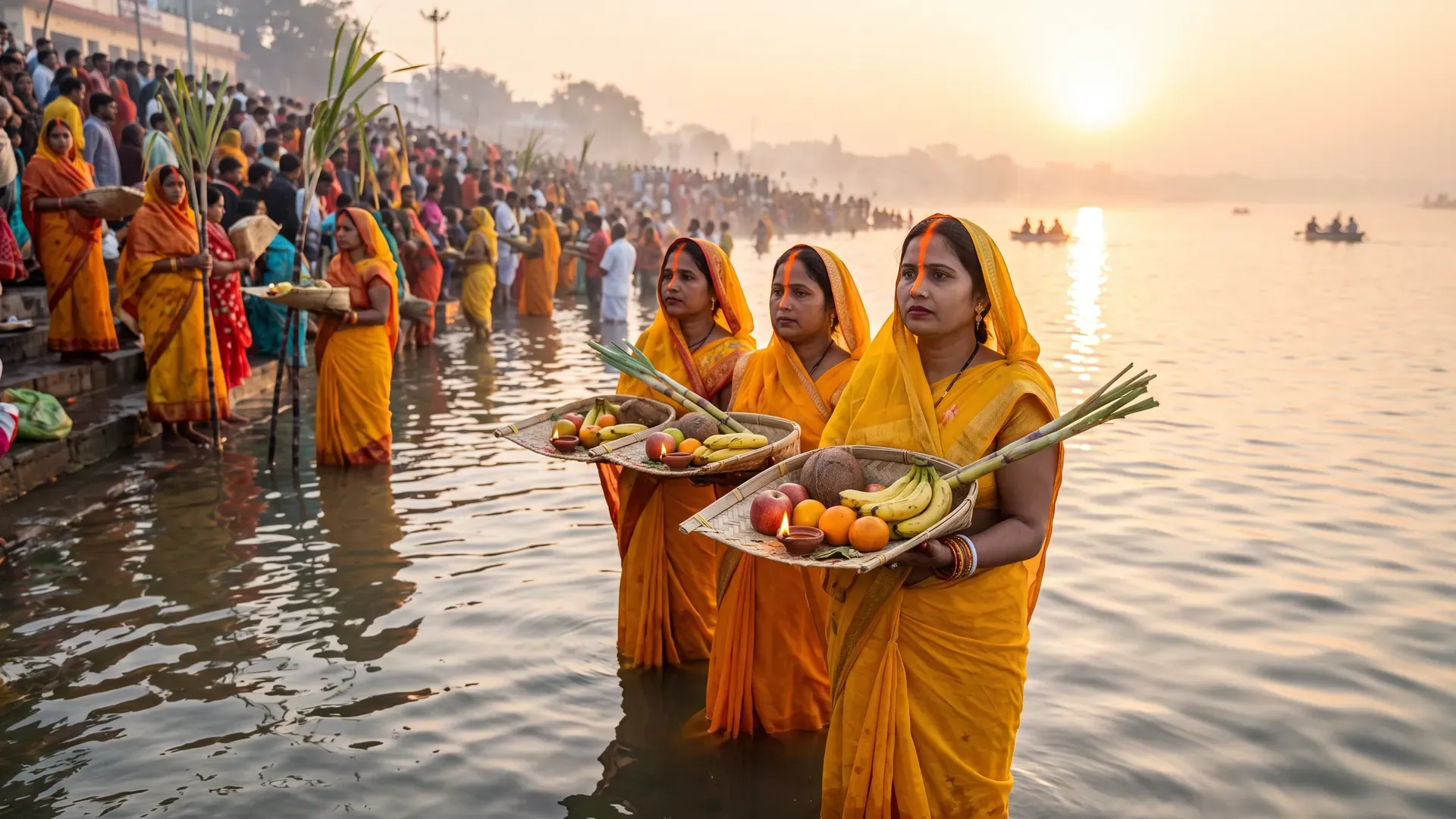
The Sandhya Arghya of Chhath Puja 2026 is on Sunday, 15 November, and the vrat ends the next morning with the Usha Arghya. It is a four-day vrat from Kartik Shukla Chaturthi to Saptami, in which devotees offer arghya to the setting and the rising sun and worship Chhathi Maiya. See your city’s sunset and sunrise below.
Each morning the tithi, Rahu Kaal and coming festivals, in one short WhatsApp message.Follow the channel
Chhath Puja 2026: Nahay-Khay on Friday 13 November, Kharna on Saturday 14 November, Sandhya Arghya on Sunday 15 November (Patna 5:01 PM, New Delhi 5:28 PM) and Usha Arghya on Monday 16 November (Patna 6:07 AM, New Delhi 6:44 AM).
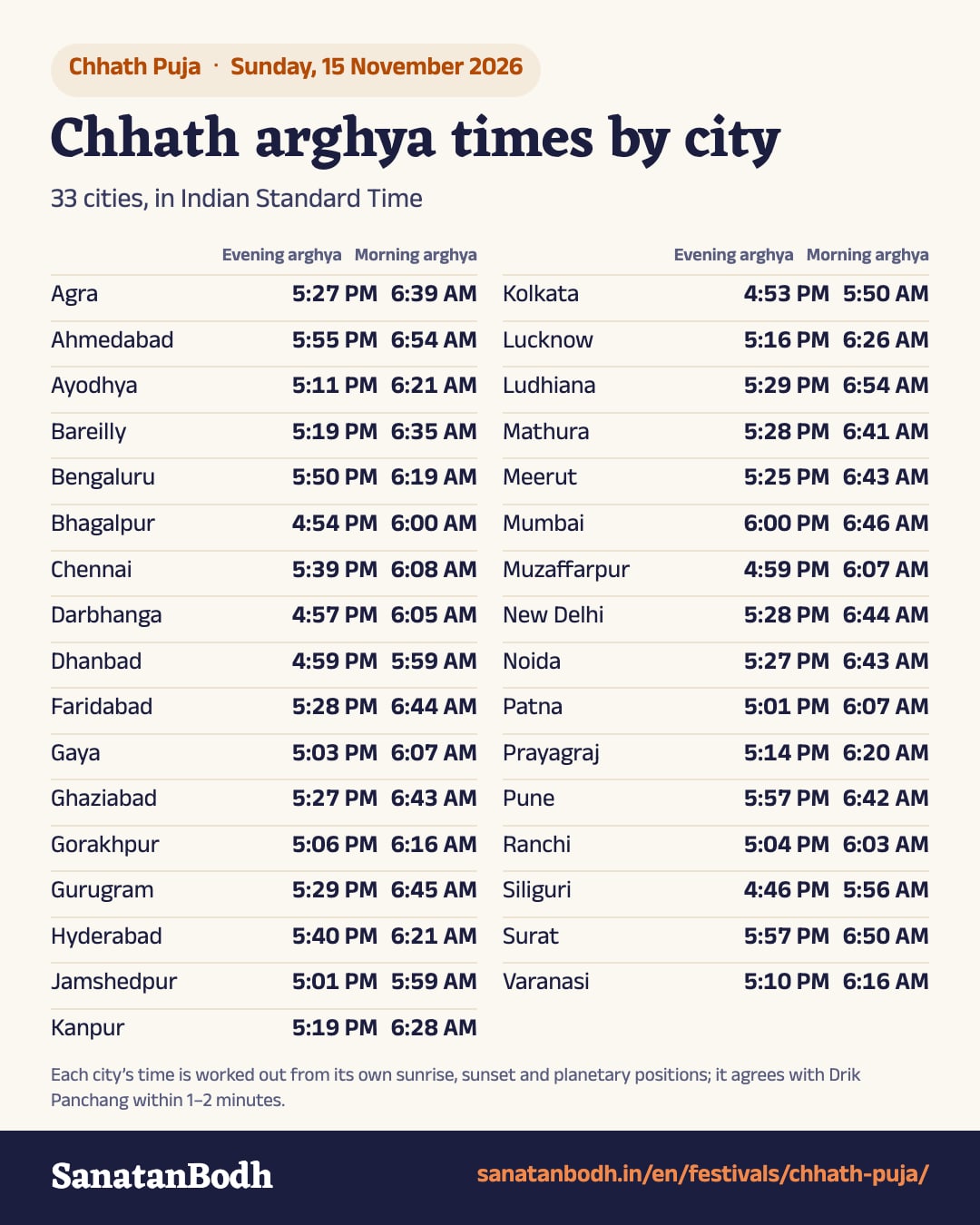
City-wise times: Evening arghya
Pick your city for its full timings, nearby cities and common questions.
- New Delhi5:28 PM
- Varanasi5:10 PM
- Mumbai6:00 PM
- Kolkata4:53 PM
- Chennai5:39 PM
- Bengaluru5:50 PM
- Hyderabad5:40 PM
- Ahmedabad5:55 PM
- Lucknow5:16 PM
- Patna5:01 PM
- Pune5:57 PM
- Noida5:27 PM
- Gurugram5:29 PM
- Ghaziabad5:27 PM
- Faridabad5:28 PM
- Ludhiana5:29 PM
- Agra5:27 PM
- Mathura5:28 PM
- Prayagraj5:14 PM
- Kanpur5:19 PM
- Ayodhya5:11 PM
- Gorakhpur5:06 PM
- Meerut5:25 PM
- Bareilly5:19 PM
- Gaya5:03 PM
- Muzaffarpur4:59 PM
- Bhagalpur4:54 PM
- Darbhanga4:57 PM
- Ranchi5:04 PM
- Jamshedpur5:01 PM
- Dhanbad4:59 PM
- Siliguri4:46 PM
- Surat5:57 PM
At a glance
- Tithi
- Kartik Shukla Chaturthi to Saptami
- Main day
- Shashthi: Sandhya Arghya to the setting sun
- Four days
- Nahay-Khay, Kharna, Sandhya Arghya, Usha Arghya
- Worshipped
- Surya and Chhathi Maiya (Shashthi Devi)
- Fast
- About 36 hours after Kharna, traditionally without water (nirjala)
- Main prasad
- Thekua, jaggery kheer (rasiyav), seasonal fruit
- Especially in
- Bihar, Jharkhand, eastern Uttar Pradesh, the Terai of Nepal
- In a year
- Twice: the Chhath of Kartik and Chaiti Chhath (Chaitra Shukla Shashthi)
The four-day vrat
The Chhath vrat is completed over four days. The date of each day is given in the timing box above; the rites vary a little by region and family.
Day 1: Nahay-Khay
On Chaturthi, those keeping the vrat bathe in a river, a pond or at home, purify the house and eat one sattvik (pure vegetarian) meal; traditionally bottle gourd (kaddu), chana dal and rice, cooked with rock salt.
Folk traditionDay 2: Kharna
On Panchami, after fasting all day, a puja is done in the evening and the prasad of jaggery kheer and roti is eaten. It is also called Lohanda. After this, the fast without water begins.
Folk traditionDay 3: Sandhya Arghya
On Shashthi, the family arranges thekua and fruit in the soop (winnowing basket) and daura (bamboo basket) and goes to the ghat. Standing in the water, those keeping the vrat offer arghya to the setting sun.
Folk traditionDay 4: Usha Arghya
On Saptami, they reach the ghat before sunrise and offer arghya to the rising sun. After this, the prasad is eaten and the fast is broken (parana).
Folk traditionChhathi Maiya and Surya
At Chhath, Surya and Chhathi Maiya are worshipped together. In folk belief, Chhathi Maiya is Surya’s sister, and she is identified with Shashthi Devi.
Shashthi Devi
The Prakriti Khanda of the Brahmavaivarta Purana describes Shashthi Devi as the sixth portion of Mula Prakriti, also named Devasena, and the goddess who protects children. This is why the Chhath vrat is kept with prayers for the well-being and protection of children.
Brahmavaivarta Purana, Prakriti Khanda; folk traditionWorship of Savitr
In the Vedas, the sun is praised as Savitr; the Gayatri mantra is a prayer to Savitr. The arghya of Chhath is worship of this god who can be seen.
Rigveda 3.62.10Sun worship in the Mahabharata
According to the Vana Parva of the Mahabharata, at the start of the exile, on the advice of the priest Dhaumya, Yudhishthira worshipped Surya, and Surya gave him the Akshaya Patra (inexhaustible vessel), which kept everyone fed in the forest. Folk tradition also links Draupadi and Karna, the son of Surya, to Chhath.
Mahabharata, Vana Parva; folk traditionPurity and folk tradition
Chhath is regarded as a vrat of purity. The prasad is traditionally cooked on an earthen stove with mango wood, and no onion or garlic is used. Bamboo soops and dauras are used in the puja. Usually no priest is needed; those keeping the vrat offer the arghya themselves, and Chhath folk songs are sung at the ghat. When a vow has been fulfilled, many families fill the kosi (a canopy of sugarcane with lamps) on the night of the Sandhya Arghya. Both women and men keep this vrat.
How to perform the puja
- Step 1
Nahay-Khay
Bathe, clean the house and the kitchen, and eat one sattvik meal.
- Step 2
Kharna
After fasting all day, do the puja in the evening, eat the prasad of jaggery kheer and roti and share it. The fast without water begins after this; if you are pregnant, unwell or taking medication, decide according to your health.
- Step 3
Prasad and daura
On Shashthi, make thekua and arrange fruit, sugarcane, a coconut and a lamp in the soop and daura.
- Step 4
Sandhya Arghya
Before sunset, stand in the water at the ghat and, holding the soop, offer arghya of milk and water to the setting sun.
- Step 5
Usha Arghya
On Saptami, reach the ghat before sunrise and offer arghya to the rising sun; pray to Chhathi Maiya for the family’s well-being.
- Step 6
Parana
After the arghya, eat the prasad and break the fast; the prasad is shared at the ghat and among family and neighbours.
King Priyavrata and Shashthi Devi
According to the Brahmavaivarta Purana, King Priyavrata, son of Svayambhuva Manu, had no child for a long time. After a long wait the queen gave birth to a son, but he was stillborn. As the king was lost in grief, a divine goddess appeared before him. She introduced herself as Devasena, Shashthi Devi, and brought the child back to life. The king then worshipped Shashthi Devi and spread her worship. Folk tradition links the Chhath vrat, and the "Chhathi" rite on the sixth day after a baby’s birth, to this Shashthi Devi.
Brahmavaivarta Purana, Prakriti Khanda; folk traditionRead the full kathaVerses
तत्सवितुर्वरेण्यं भर्गो देवस्य धीमहि।धियो यो नः प्रचोदयात्॥जपाकुसुमसङ्काशं काश्यपेयं महाद्युतिम्।तमोऽरिं सर्वपापघ्नं प्रणतोऽस्मि दिवाकरम्॥Chhath Puja: relations
See in the knowledge graphDeities, figures and sages 2
- Surya · Deity worshippedFolk tradition
- Chhathi Maiya · Deity worshippedFolk tradition
Frequently asked questions
When is Chhath Puja 2026?
The Sandhya Arghya is on Sunday, 15 November and the Usha Arghya the next morning. Nahay-Khay and Kharna fall on the two days before it; see the dates of all four days above.
When is Nahay-Khay 2026?
On Friday, 13 November 2026, the first day of Chhath (sunrise 6:42 AM in New Delhi, 6:05 AM in Patna). Kharna follows on 14 November, the Sandhya Arghya on 15 November and the Usha Arghya on 16 November.
When is Kharna 2026?
On Saturday, 14 November 2026, the second day of Chhath. After fasting all day, the prasad is taken in the evening after sunset; sunset is at 5:28 PM in New Delhi and 5:01 PM in Patna.
At what time is the Chhath arghya on 15 and 16 November?
The Sandhya Arghya is offered to the setting sun on Sunday, 15 November 2026; sunset: Patna 5:01 PM, New Delhi 5:28 PM, Lucknow 5:16 PM, Kolkata 4:53 PM, Mumbai 6:00 PM, Bengaluru 5:50 PM. The Usha Arghya is offered to the rising sun on Monday, 16 November 2026; sunrise: Patna 6:07 AM, New Delhi 6:44 AM, Lucknow 6:26 AM, Kolkata 5:50 AM, Mumbai 6:46 AM, Bengaluru 6:19 AM. Other cities are in the list above.
Who is Chhathi Maiya?
Chhathi Maiya is identified with Shashthi Devi, whom the Brahmavaivarta Purana calls the goddess who protects children. In folk belief, she is Surya’s sister.
What is Kharna?
The second day of Chhath. After fasting all day, the prasad of jaggery kheer and roti is eaten in the evening, and then the fast without water begins.
Is Chhath celebrated twice a year?
Yes. The Chhath of Kartik Shukla Shashthi is the biggest; Chaiti Chhath is also celebrated on Chaitra Shukla Shashthi.
Sources
- Brahmavaivarta Purana, Prakriti Khanda (Shashthi Devi and King Priyavrata)
- Devi Bhagavata Purana, Skandha 9 (Shashthi Devi)
- Rigveda 3.62.10 (Gayatri mantra)
- Mahabharata, Vana Parva (Yudhishthira’s worship of Surya)
- Navagraha Stotra
- Folk tradition
- Muhurat and moonrise: SanatanBodh panchang calculation, checked against Drik Panchang (New Delhi, 2026–27)
Something wrong? Report a mistake