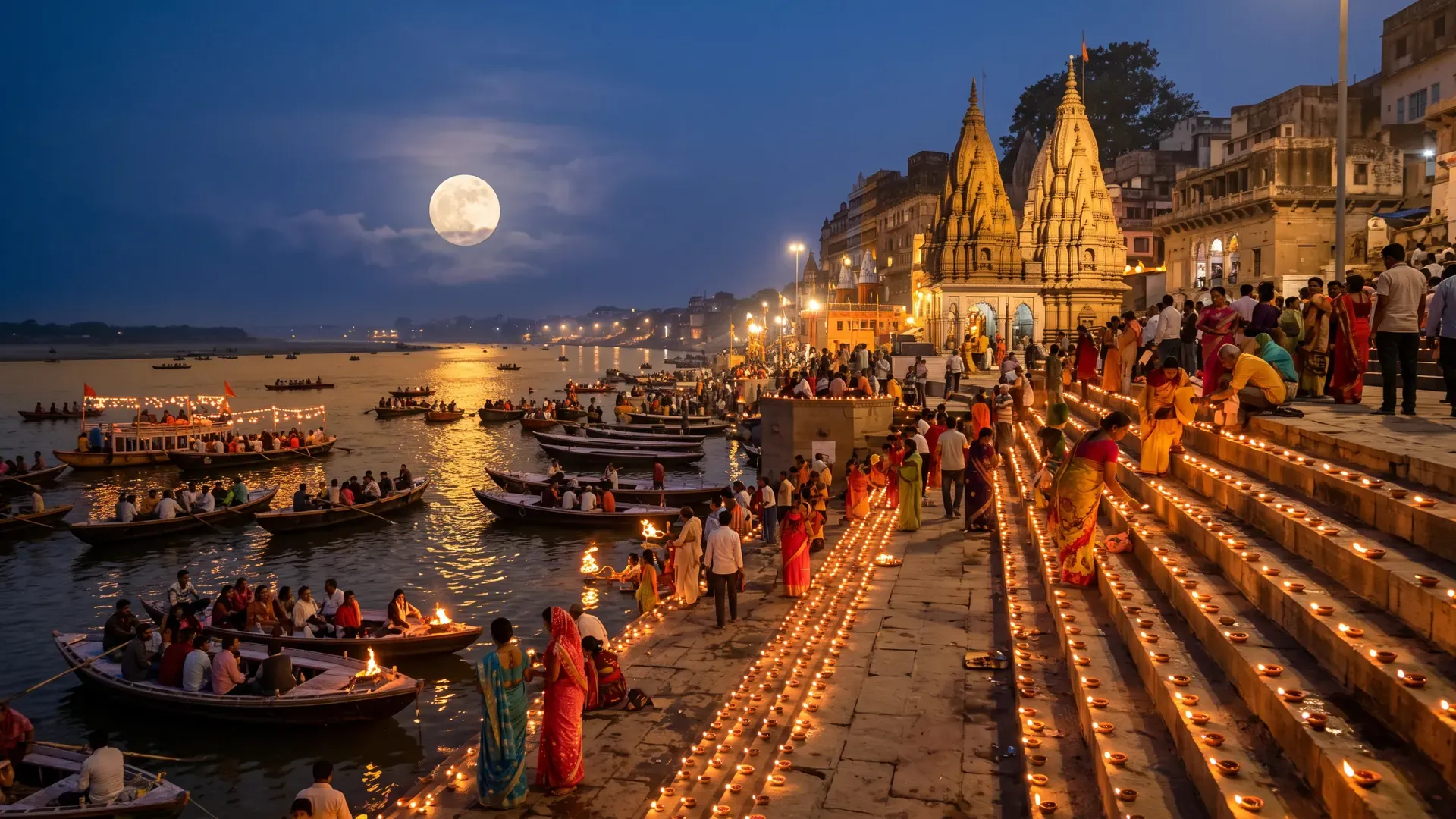
Kartik Purnima 2026 is on Tuesday, 24 November 2026: in New Delhi the Purnima tithi runs from 11:43 PM on 23 November to 8:24 PM on 24 November. The bath is taken before sunrise (Brahma muhurat 5:03–5:57 AM in New Delhi, sunrise 6:51 AM), the lamps are offered in the evening after sunset, and the Pradosh Kaal of Dev Deepawali at Varanasi is 5:08–7:47 PM. The Kartika Mahatmya of the Padma Purana gives the method for the bath and the lamps; no number of lamps is fixed. The times for six cities are in one table below.
New Delhi and Varanasi: Kartik Purnima 2026
- Purnima tithiNew Delhi, our calculation
- 23 November, 11:43 PM – 24 November, 8:24 PM
- Brahma muhurat (the bath)New Delhi, 24 November
- 5:03–5:57 AM
- SunriseNew Delhi
- 6:51 AM
- Pradosh Kaal (the lamps)New Delhi
- 5:25–8:06 PM
- Pradosh Kaal, Dev DeepawaliVaranasi
- 5:08–7:47 PM
- MoonriseNew Delhi
- 5:01 PM
In Indian Standard Time, SanatanBodh panchang calculation; each city’s time was checked against Drik Panchang.
Six cities: the times
| City | Brahma muhurat | Sunrise | Sunset | Moonrise |
|---|---|---|---|---|
| Varanasi | 4:36–5:29 AM | 6:21 AM | 5:08 PM | 4:45 PM |
| Prayagraj | 4:40–5:33 AM | 6:26 AM | 5:12 PM | 4:50 PM |
| Haridwar | 5:01–5:55 AM | 6:49 AM | 5:18 PM | 4:54 PM |
| New Delhi | 5:03–5:57 AM | 6:51 AM | 5:25 PM | 5:01 PM |
| Ujjain | 5:02–5:54 AM | 6:46 AM | 5:40 PM | 5:20 PM |
| Pushkar | 5:11–6:04 AM | 6:57 AM | 5:39 PM | 5:17 PM |
The bath is before sunrise, the lamps after sunset. For 24 November. In Indian Standard Time, SanatanBodh panchang calculation; each city’s time was checked against Drik Panchang.
Scripture read in a scripture, with the text and place. Custom a folk or family custom, as the sources describe it; follow your family’s and purohit’s practice.
The Kartik Purnima bath
When: before sunrise Scripture
The Kartika Mahatmya of the Padma Purana (Uttara Khanda 93) asks for the bath to be taken when two ghatis (about 48 minutes) of the night remain, that is, before sunrise. The table has the Brahma muhurat and sunrise of six cities; for New Delhi the Brahma muhurat is in the box above.
Sources: Padma Purana, Uttara Khanda, Kartika Mahatmya (N. A. Deshpande’s translation, Motilal Banarsidass); Abridged Padma Purana, Gita Press
Where: the Ganga, a river or a pond Scripture
The text ranks a natural pond tenfold above a man-made one, a river above a pond and a confluence above a river, and a bath at a tirtha gives unending merit. In tradition the Kartik Purnima bath is taken in the Ganga, the Yamuna or another sacred river or lake (Haridwar, Prayagraj, Varanasi, Pushkar).
Sources: Padma Purana, Uttara Khanda, Kartika Mahatmya (N. A. Deshpande’s translation, Motilal Banarsidass); Abridged Padma Purana, Gita Press; Gita Press: Vrat-Parichay, pp. 151–152
The order of the bath Scripture
According to the Padma Purana arghya is first offered to Damodara, then one bathes standing navel-deep in the water; householders apply sesame and amla powder. After it come tarpan to the gods, sages and ancestors, and the worship of Vishnu. In tradition the bath is followed by arghya to the Sun and the worship of Vishnu and Shiva.
Sources: Padma Purana, Uttara Khanda, Kartika Mahatmya (N. A. Deshpande’s translation, Motilal Banarsidass); Abridged Padma Purana, Gita Press
At home, or without water to bathe in Scripture
For one who is ill, travelling or without a water body, the Padma Purana (Uttara Khanda 115.8–20) gives marjan, purifying oneself by sprinkling water while saying Vishnu’s name. By custom, at home a little Gangajal is added to the bath water.
Sources: Padma Purana, Uttara Khanda, Kartika Mahatmya (N. A. Deshpande’s translation, Motilal Banarsidass); Abridged Padma Purana, Gita Press
Daan Custom
By custom, according to one’s means, grain, clothes, a lamp or money is given; Navbharat Live names rice, milk, ghee and white cloth. How much is left to one’s faith and means.
Deepdaan: when, where and how many lamps
When: after sunset Scripture
The Padma Purana (Uttara Khanda 121.26–37) praises the offering of lamps in Kartik: they are to be placed after sunset. On Kartik Purnima this is in Pradosh Kaal; the table gives each city’s sunset, and the box above the Pradosh Kaal of New Delhi and Varanasi.
Sources: Padma Purana, Uttara Khanda, Kartika Mahatmya (N. A. Deshpande’s translation, Motilal Banarsidass); Abridged Padma Purana, Gita Press
Where Scripture
The text speaks of placing lamps in homes, cowsheds, temples, cremation grounds and on the banks of water. Today lamps are lit or floated at a river or pond, and at home at the main door, by the Tulsi, the peepal and amla trees and the temple (Navbharat Live).
Sources: Padma Purana, Uttara Khanda, Kartika Mahatmya (N. A. Deshpande’s translation, Motilal Banarsidass); Navbharat Live: 51 diyas on Dev Deepawali
How many lamps Custom
No number is fixed. In the chapters of the Padma Purana we read there is no count of lamps, and Drik Panchang’s Dev Deepawali page gives none either. Navbharat Live calls odd numbers (5, 7, 9, 11, 13, 51) auspicious and names 51 lamps at home, but its parts (27, 5, 10, 4) add up to 46, so we do not repeat that split.
Light as many as your faith, family custom and means allow. For one who cannot place a lamp, the Padma Purana (115.8–20) says to light, or shield from the wind, the lamps others have placed.
Sources: Padma Purana, Uttara Khanda, Kartika Mahatmya (N. A. Deshpande’s translation, Motilal Banarsidass); Drik Panchang: Dev Deepawali 2026 (Varanasi); Navbharat Live: 51 diyas on Dev Deepawali
Dev Deepawali: the ghats of Varanasi
What it is, and when Custom
According to Drik Panchang, Dev Deepawali is kept on Kartik Purnima to mark Shiva’s victory over Tripurasura (it is also called Tripurotsav and Tripurari Purnima). Devotees bathe in the Ganga, and in the evening millions of clay lamps light the ghats of the Ganga and the temples of Banaras. It is believed in tradition that the gods themselves come to Kashi for the celebration.
Pradosh Kaal in Varanasi Custom
Drik Panchang shows the Pradosh Kaal of Dev Deepawali for Varanasi; the same muhurat is in the box above, and our calculation agrees with it.
Satyanarayan katha and Tripurari Purnima
The Satyanarayan katha on Purnima Custom
There is a tradition of the Satyanarayan katha and puja on Purnima, and many homes hold it on Kartik Purnima too. The katha of its five chapters is in our vrat katha section.
The story of Tripurasura Custom
According to the Shiva Purana (Rudra Samhita, Yuddha Khanda), Shiva destroyed the three cities (Tripura) of Tarakasura’s three sons with a single arrow and came to be called Tripurari; tradition links this victory to Kartik Purnima. The full story is on the Kartik Purnima katha page.
Read next
Frequently asked questions
When should the Kartik Purnima 2026 bath be taken?
On Tuesday, 24 November 2026 before sunrise, in the Brahma muhurat: Varanasi 4:36–5:29 AM; Prayagraj 4:40–5:33 AM; Haridwar 5:01–5:55 AM; New Delhi 5:03–5:57 AM; Ujjain 5:02–5:54 AM; Pushkar 5:11–6:04 AM (sunrise Varanasi 6:21 AM, Prayagraj 6:26 AM, Haridwar 6:49 AM, New Delhi 6:51 AM, Ujjain 6:46 AM, Pushkar 6:57 AM).
Is Kartik Purnima 2026 on 23 November or 24 November?
On 24 November. In New Delhi the Purnima tithi runs from 11:43 PM on 23 November to 8:24 PM on 24 November (our calculation), so Purnima holds at the sunrise of 24 November; the bath and daan are at dawn on 24 November, and the evening lamps and Dev Deepawali are the same day, since Purnima lasts until 8:24 PM and the Pradosh Kaal falls inside it. In Drik Panchang Purnima runs from 11:42 PM on 23 November to 8:23 PM on 24 November; our calculation is one minute later.
When is Dev Deepawali 2026, and what is its muhurat?
On the evening of Tuesday, 24 November 2026, on Kartik Purnima. In Varanasi the Pradosh Kaal is 5:08–7:47 PM (Drik Panchang gives the same), in New Delhi 5:25–8:06 PM (our calculation by the same rule). The lamps are lit after sunset.
What is done on Kartik Purnima?
A bath before sunrise in the Ganga or another sacred river or lake (at home, with a little Gangajal in the bath water), arghya to the Sun, the worship of Vishnu and Shiva, daan according to one’s means, and in the evening, after sunset, deepdaan. Many homes also hold the Satyanarayan katha.
How many lamps should be offered on Kartik Purnima?
No number is fixed. Neither the Padma Purana we read nor Drik Panchang’s page counts the lamps; some articles call odd numbers (5, 11, 51) auspicious. Place as many as your faith, family custom and means allow; one who cannot place a lamp may light, or shield from the wind, those others have placed (Padma Purana 115.8–20).
What is Dev Deepawali, and how is it different from Diwali?
Diwali is the festival of Lakshmi puja on Kartik Amavasya; Dev Deepawali comes a fortnight later on Kartik Purnima and, according to Drik Panchang, marks Shiva’s victory over Tripurasura. In Varanasi the ghats of the Ganga glow that evening with millions of lamps.
What if you cannot bathe in the Ganga on Kartik Purnima?
Bathe at home with a little Gangajal in the water (custom); for one who is ill, travelling or without a water body, the Padma Purana (Uttara Khanda 115.8–20) gives marjan, purification by sprinkling water while saying Vishnu’s name.
What is the Kartik Purnima katha?
According to the Shiva Purana Shiva burned the three cities (Tripura) of Tarakasura’s three sons with a single arrow and came to be called Tripurari; tradition links the victory to Kartik Purnima. The full story is on the katha page.
Sources
- Padma Purana, Uttara Khanda, Kartika Mahatmya (N. A. Deshpande’s translation, Motilal Banarsidass; Gita Press’s abridged Padma Purana): the bath (chapter 93), marjan (115.8–20), the lamps (121.26–37)
- Gita Press: Vrat-Parichay, pp. 151–152 (the Kartik bath from Ashwin Purnima to Kartik Purnima)
- Drik Panchang: Dev Deepawali 2026 (Varanasi: Pradosh Kaal, the Purnima tithi, the victory over Tripurasura); the day panchang for 24 November 2026 for six cities and for 23 November for New Delhi
- Navbharat Live: 51 diyas on Dev Deepawali (the number of lamps, the places, daan)
- Shiva Purana, Rudra Samhita, Yuddha Khanda: the destruction of Tripura
- Tithi, Brahma muhurat, sunrise, sunset and moonrise: SanatanBodh panchang calculation (Lahiri ayanamsha), checked against Drik Panchang
Something wrong? Report a mistake