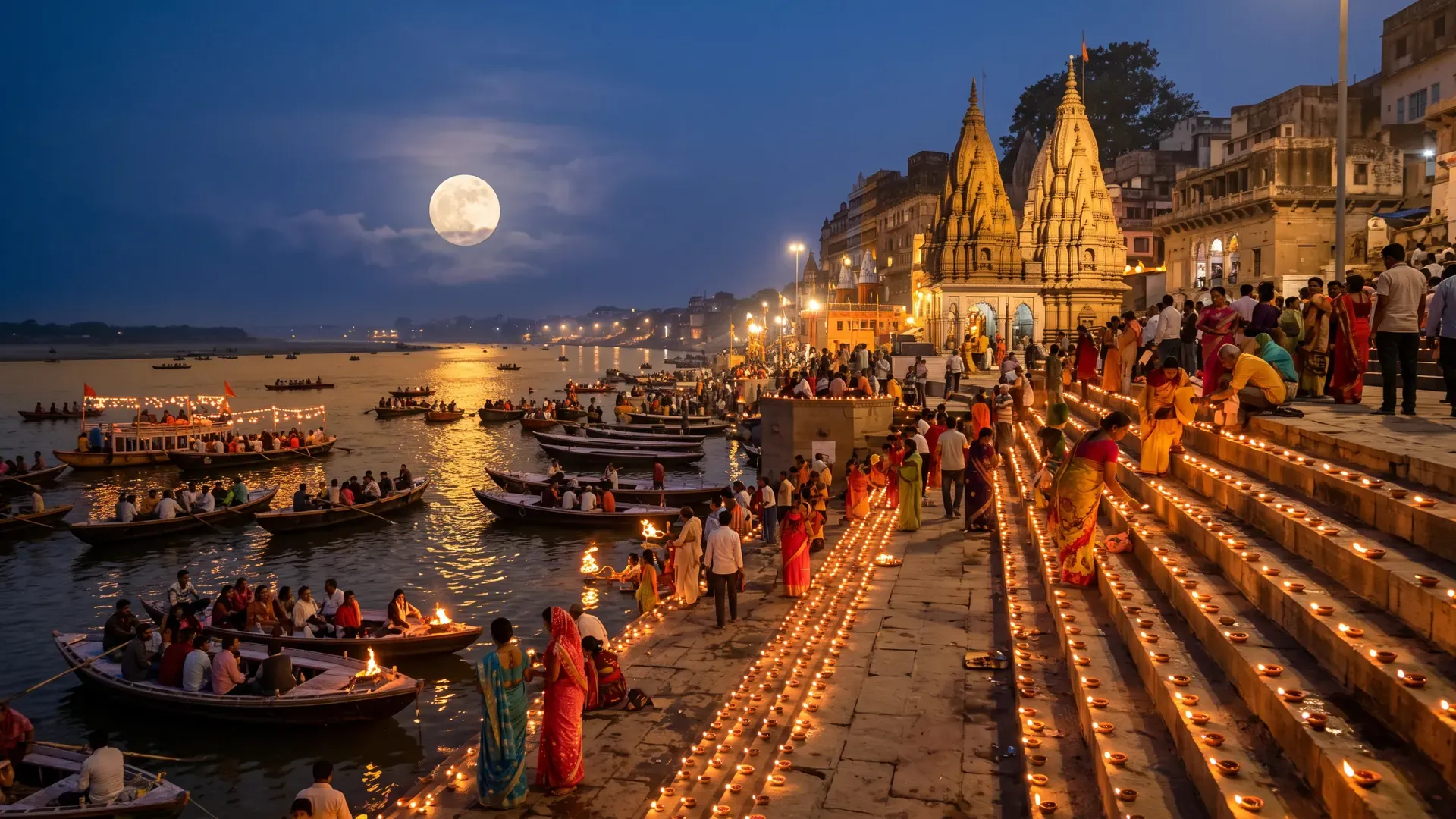
Kartik month 2026 runs from 27 October to 24 November in North India’s Purnimanta calendar, and from 10 November to 8 December in the Amanta calendar of Gujarat, Maharashtra and South India. The Kartik bath is taken from Ashwin Purnima to Kartik Purnima: in 2026 from dawn on 26 October to 24 November. The Padma Purana gives the month five observances: keeping awake, the dawn bath, serving Tulsi, the udyapan and the gift of lamps.
Kartik month 2026: dates (New Delhi)
- Kartik month (Purnimanta, North India)Kartik Krishna Pratipada to Kartik Purnima
- 27 October – 24 November 2026
- Kartik month (Amanta: Gujarat, Maharashtra, South India)From the day after the Diwali Amavasya
- 10 November – 8 December 2026
- Kartik snanAshwin Purnima (Purnima holds at dawn on 26 October) to Kartik Purnima
- 26 October – 24 November 2026
- Start of the Kartik vow in the Padma PuranaAshwin Shukla Ekadashi (Papankusha Ekadashi)
- 22 October 2026
- Kartik Purnima tithiSnan-daan and Dev Deepawali on 24 November
- 23 November 11:43 PM – 24 November 8:24 PM
In Indian Standard Time, SanatanBodh panchang calculation, checked against Drik Panchang. The festival days are the same in the Purnimanta and Amanta calendars; only the name of the month changes.
The five observances of Kartik
In the Kartika Mahatmya of the Padma Purana, Suta says that keeping awake for Vishnu, the morning bath, the service of Tulsi, the closing rite (udyapan) and the offering of lamps are the five observances of Kartik, and that with them the Kartik vow is complete (Deshpande’s translation, Uttara Khanda 115.1–4; Gita Press gives it at 117.3).
In the same text Krishna tells Satyabhama that among plants Tulsi, among months Kartik, among tithis Ekadashi and among holy places Dwarka are dear to him (Uttara Khanda 112.1–5). Drik Panchang too calls the whole month a month for the worship of Vishnu; in the Vaishnava tradition it is called Damodara month.
हरिजागरणं प्रातःस्नानं तुलसिसेवनम्।उद्यापनं दीपदानं व्रतान्येतानि कार्तिके॥Harijaagaranam praatahsnaanam tulasisevanam | Udyaapanam deepadaanam vrataanyetaani kaartike ||
Kartik snan: when and how
According to Gita Press’s ‘Vrat-Parichay’ (after Hemadri and the Madanaparijata), the Kartik bath begins on Ashwin Purnima and is completed on the thirty-first day, Kartik Shukla Purnima; Drik Panchang too gives Sharad Purnima to Kartik Purnima. The Padma Purana asks for the vow to be taken from Ashwin Shukla Ekadashi (Uttara Khanda 92.2–15). In 2026 Ashwin Purnima lasts until 9:42 AM on 26 October in New Delhi, so the first Kartik bath is at dawn on 26 October.
According to the Padma Purana (Uttara Khanda 93) the bath is taken when two ghatis (about 48 minutes) of the night remain, that is, before sunrise. A natural pond is ranked tenfold above a man-made one, a river above a pond and a confluence above a river, and a bath at a tirtha gives unending merit. Arghya is first offered to Damodara, then one bathes standing navel-deep in the water; householders apply sesame and amla powder. Then tarpan to the gods, sages and ancestors, and the worship of Vishnu.
For one who is ill, travelling or without water to bathe in, the same text gives marjan, purifying oneself by sprinkling water while saying Vishnu’s name (Uttara Khanda 115.8–20). The rule follows one’s capacity.
Deepdaan and akashdeep
In the Padma Purana (Uttara Khanda 121.26–37) Shiva tells Kartikeya the merit of lamps in Kartik: after sunset lamps are to be placed in homes, cowsheds, temples, cremation grounds and on the banks of water; five days of the dark half are singled out (Gita Press’s note: Kartik Krishna Trayodashi to Shukla Dwitiya, that is Dhanteras to Bhai Dooj). One who cannot offer a lamp may light, or shield from the wind, the lamps others have placed (115.8–20).
Akashdeep: the Nirnaya Sindhu quotes the Pushkara Purana that while the Sun is in Libra (in Kartik) an akashdeep, a raised lamp, is offered at dusk with sesame oil. Hemadri (citing the Aditya Purana) gives the method: a post of a man’s height near the house with the lamp at its top. Gita Press’s ‘Vrat-Parichay’ records that people tie a lantern to a long bamboo and light the ‘akashi deepak’ in a high place.
Custom: Today most homes light a diya by the Tulsi and at the door every evening of Kartik, and hang an akashdeep on a bamboo or in a lantern on the roof. This is custom; follow your family’s practice for the number and the direction of the lamps.
Tulsi puja
In the Padma Purana’s chapter on the bath (Uttara Khanda 93.20–32), after the bath and the worship of Vishnu comes the worship of Tulsi, circling her and bowing with the mantra below; then the story of Vishnu is heard. A separate chapter praises Tulsi and the amla tree (Uttara Khanda 105): planting, watering, seeing and touching Tulsi are called meritorious.
For the udyapan the text asks for a canopy over the Tulsi on Kartik Shukla Chaturdashi and a mandala (chowk) in four colours at her root (Uttara Khanda 95.1–9). Waking the Lord on Dev Uthani Ekadashi and the Tulsi Vivah on Dwadashi fall in this month.
देवैस्त्वं निर्मिता पूर्वमर्चितासि मुनीश्वरैः।नमो नमस्ते तुलसि पापं हर हरिप्रिये॥Devaistvam nirmitaa poorvamarchitaasi muneeshvaraih | Namo namaste tulasi paapam hara haripriye ||
The vow’s rules, as the text gives them
The Padma Purana (Uttara Khanda 94) gives these rules for one keeping the Kartik vow: no meat or honey; leaving onion, garlic and some vegetables (such as brinjal, pumpkin and radish); not eating others’ food; celibacy, sleeping on the ground, eating from a leaf plate; no oil on the body except on Narak Chaturdashi; speaking ill of no one.
Drik Panchang notes that not all these rules are kept today, and that the dawn bath, lamps and arghya, sleeping on the floor, the worship of Vishnu and the Shaligram and recitations such as the Vishnu Sahasranama are the main ones. The text too gives smaller ways for one who is unable. Take the vow you can keep; in illness or pregnancy ask your doctor and your purohit.
Fasts and festivals of Kartik 2026
Purnimanta Kartik (27 October – 24 November), for New Delhi. Names with their own page are links.
| Date | Fast / festival | Tithi |
|---|---|---|
| Thursday, 29 October | Karva Chauth | Kartik Krishna Chaturthi (Purnimanta) |
| Sunday, 1 November | Ahoi Ashtami | Kartik Krishna Ashtami (Purnimanta) |
| Thursday, 5 November | Rama Ekadashi | Kartik Krishna Ekadashi (Purnimanta) |
| Friday, 6 November | Dhanteras | Kartik Krishna Trayodashi (Purnimanta) |
| Sunday, 8 November | Narak Chaturdashi | Kartik Krishna Chaturdashi (Purnimanta) |
| Sunday, 8 November | Diwali (Deepavali) | Kartik Amavasya (Purnimanta) |
| Sunday, 8 November | Kali Puja (Bengal) | Kartik Amavasya (Purnimanta) |
| Tuesday, 10 November | Govardhan Puja | Kartik Shukla Pratipada |
| Wednesday, 11 November | Bhai Dooj | Kartik Shukla Dwitiya |
| Sunday, 15 November | Chhath Puja | Kartik Shukla Shashthi |
| Monday, 16 November | Sabarimala Mandala season | The evening before the Malayalam month day Vrischikam 1 |
| Tuesday, 17 November | Gopashtami | Kartik Shukla Ashtami |
| Wednesday, 18 November | Akshaya (Amla) Navami | Kartik Shukla Navami |
| Friday, 20 November | Dev Uthani Ekadashi | Kartik Shukla Ekadashi |
| Friday, 20 November | Bhishma Panchak begins (to 24 November) | Kartik Shukla Ekadashi |
| Saturday, 21 November | Tulsi Vivah | Kartik Shukla Dwadashi |
| Monday, 23 November | Vaikuntha Chaturdashi | Kartik Shukla Chaturdashi |
| Tuesday, 24 November | Kartik Purnima | Kartik Purnima |
| Tuesday, 24 November | Karthigai Deepam | Tamil month Karthigai, Krittika nakshatra |
For this month
Frequently asked questions
When is Kartik month in 2026?
In the Purnimanta calendar (North India) from 27 October to 24 November 2026, and in the Amanta calendar (Gujarat, Maharashtra, South India) from 10 November to 8 December 2026. The Purnima, Amavasya and festival days are the same in both; only the name of the month changes.
When does Kartik snan begin in 2026?
From Ashwin (Sharad) Purnima. In 2026 Purnima runs from 11:57 AM on 25 October to 9:42 AM on 26 October in New Delhi, so the first bath is at dawn on 26 October, and the last on Kartik Purnima, 24 November. The Padma Purana asks for the vow to be taken from Ashwin Shukla Ekadashi (22 October).
At what time is the Kartik bath taken?
Before sunrise. The Padma Purana gives the bath when two ghatis (about 48 minutes) of the night remain. Without a river or tirtha, bathe at home; for one who is ill or travelling, marjan while saying Vishnu’s name.
Where are lamps offered in Kartik?
The Padma Purana asks for lamps after sunset in the home, the cowshed, the temple and on the banks of water, and singles out the five days from Dhanteras to Bhai Dooj. A diya by the Tulsi and at the door, and an akashdeep on a tall bamboo, are customs.
What is not eaten in Kartik month?
For those keeping the Kartik vow the Padma Purana (Uttara Khanda 94) asks them to leave meat, honey, onion, garlic and some vegetables (brinjal, pumpkin, radish and others). These are rules of the vow; not everyone keeps them. Take the vow your capacity and your family’s practice allow.
Why is Kartik month special?
In the Kartika Mahatmya of the Padma Purana Krishna says Kartik is dear to him among months, and the month has five observances: keeping awake, the morning bath, serving Tulsi, the udyapan and the lamps. Karva Chauth, Diwali, Chhath, Dev Uthani Ekadashi, Tulsi Vivah and Dev Deepawali all fall in it.
Sources
- Padma Purana, Uttara Khanda, Kartika Mahatmya (chs. 88–124), tr. N. A. Deshpande, Motilal Banarsidass (archive.org: PadmaPuranaMotilalVol.3Thru10)
- Abridged Padma Purana, Gita Press, Uttara Khanda: the chapters on the Kartik bath and worship, the vow’s rules and udyapan, the vow when one is unable, and the lamps (archive.org: padma-puran-gita-press)
- Drik Panchang: Kartika Month, Kartika Mahatmya and Kartika Festivals 2026 (New Delhi)
- Gita Press, Vrat-Parichay (Pt. Hanuman Sharma), pp. 151–152: Kartik snan (archive.org: 610-vrat-parichay)
- Nirnaya Sindhu (Kamalakara Bhatta), the Kartika section: akashdeep (quoting the Pushkara Purana and Hemadri), Khemraj Shrikrishnadas, Mumbai 1927 (archive.org)
- Kartika Mahatmya (from the Padma Purana), Hindi commentary by Pt. Keshavprasad Sharma Dvivedi, Khemraj Shrikrishnadas, Mumbai (archive.org: kartika_mahatmya)
- Drik Panchang: Purnima Dates 2026 and Amavasya Dates 2026 (New Delhi)
- SanatanBodh panchang calculation (New Delhi, Lahiri ayanamsha)
Something wrong? Report a mistake
