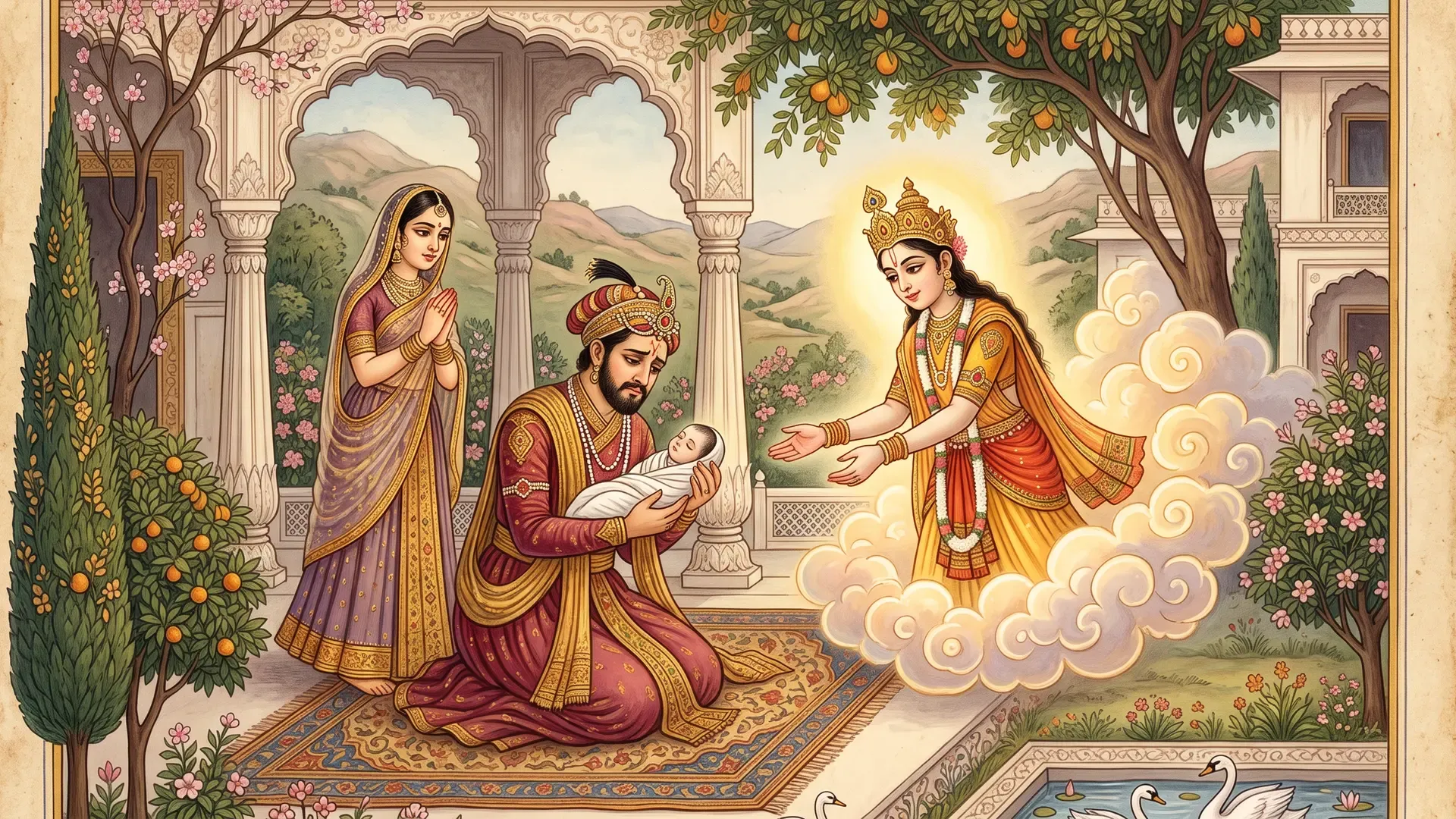
The story most often told at Chhath is that of King Priyavrata. By the Brahmavaivarta Purana and the Devi Bhagavata, his queen Malini’s son was born dead; Devi Shashthi (Devasena) appeared, brought the child back to life, and the king spread her worship. These texts do not name Kartik, Surya or Chhath; linking Chhathi Maiya to this Devi Shashthi is tradition.
Each morning the tithi, Rahu Kaal and coming festivals, in one short WhatsApp message.Follow the channel
Chhath Puja is a four-day vrat from Kartik Shukla Chaturthi to Saptami, with Shashthi as the main day. Those keeping it offer water to the setting and the rising sun and worship Chhathi Maiya. Drik Panchang also calls it Surya Shashthi and Dala Chhath; the same vrat is kept in Chaitra as Chaiti Chhath.
In tradition Chhathi Maiya is taken to be Devi Shashthi, and hers is the story most often told at Chhath. It is in the Brahmavaivarta Purana (Prakriti Khanda, chapter 43) and the Devi Bhagavata Purana (Book 9, chapter 46), and we have read and checked it in both. But these texts set Shashthi’s worship on the Shukla Shashthi of every month and after the birth of a child; they do not name the month of Kartik, Surya or the Chhath festival. Linking this story to Chhath on Kartik Shukla Shashthi is later tradition.
Three more stories are told in folk tradition: of Karna, son of Surya, of Draupadi, and of Sita. With each we say which part has a basis in a text and which is folk belief only.
How the vrat and katha are kept
- Chhath’s rites come from folk tradition and vary a little by region and family. Day one, Nahay-Khay (Chaturthi): a bath, then one sattvic meal, by custom bottle gourd (kaddu) with rice.
- Day two, Kharna or Lohanda (Panchami): a fast all day, then kheer and roti as prasad in the evening; after this the fast without water begins.
- Day three, Sandhya Arghya (Shashthi): in the evening, at the water’s edge, water is offered to the setting sun.
- Day four, Usha Arghya (Saptami): water is offered to the rising sun at dawn, and then the fast is broken (parana).
- The offerings are thekua, wheat-flour sweets pressed in moulds, and fruit, arranged in bamboo winnowing baskets (soop) and baskets (daura), with clay lamps lit beside them.
King Priyavrata, Queen Malini and Devi Shashthi
As told in the Brahmavaivarta Purana, Prakriti Khanda, chapter 43 (Sanskrit text), and the Devi Bhagavata Purana, Book 9, chapter 46. The two tell it almost alike; in the Brahmavaivarta Narayana tells it to Narada.
Priyavrata, son of Svayambhuva Manu, was a yogi. His mind was set on austerity and meditation, and he did not wish to marry. Brahma persuaded him, and then he married. His queen was named Malini.
A long time passed, but they had no child. Then the sage Kashyapa performed for them the putreshti yajna, the rite for a son, and the charu, the sacred food of the offering, was given to Queen Malini.
The queen carried the child for twelve divine years. Then she gave birth to a son who shone like gold, but there was no life in him.
King Priyavrata took the child to the cremation ground. He could not bear to part from him, and his grief was so deep that he was ready to give up his own life.
Just then a vimana, a celestial car bright as crystal and set with jewels, appeared there, and in it sat a goddess shining with radiance. She said to the king, “I am Devasena, the mind-born daughter of Brahma. Because I am the sixth part of Mula-Prakriti, I am called Shashthi. To those who have no son, I give sons.”
In the Devi Bhagavata she also says that she is the wife of Skanda (Kartikeya) and chief among the Matrikas, and that birth and death come to each being according to its karma.
Then the goddess took the child in her hands and, as if in play, brought him back to life.
But still holding the child, she began to rise towards the sky. She said the king would have the child back only if he promised to spread her worship in the world. The king gave his word, and the goddess returned the child to him.
The goddess named the boy Suvrata and blessed him: he would be learned, a yogi and renowned.
The king kept his word. He worshipped Devi Shashthi himself and had everyone worship her. Since then her festival is kept on the Shukla Shashthi of every month, and she is worshipped in the birth room on the sixth day after a child is born, on the twenty-first day, and at the annaprashana and other ceremonies of childhood. The text gives her mantra as “Om hrim Shashthidevyai svaha”.
Note: in both the Brahmavaivarta and the Devi Bhagavata this is the story of Devi Shashthi; neither names the month of Kartik, Surya or Chhath. Many katha books and websites say Priyavrata did this worship on Kartik Shukla Shashthi; that is not in the text. Tradition later linked this story to Chhath, and Chhathi Maiya came to be worshipped as Devi Shashthi.
Karna, son of Surya, and his sun worship
As told in the Mahabharata, Adi Parva 111 and Vana Parva 307 (section numbers of Ganguli’s English translation). Calling it the start of Chhath is folk belief.
Karna was the son of the sun god. By the Adi Parva of the Mahabharata he worshipped the sun every day from dawn until midday, until the sun had heated his back. While at worship he refused no brahmin anything he asked.
The Vana Parva describes how Karna, after rising from the water, praised the sun at midday with joined hands. At that hour brahmins would ask him for gifts, and it was at that hour that Indra came disguised as a brahmin to ask for his armour.
It is said in folk tradition that Karna stood waist-deep in water for hours offering water to the sun, and became a great warrior by the sun’s grace; this is held to be how Chhath’s custom of offering arghya while standing in water began. These passages of the Mahabharata speak of worship after coming out of the water and of worship until midday, but they do not describe him standing waist-deep in water, nor do they call it Chhath.
Draupadi and the Pandavas
A folk tale, given by Webdunia, Times Now Navbharat and Hindi Wikipedia. It rests on an episode in the Mahabharata, Vana Parva 3 (Ganguli’s translation).
By the popular story, the Pandavas lost their kingdom at dice and went to the forest. Then, on the advice of the priest Dhaumya, Draupadi kept the Chhath vrat, and by its merit the Pandavas got their kingdom back.
The episode in the Vana Parva of the Mahabharata is different. At the start of the exile the priest Dhaumya taught Yudhishthira the 108 names of the sun. Yudhishthira stood in the water of the Ganga and worshipped the sun, and the sun god gave him a copper vessel (the akshaya patra) whose food did not run out until Draupadi had eaten.
So in the text it is Yudhishthira who worships the sun, not Draupadi, and there is no Shashthi, no Kartik and no kingdom regained. The story of Draupadi’s Chhath vrat is a folk belief built on this episode.
Sita and Chhath
Local belief: the Ayodhya telling is given by Webdunia and Hindi Wikipedia, the Munger telling by ETV Bharat and Patrika. We did not find this story in any text we could check.
In one popular telling, after slaying Ravana and returning to Ayodhya, and before Rama’s reign began, Rama and Sita fasted on Kartik Shukla Shashthi and worshipped the sun god.
In Munger, Bihar, another story is told. Ravana was a brahmin, so slaying him was held to bring on Rama the sin of killing a brahmin. Guru Vashishtha sent Rama and Sita to the ashram of the sage Mudgal at Munger. Rama performed the rite of atonement at Kashtaharni Ghat. Women could not take part in it, so Mudgal asked Sita to keep the Chhath vrat in the ashram. Sita offered water to the setting sun facing west and to the rising sun facing east.
It is believed that her footprints are still at the Sita Charan temple, on a rock in the middle of the Ganga. Local sources tie the story to the Ananda Ramayana, but we did not find the episode in the text available online. The Munger district administration’s website links the footprints to Sita crossing the Ganga; it does not mention Chhath.
Other tellings
- In many tellings Queen Malini is given kheer from the yajna (Webdunia); the text says charu, the food of the offering. In ETV Bharat’s telling Kashyapa advises the yajna rather than performing it.
- Most printed tellings leave out the twelve divine years, and usually also the goddess rising towards the sky with the child; both are in the Brahmavaivarta Purana.
- In folk tradition Chhathi Maiya is called the sister of Surya. Webdunia credits this to the Markandeya Purana, but we found no such passage. Some sources also call her Katyayani, or the sixth form of Parvati; no text is given for this either.
- A popular explanation says the morning arghya goes to Usha and the evening one to Pratyusha, wives (shaktis) of Surya. We found no text for this; in Sanskrit dictionaries pratyusha means daybreak, not evening.
- One telling has Draupadi keeping Chhath near a spring in Nagdi village of Ranchi to win help in the war, and another has Kunti keep the vrat after the house of lac. We found both only in English Wikipedia.
After the katha
The aarti of the sun god is linked below. For the evening and dawn arghya, the sunset and sunrise for your city are on the Chhath Puja page.
Surya Aarti: Om Jai Surya BhagwanFrequently asked questions
Who is Chhathi Maiya?
In tradition Chhathi Maiya is taken to be Devi Shashthi. The Brahmavaivarta Purana and the Devi Bhagavata call Shashthi Devasena, the mind-born daughter of Brahma, the sixth part of Mula-Prakriti and the goddess who gives children; by the Devi Bhagavata she is the wife of Skanda. In folk tradition she is also called the sister of Surya, but we found no text for this; it is a folk belief.
What is the Chhath Puja katha?
The best-known katha is that of King Priyavrata. By the Brahmavaivarta Purana his queen Malini’s son was born dead; Devi Shashthi appeared, brought him back to life, named him Suvrata, and the king spread her worship. Karna’s sun worship and the folk tales of Draupadi’s and Sita’s Chhath vrat are told as well.
Do the Puranas mention the Chhath festival?
The texts in which we checked the story of Shashthi (Brahmavaivarta Purana, Prakriti Khanda 43; Devi Bhagavata 9.46) do not name Kartik, Surya or Chhath; they set Shashthi’s worship on every Shukla Shashthi and at birth ceremonies. Worshipping Chhathi Maiya together with the sun on Kartik Shukla Shashthi is folk tradition.
Did Draupadi keep the Chhath vrat?
It is a folk tale. In the Mahabharata (Vana Parva 3) the priest Dhaumya teaches Yudhishthira the 108 names of the sun, and the sun, pleased with his worship, gives him the akshaya patra. Draupadi keeps no vrat there, and Shashthi or Chhath is not named.
Sources
- Brahmavaivarta Purana, Prakriti Khanda, chapter 43 (the story of Shashthi), Sanskrit text read on sa.wikisource.org
- Devi Bhagavata Purana, Book 9, chapter 46 (Vijnanananda’s English translation, wisdomlib.org)
- Puranic Encyclopaedia (Vettam Mani): Shashthidevi, wisdomlib.org
- Mahabharata, Adi Parva 111, Vana Parva 3 and 307 (Ganguli’s English translation, en.wikisource.org and wisdomlib.org)
- Webdunia: the Puranic kathas of Chhath Puja (2025); who is Chhath Maiya (2017)
- ETV Bharat: the Chhath Puja katha (Patna, 2022); Sita’s first Chhath in Munger (2022)
- Times Now Navbharat: the Chhath Puja katha (2024); Patrika: Chhath Puja and the story of Sita
- Munger district, Government of Bihar (munger.nic.in): Manpatthar (Sita Charan)
- Hindi Wikipedia: Chhath Puja; English Wikipedia: Chhath
- India TV Hindi (2025): the evening arghya and Pratyusha; wisdomlib.org dictionary: pratyusha
- Drik Panchang: Chhath Puja
Something wrong? Report a mistake