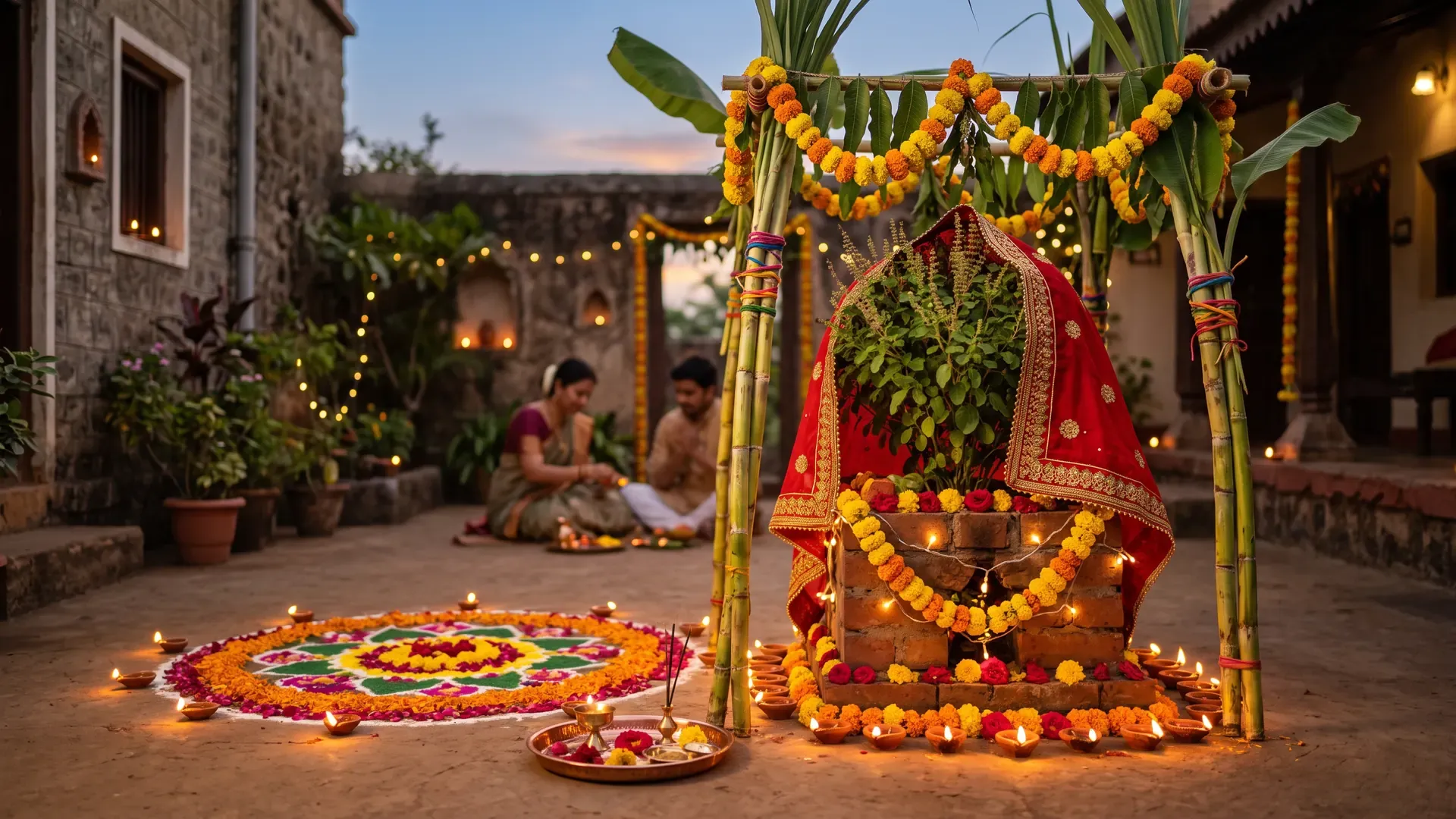
Tulsi Vivah 2026 is on Saturday, 21 November 2026 (Drik Panchang, Kartik Shukla Dwadashi); the wedding is held in the evening at the Godhuli muhurat, 5:25–5:52 PM in New Delhi. Many families hold the wedding a day earlier, on the evening of Dev Uthani Ekadashi, Friday, 20 November 2026; the Godhuli that day is 5:26–5:52 PM in New Delhi. The order of the vidhi: Tulsi on a chowki, a sugarcane mandap, dressing her as a bride, a Shaligram or an image of Vishnu or Krishna as the groom, haldi and puja, the kanyadaan, Mangalashtak and pheras at Godhuli, then aarti and prasad. The samagri list and the Godhuli times for 12 cities are below.
New Delhi: Tulsi Vivah 2026
- Godhuli muhurat (the wedding)21 November
- 5:25–5:52 PM
- Godhuli, Ekadashi evening20 November
- 5:26–5:52 PM
- Sunset21 November
- 5:25 PM
- Dwadashi tithiour calculation
- 21 November, 6:33 AM – 22 November, 4:58 AM
- Ekadashi tithiour calculation
- 20 November, 7:17 AM – 21 November, 6:33 AM
In Indian Standard Time, SanatanBodh panchang calculation; each city’s time was checked against Drik Panchang.
The Godhuli muhurat of 12 cities
| City | 20 November (Ekadashi evening) | 21 November (Dwadashi) |
|---|---|---|
| New Delhi | 5:26–5:52 PM | 5:25–5:52 PM |
| Mumbai | 5:59–6:25 PM | 5:59–6:25 PM |
| Pune | 5:56–6:22 PM | 5:56–6:22 PM |
| Ahmedabad | 5:54–6:20 PM | 5:54–6:20 PM |
| Jaipur | 5:34–6:01 PM | 5:34–6:01 PM |
| Lucknow | 5:14–5:41 PM | 5:14–5:40 PM |
| Varanasi | 5:09–5:35 PM | 5:08–5:35 PM |
| Patna | 4:59–5:26 PM | 4:59–5:26 PM |
| Kolkata | 4:52–5:18 PM | 4:52–5:18 PM |
| Bhopal | 5:34–6:00 PM | 5:34–6:00 PM |
| Hyderabad | 5:40–6:05 PM | 5:40–6:05 PM |
| Bengaluru | 5:50–6:15 PM | 5:50–6:15 PM |
Godhuli = from sunset for a thirtieth of the night (the way Drik Panchang prints it). In Indian Standard Time, SanatanBodh panchang calculation; each city’s time was checked against Drik Panchang.
Scripture read in a scripture, with the text and place. Custom a folk or family custom, as the sources describe it; follow your family’s and purohit’s practice.
What is gathered for the Tulsi Vivah
The list is of what the descriptions in Drik Panchang, Bhakti Bharat, Navbharat Live and Wikipedia mention; each family and region differs a little.
- The Tulsi plant (in a pot or its chaura) and a chowki to set it on
- Sugarcane, for the mandap
- The groom: a Shaligram stone, or an image of Vishnu or Krishna, and clothes for it
- For Tulsi: a red chunri, bangles, bindi, sindoor and the other suhag items
- Haldi (mixed with milk in many places) and akshat
- Dhoop, lamps, flowers and naivedya
- Seasonal fruit and roots: sugarcane, coconut, ber, amla, radish, leafy greens; in Maharashtra groundnuts too
- If a havan is done, the kusha-kandika materials (Drik Panchang’s method has a havan)
- An aarti thali and the prasad
The Tulsi Vivah vidhi, in order
The wedding rite comes down through tradition; we did not find its procedure in the chapters we checked (Devi Bhagavata 9.24–25 has Tulasi’s names, her tie to the Shaligram and her festival on the Kartik full moon). The order below is put together from the descriptions in Drik Panchang (after Vrat Parichay and Vishnuyamala), Bhakti Bharat, Navbharat Live and Wikipedia.
1. The day’s fast and the preparation Custom
In many families those who give the wedding fast through the day, and the wedding is in the evening. The pot of Tulsi is set on a wooden chowki in the courtyard, on the terrace or in the puja room.
Sources: Drik Panchang: Tulasi Vivah 2026 (New Delhi; the method after Vrat Parichay and Vishnuyamala); English Wikipedia: Tulasi Vivaha; Navbharat Live: Tulsi Vivah at home (2 November 2025)
2. The sugarcane mandap and the decoration Custom
A mandap of sugarcane is made over the Tulsi and decorated with flowers, lamps and a rangoli.
Sources: Navbharat Live: Tulsi Vivah at home (2 November 2025); Bhakti Bharat: Tulsi Vivah
3. Dressing the bride and the groom Custom
Tulsi is dressed as a bride: a red chunri, bangles, bindi, sindoor and the sixteen adornments. The Shaligram, or an image of Vishnu or Krishna, is dressed and set beside her as the groom.
Sources: Bhakti Bharat: Tulsi Vivah; Navbharat Live: Tulsi Vivah at home (2 November 2025); English Wikipedia: Tulasi Vivaha; Drik Panchang: Tulasi Vivah 2026 (New Delhi; the method after Vrat Parichay and Vishnuyamala)
4. Haldi and the worship Custom
Haldi is applied to both (with milk, in the Braj and Navbharat Live descriptions), then they are worshipped with dhoop, lamp, flowers and naivedya. The naivedya holds seasonal fruit and roots.
Sources: Drik Panchang: Tulasi Vivah 2026 (New Delhi; the method after Vrat Parichay and Vishnuyamala); Navbharat Live: Tulsi Vivah at home (2 November 2025)
5. The kanyadaan at Godhuli Custom
In Drik Panchang’s method the worship of Vishnu and the kanyadaan of Tulsi take place at Godhuli; see your city’s Godhuli muhurat in the table above. The family gives Tulsi away; in Maharashtra, in many places, a childless couple takes the place of her parents.
Sources: Drik Panchang: Tulasi Vivah 2026 (New Delhi; the method after Vrat Parichay and Vishnuyamala); English Wikipedia: Tulasi Vivaha; Bhakti Bharat: Tulsi Vivah
6. Mangalashtak, the rounds and the havan Custom
The Mangalashtak is read (in Maharashtra with an antarpat held between the groom and bride, removed amid showers of akshat). Then the Shaligram is carried in hand round the Tulsi (the pheras). Drik Panchang’s method also has the kusha-kandika havan and a circling of the fire, then gifts and a meal for Brahmins.
Sources: Drik Panchang: Tulasi Vivah 2026 (New Delhi; the method after Vrat Parichay and Vishnuyamala); English Wikipedia: Tulasi Vivaha; Bhakti Bharat: Tulsi Vivah; Navbharat Live: Tulsi Vivah at home (2 November 2025)
7. Aarti, prasad and the feast Custom
After the aarti of Tulsi and Vishnu the prasad is shared; in many places there is a wedding-style feast. The Tulsi aarti and the Tulsi Chalisa are in our prayers section.
Sources: Bhakti Bharat: Tulsi Vivah; Navbharat Live: Tulsi Vivah at home (2 November 2025)
Regional forms
Braj, Maharashtra, Andhra-Telangana, Bihar Custom
In the Krishna temples of Braj (Mathura, Vrindavan) the wedding of Tulsi and Krishna has all the rites: haldi, mehndi, jaimala, pheras and the baraat. In Andhra Pradesh and Telangana, at the Tulasi Kalyanam, Vishnu is set beside Tulsi as a branch of amla, and it is mostly held on Dwadashi (Kshirabdhi Dwadashi). At Saunja (Prabhu Dham) in Bihar the festival runs three days, Kartik Shukla Ekadashi to Trayodashi.
Sources: Drik Panchang: Tulasi Vivah 2026 (New Delhi; the method after Vrat Parichay and Vishnuyamala); English Wikipedia: Tulasi Vivaha; Bhakti Bharat: Tulsi Vivah
Read next
- Tulsi Vivah: date, Godhuli muhurat and rite
- Tulsi Vivah puja samagri: the full list and the Godhuli muhurat
- Dev Uthani Ekadashi puja vidhi: the chowk, waking the Lord and the parana
- Tulsi Vivah katha: Vrinda, Jalandhara and the Shaligram
- Tulsi Vivah mantras: the eight names, dhyana and stotra
- Dev Uthani Ekadashi: the fast and the parana
- Dev Uthani Ekadashi katha
- Tulsi aarti
- Kartik month: snan, deepdaan and Tulsi puja
- Wedding muhurats, November 2026
Frequently asked questions
What is the Tulsi Vivah 2026 muhurat?
On the evening of Saturday, 21 November 2026 at Godhuli, 5:25–5:52 PM in New Delhi (sunset 5:25 PM). For those who hold the wedding on the Ekadashi evening (20 November): 5:26–5:52 PM. The times of twelve cities are in the table above. Godhuli = from sunset for a thirtieth of the night, as Drik Panchang prints it.
Tulsi Vivah on 20 November or 21 November?
Drik Panchang gives Tulsi Vivah on the Dwadashi day, 21 November. Many families hold the wedding on the evening of Dev Uthani Ekadashi (20 November), and in some places any day from Ekadashi to Kartik Purnima is chosen. In New Delhi Dwadashi runs from 6:33 AM on 21 November to 4:58 AM on 22 November and Ekadashi from 7:17 AM on 20 November to 6:33 AM on 21 November (our calculation). In Drik Panchang (New Delhi, 2026) Dwadashi runs from 6:31 AM on 21 November to 4:56 AM on 22 November and Ekadashi from 7:15 AM on 20 November to 6:31 AM on 21 November; our calculation is two minutes later. In Lucknow, Varanasi, Patna, Kolkata, Hyderabad, Bengaluru Ekadashi ends only after the sunrise of 21 November, so there the tithi at sunrise is still Ekadashi; follow your purohit’s or family’s custom.
How is Tulsi Vivah done at home?
By custom, in the evening set the pot of Tulsi on a chowki and make a sugarcane mandap, dress Tulsi in a red chunri and the suhag items, set the Shaligram (or an image of Vishnu or Krishna) beside her as the groom, and after the haldi and the puja do the kanyadaan, Mangalashtak and pheras at Godhuli, then the aarti and prasad. The order is above; give first place to your purohit’s and family’s practice.
What is needed for Tulsi Vivah?
The Tulsi plant and a chowki, sugarcane, a Shaligram or an image of Vishnu or Krishna, a red chunri and suhag items for Tulsi, haldi, dhoop-lamp-flowers, seasonal fruit and roots (sugarcane, coconut, ber, amla, radish), an aarti thali and prasad. The full list is above.
Who gives the kanyadaan at Tulsi Vivah?
The family gives Tulsi away. In Maharashtra, in many places, a childless couple takes the place of Tulsi’s parents and does the kanyadaan (Drik Panchang, Wikipedia).
Whom does Tulsi marry, and what if you have no Shaligram?
With the Shaligram stone, which is taken as Vishnu’s stone form; without one, in many homes and temples with an image of Vishnu or Krishna, and in Andhra-Telangana with a branch of amla (Drik Panchang, Wikipedia, Bhakti Bharat).
What is the Tulsi Vivah katha?
In the common telling, Vishnu breaks the vow of Vrinda, the faithful wife of Jalandhara, by deceit; Vrinda curses him to become stone, he becomes the Shaligram, and tulsi grows from her ashes. The full katha, its forms in the Puranas and the variant tellings are on the katha page.
Sources
- Drik Panchang: Tulasi Vivah 2026 (New Delhi): the date, the Dwadashi tithi, the puja method after Vrat Parichay and Vishnuyamala, and the regional forms
- Drik Panchang: the day panchang for 20 and 21 November 2026, for twelve cities (sunset and Godhuli muhurat)
- English Wikipedia: Tulasi Vivaha (the fast, the mandap, the customs of Maharashtra, Andhra-Telangana and Bihar, and the books it cites)
- Bhakti Bharat: Tulsi Vivah (the adornment, kanyadaan, pheras, Mangalashtak, the feast, the Braj custom)
- Navbharat Live: how to do Tulsi Vivah at home (2 November 2025)
- Devi Bhagavata Purana 9.24–9.25 (wisdomlib.org): Tulasi’s names, the Shaligram, the festival on the Kartik full moon
- Tithi and Godhuli: SanatanBodh panchang calculation (Lahiri ayanamsha); Godhuli = from sunset for a thirtieth of the night, as Drik Panchang prints it
Something wrong? Report a mistake