The Satyanarayan vrat katha has five chapters, told by Suta to Shaunaka and the other sages at Naimisharanya. In the first, Lord Vishnu tells Narada of the vrat; in the second, a poor brahmin of Kashi and a woodcutter keep it and prosper; in the third and fourth, a merchant named Sadhu puts off his vow and tells a lie, suffers for it, and recovers when the vrat is kept; in the fifth, King Tungadhwaja spurns the prasad offered by cowherds, loses everything, and regains it after doing the puja.
Hindi in Roman letters: a reading aid, made by a program. The Devanagari text is the original.
The other language could not be loaded. Keep reading here, or try again.
Each morning the tithi, Rahu Kaal and coming festivals, in one short WhatsApp message.Follow the channel
By the first chapter of the katha, the vrat may be kept on any day, in the evening, with family and brahmins. At the end of the fourth chapter the merchant Sadhu starts doing the Satyanarayan puja on every Purnima and Sankranti; that is why many homes hold the katha on Purnima. Many families also have the puja done on happy occasions such as a housewarming or a wedding; that is custom.
At the end of every chapter the printed Sanskrit katha says "इति श्रीस्कन्दपुराणे रेवाखण्डे", that is, it belongs to the Reva Khanda of the Skanda Purana, and tradition holds it so. But scholars point out that the katha is not in the Venkateshwar Press (Bombay) edition of the Skanda Purana (P. V. Kane) and is found in the Reva Khanda of the Bengal Vangavasi Press printing. So we say: by tradition, Skanda Purana, Reva Khanda.
Below are all five chapters in our own words, checked against the Sanskrit text and the printed Hindi kathas. Where the tellings differ, it is given at the end under "Other tellings".
How the vrat and katha are kept
- Time: by the first chapter, in the evening (Sanskrit "nishamukhe"), with faith, together with relatives and brahmins.
- Offering: banana, ghee, milk and wheat flour (rice flour if there is no wheat), sugar or jaggery, all in a measure and a quarter ("savaya"), mixed and offered to the Lord. Drik Panchang’s telling adds honey.
- After the puja the katha is heard, dakshina is given to the brahmin, everyone takes prasad, and then brahmins and relatives are fed before one eats oneself.
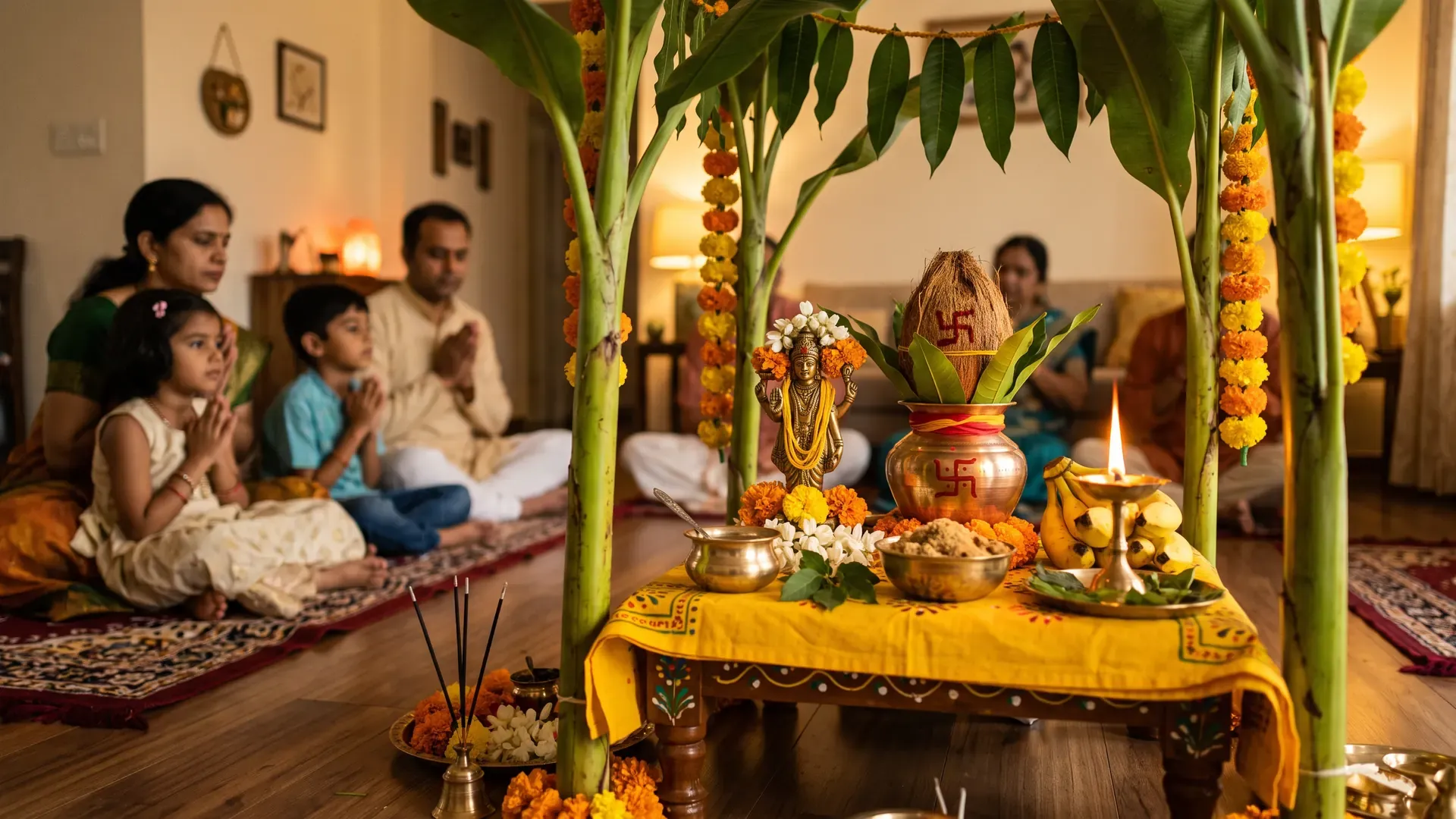
- By the katha, singing follows, and everyone goes home remembering Lord Satyanarayan. A mandap of banana stems, panchamrit, tulsi and the aarti are household custom.
- Honouring the prasad is a main point of this katha: in the fourth and fifth chapters trouble comes from leaving the prasad. So no one leaves after the katha without being given prasad.
Hindi in Roman letters: a reading aid, made by a program. The Devanagari text is the original.
The other language could not be loaded. Keep reading here, or try again.
Chapter 1: Narada’s question and the rite
Once, at Naimisharanya, Shaunaka and the other sages asked Suta, who knew the Puranas, "Which vrat or penance brings the fruit one longs for? We wish to hear it." Suta said, "Narada once asked this very question of the Lord, the husband of Lakshmi. Hear the answer the Lord gave him."
Wishing to do good to others, Narada wandered through many worlds and came to the world of mortals. There he saw people born again and again in many forms, suffering all kinds of pain because of their own deeds. Thinking how their sorrow might be ended, he went to Vishnu’s world. Seeing the four-armed Lord Narayana holding the conch, discus, mace and lotus and wearing a garland of forest flowers, he praised him: "You are beyond mind and speech, your power is endless, you have no beginning, middle or end; you take away the sorrow of your devotees. I bow to you."
The Lord asked, "Narada, why have you come? What is in your mind?" Narada said, "All the people of the mortal world are suffering for their deeds. If you are kind to me, tell me how their sorrow can be ended by some small means." The Lord said, "You have asked well, for the good of the people. There is a vrat rare in heaven and on earth alike, one that gives great merit: the vrat of Satyanarayan. One who keeps it with due rite finds happiness in this world and liberation at the end."
Narada asked what the fruit of this vrat was, what its rite was, who had kept it before, and when it should be kept. The Lord said, "This vrat removes sorrow and grief, increases wealth and grain, gives good fortune and children, and brings victory everywhere. On any day, with faith and devotion, in the evening, one should worship Satyanarayan together with brahmins and relatives. Taking banana, ghee, milk, wheat flour (rice flour if there is none), sugar or jaggery, all in a measure and a quarter, one should make the offering and offer it with devotion. After hearing the katha one should give dakshina to the brahmin, take the prasad, feed brahmins together with relatives, then sing in praise and go home remembering Satyanarayan. Done so, one’s wish is surely fulfilled. In the Kali age this small means is special on earth."
Chapter 2: the poor brahmin of Kashi and the woodcutter
Suta said, "Now hear who kept this vrat before." In the lovely city of Kashi lived a very poor brahmin. Faint with hunger and thirst, he wandered all day for alms. The Lord, who loves brahmins, saw his sorrow, took the form of an old brahmin, went to him and asked kindly, "Brahmin, why do you wander about so unhappy?" He said, "I am very poor and roam the earth for alms. If you know a way out of this, please tell me."
The old brahmin said, "Satyanarayan is Vishnu himself and gives the fruit one longs for. Keep his vrat with due rite; by it a person is freed from every sorrow." Having told him the whole rite, he vanished. The brahmin resolved that he would surely keep this vrat; thinking of it, he could not sleep that night. In the morning he went out for alms with the vow in his mind. That day he received a great deal. With it he kept the Satyanarayan vrat together with his relatives, and by its power he was freed from all his sorrows and became wealthy. From then on he kept the vrat every month.
The sages asked, "Who else kept this vrat after hearing of it from that brahmin?" Suta said: one day the brahmin was keeping the vrat at home with his relatives. Just then an old woodcutter who sold firewood came by. He set his bundle down outside and went in, thirsty, and on seeing the brahmin keeping the vrat he forgot his thirst. He bowed and asked, "Whom are you worshipping, and what fruit does it bring?" The brahmin said, "This is the vrat of Satyanarayan, who fulfils every wish; by his grace wealth and grain have come to my house."
Hearing this, the woodcutter was very glad. He drank water, ate the prasad and went home. He resolved, "Whatever I get tomorrow for my wood, with that I will keep the Satyanarayan vrat." The next day he carried his bundle to the fine town where rich people lived, and that day he got far more for his wood than before. Glad, he came home with ripe bananas, sugar, ghee, milk and wheat flour, called his relatives and kept the vrat with due rite, and by its power he was blessed with wealth, grain and children. Having enjoyed happiness in this world, at the end he went to the world of Truth (Satyaloka).
Chapter 3: King Ulkamukha, the merchant Sadhu and Kalavati
Suta went on: long ago there was a wise king named Ulkamukha, master of his senses and truthful. He went to the temple every day and gave in charity. One day he was keeping the Satyanarayan vrat with his wife on the bank of the river Bhadrashila. Just then a merchant named Sadhu, carrying much wealth for trade, came there. Mooring his boat at the bank, he went to the king and asked humbly, "King, what are you doing?" The king said, "With my family I am keeping the vrat and worship of Satyanarayan, wishing for a child."
Sadhu said, "I too have no child. Tell me the rite as well; I too will keep this vrat." Having heard the rite and finished his trade, he returned home happily and told his wife Leelavati, "When we have a child, I will keep this vrat." In time, by Satyanarayan’s grace, Leelavati conceived, and in the tenth month a beautiful daughter was born, who grew day by day like the moon of the bright fortnight. She was named Kalavati. Leelavati sweetly reminded her husband, "Why do you not keep the vrat you vowed?" Sadhu said, "My dear, I will keep it at Kalavati’s wedding." Saying so, he went off on trade again.
Kalavati grew up in her father’s house. One day Sadhu saw her playing with her friends in the town and began to think of her marriage. He sent a messenger to find a worthy groom. The messenger brought a handsome, gifted merchant’s son from the city of Kanchana, and Sadhu, glad at heart, married Kalavati to him with due rite in the presence of his kin. But by ill luck he forgot the vrat at the wedding too, and the Lord was displeased.
Some time later Sadhu set out on trade with his son-in-law and began trading in the fine city of Ratnasarapura by the sea, ruled by King Chandraketu. Satyanarayan cursed Sadhu, who had broken his word, that hard sorrow would come to him. One day a thief ran off with the king’s wealth and, seeing the king’s men behind him, quietly left it where the father-in-law and son-in-law were staying. The men found the king’s wealth there, bound the two, brought them before the king and said, "We have caught these two thieves." Without any inquiry the king had both thrown into prison and took all their wealth.
Meanwhile the curse reached the home too: thieves carried off all the wealth in the house. Leelavati and Kalavati, worn by illness, hunger and worry, began to go from door to door for food. One day the hungry Kalavati went to a brahmin’s house where the Satyanarayan vrat was being kept. She sat and heard the katha, asked for a boon, ate the prasad and came home at night. Her mother asked, "Daughter, where were you until night?" Kalavati said, "Mother, at a brahmin’s house I saw the vrat of Satyanarayan, which grants what one longs for."
Hearing this, Leelavati kept the Satyanarayan vrat with her kin and prayed, "May my husband and son-in-law soon come home; forgive whatever wrong we have done." The Lord was pleased. In a dream he told King Chandraketu, "The two merchants you hold captive are innocent. Free them in the morning and return their wealth, or I will destroy your kingdom, your wealth and your sons."
In the morning the king told his dream in the court, had the two freed and brought before him. They came and bowed to the king. The king said kindly, "Fate brought you this hard sorrow; now you have nothing to fear." He had their fetters cut, gave them new clothes and ornaments, returned twice the wealth he had taken, and said, "Sadhu, go home now." The two bowed to the king and set out for home.
Chapter 4: the ascetic’s question and Kalavati’s forgotten prasad
Suta said: having given gifts to brahmins, Sadhu began the journey home. When he had gone a little way, Lord Satyanarayan came in the form of a staff-bearing ascetic (dandi) to test him and asked, "Sadhu, what is in your boat?" Proud of their wealth, Sadhu and his son-in-law laughed and said, "Why do you ask, holy man? Do you want to take our money? Our boat holds nothing but creepers and leaves." Hearing this harsh reply, the ascetic said, "May your words be true," and went a little way off and sat by the sea.
After the ascetic left, Sadhu did his daily rites and saw that the boat had risen high in the water. Looking inside, he found only creepers and leaves indeed. He fainted and fell, and when he came to he wept aloud. His son-in-law said, "Do not grieve. This is that ascetic’s curse; let us go to him for shelter, and he will end our sorrow." Sadhu went to the ascetic, bowed with devotion and said in tears, "Forgive me for the lie I told you."
The ascetic said, "Do not weep; listen. You turned away from my worship; that is why, by my will, sorrow came to you again and again." Then Sadhu praised him: "Lord, even Brahma and the gods do not know your maya; how could a fool like me? Be gracious; I will worship you as far as my means allow. Protect me and fill the boat with wealth as before." The Lord was pleased, granted his wish and vanished. Returning to the boat, the two found it full of wealth again. Sadhu worshipped Satyanarayan there with his companions with due rite and set off for his own land.
Nearing the town, Sadhu said to his son-in-law, "Look, there is my Ratnapuri." He sent a messenger home. The messenger bowed to Leelavati and said, "Your husband and son-in-law have come near the town with much wealth." Leelavati was doing the Satyanarayan puja just then. Overjoyed, she finished the puja and told Kalavati, "I am going to meet your father; you come quickly too." Kalavati took the vrat as finished, but ran off to see her husband leaving the prasad behind.
Displeased at this disregard of the prasad, the Lord sank Kalavati’s husband along with his boat. Not seeing her husband, Kalavati fell to the ground weeping. Leelavati took her daughter in her lap and wept: "Who knows which god has taken the boat; who can know the greatness of Satyadeva?" The grieving Kalavati took her husband’s wooden sandals and thought of giving up her life to follow him. Seeing this, Sadhu was deeply shaken, and then understood that Satyadeva had done this and that he had been led astray by his maya. He called everyone together, said he would worship Satyanarayan with due rite, and bowed again and again. Then the Lord was pleased, and a voice came from the sky: "Your daughter left my prasad and came to see her husband; that is why he has vanished. If she goes home, eats the prasad and comes back, she will have her husband."
Hearing this, Kalavati went home, ate the prasad, and on returning saw her husband in the boat as before. She said to her father, "Let us go home now; why delay?" The glad Sadhu worshipped Satyadeva there with due rite and went home with his wealth and his kin. From then on he worshipped Satyanarayan on every Purnima and Sankranti, enjoyed happiness in this world and at the end went to Satyapura, the Lord’s abode.
Chapter 5: King Tungadhwaja and the cowherds’ prasad
Suta said: there was a king named Tungadhwaja, devoted to the care of his people. He too suffered for spurning the prasad of Satyadeva. One day, returning from a hunt in the forest, he came under a banyan tree. There cowherds with their families were worshipping Satyanarayan with great devotion and content. The king saw it, but out of pride he neither went near nor bowed. The cowherds brought the prasad to the king, set it before him and went back; then they all ate the prasad.
The king left the prasad there and went to his city, and on arriving found that his hundred sons and all his wealth and grain had been lost. He understood that Satyadeva had done this. Resolving, "I will go back to where the Lord was being worshipped," he returned to the cowherds, worshipped Satyanarayan with them with devotion, faith and due rite, and took the prasad. By Satyadeva’s grace he had wealth and sons again, and having enjoyed happiness in this world, at the end he went to Satyapura.
Suta told the fruit: whoever keeps this most rare vrat and hears this holy katha with devotion receives wealth and grain by Satyanarayan’s grace; the poor become rich, the captive is freed from bonds, the fearful become fearless, and having enjoyed the fruit he longed for, at the end he goes to Satyaloka. In the Kali age the worship of Truth gives special fruit. Some will call him Time, some Truth, some the Lord, some Satyanarayan and some Satyadeva; taking many forms he fulfils everyone’s wishes. Whoever reads or hears this katha daily has his sins destroyed by Satyadeva’s grace.
At the end Suta tells what those who first kept the vrat became in their next births. The poor brahmin Shatananda was born as Sudama and, meditating on Shri Krishna, attained liberation. The woodcutter became the Bhil chief Guha (Nishadraj Guha) and attained liberation by serving Shri Rama. King Ulkamukha became King Dasharatha and, worshipping Shri Ranganatha, went to Vaikuntha. The merchant Sadhu became the righteous King Moradhwaja, true to his word, who gave half a body cut with a saw and attained liberation. King Tungadhwaja became Svayambhuva Manu and, turning everyone to devotion to the Lord, went to Vaikuntha.
Other tellings
- What the boat was said to hold: the Sanskrit text has "lata-patra" (creepers and leaves), as do several Hindi books; Drik Panchang and some books say "bel leaves" or "bel and leaves".
- The woodcutter’s price for his wood: twice as much in the Sanskrit text, four times as much in Drik Panchang’s telling.
- Moradhwaja: the Sanskrit text says "gave half the body, cut with saws"; the Hindi kathas (Drik Panchang too) say King Moradhwaja sawed his son and offered half his body, as in the well-known story of Moradhwaja.
- In the fourth chapter, by the Sanskrit text Kalavati takes the vrat as finished and leaves only the prasad; in Drik Panchang she leaves "the puja and the prasad" both.
- For the offering the Sanskrit text lists banana, ghee, milk, wheat flour and sugar or jaggery; Drik Panchang adds honey, and curd in the woodcutter’s list.
- In Drik Panchang’s first chapter the sages ask how people without Vedic learning will be saved in the Kali age; in the Sanskrit text the question is only which vrat or penance brings the desired fruit.
- Besides the Vangavasi (Bengal) printing, scholars also place a description of this puja in the Pratisarga Parva of the Bhavishya Purana; in Bengal a similar worship of Satya Pir has also been kept, and some scholars connect the two. These are scholars’ views, not part of the katha.
After the katha
After the katha the Satyanarayan aarti, "Jai Lakshmi Ramana", is sung, and then everyone is given prasad (panchamrit and the offering). The date of the next Purnima is in the Purnima list.
Purnima datesFrequently asked questions
When should the Satyanarayan katha be held?
By the first chapter, on any day, in the evening. At the end of the fourth chapter the merchant Sadhu does the puja on every Purnima and Sankranti, so many homes hold it on Purnima; every month’s Purnima date is in our Purnima list. Holding it on happy occasions is custom.
How many chapters does the Satyanarayan katha have?
Five. The first gives Narada the rite; the second, the brahmin of Kashi and the woodcutter; the third, King Ulkamukha, the merchant Sadhu, Kalavati’s birth and marriage and the prison; the fourth, the ascetic’s test and Kalavati’s forgotten prasad; the fifth, King Tungadhwaja and the later births of those who kept the vrat.
Which Purana has the Satyanarayan katha?
Every chapter of the printed katha ends with "इति श्रीस्कन्दपुराणे रेवाखण्डे", and tradition holds it to be from the Reva Khanda of the Skanda Purana. According to scholars (P. V. Kane) it is not in the Venkateshwar Press edition of the Skanda Purana; it is found in the Bengal Vangavasi Press printing.
What goes into the Satyanarayan prasad?
By the katha, banana, ghee, milk, wheat flour (or rice flour) and sugar or jaggery, all in a measure and a quarter ("savaya"), are mixed into the offering. Panchamrit and tulsi are household custom.
How do I get the Satyanarayan katha as a PDF?
Press the "Print / PDF" button on this page; choosing "Save as PDF" in the print dialog of a phone or computer saves all five chapters as a PDF, without the rest of the page.
Sources
- Satyanarayan vrat katha, Sanskrit text with Hindi meaning, five chapters, each ending "iti shri-skandapurane revakhande" (sanskritdocuments.org, satyanaaraayaNa.itx; transliterated from Webdunia)
- Drik Panchang: Satyanarayan vrat katha, chapters one to five (Hindi, five pages)
- "Sampurna Satyanarayan Vrat Katha evam Pujan Vidhi", archive.org (20240818_20240818_1842)
- "Shri Satyanarayan Vrat Katha evam Aarti" (ishwarpooja.com), archive.org (shri-satyanarayan-vrat-katha-and-aarti)
- English Wikipedia: Satyanarayana Puja (citing P. V. Kane, History of Dharmaśāstra, 1958, p. 437; R. C. Hazra 1940; G. Bühnemann 1988: the question of editions)
Something wrong? Report a mistake