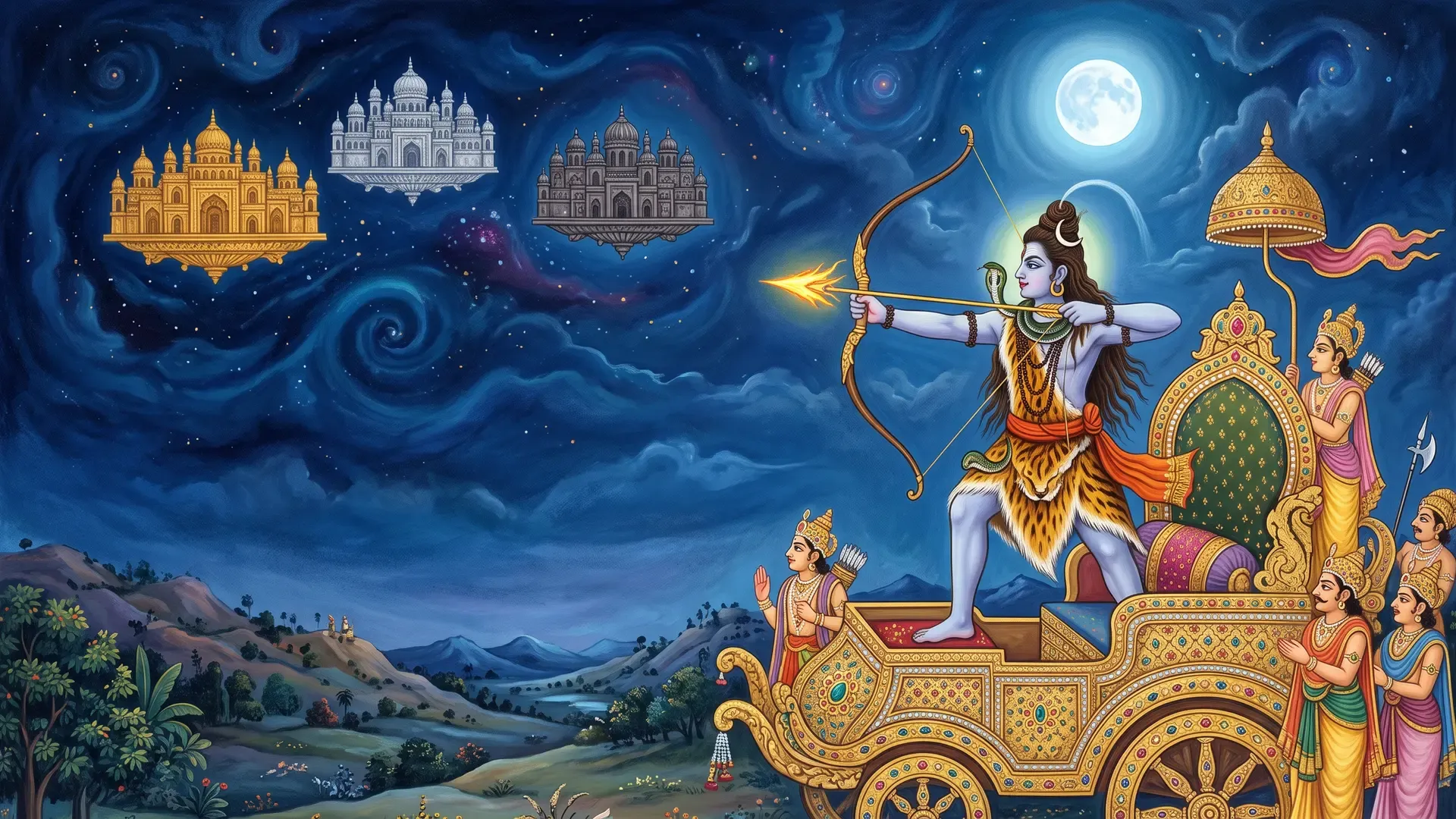
The main katha of Kartik Purnima is the fall of Tripura. By the Shiva Purana and the Mahabharata, the three cities of three asura brothers could be destroyed only when they came together and a single arrow pierced them; Shiva loosed that one arrow, burnt all three and was called Tripurari. The texts give no date for it; linking it to Kartik Purnima, and calling the day Tripurari Purnima, is tradition.
Each morning the tithi, Rahu Kaal and coming festivals, in one short WhatsApp message.Follow the channel
Kartik Purnima is the full moon of the month of Kartik. By custom people bathe at dawn in the Ganga or another holy river and offer lamps in the evening; Drik Panchang also calls it Tripuri or Tripurari Purnima and Dev Deepawali. The bathing and lamp times for your city are on the Kartik Purnima page.
The main katha of the day is Shiva’s destruction of Tripura, told in the Shiva Purana (Rudra Samhita, Yuddha Khanda, chapters 1–10) and the Mahabharata (Karna Parva, chapters 33–34 in Ganguli’s translation); we read and checked both in translation. But neither gives a month or a full moon. The Shiva Purana sets the moment when the moon is in Pushya nakshatra, which does not fit Kartik Purnima. So “Shiva destroyed Tripura on this day” is a matter of tradition, and it is from this tradition that the day is called Tripurari Purnima.
The Devi Bhagavata (9.25) puts Tulasi’s birth festival on the Kartik full moon. In the Sikh tradition Guru Nanak Dev ji’s Prakash Purab (Gurpurab) is kept on this day; he was born in 1469 at Rai Bhoi di Talwandi, now Nankana Sahib in Pakistan.
How the vrat and katha are kept
- A dawn bath in the Ganga or another holy river; the Kartik bathing that runs from Sharad Purnima ends on this day (Drik Panchang).
- In the evening, lamps are offered to the Ganga and the Ganga aarti is held. In Varanasi the ghats are lit for Dev Deepawali this evening; it is believed that the gods come to Kashi on this day to bathe in the Ganga. It is a custom, and the year it began is disputed (see the questions below).
- The five-day Bhishma Panchaka vow that begins on Dev Uthani Ekadashi ends on this day (Padma Purana, Uttara Khanda 124), and it is also the last of the days for Tulsi Vivah (Drik Panchang).
- The Pushkar fair, the bathing at Garhmukteshwar and Odisha’s Boita Bandana are also tied to this day (Drik Panchang, Wikipedia).
The fall of Tripura: the Shiva Purana story
As told in the Shiva Purana, Rudra Samhita, Yuddha Khanda, chapters 1, 8 and 10 (J. L. Shastri’s English translation, wisdomlib.org); there Sanatkumara tells the story to Vyasa.
In the Shiva Purana this story follows the slaying of Tarakasura. When Taraka had fallen at Kartikeya’s hands, his three sons remained: Tarakaksha the eldest, Vidyunmali the middle one and Kamalaksha the youngest. Popular tellings say they wished to avenge their father’s death.
The three brothers performed fierce austerities. Brahma, pleased, appeared and told them to ask a boon. They asked to be immortal, but Brahma said he could not grant that; they must ask for something else.
So they asked for three cities of their own. The cities should come together only after a thousand years, and only one who pierced all three with a single arrow at that moment could destroy them. The Shiva Purana names the moment too: midday, at Abhijit, with the moon in Pushya; and the single arrow would be Shiva’s. Brahma granted the boon.
Maya the danava built them three cities: one of gold in heaven for Tarakaksha, one of silver in the sky for Kamalaksha, and one of iron (steel) on earth for Vidyunmali. Together these three cities were called Tripura.
With these cities behind them the asuras began to torment the three worlds. The distressed gods went first to Brahma, then took refuge with Shiva. Shiva agreed to destroy Tripura.
Vishvakarman built for Shiva a wondrous chariot that held all the worlds. The sun and the moon were its right and left wheels, the four Vedas its horses, and Brahma its charioteer. Mount Meru became the bow, the king of serpents its string, and Lord Vishnu himself the arrow.
The Shiva Purana says the task was delayed because Ganesha had not been worshipped first. Ganesha was worshipped, and then the work went forward.
Then the moment came and the three cities came together. Shiva set on the bow the arrow that was Vishnu himself, with Agni as its point, and loosed that single arrow. All three cities burned to ashes at once.
By the Shiva Purana, even in that fire Maya and the asuras who were devoted to Shiva were spared.
The gods rejoiced and praised Shiva. Because he destroyed Tripura, Shiva is called Tripurari and Tripurantaka.
By tradition this victory came on Kartik Purnima and the gods celebrated with lamps; that is why the day is called Tripurari Purnima and Dev Deepawali. The Shiva Purana and the Mahabharata give no date for it.
Tripura in the Mahabharata
As told in the Mahabharata, Karna Parva, chapters 33–34 (Ganguli’s English translation, wisdomlib.org).
In the Mahabharata Duryodhana tells this story to Shalya; the sage Markandeya had once told it to Dhritarashtra. Duryodhana’s point was that, as Brahma drove Shiva’s chariot, so Shalya should drive Karna’s.
Here too the three brothers win a boon by austerity: after a thousand years the three cities will come together, and then one god with one arrow may pierce them. Maya built three cities of gold, silver and iron, in heaven, sky and earth, each a hundred yojanas across.
The Mahabharata adds one more thing: Hari, son of Tarakaksha, made a lake in which dead daityas came back to life as soon as they were placed in it.
The gods went to Brahma and then to Shiva. Shiva took half the strength of the gods and joined it to half of his own. Here the chariot is the Earth, with Mount Mandara as its axle and the Ganga as its shaft; the arrow holds Vishnu, Soma (the moon) and Agni together; and Brahma is the charioteer.
As soon as the three cities came together Shiva loosed one arrow, and they fell, burning. Shiva cast the burnt asuras into the western ocean.
Other tellings
- Many folk tellings make it a single demon, “Tripurasura”, with three cities, instead of three brothers (India TV).
- Who made up the arrow differs: in the Shiva Purana Vishnu is the arrow with Agni as its point; in the Mahabharata, Vishnu, Soma and Agni; in India.com’s telling, Vishnu, Vayu, Agni and Yama.
- The moment the cities meet: after a thousand years in both the Shiva Purana and the Mahabharata; the Shiva Purana adds midday, Abhijit and the moon in Pushya; India.com calls it Abhijit nakshatra; the Mahabharata names no star.
- By English Wikipedia the oldest form of the story is in the Taittiriya Samhita, where Rudra destroys three forts of the asuras with one arrow; we did not check that text.
- Some newspapers and websites say Vishnu took the Matsya (fish) avatar on Kartik Purnima. None of them names a text, and Drik Panchang puts Matsya Jayanti on Chaitra Shukla Tritiya. It is a popular claim for which we found no basis.
After the katha
Lamps are offered in the evening, and Varanasi celebrates Dev Deepawali. The aarti of Shiva is linked below; the bathing and lamp times for your city are on the Kartik Purnima page.
Shiv Aarti: Om Jai Shiv OmkaraFrequently asked questions
Why is Kartik Purnima called Tripurari Purnima?
By tradition it was on this day that Shiva destroyed with one arrow the three cities (Tripura) of Tarakasura’s three sons, and was called Tripurari. The story is in the Shiva Purana (Rudra Samhita, Yuddha Khanda) and the Mahabharata (Karna Parva), but they give no date; its link with Kartik Purnima comes from tradition.
What is the Kartik Purnima katha?
Tarakasura’s three sons won a boon from Brahma that their three cities would come together only after a thousand years and could be destroyed only then, by a single arrow. Maya built cities of gold, silver and iron. When the asuras began to torment the three worlds, Shiva, at the gods’ prayer, mounted a divine chariot and burnt all three cities at once with the arrow that was Vishnu.
Was the Matsya avatar on Kartik Purnima?
Many newspapers and websites say so, but none names a text. The story of the Matsya avatar (Bhagavata Purana 8.24, Matsya Purana) gives no date, and Drik Panchang puts Matsya Jayanti on Chaitra Shukla Tritiya. So it should be taken as a popular claim only.
Since when has Dev Deepawali been held in Kashi?
It is believed that the gods come to Kashi on Kartik Purnima to bathe in the Ganga, so the ghats are lit with lamps. How the present festival began is disputed: some trace it to Ahilyabai Holkar’s Hazara Deep Stambh at Panchganga Ghat (18th century), some to lamps lit by local youth at Panchganga Ghat in 1985, and English Wikipedia to Pt. Kishori Raman Dubey (Babu Maharaj) at Dashashwamedh Ghat in 1991. No single year is settled.
Sources
- Shiva Purana, Rudra Samhita, Yuddha Khanda, chapters 1, 8 and 10 (J. L. Shastri’s English translation, wisdomlib.org)
- Mahabharata, Karna Parva, chapters 33–34 (Ganguli’s English translation, wisdomlib.org)
- Puranic Encyclopaedia (Vettam Mani): the story of Tripura, wisdomlib.org
- Devi Bhagavata Purana 9.25; Padma Purana, Uttara Khanda 124 (wisdomlib.org)
- Drik Panchang: Kartik Purnima; Matsya Jayanti
- India TV Hindi (2025), India.com Hindi (2024), Amar Ujala (2025) and Webdunia (2021): Kartik Purnima, Tripurasura and the Matsya avatar
- English Wikipedia: Tripurasura, Kartika Purnima, Dev Deepavali (Varanasi), Guru Nanak Gurpurab; Hindi Wikipedia: Kartik Purnima
- Asianet News Hindi, aadikashi.com and varanasiguru.com: the history of Dev Deepawali
- SikhNet: the birth of Guru Nanak, Katik or Baisakh
Something wrong? Report a mistake