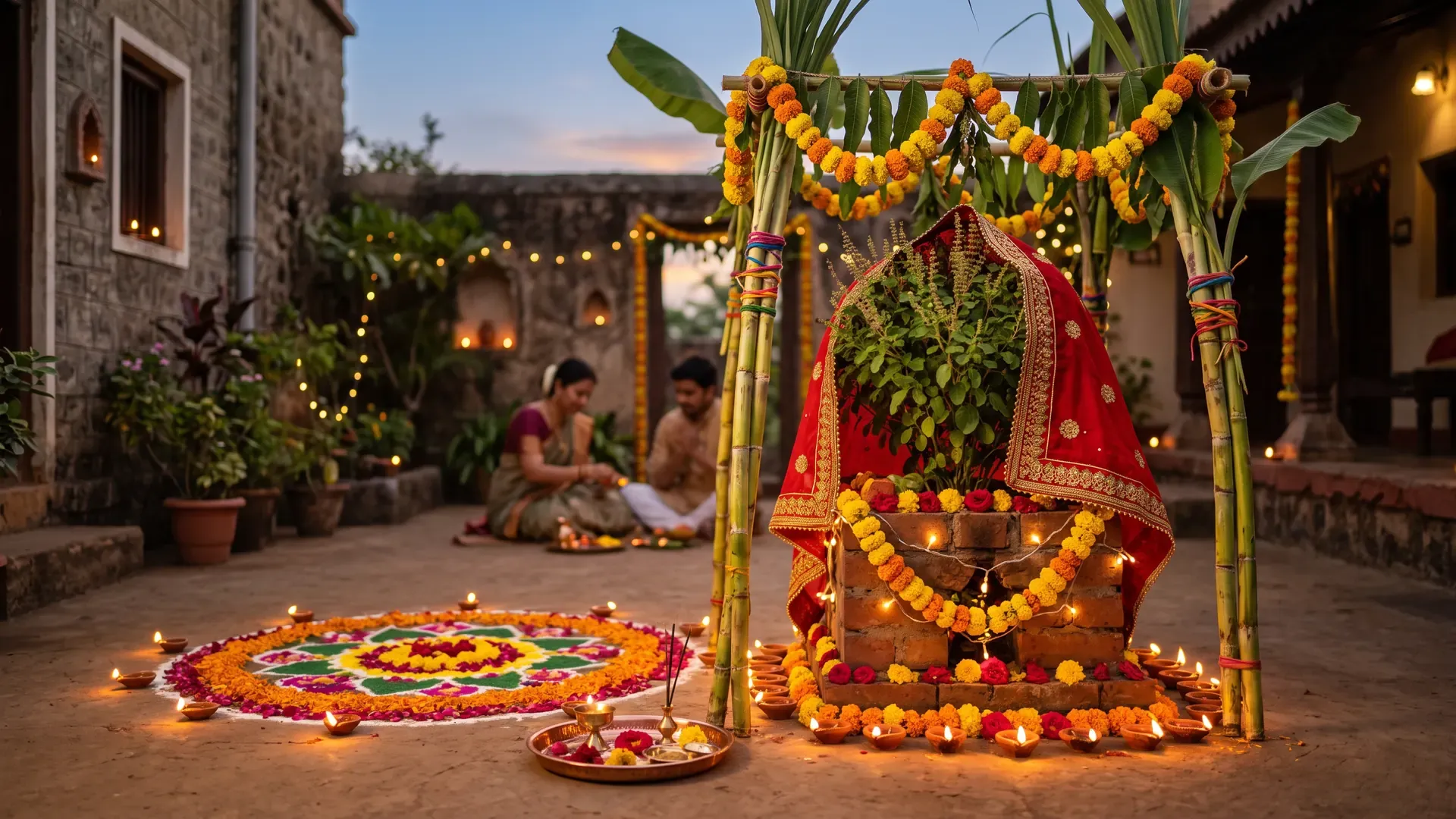
For Tulsi Vivah the texts of Tulasi are the namashtaka ‘Vrinda Vrindavani Vishvapujita Vishvapavani. Pushpasara Nandini cha Tulasi Krishnajivani’ (in the Devi Bhagavata 9.25 and the Brahmavaivarta Purana, Prakriti Khanda 22), the dhyana verses of Tulasi and Pundarika’s Tulsi stotra. Tulsi Vivah is on Saturday, 21 November 2026. The mangalashtaka verses of the wedding differ from home to home and are not printed here.
When to say them
Tulsi Vivah is on Saturday, 21 November 2026 (Kartik Shukla Dwadashi; in many families the evening of Ekadashi). The wedding is held at dusk, in godhuli. New Delhi: Godhuli muhurat: 5:25–5:52 PM.
- Godhuli muhuratFrom sunset; the wedding is held in the evening
- 5:25–5:52 PM
- Sunset
- 5:25 PM
- Dwadashi tithi
- 6:33 AM to 4:58 AM (22 Nov)
- Ekadashi tithi (Dev Uthani)
- 7:17 AM (20 Nov) to 6:33 AM
New Delhi, Indian Standard Time; SanatanBodh panchang calculation, checked against Drik Panchang. Your city’s time and the full page
1The eight names of Tulasi: Vrinda Vrindavani Vishvapujita
वृन्दा वृन्दावनी विश्वपूजिता विश्वपावनी।पुष्पसारा नन्दिनी च तुलसी कृष्णजीवनी॥एतन्नामाष्टकं चैव स्तोत्रं नामार्थसंयुतम्।यः पठेत्तां च सम्पूज्य सोऽश्वमेधफलं लभेत्॥
When: In the worship of Tulasi, in the month of Kartik and at Tulsi Vivah
Meaning: Eight names: Vrinda, Vrindavani, Vishvapujita, Vishvapavani, Pushpasara, Nandini, Tulasi, Krishnajivani. The Purana itself gives the reason for each: Vrinda for being a cluster (vrinda) of plants; Vrindavani for appearing first in Vrindavan; Vishvapujita for being worshipped in countless worlds; Vishvapavani for purifying countless worlds; Pushpasara, the essence of flowers, because the gods are not content with heaps of flowers without her; Nandini, because devotees are gladdened on finding her; Tulasi, because she has no equal (tula); and Krishnajivani, the life of Krishna. The Purana says whoever recites these eight names with their meaning and worships Tulasi gains the fruit of an Ashvamedha.
Source: Devi Bhagavata Purana 9.25.32–33 (Sanskrit Wikisource numbering; the reasons for the names in verses 18–25) and Brahmavaivarta Purana, Prakriti Khanda 22.32–33 (the same reasons in verses 18–25); the names in the first two lines are also the same in the sanskritdocuments.org ‘Tulasi Namashtaka Stotram’
Variant: The Brahmavaivarta Purana has the names in the accusative (‘vrindam vrindavanim vishvapavanim vishvapujitam …’) and in the order ‘vishvapavani’ then ‘vishvapujita’; the Devi Bhagavata in the nominative, with the form ‘nandani’ in verse 32; the form ‘nandini’ is in sanskritdocuments.org and the Brahmavaivarta. The sanskritdocuments.org text words the result differently (‘pathan mangalam apnuyat’). Above is the Devi Bhagavata form, with ‘nandini’.
2Dhyana of Tulasi: Tulasim Pushpasaram cha Satim Putam Manoharam
तुलसीं पुष्पसारां च सतीं पूतां मनोहराम्।कृतपापेध्मदाहाय ज्वलदग्निशिखोपमाम्॥पुष्पेषु तुलना यस्या नास्ति वेदेषु भाषितम्।पवित्ररूपा सर्वासु तुलसी सा च कीर्तिता॥शिरोधार्या च सर्वेषामीप्सिता विश्वपावनी।जीवन्मुक्तां मुक्तिदां च भजे तां हरिभक्तिदाम्॥
When: As the dhyana before the worship of Tulasi; the Purana says to worship her at the plant itself, without an invocation
Meaning: I meditate on Tulasi: the essence of flowers, the faithful wife, pure, charming, like a blazing flame to burn the fuel of sins done. She whose equal among flowers is nowhere found, so it is said in the Vedas; she who is called Tulasi, the purest in form among all. Worthy to be borne on every head, dear to all, the purifier of the world, giver of liberation in life and of final liberation, giver of devotion to Hari: I worship her.
Source: Devi Bhagavata Purana 9.25.41–43 (Sanskrit Wikisource numbering) and Brahmavaivarta Purana, Prakriti Khanda 22.41–43; nearly the same text in both
Variant: The Brahmavaivarta has ‘satim pujyam’, ‘kritsna-papedhma …’, ‘pushpeshu tulanapyasya nasiddevishu va mune’ and ‘ipsitam vishvapavanim … bhaja’; above is the Devi Bhagavata text.
3First verse of Pundarika’s Tulsi stotra: Jagaddhatri Namastubhyam
जगद्धात्रि नमस्तुभ्यं विष्णोश्च प्रियवल्लभे।यतो ब्रह्मादयो देवाः सृष्टिस्थित्यन्तकारिणः॥
When: In praise of Tulasi
Meaning: Salutations to you, O sustainer of the world, beloved of Vishnu; it is through you that Brahma and the other gods carry out creation, preservation and dissolution.
Source: Gita Press, Nityakarma-Pujaprakash pp. 354–355 (‘Shri Pundarika-kritam Tulasi-stotram’, 15 verses); Bhakti Bharat, ‘Shri Tulsi Stotram’. The words are the same in both
4Tulasi patu mam nityam
तुलसी पातु मां नित्यं सर्वापद्भ्योऽपि सर्वदा।कीर्तिताऽपि स्मृता वाऽपि पवित्रयति मानवम्॥
When: When bowing to Tulasi
Meaning: May Tulasi always protect me from all calamities; even by being named or remembered she purifies a person.
Source: Pundarika’s Tulsi stotra, verse 3: Gita Press, Nityakarma-Pujaprakash p. 354; Bhakti Bharat. The same verse is also in the sanskritdocuments.org ‘Tulasi Stuti’ (verse 7)
Variant: The OCR of the Gita Press page reads ‘sarvapadbhyo’ and ‘kortita’, scan slips; the words follow Bhakti Bharat and sanskritdocuments.org.
5Tulasyam sakala deva vasanti satatam yatah
तुलस्यां सकला देवा वसन्ति सततं यतः।अतस्तामर्चयेल्लोके सर्वान् देवान् समर्चयन्॥
When: As the reason for worshipping Tulasi
Meaning: Because all the gods dwell in Tulasi always, one should worship her in the world; thereby one worships all the gods.
Source: Pundarika’s Tulsi stotra, verse 9: Gita Press, Nityakarma-Pujaprakash p. 355; Bhakti Bharat. The words are the same
6Namastulasi sarvajne purushottamavallabhe
नमस्तुलसि सर्वज्ञे पुरुषोत्तमवल्लभे।पाहि मां सर्वपापेभ्यः सर्वसम्पत्प्रदायिके॥
When: As a prayer at the close of the praise of Tulasi
Meaning: Salutations to you, Tulasi, all-knowing, beloved of Purushottama (Vishnu). O giver of every prosperity, save me from all sins.
Source: Pundarika’s Tulsi stotra, verse 10: Gita Press, Nityakarma-Pujaprakash p. 355; Bhakti Bharat
Variant: The OCR of the Gita Press page reads ‘sarvatne’; Bhakti Bharat has ‘sarvajne’, which fits the sense, so that is kept.
7Tulasi shrisakhi shubhe papaharini punyade
तुलसि श्रीसखि शुभे पापहारिणि पुण्यदे।नमस्ते नारदनुते नारायणमनःप्रिये॥
When: When saluting Tulasi; the last verse of Pundarika’s stotra
Meaning: O Tulasi, friend of Shri (Lakshmi), auspicious one, remover of sin, giver of merit; praised by Narada, dear to the mind of Narayana: salutations to you.
Source: Pundarika’s Tulsi stotra, verse 15: Gita Press, Nityakarma-Pujaprakash p. 355; sanskritdocuments.org, ‘Tulasi Stuti’ (verse 1)
Variant: Bhakti Bharat and several sites also give this verse as the first verse of the ‘Tulsi Stuti’; the words are the same.
8The ten-syllable mantra of Tulasi given in the Puranas
श्रीं ह्रीं क्लीं ऐं वृन्दावन्यै स्वाहा॥
When: The Purana gives it for one who worships by rule; it is a mantra of initiation, take it from your own guru
Meaning: The Purana’s verse describes how it is built: the seeds of Lakshmi, Maya, Kama and Vani (shreem, hreem, kleem, aim) first, then ‘Vrindavani’ in the dative (vrindavanyai), and last the wife of fire (svaha): ten syllables in all. Seed-syllables carry no dictionary meaning; ‘vrindavanyai svaha’ means ‘offered to Vrindavani (Tulasi)’.
Source: Devi Bhagavata Purana 9.25.10–11 (Sanskrit Wikisource numbering) and Brahmavaivarta Purana, Prakriti Khanda 22.10–11: both describe its construction in the same way (‘lakshmi-maya-kama-vani-bija-purvam dashaksharam …’); the Brahmavaivarta text on Wikisource also writes the whole mantra out
About these texts
Every text was compared word by word in at least two separate sources: printed editions, Gita Press books and Sanskrit text sites. Mantras that only devotional sites give, with no scripture named, are marked ‘in common use’, not as a Purana’s. The meanings are our own, in plain words. Take the method and the count of repetitions from your own family or purohit.
Aartis and chalisas
Frequently asked questions
When is Tulsi Vivah 2026?
On Saturday, 21 November 2026. New Delhi: Godhuli muhurat: 5:25–5:52 PM. See the festival page for your city’s time.
Which mantras are said at Tulsi Vivah?
The texts for the worship of Tulasi are above: the eight names (namashtaka), the dhyana verses and verses of Pundarika’s Tulsi stotra. The mangalashtaka verses and the words of the kanyadan differ from region to region and home to home; we have not compared the mangalashtaka text against two sources, so we have not printed it. Follow your family priest’s method.
What is the Tulsi Namashtaka?
The eight names of Tulasi: Vrinda, Vrindavani, Vishvapujita, Vishvapavani, Pushpasara, Nandini, Tulasi, Krishnajivani. The verse is in the Devi Bhagavata Purana (9.25) and the Brahmavaivarta Purana (Prakriti Khanda 22), and both give the reason for each name.
Is there a short mantra for worshipping Tulasi?
‘Tulasi shrisakhi shubhe papaharini punyade. Namaste naradanute narayanamanahpriye’ and ‘Tulasi patu mam nityam sarvapadbhyo’pi sarvada …’ are verses of Pundarika’s stotra and are the same in two sources. Mantras for plucking Tulasi leaves are also given, but we found their text in one source only, so they are not printed.
Sources
- Devi Bhagavata Purana 9.25 (on the worship of Tulasi), Sanskrit Wikisource
- Brahmavaivarta Purana, Prakriti Khanda, chapter 22 (the praise and worship of Tulasi), Sanskrit Wikisource
- Gita Press, Nityakarma-Pujaprakash (reprints of 2066 and 2070)
- Bhakti Bharat: Shri Tulsi Stotram (bhaktibharat.com)
- sanskritdocuments.org: Tulasi Namashtaka Stotram and Tulasi Stutih
Something wrong? Report a mistake