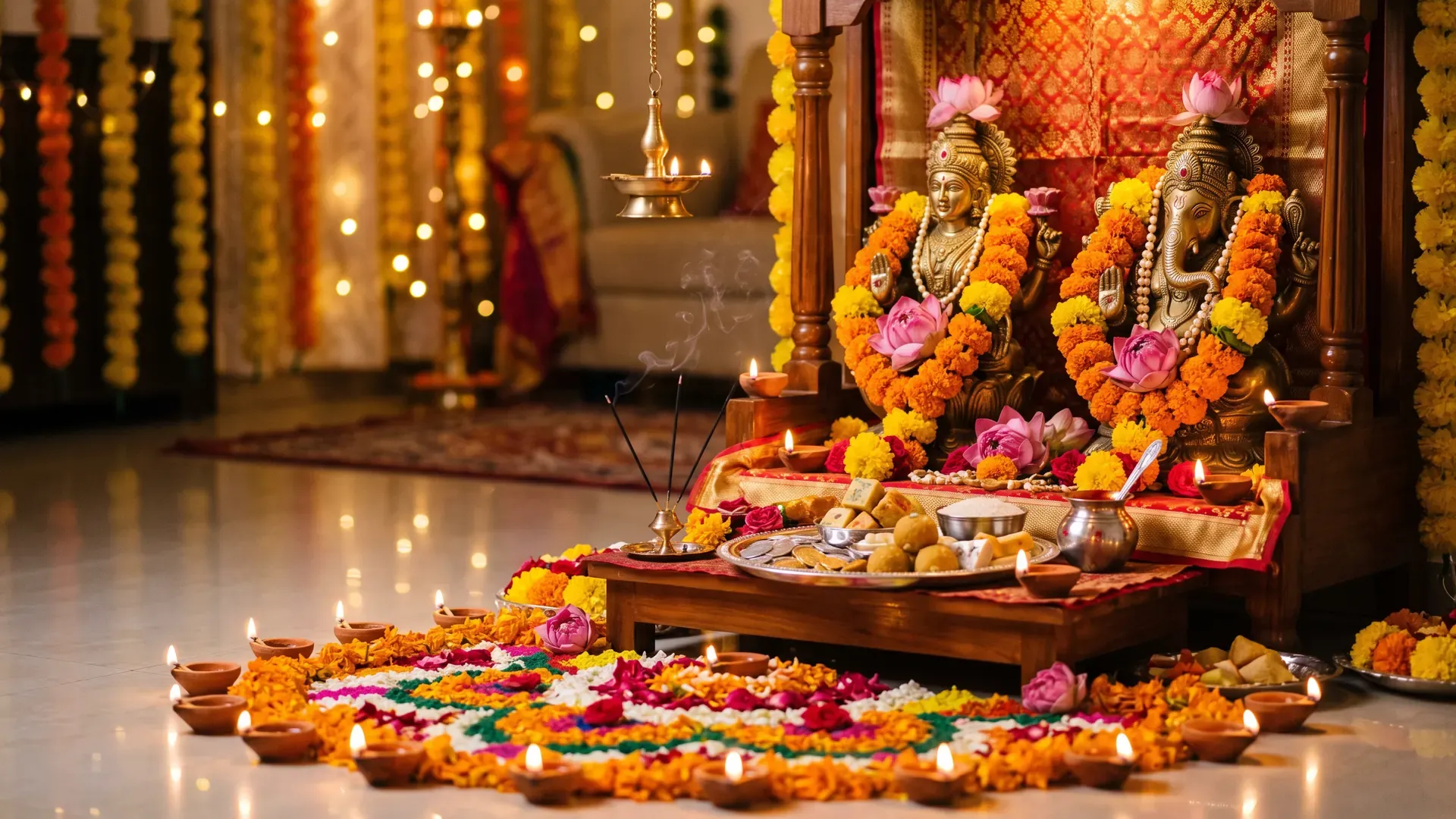
The Diwali Lakshmi puja mantras in order: purification, the verse to Ganesha ‘Vakratunda Mahakaya’, the dhyana of Lakshmi ‘ya sa padmasanastha’, the Shri Sukta ‘hiranyavarnam harinim’, the japa mantra ‘Om Shreem Hreem Shreem Kamale Kamalalaye Prasida Prasida’, the Lakshmi Gayatri, the mantras of Kubera and Saraswati, the prayer for forgiveness and the farewell. Diwali is on Friday, 29 October 2027. Below is the text, meaning and source of each.
When to say them
Diwali is on Friday, 29 October 2027. The Lakshmi puja is done in Pradosh Kaal, while the fixed ascendant (Vrishabha) lasts; the mantras above are in the order of the puja. New Delhi: Lakshmi Puja muhurat: 6:35–7:07 PM.
- Lakshmi Puja muhuratPradosh Kaal + Vrishabha lagna + tithi
- 6:35–7:07 PM
- Pradosh KaalFirst fifth of the night
- 5:39–8:13 PM
- Vrishabha KaalFixed ascendant
- 6:35–8:31 PM
- Nishita KaalEighth muhurat of the night
- 11:39 PM–12:31 AM (30 Oct)
- Amavasya tithi
- until 7:07 PM
New Delhi, Indian Standard Time; SanatanBodh panchang calculation, checked against Drik Panchang. Your city’s time and the full page
1Purification mantra
ॐ अपवित्रः पवित्रो वा सर्वावस्थां गतोऽपि वा।यः स्मरेत् पुण्डरीकाक्षं स बाह्याभ्यन्तरः शुचिः॥
When: While sprinkling water on oneself and the puja items
Meaning: Pure or impure, in whatever state one may be, whoever remembers the lotus-eyed Lord (Pundarikaksha, Vishnu) becomes clean outside and within.
Source: Gita Press, Nityakarma-Pujaprakash p. 243; Drik Panchang, Atma-shodhan vidhi
2Ganesha vandana: Vakratunda Mahakaya
वक्रतुण्ड महाकाय सूर्यकोटि समप्रभ।निर्विघ्नं कुरु मे देव सर्वकार्येषु सर्वदा॥
When: At the start of the Ganesha puja
Meaning: O Lord with the curved trunk and mighty body, shining like ten million suns, keep all my work free of obstacles, always.
Source: Text and sources: our Vakratunda Mahakaya page
Variant: Gita Press (Nityakarma-Pujaprakash p. 170, mangala-path) prints the first line as ‘vakratunda mahakaya kotisuryasamaprabha’: the same words in another order, with the same meaning.
3Dhyana of Lakshmi
या सा पद्मासनस्था विपुलकटितटी पद्मपत्रायताक्षीगम्भीरावर्तनाभिस्तनभरनमिता शुभ्रवस्त्रोत्तरीया।या लक्ष्मीर्दिव्यरूपैर्मणिगणखचितैः स्नापिता हेमकुम्भैःसा नित्यं पद्महस्ता मम वसतु गृहे सर्वमाङ्गल्ययुक्ता॥
When: With a flower in hand, at the start of the Lakshmi puja
Meaning: She who sits on a lotus seat, broad of waist, with eyes long as lotus petals, with a navel deep as a whirlpool, bending a little under the weight of her bosom, dressed in a white garment and upper cloth; she who is bathed from divine golden pots set with gems: may that Lakshmi, a lotus in her hand, live in my home always, with every blessing.
Source: Gita Press, Nityakarma-Pujaprakash p. 244; Drik Panchang, Lakshmi Puja Vidhi (dhyana)
Variant: On Drik Panchang’s Shri Sukta page the third line reads ‘lakshmir divyair gajendrair manigana-khachitaih’: there Lakshmi is bathed by divine elephants, as in pictures of Gajalakshmi.
4First verse of the Shri Sukta
ॐ हिरण्यवर्णां हरिणीं सुवर्णरजतस्रजाम्।चन्द्रां हिरण्मयीं लक्ष्मीं जातवेदो म आवह॥
When: After the dhyana; in the Gita Press vidhi each upachara is paired with a verse of the Shri Sukta
Meaning: O Agni (Jataveda), bring to me Lakshmi, golden in colour, graceful as a doe, wearing garlands of gold and silver, gladdening as the moon, made as of gold.
Source: Shri Sukta 1 (Rigveda khila hymn); Gita Press p. 245; Drik Panchang, Shri Suktam
Variant: Gita Press prints ‘ma a vaha’ as separate words; the words are the same.
5Mahalakshmi mantra: Shreem Hreem Shreem Kamale Kamalalaye
ॐ श्रीं ह्रीं श्रीं कमले कमलालये प्रसीद प्रसीद।ॐ श्रीं ह्रीं श्रीं महालक्ष्म्यै नमः॥
When: For japa after the puja; take the count and method from your own tradition or teacher
Meaning: ‘Shreem’ and ‘hreem’ are seed-syllables (they carry no dictionary meaning). ‘Kamale kamalalaye’: O lotus-like goddess who dwells in the lotus; ‘prasida prasida’: be pleased, be pleased. Then salutations to Mahalakshmi.
Source: A mantra in common use. Drik Panchang (Lakshmi mantras, no. 2) and Shubh Panchang (Mahalakshmi mantra) print the same text; neither names a scripture, so we do not call it a mantra of any Purana
Variant: Drik Panchang prints ‘mahalakshmayai’, a spelling slip; Shubh Panchang has ‘mahalakshmyai’.
6Lakshmi moola (bija) mantra: Om Hreem Shreem Lakshmibhyo Namah
ॐ ह्रीं श्रीं लक्ष्मीभ्यो नमः॥
When: A short mantra for japa
Meaning: ‘Hreem’ and ‘shreem’ are seed-syllables. ‘Lakshmibhyah’ is plural, “to the Lakshmis”: a salutation to Lakshmi (in her forms).
Source: A mantra in common use. Drik Panchang calls it the ‘Lakshmi bija mantra’ (no. 1) and Shubh Panchang the ‘Lakshmi moola mantra’; the words are the same and neither names a scripture
Variant: Drik Panchang prints ‘lakshmibhayo’, a spelling slip.
7Ya Devi Sarvabhuteshu Lakshmi-rupena Samsthita
या देवी सर्वभूतेषु लक्ष्मीरूपेण संस्थिता।नमस्तस्यै नमस्तस्यै नमस्तस्यै नमो नमः॥
When: In praise of Lakshmi
Meaning: The goddess who abides in all beings in the form of Lakshmi (grace, prosperity): salutations to her, salutations, salutations, again and again.
Source: Durga Saptashati (Markandeya Purana), chapter 5 (the gods’ hymn, the Aparajita Stuti), verses 56–58. The Gita Press illustrated Durga Saptashati (with Hindi translation) and the sanskritdocuments.org durga700 text give the same numbers and words
8Lakshmi Gayatri
महालक्ष्म्यै च विद्महे विष्णुपत्न्यै च धीमहि।तन्नो लक्ष्मीः प्रचोदयात्॥
When: In the mantra-pushpanjali, with flowers in both hands
Meaning: May we know Mahalakshmi, may we meditate on the consort of Vishnu; may that Lakshmi inspire us.
Source: Gita Press p. 259; Drik Panchang, Lakshmi mantras
Variant: Drik Panchang adds ‘Om Shri’ at the start and ‘Om’ at the end.
9First verse of the Mahalakshmi Ashtakam
नमस्तेऽस्तु महामाये श्रीपीठे सुरपूजिते।शङ्खचक्रगदाहस्ते महालक्ष्मि नमोऽस्तु ते॥
When: In praise of Lakshmi; those who read the whole ashtakam begin with it
Meaning: Salutations to you, O Mahamaya, seated on the seat of Shri, worshipped by the gods. You who hold the conch, the discus and the mace, O Mahalakshmi, salutations to you.
Source: Mahalakshmi Ashtakam (the praise spoken by Indra), verse 1
10Invoking Kubera
आवाहयामि देव त्वामिहायाहि कृपां कुरु।कोशं वर्द्धय नित्यं त्वं परिरक्ष सुरेश्वर॥
When: At the tijori or cash box, at the start of the Kubera puja
Meaning: O god, I invoke you: come here and be gracious. O lord among the gods, ever increase my treasury and guard it.
Source: Gita Press p. 256; Drik Panchang, Kuber Puja Vidhi
11The Vedic Kubera mantra: Rajadhirajaya Prasahyasahine
ॐ राजाधिराजाय प्रसह्यसाहिने नमो वयं वैश्रवणाय कुर्महे।स मे कामान् कामकामाय मह्यं कामेश्वरो वैश्रवणो ददातु।कुबेराय वैश्रवणाय महाराजाय नमः॥
When: In the mantra-pushpanjali, at the end of the Kubera and Lakshmi puja
Meaning: We bow to Vaishravana (Kubera), king of kings, who prevails by strength. May Vaishravana, lord of desires, grant me, who desire them, the things I wish for. Salutations to Kubera Vaishravana, the great king.
Source: The closing mantra of the Mantra Pushpam of the Taittiriya Aranyaka (the sanskritdocuments.org ‘Mantrapushpam’ text); Gita Press, Nityakarma-Pujaprakash p. 259 (mantra-pushpanjali)
Variant: Gita Press prints ‘prasahya sahine’ as two words and ‘mahyam’ with an anusvara; sanskritdocuments.org has ‘prasahyasahine’ and ‘mahyam’. The words are the same.
12Dhyana of Saraswati (for the account books): Ya Kundendu-tusharahara-dhavala
या कुन्देन्दुतुषारहारधवला या शुभ्रवस्त्रावृताया वीणावरदण्डमण्डितकरा या श्वेतपद्मासना।या ब्रह्माच्युतशङ्करप्रभृतिभिर्देवैः सदा वन्दितासा मां पातु सरस्वती भगवती निःशेषजाड्यापहा॥
When: As the dhyana of Saraswati in the worship of the account books and pen (that worship is a custom)
Meaning: She who is white as the kunda flower, the moon, snow and a pearl necklace, clad in white; whose hands are adorned with the veena and the boon-giving gesture, who sits on a white lotus; whom Brahma, Vishnu (Achyuta), Shankara and the other gods always honour: may that goddess Saraswati, who removes all dullness, protect me.
Source: Gita Press, Nityakarma-Pujaprakash p. 256 (worship of Saraswati and the account books); sanskritdocuments.org, Sarasvati-stuti (verse 1)
Variant: In the third line Gita Press (as the OCR reads it) has ‘devaih sada vandita’, sanskritdocuments.org ‘devaih sada pujita’. The sense is the same.
13Verse for the lamp: Dipo Jyotih Param Brahma
दीपो ज्योतिः परं ब्रह्म दीपो ज्योतिर्जनार्दनः।दीपो हरतु मे पापं सांध्यदीप नमोऽस्तु ते॥
When: Gita Press says to light a lamp at sunset and bow to it with these verses, seeing it as Brahman in the form of light; the book says this brings Lakshmi. It is a verse for every evening, not only for Diwali.
Meaning: The light of the lamp is the supreme Brahman; the light of the lamp is Janardana (Vishnu). May the lamp take away my sin; O evening lamp, salutations to you.
Source: The verse for the evening lamp, by tradition (Gita Press, Nityakarma-Pujaprakash, in the daily routine); we did not find a source text with chapter and verse
Variant: The sanskritdocuments.org verse collections give the first line as ‘dīpajyotiḥ parabrahma dīpajyotir janārdanaḥ’ and end with ‘sandhyādīpa namo ’stu te’ or ‘dīpajyotir namo ’stu te’. The sense is the same.
14Shubham Karotu Kalyanam
शुभं करोतु कल्याणमारोग्यं सुखसम्पदम्।शत्रुबुद्धिविनाशं च दीपज्योतिर्नमोऽस्तु ते॥
When: Gita Press gives it with ‘dīpo jyotiḥ paraṃ brahma’ among the verses for the evening lamp.
Meaning: O light of the lamp, bring what is good: welfare, health, and the wealth of happiness, and wipe out the spirit of enmity; salutations to you.
Source: The verse for the evening lamp, by tradition (Gita Press, Nityakarma-Pujaprakash); we did not find a source text with chapter and verse
Variant: It is most often sent in this form, which is also the one in the sanskritdocuments.org verse collection: ‘śubhaṃ karoti kalyāṇam ārogyaṃ dhanasampadā, śatrubuddhivināśāya dīpajyotir namo ’stu te’ (‘karoti’ = it brings, ‘dhanasampadā’ = wealth, ‘vināśāya’ = for the destruction of). We give the Gita Press reading.
15Prayer for forgiveness
आवाहनं न जानामि न जानामि विसर्जनम्।पूजां चैव न जानामि क्षमस्व परमेश्वरि॥मन्त्रहीनं क्रियाहीनं भक्तिहीनं सुरेश्वरि।यत्पूजितं मया देवि परिपूर्णं तदस्तु मे॥
When: After the aarti and pradakshina, with joined hands
Meaning: I do not know how to invoke you, nor how to bid you farewell, nor the way of worship: forgive me, Supreme Goddess. Whatever worship I have offered, lacking in mantra, in rite or in devotion, O Goddess, may it be made complete for me.
Source: Gita Press pp. 259–260; Drik Panchang, Lakshmi Puja Vidhi and the Durga Saptashati kshama-prarthana
Variant: Drik Panchang’s Lakshmi puja has ‘puja-karma na janami’ and ‘maya yat pujitam devi’; the Durga Saptashati kshama-prarthana has ‘kshamyatam parameshvari’.
16Mantra for farewell
यान्तु देवगणाः सर्वे पूजामादाय मामकीम्।इष्टकामसमृद्ध्यर्थं पुनरागमनाय च॥
When: At the end, with akshat in hand
Meaning: May all the gods accept my worship and go, and come again to fulfil our wishes.
Source: Gita Press p. 260; Drik Panchang, Visarjan vidhi
About these texts
Every text was compared word by word in at least two separate sources: printed editions, Gita Press books and Sanskrit text sites. Mantras that only devotional sites give, with no scripture named, are marked ‘in common use’, not as a Purana’s. The meanings are our own, in plain words. Take the method and the count of repetitions from your own family or purohit.
Aartis and chalisas
Frequently asked questions
When is Diwali 2027?
On Friday, 29 October 2027. New Delhi: Lakshmi Puja muhurat: 6:35–7:07 PM. See the festival page for your city’s time.
What are the mantras of the Diwali Lakshmi puja?
The order in the Gita Press puja is: purification, the verse to Ganesha, the dhyana of Lakshmi (‘ya sa padmasanastha’), a verse of the Shri Sukta, then ‘Om Mahalakshmyai namah … samarpayami’ with each offering, the invocation of Kubera, the dhyana of Saraswati on the account books, the mantra-pushpanjali (Lakshmi Gayatri and the Vedic Kubera mantra), the prayer for forgiveness and the farewell. For japa ‘Om Shreem Hreem Shreem Kamale Kamalalaye Prasida Prasida …’ and ‘Om Hreem Shreem Lakshmibhyo Namah’ are in common use. Text, meaning and source of each are above.
What is the Lakshmi Gayatri mantra?
‘Mahalakshmyai cha vidmahe Vishnupatnyai cha dhimahi. Tanno Lakshmih prachodayat.’ In the Gita Press Diwali puja it comes in the mantra-pushpanjali; Drik Panchang adds ‘Om Shri’ at the start and ‘Om’ at the end.
Which is the Kubera mantra for Diwali?
In the Gita Press puja Kubera is invoked at the tijori with ‘avahayami deva tvam ihayahi kripam kuru …’, and the mantra-pushpanjali has ‘Rajadhirajaya prasahyasahine …’ from the Taittiriya Aranyaka. Both are above with meaning.
Is it necessary to recite the Shri Sukta and Kanakadhara Stotra on Diwali?
In the Gita Press method a verse of the Shri Sukta goes with each offering, so the Shri Sukta is part of the puja. The Kanakadhara Stotra is read by devotees’ custom; we found no source that makes it a required part of the rite. Follow your family’s or purohit’s practice.
Sources
- Gita Press, Nityakarma-Pujaprakash (reprints of 2066 and 2070)
- Drik Panchang (the Lakshmi mantras, Lakshmi puja vidhi and Kuber puja vidhi pages)
- Shubh Panchang (shubhpanchang.com), the Mahalakshmi mantra and the Lakshmi moola mantra
- Durga Saptashati with Hindi translation, Gita Press, and the sanskritdocuments.org durga700 text
- sanskritdocuments.org: Mantrapushpam (Taittiriya Aranyaka) and Sarasvati-stuti
- Shri Sukta, Mahalakshmi Ashtakam, the lamp verses: comparisons in docs/checks/shubhkamna.md and docs/checks/diwali-puja-vidhi.md (editions and page numbers)
Something wrong? Report a mistake
