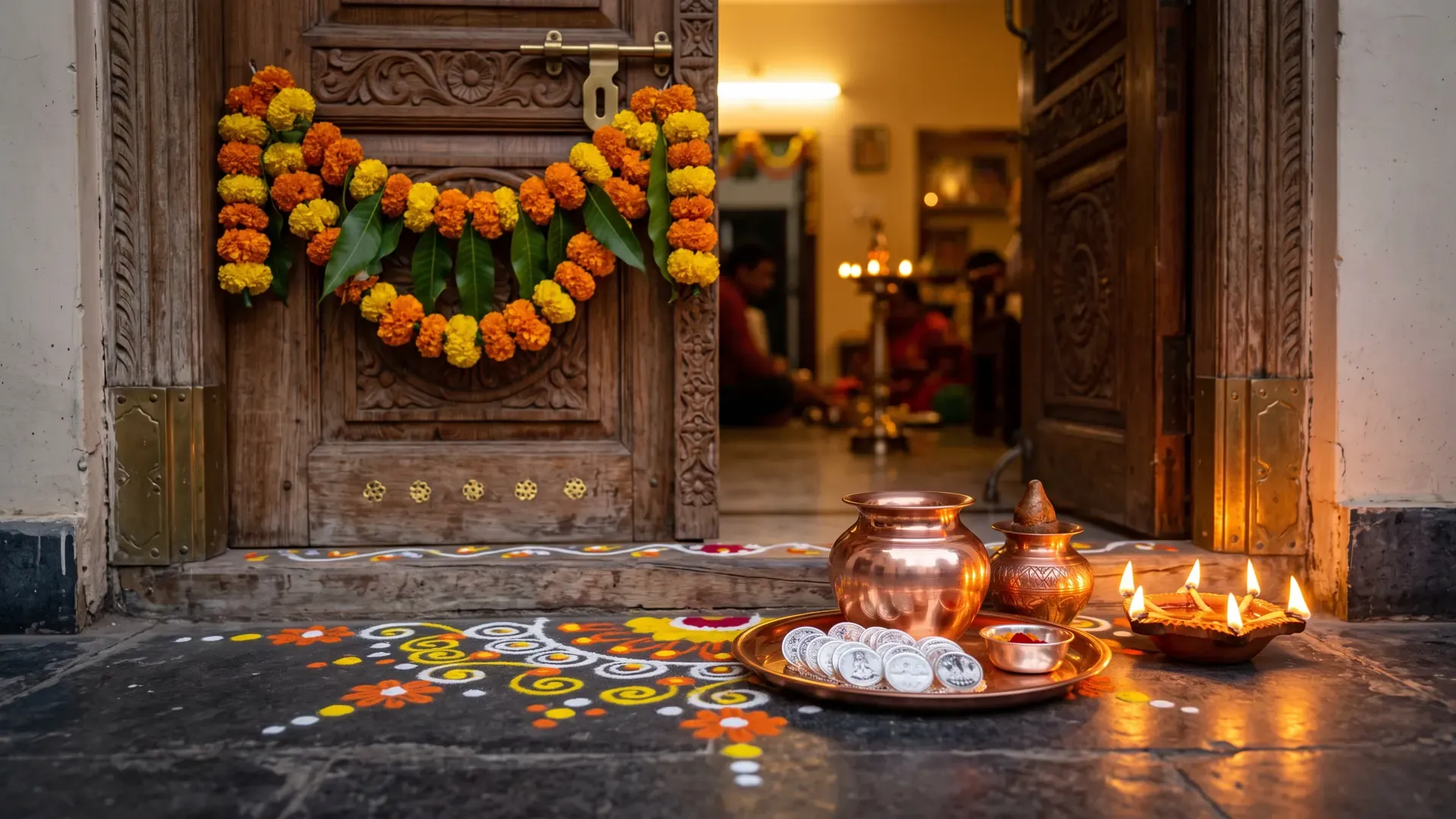
The Dhanteras mantras: Dhanvantari’s ‘Om namo bhagavate vasudevaya dhanvantaraye …’, the Yama lamp mantra ‘mrityuna pashadandabhyam kalena shyamaya saha …’ (in the Nirnaya Sindhu and Gita Press’s Vrat-Parichay), and Kubera’s ‘rajadhirajaya prasahyasahine …’ and ‘avahayami deva tvam ihayahi …’. Dhanteras is on Wednesday, 27 October 2027. Below are the text, meaning and source.
When to say them
Dhanteras is on Wednesday, 27 October 2027. Dhanvantari, Lakshmi and Kubera are worshipped in Pradosh Kaal, and the Yama lamp is given in the evening twilight after sunset. New Delhi: Dhanteras puja muhurat: 6:43–8:14 PM.
- Dhanteras puja muhuratPradosh Kaal + Vrishabha lagna + tithi
- 6:43–8:14 PM
- Pradosh KaalFirst fifth of the night
- 5:40–8:14 PM
- Vrishabha KaalFixed ascendant
- 6:43–8:39 PM
- Yama DeepdaanSayahna Sandhya: after sunset
- 5:40–6:57 PM
- Trayodashi tithi
- until 10:51 PM
New Delhi, Indian Standard Time; SanatanBodh panchang calculation, checked against Drik Panchang. Your city’s time and the full page
1Dhanvantari mantra: Om Namo Bhagavate Vasudevaya Dhanvantaraye
ॐ नमो भगवते वासुदेवाय धन्वन्तरयेअमृतकलशहस्ताय सर्वामयविनाशनायत्रैलोक्यनाथाय श्रीमहाविष्णवे नमः॥
When: In the worship and japa of Dhanvantari, on the evening of Dhanteras
Meaning: Salutations to the Lord Vasudeva; to Dhanvantari, who holds the pot of nectar in his hand, the destroyer of all ailments (amaya) and lord of the three worlds; salutations to Shri Mahavishnu.
Source: A mantra in common use. shlokam.org (‘Dhanvanthari Mantra’), in Devanagari, and the New York Ganesh Temple (nyganeshtemple.org/dhanvantari), in Roman letters, give the same words; neither names a scripture, so it is not called a verse of any Purana
Variant: shlokam.org prints ‘amritakalasha hastaya’ as two words; we write it as one compound. Longer forms are said in some homes; we give only the form that both sources share.
2How Dhanvantari appeared: Bhagavata Purana 8.8.32–34
दीर्घपीवरदोर्दण्डः कम्बुग्रीवोऽरुणेक्षणः।श्यामलस्तरुणः स्रग्वी सर्वाभरणभूषितः॥पीतवासा महोरस्कः सुमृष्टमणिकुण्डलः।स्निग्धकुञ्चितकेशान्तसुभगः सिंहविक्रमः॥अमृतापूर्णकलसं बिभ्रद्वलयभूषितः।स वै भगवतः साक्षाद्विष्णोरंशांशसम्भवः॥धन्वन्तरिरिति ख्यात आयुर्वेददृगिज्यभाक्॥
When: The description of Dhanvantari’s form; some read it as a dhyana in the puja (not a rule of the rite)
Meaning: In the churning of the ocean a wondrous being rose: long, strong-armed, with a conch-like neck and reddish eyes, dark, young, garlanded, adorned with every ornament; in yellow cloth, broad-chested, with shining jewelled earrings, glossy curled hair, a lion’s stride; holding a pot full of nectar in hands decked with bracelets. He was a portion of a portion of Lord Vishnu himself, known as Dhanvantari, the seer of Ayurveda and sharer of the sacrifice.
Source: Srimad Bhagavata Mahapurana, canto 8, chapter 8, verses 32–34 (the VedaBase numbering). The text is the same on VedaBase (vedabase.io, Devanagari) and Sanskrit Wikisource; Wikisource splits these lines into verses 33–36
Variant: Both print ‘kalasam’, not ‘kalasham’.
3The Yama lamp mantra: Mrityuna Pasha-dandabhyam
मृत्युना पाशदण्डाभ्यां कालेन श्यामया सह।त्रयोदश्यां दीपदानात् सूर्यजः प्रीयतां मम॥
When: On the evening of Kartik Krishna Trayodashi, while giving the lamp, facing south
Meaning: May Yama, the son of the Sun, together with Death, his noose and staff, Time and Shyama, be pleased with me through this giving of a lamp on Trayodashi.
Source: Nirnaya Sindhu (Kamalakara Bhatta), second paricheda, the Yama lamp of Kartik Krishna Trayodashi (in both editions; p. 145 of the 1927 edition); Gita Press, Vrat-Parichay p. 155 (‘Yama-deepdan’, under the name of the Skanda Purana, the lamp given with this mantra)
Variant: Gita Press’s Vrat-Parichay has the first line as ‘mrityuna dandapashabhyam’ (noose and staff in the other order); the Nirnaya Sindhu has ‘pashadandabhyam’. The sense is the same.
4The Yama lamp verse (quoted from the Skanda Purana): Kartikasyasite Pakshe
कार्तिकस्यासिते पक्षे त्रयोदश्यां निशामुखे।यमदीपं बहिर्दद्यादपमृत्युर्विनश्यति॥
When: The verse that gives the reason for the Yama lamp
Meaning: On the Trayodashi of the dark half of Kartik, at the start of the evening, give a lamp for Yama outside the house; (by this) untimely death is destroyed.
Source: Quoted in the Nirnaya Sindhu as ‘skande’ (from the Skanda Purana), just before the mantra above (both editions). Gita Press’s Vrat-Parichay p. 155 assigns the lamp to the Skanda Purana but does not give this verse. We did not find the verse in the Skanda Purana itself, so it is called ‘quoted from’
Variant: Both printed editions show the first line as ‘kartikasya site pakshe’; the Trayodashi is of the dark half and the Nirnaya Sindhu gives the verse under Krishna Trayodashi, so we read ‘asite’ (the dark half).
5Invoking Kubera
आवाहयामि देव त्वामिहायाहि कृपां कुरु।कोशं वर्द्धय नित्यं त्वं परिरक्ष सुरेश्वर॥
When: At the tijori or cash box, at the start of the Kubera puja
Meaning: O god, I invoke you: come here and be gracious. O lord among the gods, ever increase my treasury and guard it.
Source: Gita Press p. 256; Drik Panchang, Kuber Puja Vidhi
6The Vedic Kubera mantra: Rajadhirajaya Prasahyasahine
ॐ राजाधिराजाय प्रसह्यसाहिने नमो वयं वैश्रवणाय कुर्महे।स मे कामान् कामकामाय मह्यं कामेश्वरो वैश्रवणो ददातु।कुबेराय वैश्रवणाय महाराजाय नमः॥
When: At the end of the Kubera puja, in the mantra-pushpanjali
Meaning: We bow to Vaishravana (Kubera), king of kings, who prevails by strength. May Vaishravana, lord of desires, grant me, who desire them, the things I wish for. Salutations to Kubera Vaishravana, the great king.
Source: The closing mantra of the Mantra Pushpam of the Taittiriya Aranyaka (the sanskritdocuments.org ‘Mantrapushpam’ text); Gita Press, Nityakarma-Pujaprakash p. 259 (mantra-pushpanjali)
Variant: Gita Press prints ‘prasahya sahine’ as two words and ‘mahyam’ with an anusvara; sanskritdocuments.org has ‘prasahyasahine’ and ‘mahyam’. The words are the same.
7Lakshmi Gayatri (for the evening Lakshmi puja)
महालक्ष्म्यै च विद्महे विष्णुपत्न्यै च धीमहि।तन्नो लक्ष्मीः प्रचोदयात्॥
When: In the mantra-pushpanjali, with flowers in both hands
Meaning: May we know Mahalakshmi, may we meditate on the consort of Vishnu; may that Lakshmi inspire us.
Source: Gita Press p. 259; Drik Panchang, Lakshmi mantras
Variant: Drik Panchang adds ‘Om Shri’ at the start and ‘Om’ at the end.
About these texts
Every text was compared word by word in at least two separate sources: printed editions, Gita Press books and Sanskrit text sites. Mantras that only devotional sites give, with no scripture named, are marked ‘in common use’, not as a Purana’s. The meanings are our own, in plain words. Take the method and the count of repetitions from your own family or purohit.
Aartis and chalisas
Frequently asked questions
When is Dhanteras 2027?
On Wednesday, 27 October 2027. New Delhi: Dhanteras puja muhurat: 6:43–8:14 PM. See the festival page for your city’s time.
What is the Dhanvantari mantra?
‘Om namo bhagavate vasudevaya dhanvantaraye amritakalashahastaya sarvamayavinashanaya trailokyanathaya shri mahavishnave namah’. It is a mantra in common use; neither of the two sites that give it (shlokam.org and the New York Ganesh Temple) names a scripture. The verse describing Dhanvantari’s form is Bhagavata Purana 8.8.32–34.
What is the mantra for the Yama lamp?
‘Mrityuna pashadandabhyam kalena shyamaya saha. Trayodashyam deepadanat suryajah priyatam mama.’ By Gita Press’s Vrat-Parichay, on the evening of Kartik Krishna Trayodashi one fills clay lamps with sesame oil, puts in new cotton wicks, worships them and gives them facing south with this mantra.
Which Lakshmi and Kubera mantra is said on Dhanteras?
For Kubera, ‘avahayami deva tvam ihayahi …’ and the Taittiriya Aranyaka’s ‘rajadhirajaya prasahyasahine …’ are above. For Lakshmi the Lakshmi Gayatri is above and the other mantras are on the Diwali mantra page. We found no textual rule on which of them is said on which day; follow your family’s practice.
Sources
- Gita Press, Vrat-Parichay (Pt Hanuman Sharma, 2073)
- Nirnaya Sindhu (Kamalakara Bhatta), Nirnaya Sagar Press, Mumbai 1901, and Khemraj Shrikrishnadas, Mumbai 1927
- Gita Press, Nityakarma-Pujaprakash (reprints of 2066 and 2070)
- Srimad Bhagavata Mahapurana 8.8.31–35: VedaBase (vedabase.io, Devanagari) and Sanskrit Wikisource
- shlokam.org, ‘Dhanvanthari Mantra’; New York Ganesh Temple, Sri Dhanvantari Mantra Japam (nyganeshtemple.org/dhanvantari)
- sanskritdocuments.org: Mantrapushpam (Taittiriya Aranyaka)
- Drik Panchang (the Lakshmi mantras, Lakshmi puja vidhi and Kuber puja vidhi pages)
Something wrong? Report a mistake
