Advertisement
Download the Om Jai Jagdish Hare PDF
Advertisement
Meaning, sources and more prayers: sanatanbodh.in/en/prayers/om-jai-jagdish-hare/
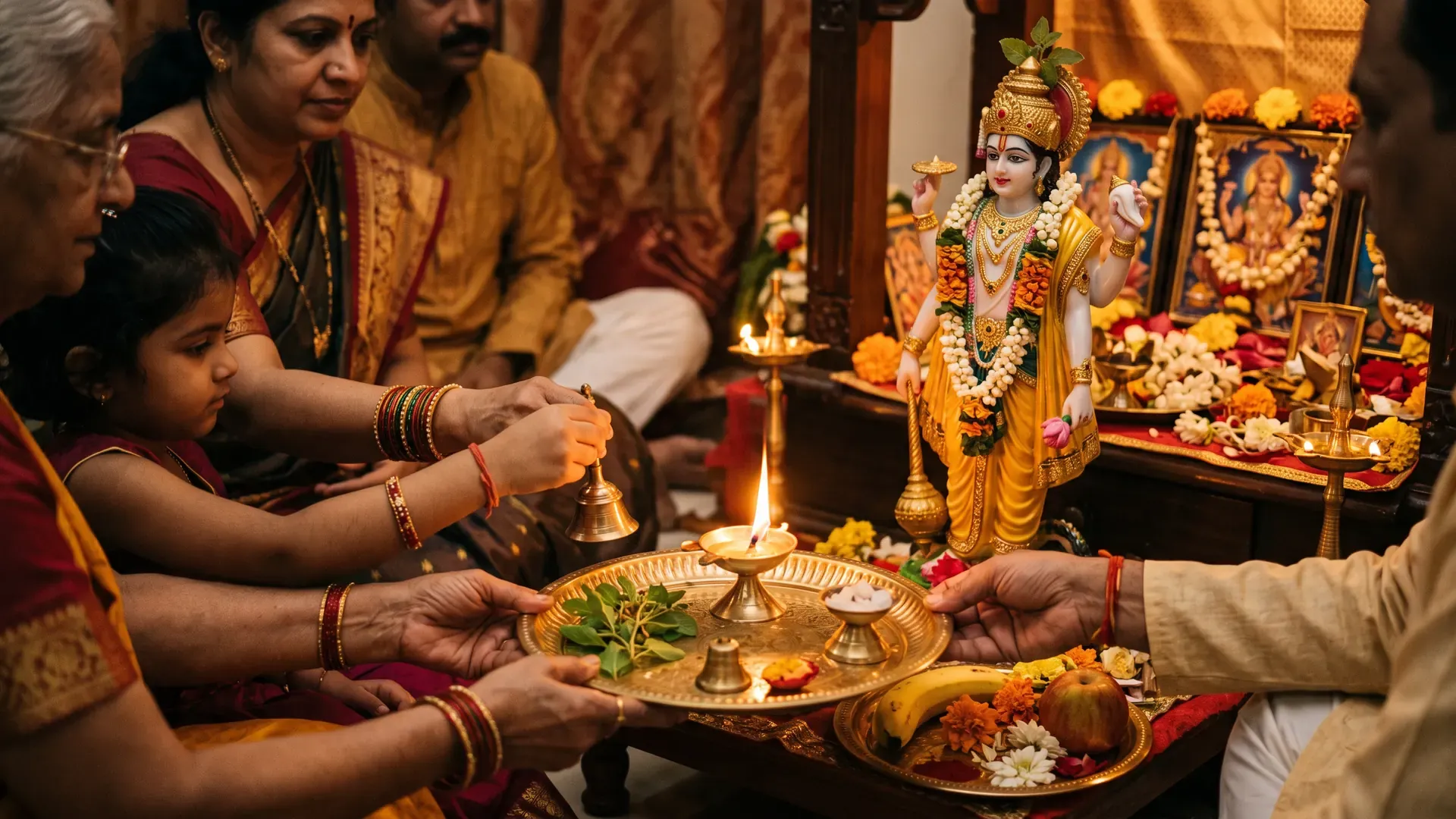
“Om Jai Jagdish Hare” is an aarti to Lord Vishnu (Jagdish, Hari), written in Punjab in the 19th century by Pandit Shardha Ram Phillauri (Shraddha Ram Sharma). It is one of the most widely sung aartis of North India. It is sung at Vishnu puja, the Satyanarayan Katha and on Ekadashi, and in many homes at the end of daily worship.
This is the form in which the aarti is usually sung, including its repeated lines. Some versions differ slightly, for example ‘main moorakh phalkami’ in place of ‘main moorakh khal kami’ in verse 5, and ‘Swami rakshak tum mere’ and ‘apne sharan lagao’ in verse 7. Some versions add a final verse: ‘Shri Jagdishji ki aarti, jo koi nar gave. Kahat Shivanand Swami, sukh sampatti pave.’ When sung, the first line (the refrain) is repeated after every verse.
After the aarti, most homes recite: कर्पूरगौरं करुणावतारं संसारसारं भुजगेन्द्रहारम्।
Each morning the tithi, Rahu Kaal and coming festivals, in one short WhatsApp message.Follow the channel
Frequently asked questions
Who wrote “Om Jai Jagdish Hare”?
Pandit Shardha Ram Phillauri (Shraddha Ram Sharma, 1837 to 1881), a scholar, writer and preacher from Phillaur in Punjab. According to common accounts he wrote it around 1870.
Which deity is this aarti addressed to?
Lord Vishnu. ‘Jagdish’ (Lord of the world) and ‘Hari’ are names of Vishnu. Even so, it is also sung at the end of many other pujas.
How many verses does this aarti have?
The common text has eight verses. Some versions add one more verse at the end.
What else did Shardha Ram Phillauri write?
Besides the aarti he also wrote prose. His novel ‘Bhagyawati’ is counted among the earliest novels in Hindi.
Sources
- Traditional aarti text
- Author: Pandit Shardha Ram Phillauri (19th century)
Something wrong? Report a mistake
Text checked against: bhaktibharat.com, vignanam.org, drikpanchang.com, hi.wikipedia.org