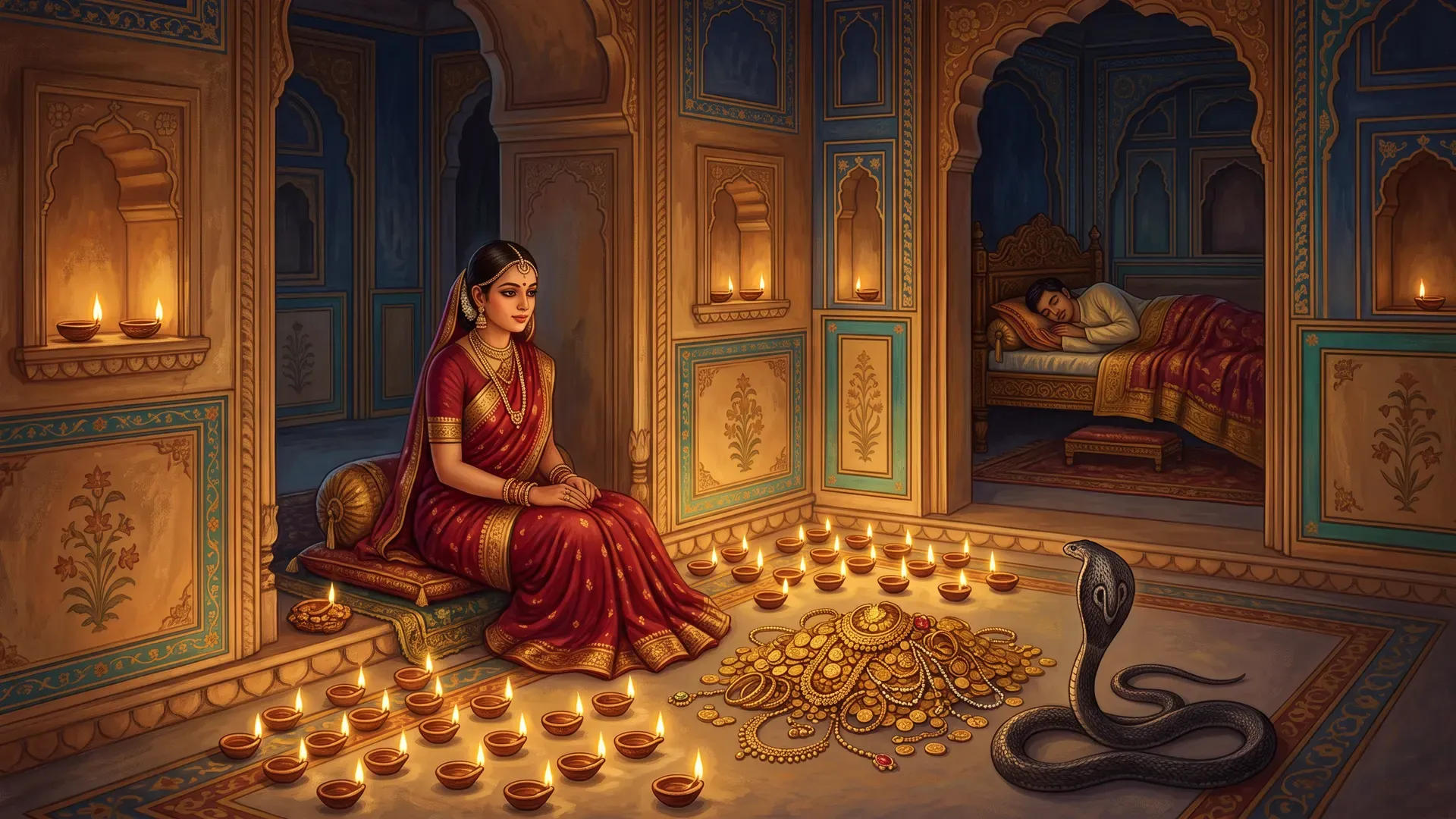
The story most often told on Dhanteras is of King Hema’s (Hima’s) son, fated to die on the fourth day of his marriage. It is tied to the custom of lighting a lamp for Yama outside the house, facing south, on the evening of Dhanteras (Yama deepdaan), a rite the Skanda Purana prescribes. Tradition also holds that Dhanvantari rose from the churning of the ocean on this day, and the folk tale of Lakshmi and the farmer is told too.
Each morning the tithi, Rahu Kaal and coming festivals, in one short WhatsApp message.Follow the channel
Dhanteras (Dhana Trayodashi) falls on Kartik Krishna Trayodashi (Purnimanta), two days before Diwali. In the evening a lamp is lit outside the house for Yama, and Dhanvantari and Lakshmi with Kubera are worshipped.
The Skanda Purana (Vaishnava Khanda, Kartik Masa Mahatmya, chapter 9) prescribes a lamp for Yama at the door of the house, facing south, on the evening of this Trayodashi; the Narada Purana (Purva Bhaga 1.122) also says to eat one meal that day and keep an oil lamp outside the door. The same Skanda chapter mentions in one line that the son of King Hemanaka was saved from untimely death; the full story of that prince is told in tradition in the two forms below. (The Skanda Purana, counting months Amanta, calls this fortnight Ashwin Krishna; in the North Indian Purnimanta count it is Kartik Krishna.)
How the vrat and katha are kept
- In the evening (Pradosh) a new clay lamp is lit with mustard oil and placed outside the main door, facing south. In many places thirteen lamps are lit.
- By the Narada Purana, one meal is eaten on the day, and while placing the lamp one prays that Yama be pleased.
- The same evening Dhanvantari is worshipped (Dhanvantari Jayanti) along with Lakshmi and Kubera, and the katha is heard.
The pity of Yama’s messengers: the son of King Hema
This telling is given by Webdunia, Bharat-Darshan and India.com; the names differ a little in each.
Once Yama asked his messengers, “When you take a life, have you ever felt pity for anyone?” At first they said they only carry out orders. But when Yama asked again, they told of one event that still moved them to remember.
A king named Hansa, out hunting, strayed into the land of King Hema. That very day a son had been born in King Hema’s house. The astrologers read the child’s stars and said he would die on the fourth day after his marriage.
Hearing this, King Hema had the boy raised as a brahmachari in a cave on the bank of the Yamuna, where not even a woman’s shadow would fall. But as chance would have it, King Hansa’s daughter came to the Yamuna. The prince and the princess saw each other and married by gandharva vivah.
On the fourth day of the marriage the prince died. The young bride’s grief was so deep that even Yama’s messengers wept as they carried his life away.
One messenger folded his hands and asked, “Lord, is there no way a person can escape untimely death?” Yama said, “Whoever worships on Dhanteras and in the evening lights a lamp in my name facing south will be free of the fear of untimely death.” From then on, lamps have been offered to Yama on the evening of Dhanteras.
The line in the Skanda Purana ends differently: there the son of King Hemanaka is saved from untimely death on this day by the Lord’s grace, and when the messengers ask, Yama orders that those who light a lamp at the door of their house on this evening are not to be brought.
The wife’s lamps: when Yama came as a snake
This telling is given by Webdunia, Amar Ujala and English Wikipedia.
It had been foretold that King Hima’s son would die of a snakebite on the fourth day of his marriage. He was married all the same. His wife was a devotee of Mahalakshmi and resolved to save her husband.
On the fourth night she did not sleep. She lit lamps all around, inside and outside the room, and kept singing the aarti of Mahalakshmi. In some tellings she heaps all her ornaments and gold and silver coins at the door of the bedroom and keeps her husband awake all night with stories and songs.
At the appointed hour Yama came in the form of a snake. But the blaze of the lamps dazzled his eyes and he could not go in. He stayed where he was, listening to her songs and aarti.
Dawn came and the hour of death passed. Yama went back empty-handed, and the prince lived a long life. That is held to be why lamps are lit for Yama on the night of Dhanteras.
Dhanvantari from the churning of the ocean
As told in the Bhagavata Purana 8.8.31–35 and 1.3.17, and the Vishnu Purana 1.9.
As the devas and asuras churned the ocean of milk, a wondrous person rose from it. The Bhagavata Purana describes him: strong in build, long-armed, dark, garlanded, in yellow cloth with pearl earrings, holding a pot full of amrita.
He was Dhanvantari, a portion of Vishnu and master of the science of medicine; the Bhagavata Purana (1.3.17) counts him among the Lord’s avatars. The moment the asuras saw the pot of amrita they snatched it, and then the Lord took the form of Mohini.
Tradition holds that Dhanvantari appeared on Kartik Krishna Trayodashi, which is why Dhanvantari Jayanti is kept on this day. The Bhagavata and Vishnu Puranas do not give a date for it.
Lakshmi and the farmer
A folk tale, given by Drik Panchang, Webdunia and Amar Ujala.
Once Lakshmi wished to go with Lord Vishnu to earth. He agreed on one condition: she must not look to the south. But restless Lakshmi’s eyes strayed that way, to a field of mustard in flower and a field of sugarcane. She adorned herself with mustard flowers and broke off sugarcane to drink its juice.
Displeased that she had taken a farmer’s crop without asking, Vishnu told her to serve that poor farmer in his house for twelve years. Lakshmi went to live there. She told the farmer’s wife to bathe and worship Lakshmi before cooking each day, and soon the farmer’s house filled with grain, wealth and jewels.
After twelve years Vishnu came to take her back, but the farmer would not let her go. Then Lakshmi revealed herself and promised to come to his house every year on the Krishna Trayodashi before Diwali. In Webdunia’s telling she says: clean the house that day, light a ghee lamp at night and worship with a copper kalash filled with coins, and I will stay in that house all year. This is how Lakshmi puja on Dhanteras is explained.
Other tellings
- The prince’s father is called Hema, Hima or Hemanaka (Skanda Purana); in India.com the prince himself is named Hema. The bride’s father is named Hansa.
- In the first telling the prince dies and the rite of the lamp is made for others; in the Skanda Purana line and in the second telling he is saved.
- The heap of ornaments and coins and the night of stories and songs is in English sources (William Crump, Encyclopedia of New Year’s Holidays Worldwide); Hindi sources speak of the lamps and Mahalakshmi’s aarti.
- The number of lamps varies: one new lamp, or thirteen.
- Dhanvantari’s garments are yellow in the Bhagavata Purana and white in the Vishnu Purana.
- Webdunia ties another story, of a king who turned a hungry brahmin away, to Trayodashi; other sources tell the same story of King Rantideva on Narak Chaturdashi.
After the katha
After the katha, the lamp for Yama is placed in the evening and Dhanvantari and Lakshmi with Kubera are worshipped. The Dhanteras puja muhurat for your city is on the Dhanteras page.
Dhanvantari Aarti: Jai Dhanvantari DevaFrequently asked questions
Why is a lamp lit for Yama on Dhanteras?
The Kartik Masa Mahatmya of the Skanda Purana (chapter 9) prescribes a lamp for Yama at the door on the evening of this Trayodashi, to remove the fear of untimely death. Popular tradition ties it to the story of King Hema’s son.
How is the lamp for Yama offered?
In the evening a new clay lamp is lit with mustard oil and placed outside the main door facing south. Many families light thirteen. The details vary with family custom.
Why is Dhanvantari worshipped on Dhanteras?
Tradition holds that Dhanvantari rose from the churning with the pot of amrita on this day, so it is Dhanvantari Jayanti. The churning is told in the Bhagavata Purana (8.8), which does not give the date.
Is the story of King Hema in a Purana?
The Skanda Purana has only one line saying that King Hemanaka’s son was saved from untimely death on this day. The full story, with its names and events, comes from popular tradition.
Sources
- Skanda Purana, Vaishnava Khanda, Kartik Masa Mahatmya, chapter 9, verses 20–26 (G. V. Tagare’s translation, checked on wisdomlib.org)
- Narada Purana, Purva Bhaga 1.122.46–47 (wisdomlib.org)
- Bhagavata Purana 8.8.31–35 and 1.3.17 (vedabase.io); Vishnu Purana 1.9 (H. H. Wilson’s translation)
- Webdunia: Dhanteras ki pauranik katha; the katha of the lamp for Yama; Lakshmi in the farmer’s house
- Amar Ujala: the Yama lamp on Dhanteras; the Dhanteras katha
- Bharat-Darshan (bharatdarshan.co.nz): the story of King Hema
- Drik Panchang: Dhanteras legends and Dhanvantari Trayodashi
- Hindi and English Wikipedia: Dhanteras (the English page cites William D. Crump, Encyclopedia of New Year’s Holidays Worldwide, 2016, p. 112)
Something wrong? Report a mistake