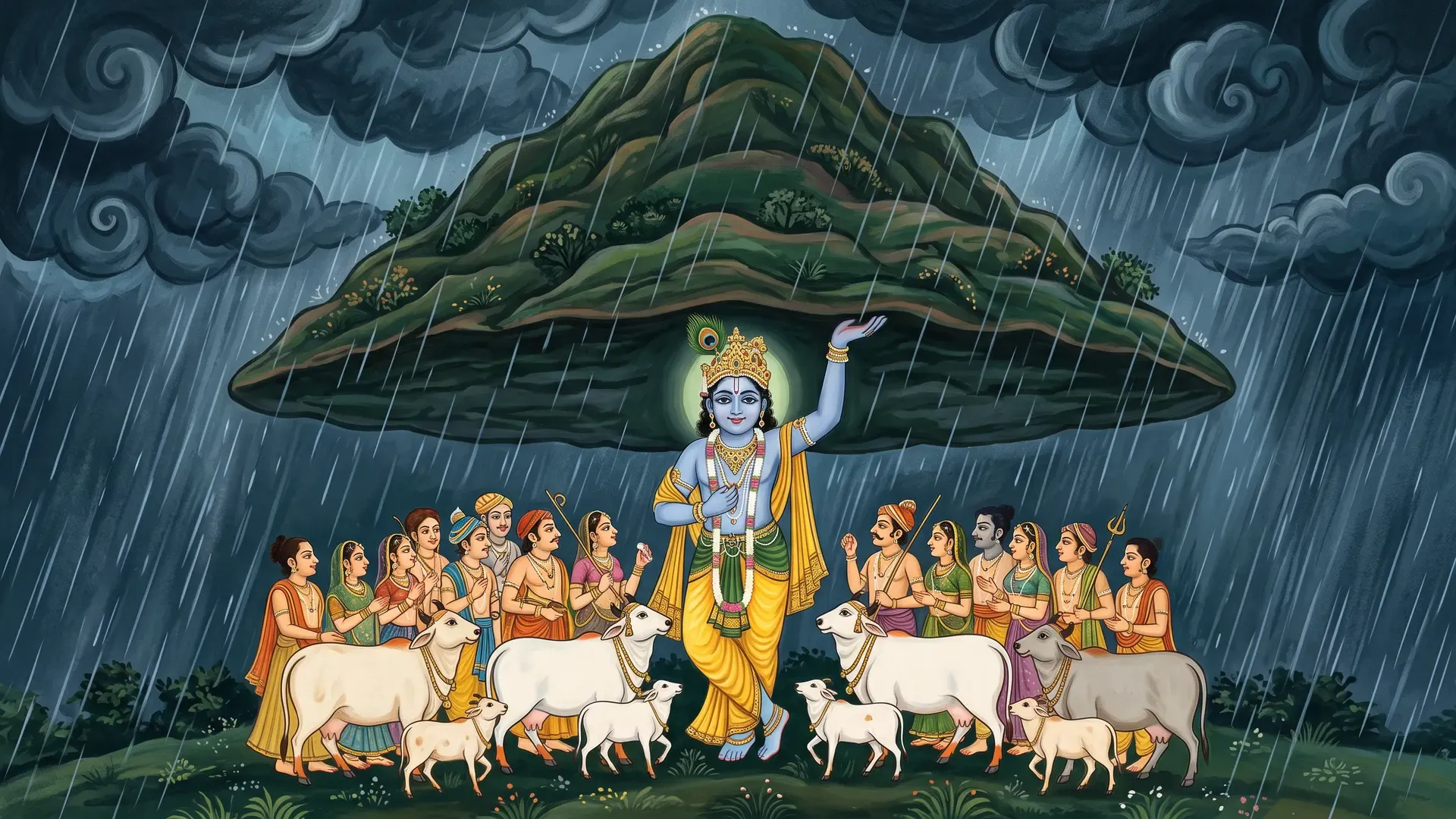
By the Bhagavata Purana (10.24–27), Krishna persuaded the people of Vraj to worship the cows, the brahmins and the hill Govardhan instead of offering their sacrifice to Indra. When the angry Indra sent the clouds of dissolution, Krishna lifted Govardhan with one hand and sheltered all of Vraj beneath it for seven days. In the end Indra asked forgiveness, and the cow Surabhi and Indra bathed Krishna in abhisheka and named him “Govinda”.
Each morning the tithi, Rahu Kaal and coming festivals, in one short WhatsApp message.Follow the channel
Govardhan Puja is kept on the morning of Kartik Shukla Pratipada, after Diwali; it is also called Annakut. The Padma Purana (Uttara Khanda, chapter 122) and the Skanda Purana (Vaishnava Khanda, Kartik Masa Mahatmya, chapter 10) prescribe the worship of Govardhan on this morning, with a prayer that calls Govardhan the support of the earth, the protector of Gokula and the hill lifted by Vishnu’s hand. But these texts do not say the hill was lifted on this date, and the word “Annakut” is not in these chapters; the Annakut of many dishes is tradition.
The story is told at length in the Bhagavata Purana (tenth canto, chapters 24–27); the Vishnu Purana (5.10–12) and the Harivamsha (Vishnu Parva, chapters 16–19) tell it too. Below it follows the Bhagavata’s order, and notes where the other texts differ.
How the vrat and katha are kept
- The katha is read and heard on the day of Govardhan Puja; printed vrat-katha booklets carry it as the “Govardhan katha”.
- By the Padma and Skanda Puranas, Govardhan is worshipped on the Pratipada morning; the cows are decorated, and that day they are neither milked nor made to carry loads.
- By tradition a Govardhan is shaped from cow dung in the courtyard, in many places as a reclining man, with flowers and small figures of cows and calves. Milk, curd, Ganga water, honey and sweets are placed in the hollow of its navel, and seven rounds are made around it while pouring water and sowing barley (Drik Panchang, Hindi Wikipedia, Bharatkosh).
- Many dishes are offered to the Lord, which is called Annakut; Drik Panchang names grain dishes, besan kadhi and leafy vegetables. Temples set out the Annakut before the deity, and afterwards everyone shares the prasad.
Govardhan worshipped in place of Indra
As told in the Bhagavata Purana 10.24, the Vishnu Purana 5.10 and the Harivamsha (Vishnu Parva, chapters 16–17).
The rains had ended and autumn had come. Krishna and Balarama lived in Vraj. One day Krishna saw all the cowherds busy preparing a great sacrifice. He asked Nanda respectfully, “Father, whose worship is this? Is it laid down in scripture, or is it only a custom?”
Nanda said, “Son, Indra, king of the gods, is lord of the clouds. The clouds he sends bring rain, the rain grows our grain and the grass for our cows. So after the rains we offer a sacrifice to Indra every year.”
In the Bhagavata Purana Krishna answers that every being meets joy and sorrow through its own karma, that clouds rain by their own nature, and that Indra cannot change anyone’s destiny. In the Vishnu Purana and the Harivamsha his reasoning is different: “We are neither farmers nor traders. We are cowherds who live in the forest; the cows are our living and our gods, and these forests and hills shelter us. What have we to do with Indra? We should worship the hill and the cows.”
Then Krishna said that the things gathered for Indra’s sacrifice should be used for a sacrifice to the cows, the brahmins and the hill Govardhan. Let many dishes be cooked, from sweet rice to dal, with cakes and all kinds of fried and baked foods, and let all the milk, curd and ghee be gathered. Let the brahmins be fed, and everyone else too, down to the dogs and those held lowest in society; let the cows be given fresh grass. Then let everyone dress in their best and walk around the cows, the brahmins, the fire and the hill.
Nanda and all the cowherds liked the plan, and they did as he said. The Harivamsha paints the festival: trumpets sounded, bulls roared and calves called, there were lakes of curd and rivers of milk, and a mountain-like heap of cooked rice was carried to Govardhan.
When the worship was done, Krishna took on a vast form and said, “I am the hill.” In that form he accepted all the food the people of Vraj had offered. At the same time, in his own boyish form, he bowed with them to that form and said, “See, the hill has appeared and shown us its grace.”
Indra’s rain and the lifting of Govardhan
As told in the Bhagavata Purana 10.25 and 10.26.3, the Vishnu Purana 5.11 and the Harivamsha (Vishnu Parva, chapter 18).
When Indra saw that his sacrifice had been stopped, he was filled with rage. He sent against Vraj the Samvartaka clouds, the clouds that pour at the dissolution of the world. In the Vishnu Purana Indra says he will ride his elephant Airavata himself to make the storm fiercer.
Torrents of rain fell on Vraj. A fierce wind blew and hail came down. Earth, sky and every direction became one sheet of water. Many cows covered their calves with their own bodies, the calves shivered in the wind, and the frightened people of Vraj ran to Krishna: “Krishna, save us!”
Krishna understood that this was Indra’s anger and that Vraj must be protected. He pulled the hill Govardhan up from the earth and held it aloft with one hand, as easily as a child holds up a mushroom (Bhagavata Purana). By the Harivamsha he held it on his left hand.
He told the people of Vraj, “Come under the hill quickly with your cows and belongings. Don’t be afraid; the hill will not fall.” All the cowherd men and women came beneath it with their cows, calves, carts and goods, and there was room for everyone.
For seven days the rain went on, and for seven days Krishna stood holding the hill without moving. He paid no heed to hunger or thirst, while the people of Vraj gazed at him from beneath the hill in wonder and love. Later in the Bhagavata Purana the cowherds marvel that a boy of seven lifted so great a hill with one hand, as an elephant lifts a lotus.
All of Indra’s efforts came to nothing. Astonished, he called back the clouds. The sky cleared and the sun came out. Everyone came out with their cows and belongings, and as they watched, Krishna set Govardhan back in its place.
The people of Vraj embraced Krishna with love, and the gods showered flowers from the sky.
Indra’s apology and the naming of Govinda
As told in the Bhagavata Purana 10.27, the Vishnu Purana 5.12 and the Harivamsha (Vishnu Parva, chapter 19).
Indra’s pride was broken. By the Bhagavata Purana he came to Krishna in private, together with Surabhi, the divine cow from Goloka, bowed his head at Krishna’s feet and confessed that he had erred in his pride. In the Vishnu Purana Indra rides Airavata to Govardhan and sees Garuda, unseen by mortals, spreading his wings to shade Krishna.
Krishna told him that he had stopped the sacrifice for this very reason: to cure Indra of his pride.
Then Surabhi spoke for the cows: “Be our Indra.” She bathed Krishna with her own milk, and at the urging of Aditi and the mothers of the gods, Indra bathed him with water of the heavenly Ganga from Airavata’s trunk. The gods and sages hailed him as “Govinda”.
In the Vishnu Purana Indra says he has come at the cows’ wish. With holy water from a ewer taken from Airavata he performs the abhisheka, installs Krishna as “Upendra”, and says that as Indra of the cows he will be called “Govinda”; as he does so, the cows drench the earth with their milk. In the Harivamsha Indra pours heavenly water from a golden jar, and the cows of heaven shower milk from the clouds.
Then Indra returned to heaven, and Krishna went back to Vraj with the cows and the cowherds. In the Harivamsha Indra says that whoever recites this account and bows will not be touched by misery.
Other tellings
- Krishna’s reasoning differs between the texts: the Bhagavata speaks of karma and nature, the Vishnu Purana and the Harivamsha of the cowherds living by their cows, forest and hill. Modern tellings such as Aaj Tak put it as worship of nature: rivers, cattle, earth, trees and the hill.
- The Bhagavata and Vishnu Puranas say the hill was lifted with one hand; the Harivamsha (M. N. Dutt’s translation) says the left hand, and in one place the same translation says “on the tip of his finger” (we have not checked the Sanskrit). The little finger comes from popular telling: Drik Panchang, Hindi Wikipedia, Bharatkosh, Aaj Tak and a printed vrat-katha booklet (“kani ungli”); Tagare’s note on the Skanda Purana also calls it the popular account.
- Duration: seven days in the Bhagavata, seven days and nights in the Vishnu Purana, seven nights in the Harivamsha; Drik Panchang says only “many days”.
- The abhisheka differs in each text: Surabhi’s milk and heavenly Ganga water from Airavata’s trunk in the Bhagavata; water from a ewer taken from Airavata, and the cows’ milk, in the Vishnu Purana; a golden jar and milk from the cows of heaven in the Harivamsha. In a printed vrat-katha booklet Indra himself bathes Krishna in milk, which collects in a kund; the kund’s name cannot be read clearly in that scan.
- Only in the Vishnu Purana does Indra, at this meeting, ask Krishna to protect Arjuna, born of a portion of Indra.
- The 56 bhog appear in Aaj Tak, Bharatkosh and the printed booklet. The explanation of seven days with eight meals a day (7 × 8 = 56) is given by GNT and Amrit Vichar; it is belief, not scripture. Bharatkosh says the 56 dishes had first been made for Indra.
- The ending: by Bharatkosh, Krishna then asked for Govardhan to be worshipped every year; by the printed booklet, Annakut is kept as a festival of victory, in memory of Indra’s pride being humbled.
After the katha
After the katha the aarti of Govardhan is sung and the Annakut prasad is shared. The Govardhan Puja muhurat for your city is on the Govardhan Puja page.
Govardhan Aarti: Shri Govardhan MaharajFrequently asked questions
On which finger did Krishna lift Govardhan?
The Bhagavata Purana (10.25.19) and the Vishnu Purana (5.11) say Krishna lifted the hill with one hand; the Harivamsha says the left hand. The little finger is popular belief, found in Drik Panchang, Bharatkosh and printed vrat kathas; none of the texts we checked mentions the little finger.
Which Purana has the Govardhan katha?
The Bhagavata Purana tells it at length (tenth canto, chapters 24–27); the Vishnu Purana (5.10–12) and the Harivamsha (Vishnu Parva, chapters 16–19) tell it too. The worship of Govardhan on Kartik Shukla Pratipada is prescribed in the Padma Purana (Uttara Khanda, chapter 122) and the Skanda Purana (Kartik Masa Mahatmya, chapter 10).
Why are 56 dishes (chhappan bhog) offered on Govardhan Puja?
It is popular belief and is not found in any text. The common explanation is that Yashoda fed Krishna eight times a day, and for the seven days he held the hill he ate nothing, so eight dishes for each of seven days, fifty-six in all, were offered.
What is Annakut?
Annakut means a heap or mountain of food; offering the Lord many dishes on this day is tradition. The word is not in the Govardhan chapters of the Padma and Skanda Puranas; the closest image is the Harivamsha’s mountain-like heap of cooked rice at the hill sacrifice.
Sources
- Bhagavata Purana 10.24, 10.25, 10.26.3 and 10.27 (checked verse by verse on vedabase.io)
- Vishnu Purana 5.10–12 (H. H. Wilson’s translation, wisdomlib.org)
- Harivamsha, Vishnu Parva, chapters 16–19 (M. N. Dutt’s 1897 translation, wisdomlib.org; vulgate chapter numbers)
- Padma Purana, Uttara Khanda, chapter 122 (N. A. Deshpande’s translation) and Skanda Purana, Vaishnava Khanda, Kartik Masa Mahatmya, chapter 10 (G. V. Tagare’s translation), wisdomlib.org
- Drik Panchang: Govardhan Puja 2026; Diwali legends
- Hindi Wikipedia: Govardhan Puja
- Bharatkosh (bharatdiscovery.org): Govardhan Puja
- Aaj Tak: the history of Govardhan Puja (22 October 2025)
- GNT and Amrit Vichar: the belief behind the 56 bhog
- “Vrat Katha” booklet (archive.org, 20240806_20240806_0450): the Govardhan katha
Something wrong? Report a mistake