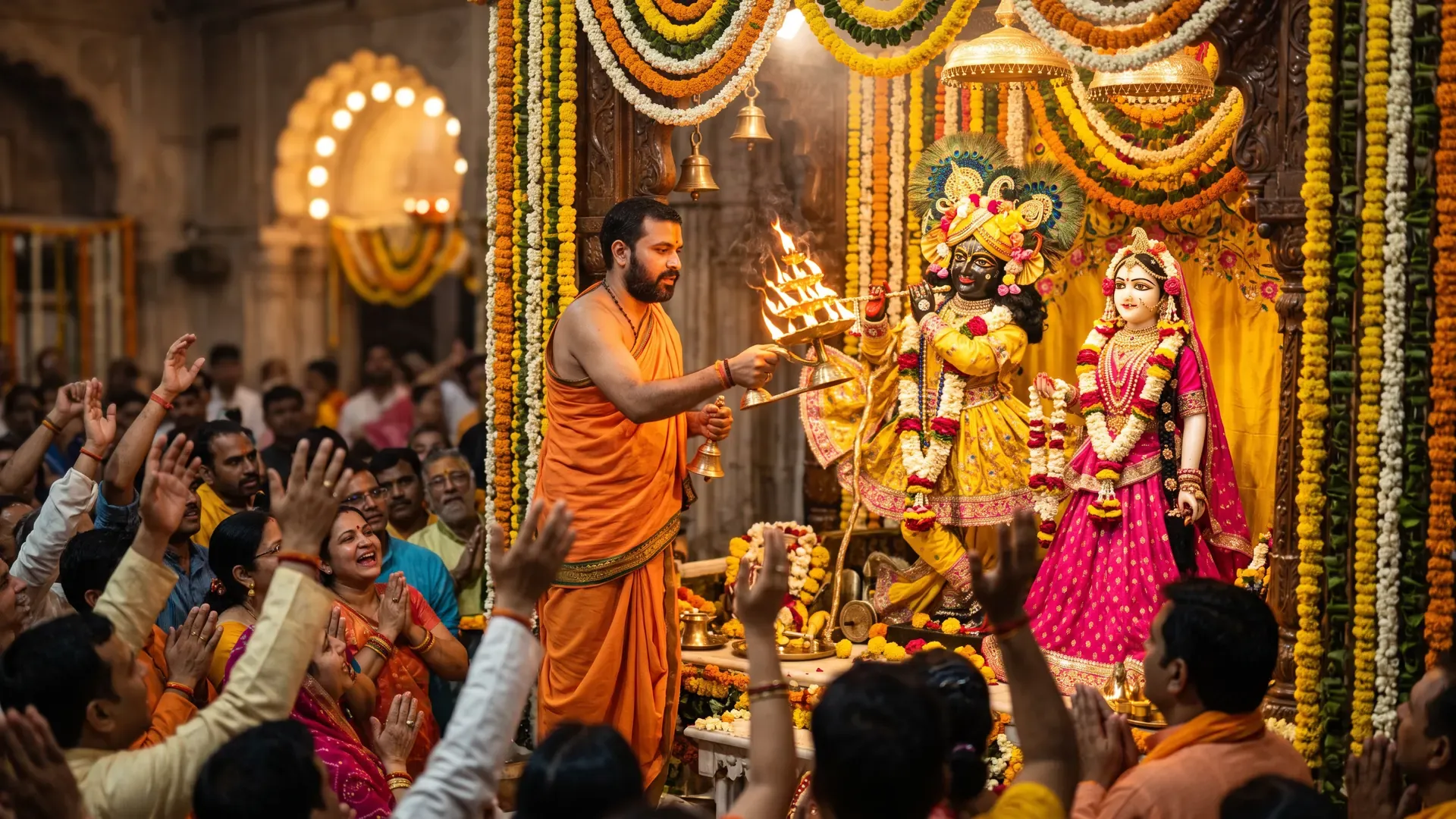
Aarti kunjabihari ki,
Shri giridhar Krishna murari ki ||
This is the aarti of Kunj Bihari, who roams the leafy groves of Vrindavan: Shri Krishna, Giridhar (holder of the mountain) and Murari (foe of the demon Mura).
Verse 2
गले में बैजंती माला, बजावै मुरली मधुर बाला।
श्रवण में कुण्डल झलकाला, नंद के आनंद नंदलाला।
गगन सम अंग कांति काली, राधिका चमक रही आली।
लतन में ठाढ़े बनमाली;
भ्रमर सी अलक, कस्तूरी तिलक, चंद्र सी झलक;
ललित छवि श्यामा प्यारी की॥
Gale mein baijanti mala, bajavai murli madhur bala.
Shravan mein kundal jhalkala, nand ke aanand nandalala.
Gagan sam ang kanti kali, radhika chamak rahi aali.
Latan mein thadhe banmali;
Bhramar si alak, kastoori tilak, chandra si jhalak;
Lalit chhavi shyama pyari ki ||
Wearing the Vaijayanti garland, the lovely young Krishna plays sweet music on his flute, earrings glinting in his ears; he is Nandalala, the joy of Nanda, his body dark and radiant like the sky, and beside him shines Radhika (‘aali’ is how Braj women address a companion). Standing among the vines is Banmali, wearer of the forest garland, with locks as dark as bees, a tilak of musk and a glow like the moon; lovely is this image of Shyama (Radha) and her beloved.
Verse 3
कनकमय मोर मुकुट बिलसै, देवता दरसन को तरसैं।
गगन सों सुमन रासि बरसै;
बजे मुरचंग, मधुर मिरदंग, ग्वालिन संग;
अतुल रति गोप कुमारी की॥
Kanakmay mor mukut bilsai, devta darsan ko tarsain.
Gagan son suman rasi barsai;
Baje murchang, madhur mirdang, gvalin sang;
Atul rati gop kumari ki ||
A golden crown of peacock feathers gleams on his head, the gods long for a sight of him, and heaps of flowers rain down from the sky. With the gopis, the murchang (a folk jaw harp) and the sweet mridang drum are played, and the love of the cowherd maidens for him is beyond compare.
Verse 4
जहाँ ते प्रकट भई गंगा, कलुष कलि हारिणि श्रीगंगा।
स्मरन ते होत मोह भंगा;
बसी शिव सीस, जटा के बीच, हरै अघ कीच;
चरन छवि श्रीबनवारी की॥
Jahan te prakat bhaee ganga, kalush kali harini shriganga.
Smaran te hot moh bhanga;
Basi Shiv sis, jata ke bich, harai agh kich;
Charan chhavi shribanvari ki ||
This is the beauty of the feet of Shri Banwari (Krishna), from where Shri Ganga came forth: she who takes away the stains of the Kali age, whose remembrance breaks delusion, and who, dwelling in Shiva’s matted hair, washes away the mire of sin. The Puranas describe the Ganga as flowing from the foot of Lord Vishnu (Bhagavata Purana 5.17).
Chamakti ujjval tat renoo, baj rahi vrindavan benoo.
Chahun disi gopi gval dhenoo;
Hansat mridu mand, chandani chand, katat bhav phand;
Ter sun din bhikhari ki ||
The bright sand (renu) of the Yamuna’s bank sparkles, the flute (benu) plays in Vrindavan, and all around are gopis, cowherd boys and cows (dhenu). Under the moonlit sky the Lord smiles softly and the snares of worldly life fall away; O Lord, hear the call (ter) of this humble beggar.
“Aarti Kunj Bihari Ki” is one of the most widely sung aartis of Shri Krishna. In Braj Bhasha it describes Krishna, who roams the groves of Vrindavan and lifted Mount Govardhan (Giridhar): his form, his flute, Radha and the gopis. It is sung on Janmashtami, at Govardhan Puja, in the month of Kartik and in the daily aarti of Krishna temples. The name of its author is not known.
Some versions differ slightly, for example ‘Nand ke anand Nandlala ki’ and ‘jhalkata’ in verse 2, ‘gagan se suman rashi barsain’ in verse 3, ‘sakal man harini’ in place of ‘kalush kali harini’ in verse 4, and ‘deen dukhari’ in place of ‘deen bhikhari’ in verse 5. When sung, ‘Shri Giridhar Krishna Murari ki’ is added at the end of every verse, and then the first two lines (the refrain) are repeated. No verse carries a poet’s name.
Each morning the tithi, Rahu Kaal and coming festivals, in one short WhatsApp message.Follow the channel
Frequently asked questions
What does ‘Kunj Bihari’ mean?
A kunj is a grove enclosed by creepers, and bihari is one who roams and plays. Shri Krishna, who plays in the groves of Vrindavan, is called Kunj Bihari.
What do ‘Giridhar’ and ‘Murari’ mean?
Giridhar means the holder of the mountain: according to the Bhagavata Purana (10.25), Krishna lifted Mount Govardhan to shelter Braj from Indra’s rains. Murari means the foe of the demon Mura; in the Bhagavata Purana (10.59) Krishna slays Mura.
When is this aarti sung?
On Janmashtami, at Govardhan Puja and Annakut, in the month of Kartik, and in the daily aarti of Krishna temples and homes.
Why does a Krishna aarti mention the Ganga?
Verse 4 praises Krishna’s feet. According to the Bhagavata Purana (5.17), the Ganga flowed from the foot of Lord Vishnu, and Krishna is regarded as an avatar of Vishnu; so the aarti says that the feet from which the Ganga came forth are Banwari’s feet.
Who wrote this aarti?
The author is not known. No verse carries any poet’s name.
Sources
Traditional aarti text
Lifting of Govardhan: Bhagavata Purana 10.25
The Ganga flowing from Vishnu’s foot: Bhagavata Purana 5.17
Add SanatanBodh to your phone as an appToday’s panchang and choghadiya in one tap. Free, no app store needed.Tap the Share button below, then “Add to Home Screen”. How?