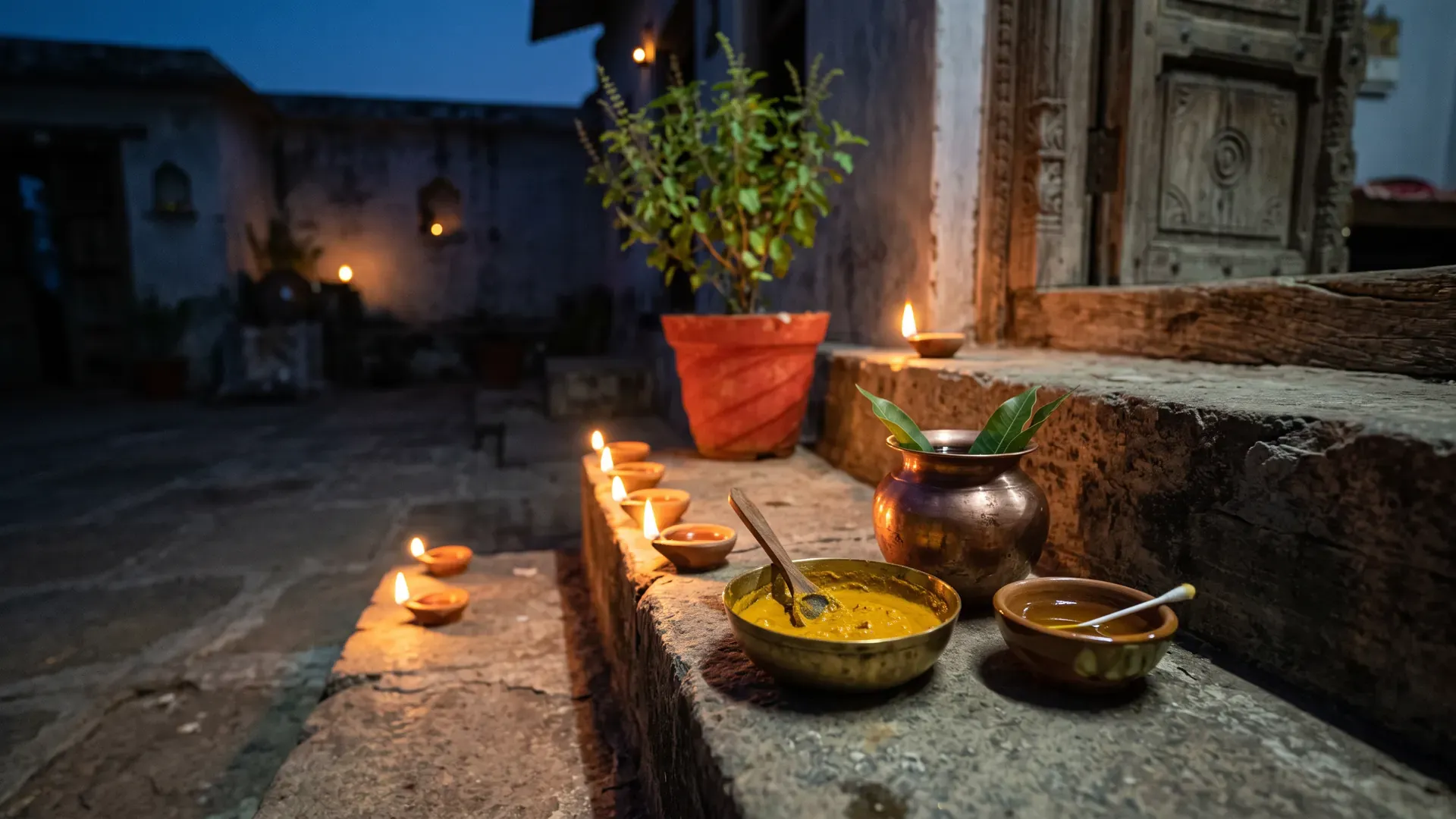
Naraka Chaturdashi (Chhoti Diwali) 2026 is on Sunday, 8 November. It is celebrated on Kartik Krishna Chaturdashi (Purnimanta), the second day of the Deepotsav. In tradition, it is the day that remembers Shri Krishna’s slaying of Narakasura. The main rite is the abhyanga snan, a bath with oil and ubtan before sunrise; see its muhurat for your city below.
Each morning the tithi, Rahu Kaal and coming festivals, in one short WhatsApp message.Follow the channel
Diwali 2026 dates: Dhanteras 6 November to Bhai Dooj 11 November
| Date | Festival | Time (New Delhi) |
|---|---|---|
| 6 November Friday | Dhanteras | 6:03–7:58 PM Puja muhurat |
| 7 November Saturday, night | Kali Chaudas | 11:39 PM–12:31 AM Nishita Kaal |
| 8 November Sunday, dawn | Narak Chaturdashi | 5:41–6:38 AM Abhyang Snan |
| 8 November Sunday, evening | Diwali | 5:55–7:51 PM Lakshmi Puja |
| 10 November Tuesday | Govardhan Puja | 6:40–8:50 AM Pratahkala |
| 11 November Wednesday | Bhai Dooj | 1:10–3:20 PM Tilak (Aparahna) |
Times for New Delhi, by our calculation (checked against Drik Panchang); your city’s time is on each festival’s page. Amavasya lasts until 12:33 PM on 9 November, so Govardhan Puja is on 10 November.
At a glance
- Tithi
- Kartik Krishna Chaturdashi (Purnimanta)
- Also called
- Chhoti Diwali, Roop Chaudas, Narak Chaudas
- Main rite
- Abhyanga (oil and ubtan) snan before sunrise
- Time of the bath
- After moonrise and before sunrise, while Chaturdashi lasts
- Story
- Shri Krishna slays Narakasura (Bhagavata Purana 10.59)
- In the evening
- Lighting lamps; in many families, a lamp for Yama
- Gujarat
- Kali Chaudas, which sometimes falls a day earlier
- Deepotsav
- Second day of the five-day festival
Abhyanga snan
The main rite of the day is to rub oil on the body and bathe with ubtan (a paste of gram flour, turmeric and the like) before sunrise; this is called abhyanga snan. Panchangs take its muhurat to be the time between moonrise and sunrise when Chaturdashi tithi prevails. It is believed that this bath removes the fear of naraka (hell); another popular belief is that on this day Lakshmi dwells in oil and the Ganga in water. The name Roop Chaudas is linked to this bath and the ubtan.
One festival, many forms
North India: Chhoti Diwali and Roop Chaudas
Lamps are lit in the home on the evening before Diwali. In Rajasthan, Gujarat and many parts of North India it is called Roop Chaudas, and the bath with ubtan has special importance. In many families, a lamp for Yama is placed facing south in the evening.
Folk traditionGujarat: Kali Chaudas
In Gujarat this festival is called Kali Chaudas, and Mahakali is worshipped at night; many families also worship Hanuman. Kali Chaudas is observed on the day when Chaturdashi prevails at midnight, so it sometimes falls a day before Naraka Chaturdashi.
TraditionBengal: Bhoot Chaturdashi
In Bengal, the Chaturdashi before Kali Puja is called Bhoot Chaturdashi; it is the custom to light fourteen lamps in the home and to eat fourteen kinds of leafy greens.
Folk traditionSouth India and Goa
In Tamil Nadu and many parts of South India, Deepavali itself is celebrated on this morning, with an oil bath. In Goa, effigies of Narakasura are burned before dawn.
Folk traditionHanuman Jayanti (in some traditions)
In some traditions, including Ayodhya’s, Hanuman Jayanti is celebrated on Kartik Krishna Chaturdashi. The more widely observed Hanuman Jayanti falls on Chaitra Purnima.
TraditionIts link with Diwali
Naraka Chaturdashi is the second day of the five-day Deepotsav; Dhanteras comes before it and Diwali after it. Because tithis lengthen and shorten, in some years Naraka Chaturdashi and Diwali fall on the same day: the abhyanga snan is done in the morning during Chaturdashi, and Lakshmi Puja in the evening during Amavasya.
How to perform the puja
- Step 1
Rising before sunrise
The abhyanga snan is done before sunrise; see the time for your city above.
- Step 2
Oil and ubtan
Rub sesame oil on the body and bathe with ubtan. In some traditions, a twig of apamarga (prickly chaff flower) is moved around the head during the bath.
- Step 3
Puja
After the bath, worship Shri Krishna, Hanuman or Mahakali, as per your tradition.
- Step 4
Lamps in the evening
In the evening, light lamps in the house, the courtyard and at the door.
- Step 5
A lamp for Yama
In many families, a lamp for Yama is placed outside the house, facing south; some families do this on Dhanteras.
The slaying of Narakasura
According to the Bhagavata Purana, Naraka, the son of Bhumi (the Earth), also called Bhaumasura, was the king of Pragjyotishapura. He had seized Varuna’s umbrella and the earrings of Aditi, mother of the devas, and held the daughters of many kings captive. Hearing all this from Indra, Shri Krishna flew to Pragjyotishapura on Garuda with Satyabhama, broke through the city’s defences, slew the five-headed asura Mura, and finally cut off Narakasura’s head with the Sudarshana chakra. Then Bhumi Devi returned Aditi’s earrings and offered praise to Shri Krishna. Shri Krishna freed the sixteen thousand captive princesses. In tradition, the memory of this victory is linked to Kartik Krishna Chaturdashi.
Bhagavata Purana 10.59Read the full kathaVerses
नमस्ते देवदेवेश शङ्खचक्रगदाधर।भक्तेच्छोपात्तरूपाय परमात्मन् नमोऽस्तु ते॥Naraka Chaturdashi: relations
See in the knowledge graphDeities, figures and sages 5
- Krishna · Deity worshippedTradition; story in Bhagavata Purana 10.59
- Narakasura · Asura whose slaying it remembersTradition
- Yama · Lamp offered to himFolk tradition
- Hanuman · Deity worshipped (in some traditions)Tradition (Ayodhya and others)
- King Bali · King Bali, whose boon the lamps are tied toSkanda Purana, Vaishnava Khanda, Kartika Masa Mahatmya 9.49-60
Scriptures and mantras 1
- Bhagavata Purana · Source of the story (slaying of Narakasura)Bhagavata Purana 10.59
Festivals 1
- Diwali · Main festivalTradition
Frequently asked questions
When is Naraka Chaturdashi 2026?
On Sunday, 8 November.
Narak Chaturdashi (Chhoti Diwali) 2026: 7 November or 8 November?
Chaturdashi tithi runs from 10:49 AM on 7 November to 11:29 AM on 8 November. The Narak Chaturdashi abhyang snan is taken before sunrise during Chaturdashi, so at dawn on Sunday, 8 November (New Delhi 5:41–6:38 AM), and Diwali is that evening. The Kali Chaudas night puja is done at midnight (Nishita Kaal) while Chaturdashi lasts: the night of 7 November, 11:39 PM–12:31 AM (Drik Panchang).
At what time is the abhyang snan on 8 November?
Before sunrise, after moonrise, while Chaturdashi tithi lasts. On Sunday, 8 November 2026: New Delhi 5:41–6:38 AM, Lucknow 5:23–6:21 AM, Jaipur 5:44–6:41 AM, Patna 5:03–6:02 AM, Chandigarh 5:46–6:43 AM, Indore 5:38–6:35 AM, Mumbai 5:45–6:42 AM, Kolkata 4:45–5:45 AM, Bengaluru 5:17–6:15 AM. For your city, choose it in the box above.
Are Chhoti Diwali and Naraka Chaturdashi the same?
Yes. In North India, Naraka Chaturdashi is also called Chhoti Diwali and Roop Chaudas.
What is the difference between Kali Chaudas and Naraka Chaturdashi?
Both are festivals of Kartik Krishna Chaturdashi. Kali Chaudas (Gujarat) falls on the day when Chaturdashi prevails at midnight, and Naraka Chaturdashi on the day when Chaturdashi prevails before sunrise; so Kali Chaudas sometimes falls a day earlier.
Who slew Narakasura?
According to the Bhagavata Purana (10.59), Shri Krishna, with the Sudarshana chakra. Some folk traditions of South India say that Satyabhama slew him.
When are the five days of Diwali 2026?
Dhanteras on 6 November (Friday), the Narak Chaturdashi abhyang snan at dawn and Diwali in the evening of 8 November (Sunday), Govardhan Puja on 10 November (Tuesday) and Bhai Dooj on 11 November (Wednesday). The Kali Chaudas night puja is on 7 November (Drik Panchang).
Sources
- Bhagavata Purana 10.59 (the slaying of Narakasura and Bhumi Devi’s hymn)
- Dharmasindhu (ruling on Naraka Chaturdashi)
- Folk tradition
- Muhurat and moonrise: SanatanBodh panchang calculation, checked against Drik Panchang (New Delhi, 2026–27)
Something wrong? Report a mistake