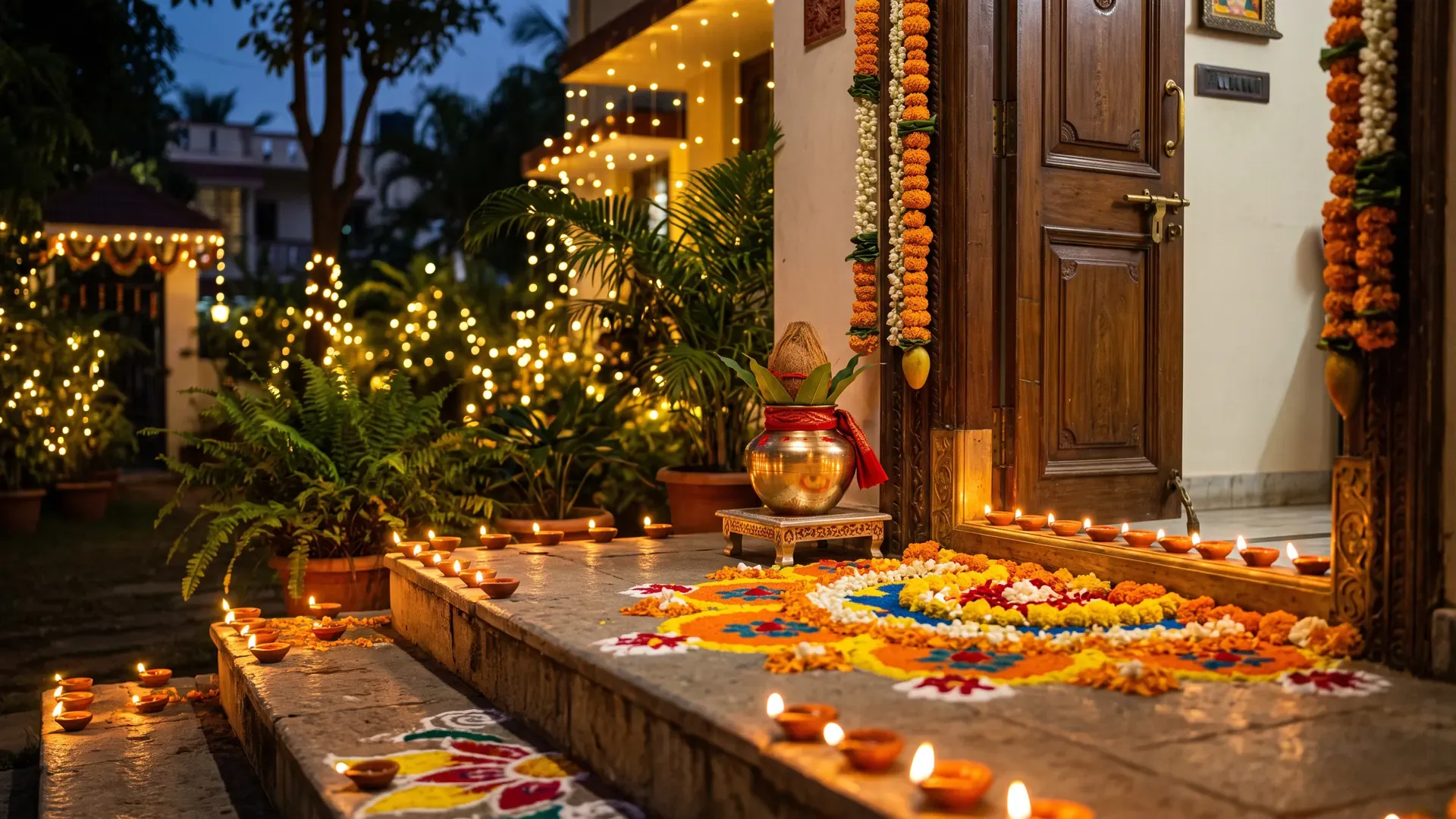
Kali Puja 2026 is on the night of Sunday, 8 November. According to Drik Panchang, Kali Puja is done at midnight, in Nishita Kaal, while Amavasya tithi holds. Amavasya runs from 11:29 AM on 8 November to 12:33 PM on 9 November, so in every city the puja is on the night of 8 November, the same day as the Diwali Lakshmi Puja in the rest of India. In Kolkata Nishita Kaal is 10:55 to 11:46 PM; in New Delhi it is 11:39 PM to 12:31 AM, past midnight into 9 November, but it is still the night of 8 November. See your city’s time below.
Each morning the tithi, Rahu Kaal and coming festivals, in one short WhatsApp message.Follow the channel
City-wise times: Nishita Kaal
Pick your city for its full timings, nearby cities and common questions.
| City | Nishita Kaal |
|---|---|
| New Delhi | 11:39 PM–12:31 AM (9 Nov) |
| Kolkata | 10:55–11:46 PM |
| Patna | 11:07–11:59 PM |
| Guwahati | 10:41–11:33 PM |
| Bhagalpur | 11:00–11:52 PM |
| Darbhanga | 11:04–11:56 PM |
| Ranchi | 11:07–11:58 PM |
| Jamshedpur | 11:03–11:55 PM |
| Dhanbad | 11:02–11:54 PM |
| Bhubaneswar | 11:05–11:56 PM |
| Puri | 11:05–11:56 PM |
| Siliguri | 10:54–11:46 PM |
At a glance
- Tithi
- Kartik Amavasya (Purnimanta); Ashwin Amavasya in the Amanta calendar
- In 2026
- The night of Sunday, 8 November; the Diwali Lakshmi Puja is on the same day
- Puja time
- Nishita Kaal (around midnight), while Amavasya holds
- Deity
- Goddess Kali (Shyama)
- Also called
- Shyama Puja; Dipanwita Kali Puja
- Where
- West Bengal, Odisha and Assam (Drik Panchang); also the Anga region of Bihar (Bhagalpur), Jharkhand, Tripura and Bangladesh (Wikipedia)
- Famous temples
- Kalighat and Dakshineswar in Kolkata
- After it
- Bhai Phonta (Bhai Dooj), Wednesday 11 November
Kali Puja 2026: why the night of 8 November
According to Drik Panchang, the midnight during which Amavasya holds is the right time for Kali Puja, while for Lakshmi Puja it is Pradosh (the time after sunset) during which Amavasya holds. This year Drik has Amavasya from 11:27 AM on 8 November to 12:31 PM on 9 November (by our calculation 11:29 AM to 12:33 PM, about 2 minutes later). Midnight of 8 November falls in Amavasya, and by the night of 9 November Amavasya is over, so Kali Puja is on the night of 8 November, and Lakshmi Puja on the same evening. Drik Panchang notes that in most years the two fall on the same day, but in some years Kali Puja falls a day before Diwali Puja. Nishita Kaal is the eighth muhurat of the night (from sunset to the next sunrise), so it differs from city to city: 10:55 to 11:46 PM in Kolkata, 10:41 to 11:33 PM in Guwahati, 11:07 to 11:59 PM in Patna; in New Delhi it begins at 11:39 PM and runs past midnight to 12:31 AM, and the puja still belongs to the night of 8 November. All these times agree with Drik Panchang to the minute.
What Kali Puja, or Shyama Puja, is
Kali Puja is the worship of Goddess Kali on the Amavasya night of Diwali; it is also called Shyama Puja (Drik Panchang). According to Drik Panchang, while most of India worships Lakshmi on this Amavasya, people in West Bengal, Odisha and Assam worship Kali; in these regions the greatest day of Lakshmi Puja is the Kojagara Puja of Ashwin Purnima. Wikipedia describes it as a major festival in the Anga region of Bihar (Bhagalpur), Jharkhand, Tripura and Bangladesh too, and calls this Kartik puja the Dipanwita Kali Puja, to tell it apart from the year’s other Kali Pujas: the Ratanti Kali Puja of Magha Krishna Chaturdashi, the Phalaharini Kali Puja of Jyeshtha Amavasya and the puja of Kaushiki Amavasya. Kali’s appearance is told in the seventh chapter of the Durga Saptashati (Markandeya Purana): in the battle with Chanda and Munda, Ambika’s face turned dark with anger and Kali came forth from her forehead, slew Chanda and Munda, and so was called Chamunda (see the verse below).
Kali Puja in Bengal: the tradition
What follows is custom and practice, not scriptural rule; it comes from Wikipedia’s "Kali Puja" article and the books it cites, named with each point. Practice varies by family, pandal and purohit.
Homes and pandals
Clay images of Kali are set up in homes and in pandals, and the puja is held at night. The offerings named are red hibiscus (jaba) flowers, sweets, rice and lentils, and the worshipper is prescribed to meditate until dawn.
June McDaniel (2004), as cited by WikipediaTwo ways of worship
Many homes and pandals worship in the Brahmanical (non-Tantric) way, dressing the goddess as Adya Shakti Kali, with no sacrifice; some traditions worship by Tantric rites, and the Tantric tradition has also practised animal sacrifice.
June McDaniel (2004); Rachel Fell McDermott and Jeffrey Kripal (2003), as cited by WikipediaKalighat
At the Kalighat temple in Kolkata, Kali is worshipped as Lakshmi on this day, and thousands of devotees come with offerings. Kalighat is the Kalipitha of the Pithanirnaya (see our Kalighat page).
McDermott and Kripal (2003); C. J. Fuller (2004), as cited by WikipediaDakshineswar
The goddess of the Dakshineswar Kali temple, on the east bank of the Hooghly, is Bhavatarini (Kali). Rani Rashmoni built the temple in 1855, and it is linked with Ramakrishna and Sarada Devi; Ramakrishna performed the worship here.
Wikipedia: Dakshineswar Kali TempleHistory
Kali Puja spread in the eighteenth century through patrons; King Krishnachandra of Nadia also promoted it. In the nineteenth century, as Ramakrishna’s fame grew in Bengal, landowning families began to sponsor it on a large scale.
McDermott (2001); McDermott and Kripal (2003), as cited by WikipediaPandals and the night
Besides Kali, pandals show images of Shiva, Ramakrishna and Bamakhepa and scenes of the ten Mahavidyas; people go round the pandals all night, and there are fireworks, plays and magic shows.
McDaniel (2004); Kinsley (1997), as cited by WikipediaBhagalpur (Bihar)
In the Anga region, above all in Bhagalpur, hundreds of pandals are set up, and after the puja a large procession takes the images for immersion.
Wikipedia; Dainik JagranThe day before: Bhoot Chaturdashi
In Bengal, the Chaturdashi before Kali Puja is called Bhoot Chaturdashi; it is the custom to light fourteen lamps in the home and to eat fourteen kinds of leafy greens (see our Narak Chaturdashi page).
Folk traditionDiwali, Kali Puja and Bhai Phonta
Drik Panchang’s Diwali calendar for 2026 (for Kolkata too) has Lakshmi Puja, Diwali and Kali Puja together on 8 November. So on the same Amavasya, North India worships Lakshmi and Ganesha in the evening, in Pradosh Kaal, and Bengal, Odisha and Assam worship Kali at midnight. Amavasya lasts until 12:31 PM on 9 November (Drik), Govardhan Puja is on 10 November, and on Wednesday 11 November comes Bhai Dooj, which Bengal calls Bhai Phonta: sisters put a phonta (tilak) on their brothers’ foreheads. The customs and story of Bhai Phonta are on the Bhai Dooj page.
How to perform the puja
- Step 1
Preparation
Clean the place of worship at home and set up an image or picture of Kali. It is the Amavasya night, so lamps are lit in the house and courtyard (custom).
- Step 2
Time
By tradition the puja is at night, in Nishita Kaal; see your city’s time above. In a pandal or temple, the puja committee or the purohit sets the time.
- Step 3
Flowers and offerings
Red hibiscus (jaba) flowers or a garland of them, incense, a lamp, sweets and a bhog of rice and lentils are offered (the Bengal practice, according to McDaniel).
- Step 4
Recitation
Many families recite the Kali Chalisa, hymns to the Goddess or the Durga Saptashati this night (custom).
- Step 5
Aarti and prasad
After the aarti, share the prasad; many stay awake through the night in meditation and devotional song.
- Step 6
Your purohit’s way
The method varies by family, tradition and purohit. Tantric rites are done only with a guru and initiation; for the puja at home, follow your own purohit.
Verses
भ्रुकुटीकुटिलात्तस्या ललाटफलकाद्द्रुतम्।काली करालवदना विनिष्क्रान्तासिपाशिनी॥Frequently asked questions
When is Kali Puja 2026?
On the night of Sunday, 8 November (Drik Panchang). Kali Puja is done in Nishita Kaal while Amavasya holds; Amavasya runs from 11:29 AM on 8 November to 12:33 PM on 9 November, so in every city the puja is on the night of 8 November.
Are Kali Puja and Diwali on the same day?
Yes, in 2026 both are on 8 November. Lakshmi Puja is in the evening, in Pradosh Kaal, and Kali Puja at midnight, in Nishita Kaal; both need Amavasya at that time. According to Drik Panchang, in some years Kali Puja falls a day before Diwali Puja.
What is the Kali Puja muhurat in Kolkata?
In Kolkata Nishita Kaal on 8 November is 10:55 to 11:46 PM. In Guwahati 10:41–11:33 PM, Siliguri 10:54–11:46 PM, Bhubaneswar 11:05–11:56 PM, Patna 11:07–11:59 PM, Ranchi 11:07–11:58 PM, and New Delhi 11:39 PM to 12:31 AM (9 November). All agree with Drik Panchang.
In Delhi Nishita Kaal runs past midnight; which date is the puja?
The night of 8 November. In the panchang a day runs from sunrise to the next sunrise, so 12:31 AM after midnight still falls in the night of 8 November; only the clock date becomes 9 November.
What is Shyama Puja?
Another name for Kali Puja (Drik Panchang). In Bengal Kali is also called Shyama, and songs of devotion to her are called Shyama Sangeet.
Why is Lakshmi Puja not the main Diwali puja in Bengal?
According to Drik Panchang, in West Bengal, Odisha and Assam the greatest day of Lakshmi Puja is the Kojagara Puja of Ashwin Purnima (Sharad Purnima, 25 October in 2026), and on the Amavasya of Diwali Kali is worshipped there. At Kalighat in Kolkata, Kali is worshipped as Lakshmi on this day (McDermott and Kripal, as cited by Wikipedia).
When is Bhai Phonta 2026?
On Wednesday, 11 November, the day of Kartik Shukla Dwitiya. It is Bengal’s Bhai Dooj; Drik Panchang gives Bhai Dooj on 11 November, for Kolkata too.
What is offered at Kali Puja?
In the Bengal practice, red hibiscus (jaba) flowers, sweets, rice and lentils (June McDaniel, as cited by Wikipedia). Offerings and method vary by family and purohit.
Sources
- Drik Panchang: Bengal Kali Puja 2026 (New Delhi, Kolkata, Guwahati, Patna, Bhubaneswar, Ranchi, Siliguri, Puri, Dhanbad, Jamshedpur, Bhagalpur, Darbhanga), Diwali Puja Calendar 2026 (Kolkata) and Bhai Dooj 2026 (Kolkata)
- Markandeya Purana, chapter 87 (Durga Saptashati, chapter 7: Kali’s appearance and the name Chamunda), sa.wikisource and Gita Press
- Wikipedia: "Kali Puja" and "Dakshineswar Kali Temple"
- June McDaniel, Offering Flowers, Feeding Skulls: Popular Goddess Worship in West Bengal (Oxford University Press, 2004); Rachel Fell McDermott, Mother of My Heart, Daughter of My Dreams (Oxford University Press, 2001); Rachel Fell McDermott and Jeffrey Kripal (eds.), Encountering Kali (University of California Press, 2003); C. J. Fuller, The Camphor Flame (Princeton University Press, 2004): as cited in Wikipedia’s "Kali Puja" article
- Kali Puja in Bhagalpur: Wikipedia and Dainik Jagran
- Bhoot Chaturdashi and Bhai Phonta: folk tradition
- Nishita Kaal and Amavasya: SanatanBodh panchang calculation, checked against Drik Panchang’s Bengal Kali Puja page (2026; New Delhi, Kolkata, Guwahati, Patna and 8 more cities)
Something wrong? Report a mistake
