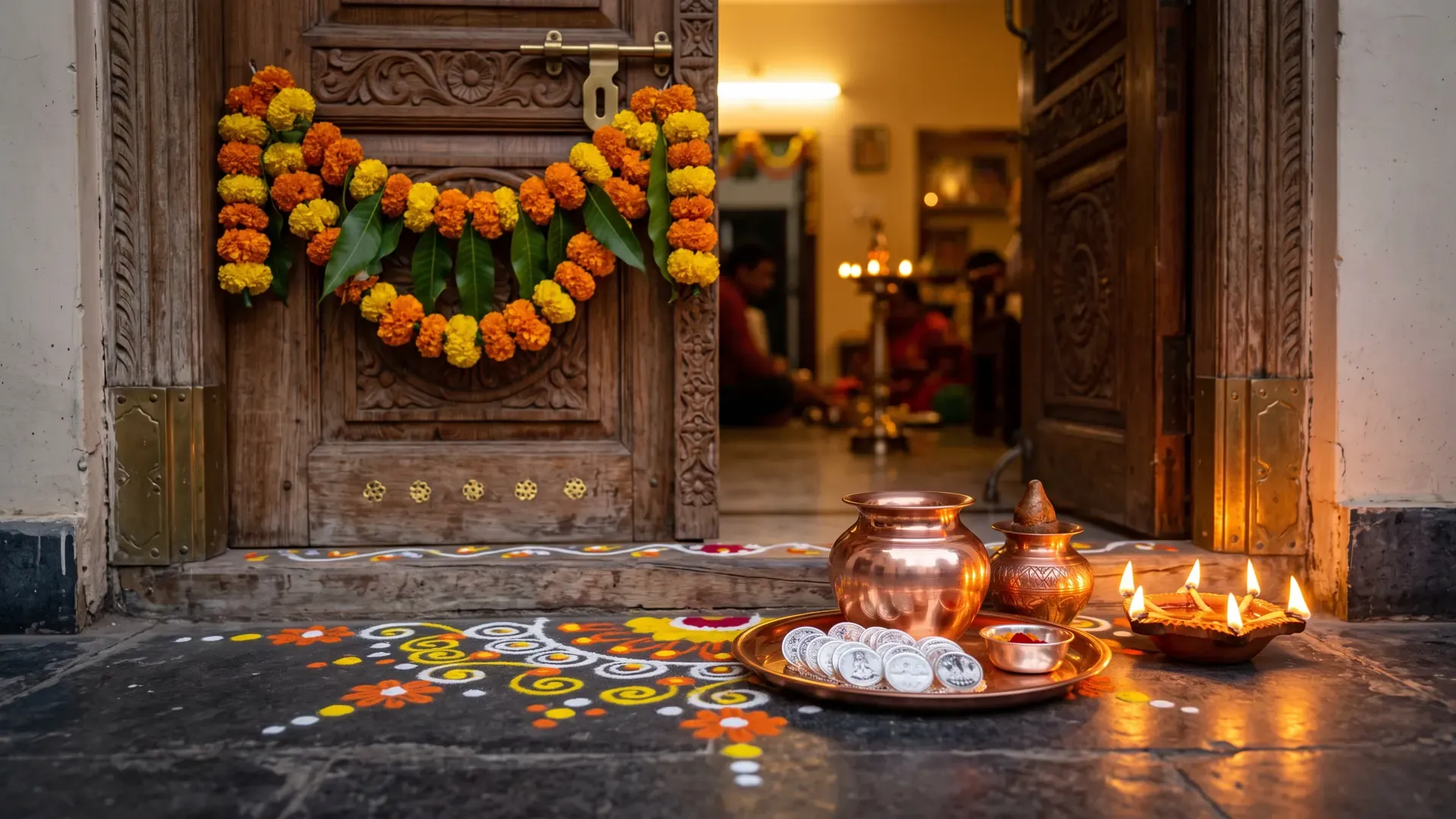
Dhanteras puja is done on the evening of Wednesday, 27 October 2027, in Pradosh Kaal. In New Delhi the puja muhurat is 6:43–8:14 PM and the Yama deepdaan time is 5:40–6:57 PM. The order: Ganesha first, then Dhanvantari, then Lakshmi and Kubera; and outside the house, facing south, a lamp for Yama. Below is every step, what goes where, and the source for each point.
New Delhi: Puja muhurat, 27 October
- Dhanteras puja muhuratPradosh Kaal + Vrishabha lagna + tithi
- 6:43–8:14 PM
- Pradosh KaalFirst fifth of the night
- 5:40–8:14 PM
- Vrishabha KaalFixed ascendant
- 6:43–8:39 PM
- Yama DeepdaanSayahna Sandhya: after sunset
- 5:40–6:57 PM
- Trayodashi tithi
- until 10:51 PM
In Indian Standard Time, SanatanBodh panchang calculation, checked against Drik Panchang. Muhurat for your city
At a glance: the order of the evening
- By day: clean the house and the place of worship, draw a chowk or rangoli at the door, and lay out the chowki and samagri (by Bharatkosh, the house is cleaned, a chowk or rangoli made, and Lakshmi invoked in the evening with a lamp lit).
- After sunset, 5:40–6:57 PM: the Yama deepdaan outside the house, facing south (Drik Panchang: Sayan Sandhya).
- Puja muhurat, 6:43–8:14 PM: Ganesha, then Dhanvantari, then Lakshmi and Kubera. This window lies in Pradosh Kaal and the fixed Vrishabha lagna, while Trayodashi lasts.
- Aarti and bhog: the aarti texts are linked below.
- All night: the lamp at the door should keep burning and not go out (Gita Press, Vrat-Parichay).
The deepdaan window (5:40–6:57 PM) opens before the puja muhurat (6:43–8:14 PM) and the two overlap. The sources fix no order between them; by the clock the deepdaan window opens first.
Dhanvantari puja, step by step
Dhanteras is also kept as Dhanvantari Jayanti. The steps below are the gist of Drik Panchang’s Dhanvantari puja vidhi (21 steps); a short mantra goes with each, which a purohit can teach.
First
- Place the murti or picture of Dhanvantari in the east (Amar Ujala, Agra).
- Worship Ganesha first, then Dhanvantari (Amar Ujala).
- Keep a lit ghee lamp in front; the meditation is done in its flame (Drik Panchang).
The steps (Drik Panchang’s order)
- Achamana: sip water from the hand three times.
- Sankalpa: with water, akshat and flowers in the right hand, resolve to worship Shri Dhanvantari on Kartik Krishna Trayodashi for growth of life, health and prosperity; then let the water fall in front.
- Self-purification: sprinkle water on yourself and the puja water with ‘Om apavitrah pavitro va …’ (the same mantra is in Gita Press’s Lakshmi puja).
- Dhyana: meditate on Dhanvantari, four-armed, in yellow cloth, holding the pot of nectar.
- Avahana: invite him with joined palms (avahana mudra).
- Asana: offer five flowers as his seat; say ‘welcome’.
- Padya and arghya: water to wash the feet, then arghya water.
- Gandha, pushpa, dhupa, dipa, naivedya: sandal, flowers, incense, lamp and food, in that order.
- Water, tambula, dakshina: water to sip, betel leaf, and an offering of coins.
- Pradakshina, pushpanjali, pranama: circle with flowers, offer flowers with praise, then bow.
- Kshama-prarthana: ask forgiveness for any mistake in the puja.
ॐ नमो भगवते वासुदेवाय धन्वन्तरयेअमृतकलशहस्ताय सर्वामयविनाशनायत्रैलोक्यनाथाय श्रीमहाविष्णवे नमः॥Om namo bhagavate vaasudevaaya dhanvantaraye Amritakalashahastaaya sarvaamayavinaashanaaya Trailokyanaathaaya shreemahaavishnave namah ||
Custom
- By Bharatkosh, dishes are placed in a new vessel and offered to Dhanvantari, and the community of vaidyas especially worships him.
Dhanvantari’s form is described in the Bhagavata Purana 8.8.32–34: yellow cloth, a pot full of nectar in his hands; he rose in the churning of the ocean and is called the seer of Ayurveda.
Worship of Lakshmi and Kubera
Lakshmi
- By Drik Panchang, Lakshmi is worshipped with Kubera on Dhanteras, in Pradosh Kaal.
- The sixteen-part Lakshmi puja (seat, padya, bath, sandal, flowers, incense, lamp, food, aarti …), with its order and mantras, is on the Diwali puja vidhi page.
- Lakshmi is placed on Ganesha’s right (Gita Press’s Diwali puja vidhi).
Kubera puja (Drik Panchang, 5 steps)
- No idol of Kubera: take the tijori or a jewellery box as Kubera. First draw a swastika on it in sindoor and tie mauli.
- Dhyana: remember Kubera.
- Avahana: invite him with the hands in avahana mudra before the chest (mantra below).
- Asana: offer five flowers.
- Worship: sandal, akshat, flowers, incense, lamp and food.
- Offering: take sandal, akshat and a flower in the left hand and release them with the right near the chest.
आवाहयामि देव त्वामिहायाहि कृपां कुरु।कोशं वर्द्धय नित्यं त्वं परिरक्ष सुरेश्वर॥Aavaahayaami deva tvaamihaayaahi kripaam kuru | Kosham varddhaya nityam tvam pariraksha sureshvara ||
Custom / belief: A new silver or clay idol of Lakshmi-Ganesha, or a silver coin bearing their picture: mark it with a saffron tilak, worship it on a red or yellow cloth, and after the Diwali puja keep it in the tijori (Amar Ujala). This is a folk custom.
Yama deepdaan: time, method and mantra
When
- 5:40–6:57 PM (Drik Panchang: Sayan Sandhya, after sunset).
- On the evening of Kartik Krishna Trayodashi, when Trayodashi covers Pradosh Kaal; if it falls on two days or on neither, the next day (Gita Press). Trayodashi tithi: until 10:51 PM.
How (Gita Press, Vrat-Parichay p. 155)
- Set clay lamps in a vessel.
- Fill them with sesame oil.
- Put in new cotton wicks and light them.
- Worship the lamps with sandal and the like.
- Facing south, give the lamps away with the mantra below.
मृत्युना पाशदण्डाभ्यां कालेन श्यामया सह।त्रयोदश्यां दीपदानात् सूर्यजः प्रीयतां मम॥Mrityunaa paashadandaabhyaam kaalena shyaamayaa saha | Trayodashyaam deepadaanaat sooryajah preeyataam mama ||
Where to place it
- Outside the house (Drik Panchang; ‘bahih’ in the verse quoted in the Nirnaya Sindhu).
- At the main door, facing south (Bharatkosh; Amar Ujala: outside the main door).
How many lamps, how many wicks
- Bharatkosh and Amar Ujala give one lamp with four wicks; Bharatkosh says it is made of flour (called ‘jamdiva’), with new cotton wicks, oil, and worship with roli, flowers, rice, jaggery and a food offering.
- Gita Press gives no number, only ‘clay lamps’ in a vessel. The number follows your family’s custom.
Custom / belief: By Drik Panchang the lamp is lit so that no one in the family dies untimely, and Yama is believed to be pleased by it. This is a matter of faith; we promise nothing.
The lamp at the door (Dhanatrayodashi, Gita Press)
- In the evening fill a lamp with oil, light it and worship it with sandal and the like.
- Set it on a heap of grain at the door.
- It must burn all night and not go out.
The verse ‘kartikasyasite pakshe …’ is quoted in the Nirnaya Sindhu under the name of the Skanda Purana, but we did not find it in that Purana itself; details on the mantra page.
What goes where: a list
- Picture or murti of Dhanvantari: the east (Amar Ujala).
- Your direction while worshipping: east or north (in the Lakshmi puja of both Gita Press and Drik Panchang).
- Lakshmi: on Ganesha’s right (Gita Press).
- Kubera: a murti, or the tijori or jewellery box marked with a sindoor swastika and tied with mauli (Drik Panchang).
- Yama’s lamp: outside the house, at the main door, facing south (Gita Press, Drik Panchang, Bharatkosh).
- The door lamp: on a heap of grain, all night (Gita Press).
- Both sides of the main door: lamps in the evening (Amar Ujala).
Samagri for the Dhanteras puja (a short list)
Dhanvantari and Kubera puja
- Ghee lamp, sandal, akshat, flowers, incense, food offering, betel leaf, dakshina (Drik Panchang).
- Five flowers for the seat; water for padya, arghya and achamana (Drik Panchang).
- Sindoor and mauli for Kubera (for the swastika and thread on the tijori if there is no idol).
Yama deepdaan and the door lamp
- Clay lamps, sesame oil, new cotton wicks, sandal (Gita Press).
- A little grain to make the heap for the door lamp (Gita Press).
Buying (utensils, silver, a broom, coriander) is a folk custom, not part of the puja vidhi; it is on a separate page, with sources.
Aartis and chalisas
Frequently asked questions
What is the Dhanteras puja vidhi?
In the evening, in Pradosh Kaal: Ganesha first, then Dhanvantari (ghee lamp, sankalpa, dhyana, avahana, seat, sandal-flowers-incense-lamp-food, circumambulation, prayer for forgiveness), then Lakshmi and Kubera; and after sunset a lamp for Yama outside the house, facing south. The steps above follow Drik Panchang and Gita Press (Vrat-Parichay).
What is the Dhanteras 2027 puja muhurat?
Wednesday, 27 October 2027: 6:43–8:14 PM in New Delhi (Pradosh Kaal 5:40–8:14 PM, fixed Vrishabha lagna and Trayodashi together). Trayodashi tithi until 10:51 PM. Other cities’ times are on the main Dhanteras page.
When, in which direction and with how many wicks is the Yama lamp placed?
In the evening, in 5:40–6:57 PM (Drik Panchang), outside the house at the main door, facing south. Bharatkosh and Amar Ujala give one lamp with four wicks; Gita Press gives clay lamps with sesame oil and new cotton wicks, without a number. The number follows your family’s custom.
Whom is Dhanteras puja for, and who comes first?
Dhanvantari, Lakshmi and Kubera, and in the evening a lamp for Yama. Ganesha is worshipped first (Amar Ujala: Ganesha, then Dhanvantari). The sources fix no order between Lakshmi-Kubera and Dhanvantari.
How to worship Kubera without an idol?
By Drik Panchang, take the tijori or a jewellery box as Kubera: first draw a sindoor swastika on it and tie mauli, then invoke him, offer a seat of five flowers and worship with sandal, akshat, flowers, incense, lamp and food.
Which Dhanvantari mantra is said on Dhanteras?
‘Om namo bhagavate vasudevaya dhanvantaraye amritakalashahastaya sarvamayavinashanaya trailokyanathaya shri mahavishnave namah’ is the mantra in common use; the two sites that give it name no scripture. Meaning and sources are on the Dhanteras mantra page.
Is the Dhanteras 2027 puja on 27 October or the next day?
By Gita Press the Yama deepdaan is done on the evening when Trayodashi covers Pradosh Kaal. On 27 October Trayodashi lasts until 10:51 PM; so the evening of 27 October is the day of the puja.
Sources
- Gita Press, Vrat-Parichay (Pt. Hanuman Sharma), p. 155: the Yama deepdaan (under the name of the Skanda Purana) and the door lamp of Dhanatrayodashi; archive.org/details/610-vrat-parichay
- Drik Panchang: Dhanvantari Puja Vidhi (21 steps) and Kuber Puja Vidhi (5 steps); the Dhanteras puja timings and Yama Deepam pages (New Delhi, 2026)
- Bharatkosh: Dhanteras (Dhanvantari, Lakshmi-Kubera and the Yama lamp custom)
- Amar Ujala (Agra), 21 October 2022: Dhanteras pujan vidhi
- Nirnaya Sindhu (Kamalakara Bhatta), second paricheda, p. 145: the Yama deepdaan verse and mantra (editions of 1901 and 1927)
- Srimad Bhagavata Mahapurana 8.8.32–34 (the appearance of Dhanvantari)
- Gita Press, Nityakarma-Pujaprakash pp. 243, 256 (Lakshmi’s place, the invocation of Kubera)
- Muhurat: SanatanBodh panchang calculation, checked against Drik Panchang (New Delhi, 2026)
Something wrong? Report a mistake