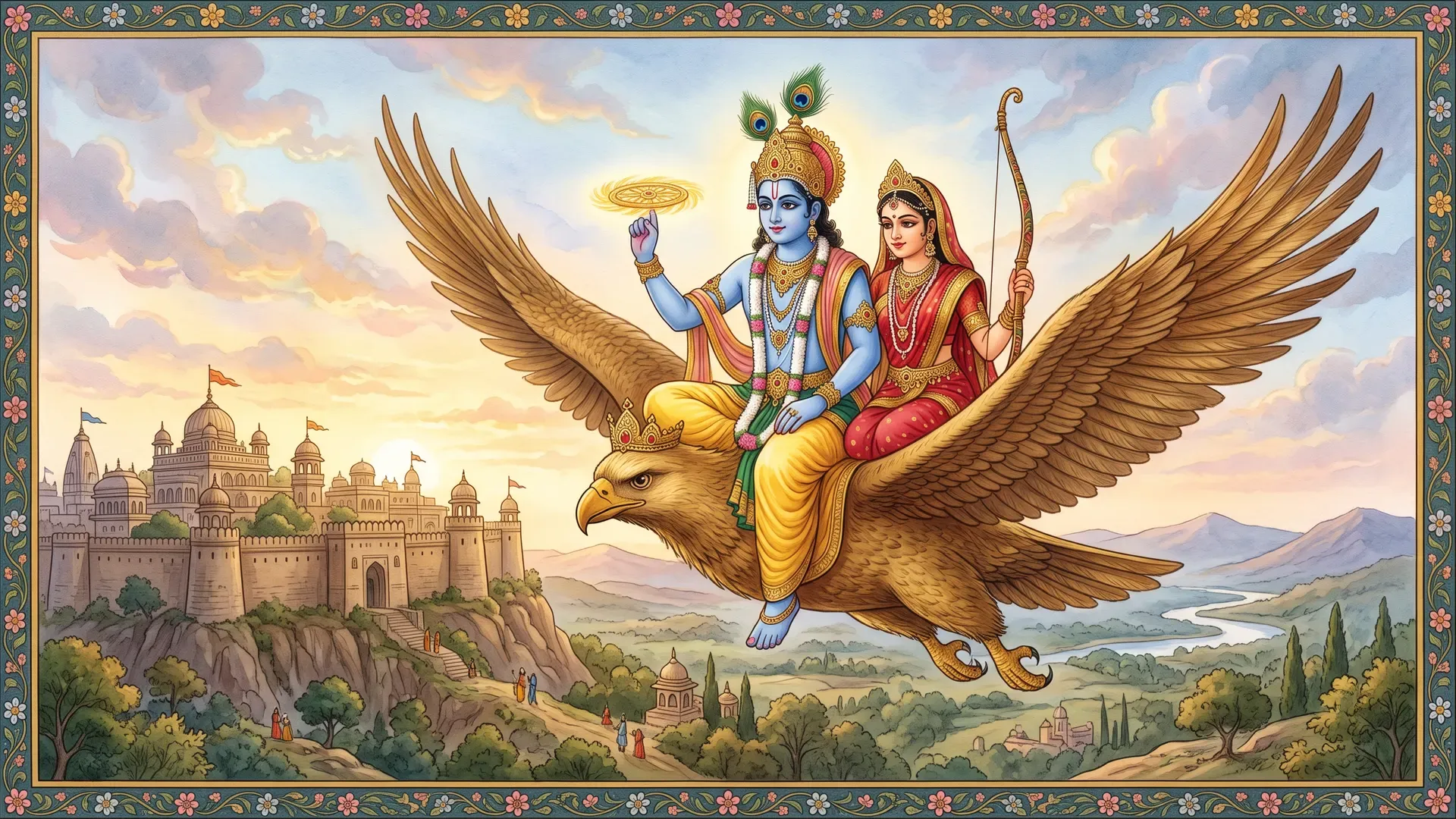
Three stories belong to Narak Chaturdashi. In the Bhagavata Purana (10.59), Krishna rides Garuda with Satyabhama, slays Narakasura (Bhaumasura) and frees sixteen thousand princesses from his prison. In a folk tale, King Rantideva keeps a fast on this day and is freed from the fault of one mistake. And in the Skanda Purana, lamps are lit on this day because of the boon given to King Bali.
Each morning the tithi, Rahu Kaal and coming festivals, in one short WhatsApp message.Follow the channel
Narak Chaturdashi falls on Kartik Krishna Chaturdashi (Purnimanta), before Diwali; it is also called Choti Diwali, Roop Chaudas and Kali Chaudas. On this day people bathe with oil before sunrise (abhyanga snan), offer tarpan to Yama and light lamps in the evening. The bathing time for your city is on the Narak Chaturdashi page.
How the vrat and katha are kept
- Bathing with oil before sunrise, in the last watch of the night. The Skanda Purana (Kartik Masa Mahatmya 9.27–32) calls it the main rite of the day and says that on this day Lakshmi is in the oil and Ganga in the water. The Narada Purana (1.123.46–47) places this bath at moonrise.
- A twig of apamarga (prickly chaff flower) is whirled in the bath water and passed around the head (Skanda Purana 9.33–35).
- Tarpan to Yama with his fourteen names; by the Skanda Purana even one whose father is alive may offer it (9.37–42).
- In the evening lamps are lit outside the house and at crossroads (Narada Purana 1.123); by the Skanda Purana, the forefathers of those who offer lamps for Naraka on the Chaturdashi do not remain in hell.
Krishna and Narakasura
As told in the Bhagavata Purana, tenth canto, chapter 59, and the Vishnu Purana 5.29.
Bhaumasura, called Narakasura, son of the Earth goddess, ruled in Pragjyotishapura. He seized Varuna’s royal umbrella and the earrings of Aditi, mother of the gods, and took Maniparvata, the gods’ pleasure ground on Mount Mandara. Distressed, Indra went to Krishna in Dwarka.
Krishna mounted Garuda with Satyabhama and reached Pragjyotishapura. The city was guarded on every side, but he broke through each defence. When the five-headed demon Mura rushed at him, he cut off all five heads with his discus. Then Mura’s seven sons, Tamra, Antariksha, Shravana, Vibhavasu, Vasu, Nabhasvan and Aruna, came to fight with their general Pitha, and they too were slain.
Then Narakasura himself came out on an elephant with his army. He hurled his spear at Garuda, who did not flinch. As Narakasura raised his trident, Krishna cut off his head with the discus. In the Vishnu Purana the discus cuts him in two.
Then the Earth goddess herself came. She returned the stolen treasures to Krishna, praised him, and placed Narakasura’s frightened son under his protection. Krishna assured him of safety.
In Narakasura’s palace Krishna found the princesses he had taken captive by force. The Bhagavata verse gives their number as sixteen thousand; the Vishnu Purana says sixteen thousand one hundred. Each of them wished for Krishna as her husband. He sent them with honour, and with the palace treasures, to Dwarka in palanquins.
Krishna then went to heaven, returned Aditi’s earrings, and came back to Dwarka with the parijata tree for Satyabhama. There he married all the princesses at once, taking a separate form for each.
Popular tradition says the slaying took place on Kartik Krishna Chaturdashi and that people lit lamps in joy, which is how the day came to be called Narak Chaturdashi; the Bhagavata and Vishnu Puranas give no date. Many folk tellings give Satyabhama a larger part: in some she drives Krishna’s chariot, in others she slays Narakasura herself, because he could die only at the hands of his mother, the Earth goddess, whose incarnation Satyabhama is held to be. In the Puranas the slaying is by Krishna’s discus.
King Rantideva
A folk tale, given by Webdunia, Bharatkosh, Hindi Wikipedia and Times Now Hindi.
There was a righteous and generous king named Rantideva. When his end came, Yama’s messengers arrived and said they must take him to hell. The astonished king said, “All my life I have done right. Why hell?”
The messengers said, “Once a brahmin went away hungry from your door; this is its fruit.” The king begged for one year’s time, and they granted it.
The king went to the sages and told them everything. They told him to fast on Kartik Krishna Chaturdashi, feed brahmins and ask forgiveness for his mistake. The king did so.
By the merit of this fast the king was freed of that fault and reached the realm of Vishnu (heaven, in one telling). Since then this Chaturdashi fast is held to free one from the fear of hell.
The Bhagavata Purana (9.21) tells a different story of Rantideva: after a fast of forty-eight days he gives away even the food and water he has received to hungry guests. The Narak Chaturdashi story is a folk tale told under the same name; no text is named for it.
King Bali’s boon and the lamps
As told in the Skanda Purana, Vaishnava Khanda, Kartik Masa Mahatmya, chapter 9, verses 49–60.
As Vamana, the Lord asked King Bali for three steps of land and took the three worlds. By the Skanda Purana, pleased with Bali’s giving, the Lord asked him to choose a boon.
Bali asked that on these three days, Chaturdashi, Amavasya and Pratipada, the earth be counted as his kingdom, and that Lakshmi dwell for ever in the homes of those who light lamps on these days. In the same passage it is said that the forefathers of those who offer lamps for Naraka on the Chaturdashi do not remain in hell. The Lord granted the boon.
This is how the lamps lit from Narak Chaturdashi through Diwali to the Govardhan Pratipada are explained.
Other tellings
- The number of princesses is sixteen thousand in the Bhagavata verse (10.59.33) and sixteen thousand one hundred in the Vishnu Purana (5.29); Hindi sources give both.
- The boon that Narakasura could die only at his mother’s hands, and Satyabhama slaying him, are not in the Bhagavata or Vishnu Purana; they come from folk and newspaper tellings.
- Drik Panchang says Krishna took an oil bath after slaying Narakasura, but names no text for it.
After the katha
After the katha, lamps are lit in the house and outside the door in the evening. The bathing time and the Diwali puja muhurat for your city are on the Narak Chaturdashi and Diwali pages.
Krishna Aarti: Aarti Kunj Bihari KiFrequently asked questions
Who slew Narakasura, Krishna or Satyabhama?
By the Bhagavata Purana (10.59) and the Vishnu Purana (5.29), Krishna slew Narakasura with his discus, and Satyabhama rode with him on Garuda. Many folk tellings make Satyabhama the one who slays him.
Why is an oil bath taken on Narak Chaturdashi?
The Kartik Masa Mahatmya of the Skanda Purana (chapter 9) prescribes an oil bath before dawn on this day, saying that on this day Lakshmi is in the oil and Ganga in the water.
Why is it called Choti Diwali and Roop Chaudas?
It is the night before Diwali and lamps are lit on it too, hence Choti Diwali. It is called Roop Chaudas from the belief that the morning ubtan and oil bath bring out one’s beauty.
Sources
- Bhagavata Purana 10.59 and 9.21 (checked verse by verse on vedabase.io)
- Vishnu Purana 5.29 (H. H. Wilson’s translation, wisdomlib.org)
- Skanda Purana, Vaishnava Khanda, Kartik Masa Mahatmya, chapter 9, verses 27–60 (wisdomlib.org)
- Narada Purana, Purva Bhaga 1.123.46–47 (wisdomlib.org)
- Webdunia: three stories of Narak Chaturdashi; Roop Chaudas; Satyabhama and Narakasura
- Bharatkosh (bharatdiscovery.org) and Hindi Wikipedia: Narak Chaturdashi
- Drik Panchang: Naraka Chaturdashi
Something wrong? Report a mistake