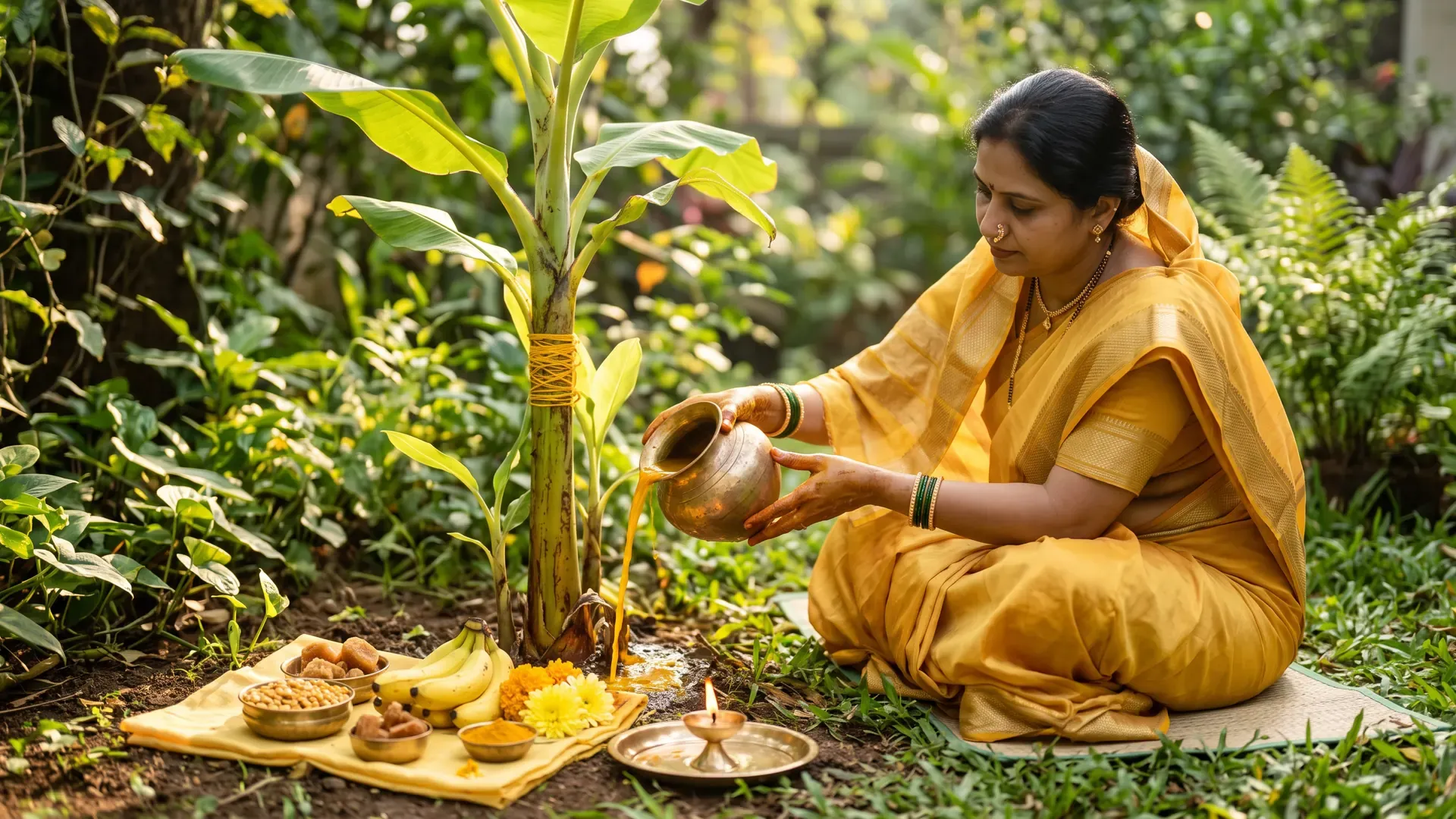
In the katha as tradition tells it, the queen of a generous king disliked all giving. By doing what Brihaspati, come as a sadhu, told her, she lost all their wealth, and the king became a woodcutter in a far land; then first the queen and later the king kept the Thursday vrat and katha, and their wealth, honour and the joy of a child came back. Within this katha comes the story of a brahmin’s daughter and her golden barley, and a separate story of a miserly Sethani is told as well.
Hindi in Roman letters: a reading aid, made by a program. The Devanagari text is the original.
The other language could not be loaded. Keep reading here, or try again.
Each morning the tithi, Rahu Kaal and coming festivals, in one short WhatsApp message.Follow the channel
Drik Panchang counts the Brihaspativar, that is Thursday, vrat among the most widely kept of the weekday vrats. By the same source, on this day some worship Brihaspati, the guru of the gods, and some Lord Vishnu, each by family tradition; in the katha itself the queen’s sister tells of worshipping Lord Vishnu at the root of a banana plant. Yellow things, chana dal, jaggery and the worship of the banana tree belong to the vrat by tradition.
This is a katha told by tradition; we found no Purana chapter for it. We have checked it line by line against Drik Panchang and three printed booklets and written it in our own words. In the middle of the katha the sadhu names things which, done on a Thursday, make wealth go (such as washing the hair with yellow clay, having clothes washed, shaving); these are part of the story and folk belief, not a rule of scripture.
Below comes first the story of the king and queen, then the story of the brahmin’s daughter (which in several books the sadhu tells the king), and then the short story of the miserly Sethani. Where the tellings differ, it is given at the end under "Other tellings".
How the vrat and katha are kept
- Start: by Gita Press’s "Vrat Parichay" (which ascribes this rite to the Bhavishya Purana) and the Manav Vikas Foundation booklet, on a Thursday of the bright half of any month that falls on Anuradha nakshatra. Drik Panchang too gives a Thursday with Anuradha for the start.
- By tradition: bathe in the morning and wear yellow; offer yellow flowers, yellow sandal paste, yellow fruit and a yellow offering; worship the banana tree (or, as in the katha, Lord Vishnu at the root of the banana), with chana dal, jaggery or munakka and a lamp.
- Food: one meal in the day, without salt (Drik Panchang and the booklets); the booklets say this meal is of chana dal. Drik Panchang’s rite for the Vishnu vrat says to give away bananas, chana dal, yellow rice, saffron and turmeric but not eat them oneself, and not to eat the banana since the tree is worshipped. Follow your own family’s custom.
- After the puja, read or hear the katha, then do the aarti. In the katha the queen’s sister says that one neither rises nor speaks while the katha is going on; after it, share the prasad (chana with jaggery or munakka) and the charanamrit of sugar stirred into water in a lota with everyone and take some yourself, and no one leaves without prasad.
- Prayer (in "Vrat Parichay", the Manav Vikas Foundation booklet and Drik Panchang): "Dharmashastrartha-tattvajña jñana-vijñana-paraga, vividharti-hara-acintya devacharya namo’stu te." Meaning: you who know the essence of the dharma texts, who have gone beyond knowledge and learning, who take away many kinds of suffering, beyond thought, teacher of the gods, I bow to you.
- By "Vrat Parichay", at the end of the vrat brahmins are fed chana dishes made in ghee and given dakshina, and then one eats. By Drik Panchang, even those not keeping the vrat feed a cow a ball of dough mixed with turmeric and chana dal on this day; that is custom.
Hindi in Roman letters: a reading aid, made by a program. The Devanagari text is the original.
The other language could not be loaded. Keep reading here, or try again.
First story: the generous king, the miserly queen and the sadhu
Nearly the same on Drik Panchang, in all three booklets and on Bhakti Bharat.
By tradition, long ago there was a mighty and generous king in Bharatavarsha. Every day he helped the poor and the brahmins. His queen did not like this at all; she gave nothing to anyone, did no worship, and kept trying to stop the king from giving as well.
One day the king had gone to the forest to hunt and the queen was in the palace. Just then Brihaspati, in the guise of a sadhu, came to the palace door to ask for alms. Refusing him, the queen said, "Maharaj, I am worn out by all this giving. My husband keeps spending our wealth on it. I would rather the whole of it were gone, so that there would be nothing left to give."
The sadhu said, "Devi, you are a strange one. Everyone in the world wants wealth and children. If you have more than enough, feed the hungry, set up water stalls for the thirsty, build rest houses for travellers, and pay for the weddings of daughters whose poor parents cannot. Such deeds bring good name in this world and the next." But it had no effect on the queen. She said, "I do not want wealth that I must go about handing out and keep looking after."
Then the sadhu said, "If that is what you wish, so be it. On Thursday plaster the house, wash your hair with yellow clay and bathe, have the clothes boiled and washed, and ask the king to have himself shaved; then all your wealth will go." Saying this, he vanished. The queen did just that, and only three Thursdays had passed when all their wealth was gone. The royal family could not even find one meal a day.
One day the king said to the queen, "Stay here. Everyone here knows me, so I cannot do humble work here; I will go to another land and find a living." In that far land he began cutting wood in the forest and selling it in the town, and so lived the life of a woodcutter. Here at home the queen and her maid fell into still greater hardship.
Once the queen and the maid went seven days without food. The queen said to the maid, "My elder sister lives in the next town, and she is very rich. Go to her and bring back something so that we can get by." The maid went. That day was Thursday, and the queen’s sister was just then listening to the Thursday vrat katha. The maid gave the message, but the sister gave no answer. The maid was both hurt and angry. When she came back and told everything, the queen began to curse her fate.
Meanwhile the sister thought that the maid had gone back without an answer and must have felt hurt. After finishing the katha and puja she came to the queen’s house and said, "When your maid came, I was keeping the Thursday vrat. During the katha one neither rises nor speaks, so I said nothing. Tell me, why did you send her?" The queen’s eyes filled; she told her that there was not one grain of food in the house and they had been hungry for seven days. The sister said, "Lord Brihaspati fulfils everyone’s wishes. Look in the house once; perhaps some grain is stored there." The queen did not believe it, but at her sister’s urging the maid went in, and there indeed she found a pot full of grain.
The maid said to the queen, "When we get no food we go hungry anyway; why not ask her the way of the vrat and the katha, so that we can keep it too?" When asked, the sister said, "On Thursday worship Lord Vishnu at the root of a banana plant with chana dal and munakka, light a lamp, read or hear the katha, and eat only yellow food. This pleases Brihaspati." Having told them the way, she went back home.
When Thursday came seven days later, the queen and the maid kept the vrat. They gathered chana and jaggery from the horse stable and with them worshipped the banana root and Lord Vishnu. Now both were sad, for where was yellow food to come from? But they had kept the vrat with faith, so Brihaspati was pleased; he came in the form of an ordinary man and gave the maid two plates of fine yellow food. The maid was overjoyed, and after offering it to the Lord the two of them ate.
After that they kept the vrat and puja every Thursday, and by Lord Brihaspati’s grace wealth began to come to them again. But as soon as it came, the queen grew idle as before. Then the maid reasoned with her: "Before, too, it was a burden for you to look after wealth, and that is why it all went. After great hardship this wealth has come by the Lord’s grace. So give, feed the hungry, spend it on good works; the family’s good name will grow, heaven will be yours and the ancestors will be pleased." The maid’s words went home. The queen began spending her wealth on good works, and her name spread through the whole town.
The king as woodcutter: the sadhu in the forest, the queen’s necklace and the return home
The rest of the first story: on Drik Panchang, in one printed booklet and on Bhakti Bharat; the Manav Vikas Foundation booklet leaves this part out.
Meanwhile one day the king, weary of the woodcutter’s life, sat under a tree in the forest thinking over his state. It was Thursday. Just then a sadhu appeared in that lonely forest; he was Brihaspati himself. He asked, "What worry has you sitting in this empty forest?" The king folded his hands and bowed, his eyes filled, and he told his whole story.
The sadhu said, "Your wife slighted Brihaspati on a Thursday, and that is why you are in this state. Now set your worry aside; the Lord will give you more wealth than before. Keep the katha on Thursdays. Make prasad of chana and munakka worth two paise, stir sugar into clean water in a lota for charanamrit, and after the katha share them with your family and the listeners and take some yourself. The Lord will fulfil all your wishes."
The king said, "Lord, selling wood does not even leave anything over after food. Last night in a dream I saw my queen in distress, and I have no way of getting news of her." The sadhu said, "Do not worry. On Thursday take your wood to town as usual; that day you will get twice the usual money, enough for food and for the things of the puja too." Then he told the king the Thursday katha, the one of the brahmin’s daughter, which is the second story below, and vanished.
When the next Thursday came, the king did indeed get more for his wood than on other days. He bought chana and jaggery and kept the Thursday vrat and katha with faith, and his troubles began to lift. But the following Thursday he forgot the vrat. That very day the king of that town held a great yajna and had it announced that no one was to light a stove at home that day; all the people were to eat at the palace. Everyone went, but the woodcutter arrived late, so the king took him into the palace himself to feed him.
They were still eating when the queen of that town glanced at the peg on which her necklace always hung. The necklace was not there. The queen thought this man had stolen it, and the woodcutter was thrown into prison at once. There he wondered what deeds of his had brought this sorrow, and he remembered the sadhu of the forest. At once Brihaspati appeared as the sadhu and said, "You did not keep Brihaspati’s katha, and that is why this trouble has come. Do not worry now. On Thursday you will find four paise lying at the prison door; with them worship Brihaspati, and all your troubles will pass."
On Thursday he did find four paise at the door. He had the things for the puja fetched, told the katha and shared the prasad. That night Brihaspati told the king of that town in a dream, "The man you have put in prison is innocent; he too is a king. Let him go. The queen’s necklace is hanging on that same peg." In the morning the king saw that the necklace was on its peg. He called the woodcutter, asked his forgiveness, and sent him off with fine clothes and ornaments fit for a king.
At Brihaspati’s bidding the king set out for his own town. Nearing it, he was amazed: far more gardens, ponds, wells, rest houses and temples had been built than before. When he asked, people said that the queen and her maid had built them all. The king was surprised, and angry too, wondering where this wealth had come from in his absence. Hearing that the king was coming, the queen said to the maid, "The king left us in a sorry state; seeing how changed things are, he may turn back. Stand at the door." The maid brought him in. When the king asked how this wealth had come, the queen said, "It all came by the power of this vrat of Brihaspati."
The king resolved, "Everyone worships Brihaspati once in seven days; I will fast every day and tell the katha three times a day." From then on the king always had chana dal tied in the end of his cloth, and he told the katha three times a day.
One day the king rode off on his horse to his sister’s house. On the way he met some people carrying a body. The king stopped them and said, "Brothers, listen to my Thursday katha." Some were angry that they had lost one of their own and he cared only for his katha, but some said, "All right, tell it, we will listen." The king took out his dal and began the katha. When it was half done the body began to stir, and by the time it ended the man stood up saying "Ram, Ram".
Further on a farmer was ploughing his field. When the king asked him to hear the katha, he said, "In the time it takes to hear your katha I could plough the field four times; go and tell it to someone else." As soon as the king moved on, the farmer’s oxen collapsed and he was seized by a sharp pain in his stomach. Just then his mother came with his meal. Hearing everything, the old mother ran after the rider and said, "I will hear your katha, but come and tell it at my field." The king went to the field and told the katha; as it was heard the oxen got up and the farmer’s pain eased too.
When the king reached his sister’s house she welcomed him with great love. The next morning the king saw that everyone was eating. He asked his sister, "Is there anyone who has not yet eaten and would hear my Thursday katha?" She said, "Brother, people here eat first and only then do anything else." She went to search the neighbourhood. At last, at a potter’s house, she learned that their son was ill and no one there had eaten for three days. The potter agreed to hear the katha. The king told it there, and the potter’s son got well. Now the king was praised on every side.
One day the king said to his sister, "I am going home; come with me." The sister asked her mother-in-law. The mother-in-law said, "Go, but do not take your sons; your brother has no child." The sister said to her brother, "I will come, but the children will not." The king said, "If no child is coming, you need not come either," and went back to his town with a heavy heart.
At home he told the queen everything, said that they were childless, and lay down without eating. The queen said, "Brihaspati has given us everything; he will surely give us a child too." That very night Brihaspati said to the king in a dream, "Get up, leave all your worry; your queen is with child." The king was overjoyed, and in due time the queen gave birth to a beautiful son.
The king asked the queen not to bring up the old matter when his sister came, and the queen agreed. Hearing the good news, the sister was delighted and came to her brother’s house with her blessings. The queen could not hold back; she teased her that when her brother had wanted to bring her she had put it off, and today she had come running without being asked. The sister laughed and said, "Sister-in-law, if I had not said what I did, how would you have had a child?" Then they all let go of the old hurt and lived happily.
The katha says that this is how Brihaspati fulfils the wishes of his devotees. Just as the king and queen kept his katha with faith and all their wishes came true, so whoever keeps the Thursday vrat with faith and reads the katha, hears it or tells it to others has their wishes fulfilled by Brihaspati.
Second story: the brahmin’s daughter and the golden barley
On Drik Panchang and in one printed booklet the sadhu in the forest tells this story to the king; in the Manav Vikas Foundation booklet and on Bhakti Bharat it is a separate story.
By tradition, in olden days there lived a very poor brahmin who had no children. His wife did not keep herself clean; she neither bathed nor worshipped any god. The brahmin tried in every way to make her see, but nothing reached her, and this grieved him deeply.
By the Lord’s grace the brahmin’s wife had a lovely daughter. When she grew up she bathed every morning, worshipped Lord Vishnu and began keeping the Thursday vrat as well. After her puja, on her way to school, she would take a fistful of barley and scatter it along the road. By the Lord’s maya the barley turned to gold, and on her way back she gathered it and brought it home.
One day she was winnowing the golden barley in a sup, a winnowing basket, and her father said, "Daughter, golden barley ought to have a golden sup." The next day was Thursday. The daughter kept the vrat and prayed to Brihaspati, "If I have worshipped you with a true heart, give me a golden sup." Brihaspati heard her prayer, and as she gathered the barley on her way back from school she found a golden sup. She began winnowing the barley in it. But her mother stayed just as she had been.
One day, as she was cleaning the barley in the golden sup, the prince of that town passed by. Charmed by her beauty and by what she was doing, he went back to the palace, gave up food and water and lay down in low spirits. The king came with his chief minister and asked whether someone had insulted him or some other sorrow troubled him. The prince said, "By your grace I have no sorrow; but I wish to marry the girl who was cleaning barley in a golden sup." The king was astonished and said, "You find out who she is, and I will surely arrange the marriage." The prince told him the house, the minister went to the brahmin, the brahmin agreed, and the brahmin’s daughter was married to the prince with due rite.
As soon as the daughter left home, poverty came back to the brahmin’s house as before; even food was hard to come by. One day, sad at heart, the brahmin went to see his daughter. She saw how her father was, asked after her mother, and sent him home with a great deal of wealth. For a while they lived in comfort, then things were as bad as ever. When the brahmin went again, his daughter said, "Father, bring Mother here. I will tell her the way that will send poverty off for good."
The brahmin came with his wife. The daughter reasoned with her mother: "Mother, rise early, bathe and worship Lord Vishnu, and all the poverty will go." But her mother heeded not a word of it, and on rising in the morning ate the leftovers from her grandchildren’s plates. The daughter was deeply hurt and angry. One night she had a small room emptied and shut her mother inside it. In the morning she brought her out, had her bathe and do the puja and path, and her mother’s mind changed; she began to keep the vrat every Thursday.
By the merit of this vrat the daughter’s parents became wealthy and had sons as well, and by the grace of Lord Vishnu and Brihaspati they enjoyed the joys of this world and at the end went to heaven.
Third story: the miserly Sethani and the sadhu
On Drik Panchang’s navagraha weekday page and in a printed collection of vrat kathas; in some homes this is the Thursday katha that is read.
By tradition, a moneylender lived in a village. His house lacked nothing, neither grain nor clothes nor money, but his wife was very miserly. She never gave anything and sent those who begged away empty-handed; all day she was busy with the work of the house.
One Thursday an old sadhu came to her door to beg. She was plastering the courtyard, and said, "Maharaj, I am plastering the house just now and can give nothing; come another time when I am free." The sadhu went away empty-handed. Some days later he came again; she was feeding her child then, and once more sent him off saying she had no time. When she tried to put him off a third time, the sadhu asked, "If you had all the time in the world, would you give me alms then?" She said, "Yes, Maharaj; if that happened it would be a great kindness."
The sadhu said, "Then listen. On Thursday get up late in the day, sweep and leave the dirt piled in a corner of the house, do not clean the cooking place, ask the men of the house to shave that day, keep the cooked food behind the stove, light the lamp only after dark has fallen, and that day neither wear yellow clothes nor eat yellow things. Do this, and you will have no work left to do." The Sethani began doing just that every Thursday. In a short while her merit wore away, all the wealth and grain were gone, and not one grain was left in the house.
Some days later the same sadhu came again and asked for alms. The Sethani burst into tears: "Maharaj, there is no food in the house; what can I give you? I have become a beggar myself." The sadhu said, "When you had everything, you gave nothing for want of time; now you have all the time there is, and still you give nothing. What is it you want?" Seeing her mistake, the Sethani folded her hands: "Maharaj, tell me a way for the house to be full again as it was. I will do just as you say."
The sadhu said, "On Thursday rise early, bathe and plaster the house with cow dung; let the men of the house not shave that day; keep giving food and water to the hungry; and light the lamp right at dusk. Do this, and by Lord Brihaspati’s grace all your wishes will be fulfilled." The Sethani did so faithfully, and her house was full of wealth and grain again as before. By Lord Brihaspati’s grace she lived long and happily.
Other tellings
- The king: on Drik Panchang, in the Manav Vikas Foundation booklet and on Bhakti Bharat he gives daily to the poor and brahmins; in an older printed booklet he himself keeps the vrat and puja every Thursday.
- What the sadhu tells the queen to do: Drik Panchang has the longest list (plaster the house, wash the hair with yellow clay, have clothes boiled and washed by a washerman, the king’s shave, tamasic food); the Manav Vikas Foundation booklet and Bhakti Bharat have only plastering, washing the hair with yellow clay and boiling and washing clothes; one booklet adds meat and wine to the food and says to do this for seven Thursdays.
- The brahmin’s daughter: on Drik Panchang and in one printed booklet the sadhu in the forest tells it to the king; in the Manav Vikas Foundation booklet and on Bhakti Bharat it is a separate story. The remark about the golden sup is the father’s on Drik Panchang, in the Manav Vikas Foundation booklet and on Bhakti Bharat, the mother’s in one booklet.
- In the Manav Vikas Foundation booklet (Mumbai, 2021) the king-and-queen story has no woodcutter, necklace or prison; that part comes in its first katha with a merchant. There the miserly wife dies when the wealth goes, the merchant sells wood with his daughter, his wood fetches four times the price, he finds two paise at the prison door, and there is a story of two women: the son of the one who refuses to fetch chana and jaggery for the katha falls from his mare and dies, and the dead son of the one who fetches them and hears the katha comes back to life with the prasad and charanamrit; when the first woman asks forgiveness and hears the katha, her son revives too. In the end the king gives the merchant half his kingdom and arranges his daughter’s marriage. We found this form in this one booklet only.
- The price of the wood: twice the usual on Drik Panchang and Bhakti Bharat; four times in the Manav Vikas Foundation merchant story.
- The prasad the sadhu names in the forest: chana and munakka, and sugar water in a lota, on Drik Panchang and Bhakti Bharat; in one booklet, chana dal and jaggery put into the water of the lota and the banana worshipped.
- Who is worshipped: Lord Vishnu at the banana root in the katha; Brihaspati, guru of the gods, on Drik Panchang and in "Vrat Parichay" (Drik Panchang: Brihaspati or Vishnu by family tradition); "Brihaspateshwar Mahadev" in one collection of vrat kathas.
- How many: seven in "Vrat Parichay"; by Drik Panchang, seven months in "Vratraj", sixteen Thursdays with the udyapan on the seventeenth in one common custom, and seven for some; in Drik Panchang’s rite for the Vishnu vrat, a vow of 11, 21 or 51 Thursdays.
After the katha
After the katha the Brihaspati aarti, "Om Jai Brihaspati Deva", is sung (the Manav Vikas Foundation booklet and an older printed booklet print this aarti after the katha; that booklet also has "Om Jai Jagdish Hare"). Then everyone is given prasad and charanamrit.
Frequently asked questions
How many Thursday vrats should one keep, and when is the udyapan?
There is no single view. Gita Press’s "Vrat Parichay" gives seven vrats. By Drik Panchang, "Vratraj" gives the vrat for seven months, a common custom keeps sixteen Thursdays and does the udyapan on the seventeenth, and some keep seven Thursdays; in its rite for the Vishnu vrat one vows 11, 21 or 51 Thursdays at the start and does the udyapan when they are complete. At the udyapan (Drik Panchang): puja and havan guided by an acharya, food and dakshina for brahmins, then one eats with the family. Settle it with your own purohit and family custom.
On which Thursday should the vrat be started?
By "Vrat Parichay" and the Manav Vikas Foundation booklet, on a Thursday in the bright half of any month that falls on Anuradha nakshatra; Drik Panchang too gives a Thursday with Anuradha for the start. The nakshatra of the day can be seen in our daily panchang.
What is eaten on the Thursday vrat?
By tradition, one meal in the day, without salt (Drik Panchang and the booklets). The booklets say this meal is of chana dal, and in the katha the queen’s sister says to eat yellow food. Drik Panchang’s rite for the Vishnu vrat speaks of a fruit fast of milk, dry fruit and fruit, and says to give away bananas, chana dal, yellow rice and the like but not to eat them oneself. Follow your family’s custom; if your health is not good, set the fasting rule with your doctor’s advice.
Is this the same as the Guru Pradosh katha?
No. This is the katha of the vrat kept every Thursday. The Guru Pradosh katha is a different one: in it Brihaspati, guru of the gods, tells Indra of Vritrasura’s past birth and has him keep the Pradosh vrat on a Thursday Trayodashi. That katha is on the "Guru Pradosh vrat katha" page among the weekday kathas of the Pradosh vrat.
How do I get the Brihaspativar vrat katha as a PDF?
Press the "Print / PDF" button on this page; choosing "Save as PDF" in the print dialog of a phone or computer saves all three stories and the rite as a PDF, without the rest of the page.
Sources
- Drik Panchang, "Vishnu Brihaspativar Vrat Katha" (drikpanchang.com/vrat-katha/weekdays/brihaspativara/vishnu-brihaspativara-vrat-katha.html), read 16 October 2026
- Drik Panchang, "Brihaspati Brihaspativar Vrat Katha" (drikpanchang.com/vrat-katha/weekdays/brihaspativara/brihaspati-brihaspativara-vrat-katha.html), read 16 October 2026
- Drik Panchang, "Vishnu Brihaspativar Vrat" and "Brihaspati Brihaspativar Vrat", rite and udyapan (drikpanchang.com/vrats/weekdays/brihaspativara/vishnu-brihaspativara-vrat.html, …/brihaspati-brihaspativara-vrat.html), read 16 October 2026
- "Brihaspativar Vrat Katha" (in simple Hindi, with the greatness of the vrat, the rite and the aarti), printed booklet, archive.org (archive.org/details/20200714_20200714_0648), read 16 October 2026
- "Saptavar Vrat, Vidhi, Katha, Aarti", Manav Vikas Foundation, Mumbai (Acharya Akhilesh Dwivedi), 2021, Brihaspativar (Thursday) vrat katha (archive.org/details/m_20240804_20240804_1514), read 16 October 2026
- "Vrat Katha" collection, weekly vrat kathas: Brihaspativar vrat katha (archive.org/details/20240806_20240806_0450), read 16 October 2026
- "Vrat Parichay", Pt. Hanuman Sharma, Gita Press, Gorakhpur (1956 printing), appendix, "Guru-vrat (Bhavishya Purana)", pp. 279–280 (archive.org/details/fkvt_vrat-parichay-by-pandit-hanuman-sharma-hindi-hindu-rituals-1956-gorakhpur-gita-press), read 16 October 2026
- Bhakti Bharat, "Ath Shri Brihaspativar Vrat Katha" (bhaktibharat.com/katha/shri-brihaspatidev-ji-vrat-katha), read 16 October 2026
Something wrong? Report a mistake