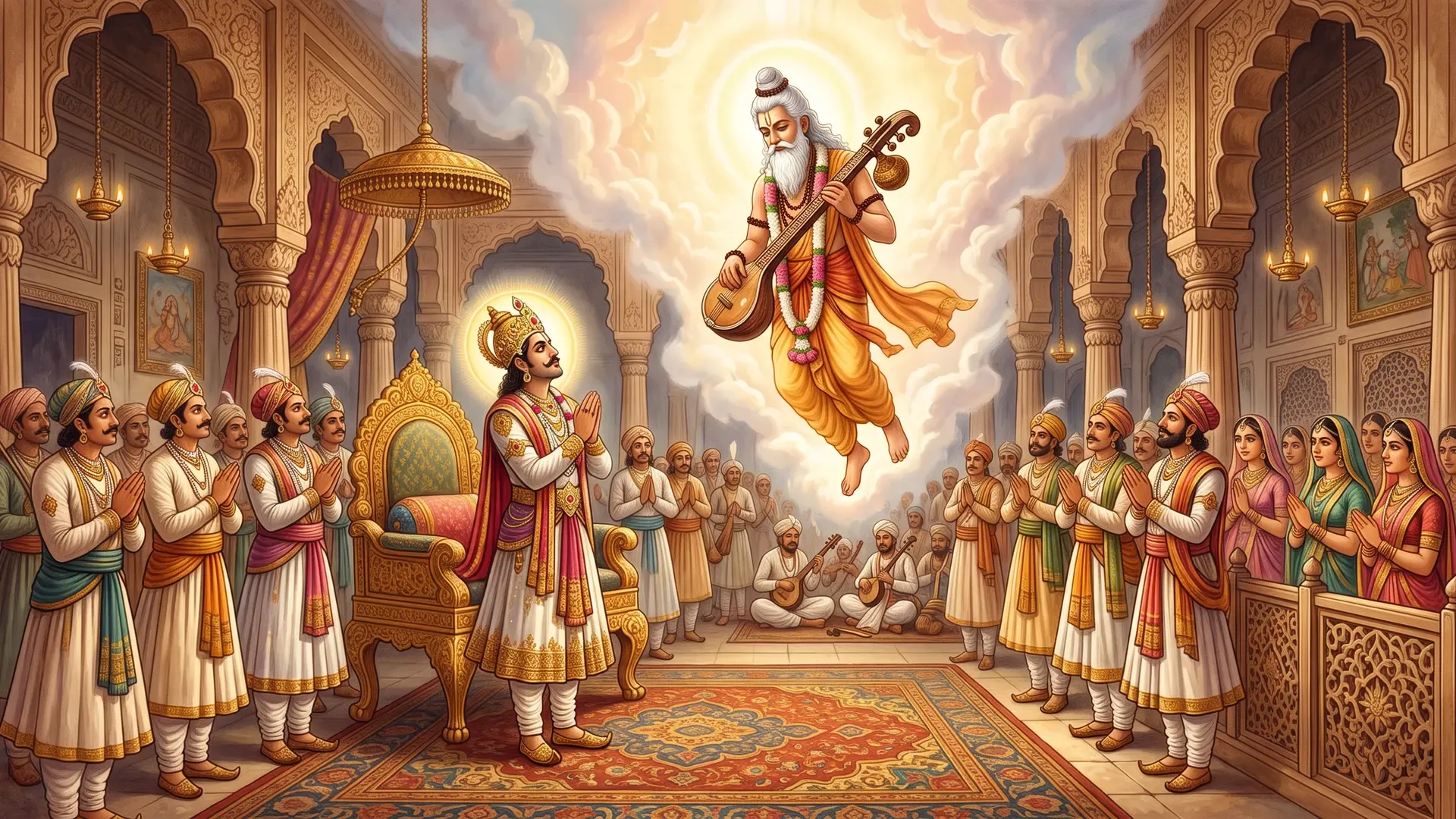
The Indira Ekadashi katha is in the Padma Purana (Uttara Khanda). The sage Narada tells King Indrasena of Mahishmati that his father is held in Yama’s assembly because of a shortfall in a vow, and asks his son for the merit of the Indira fast. The king keeps the fast as prescribed with his household, and by its merit his father rides Garuda to the abode of Lord Vishnu.
Each morning the tithi, Rahu Kaal and coming festivals, in one short WhatsApp message.Follow the channel
Indira Ekadashi falls on Ashwin Krishna Ekadashi (Purnimanta calendar; Bhadrapada Krishna in the Amanta calendar), during Pitru Paksha. So its fast is kept with the worship of Lord Vishnu and also with a prayer for the good of one’s forefathers, and this katha is read or heard after the puja.
The katha is in the Uttara Khanda of the Padma Purana, where Krishna tells Yudhishthira, at his request, the glory of each Ekadashi; the whole Uttara Khanda is framed as a dialogue between Lord Shiva and the sage Narada. We have written it in our own words from the Sanskrit, its English translation and the Gita Press Hindi translation. The rite of the fast is given by Narada within the story; it includes shraddh, on which the editions differ (see below).
How the vrat and katha are kept
- In the katha Narada gives the rite over three days. Dashami (Ashwin Krishna Dashami): a bath in the morning with faith, another bath at midday followed by shraddh to please the forefathers; one meal in the day, and sleep on the ground at night.
- Ekadashi: in the morning, wash the face and take the vow of fasting with devotion. The vow verse in the katha is “अद्य स्थित्वा निराहारः सर्वभोगविवर्जितः। श्वो भोक्ष्ये पुण्डरीकाक्ष शरणं मे भवाच्युत॥”, in sense: today I stay without food, giving up every pleasure, and I will eat tomorrow; lotus-eyed Achyuta, be my refuge. At midday a bath as prescribed at the Shalagrama stone, worship of Lord Hrishikesha with incense and fragrance, and at night a vigil near the Lord.
- Dwadashi: in the morning, worship of Shri Hari and then shraddh for the forefathers; brahmins are fed with dakshina, and after that one eats in silence with one’s kin, daughters’ sons and sons. By the Padma Purana a shraddh made with wheat flour is pure, and so is one made with barley, rice, sesame, urad, wheat or gram.
- In the katha the merit of the fast is offered to the forefathers: King Indrasena gives it to his father.
- The Gita Press Hindi translation orders it a little differently: it has no shraddh on Dashami; the shraddh is done at midday on Ekadashi before the Shalagrama, brahmins are fed, and the pinda offered to the forefathers is smelled and then fed to a cow; it has no shraddh line on Dwadashi. The pinda given to a cow is also in the ISKCON book (and on Webdunia), but the Sanskrit text of the Padma Purana has neither a shraddh on Ekadashi nor the pinda for a cow. The Sanskrit says to wash the face on Ekadashi morning without a tooth-stick; the Gita Press translation says with one.
- Shraddh customs vary by family and region; ask your own purohit how to perform it.
King Indrasena and his father
As told in the Padma Purana, Uttara Khanda, chapter 58 (60 in the Gita Press edition), checked against the Sanskrit, Deshpande’s English translation and the Gita Press Hindi.
King Yudhishthira asked Lord Krishna, “Madhusudana, please tell me: which Ekadashi comes in the dark half of the month of Ashwin?” Krishna said, “O king, that Ekadashi is called Indira. By the power of its fast even great sins are wiped away, and it gives a good end even to forefathers who have fallen into lower births. Listen closely to its story, which takes away sin; merely hearing it brings the fruit of a Vajapeya sacrifice.”
Long ago, in the Satya Yuga, a renowned king named Indrasena ruled the city of Mahishmati. He cared for his people by dharma. His family was full of sons and grandsons, and his kingdom lacked neither wealth nor grain. The king was wholly devoted to Lord Vishnu, and he passed his days chanting the names of Govinda, which grant liberation, and meditating on the Self.
One day, as the king sat at ease in his court, the divine sage Narada came down from the sky. The moment he saw him, the king rose with folded hands, worshipped him as is proper and seated him with honour. Then he said, “Divine sage, by your kindness all is well with me. Seeing you, I feel that every sacrifice I have performed has borne fruit today. Please tell me, what brings you here?”
Narada said, “Best of kings, listen; what I have to say will astonish you. I went from Brahma’s world to the world of Yama. There Yama received me with devotion and gave me a fine seat. In his assembly I saw your father. He did much good in his life, yet because of a shortfall in a vow he is held there.”
“He gave me a message for you; hear it. He said, ‘O brahmin, tell Indrasena, king of Mahishmati, that because of some obstacle from a former birth I am held near Yama. My son, give me the merit of the Indira vow and send me to heaven.’ I have come to you with that message. O king, keep the Indira fast so that your father may reach heaven. By the power of that vow he will go there.”
The king folded his hands and asked, “Revered one, please tell me about the Indira vow. In which fortnight is it kept, on which tithi, and in what way?”
Narada said, “Lord of kings, hear how this blessed vow is kept. On the Dashami of the dark half of Ashwin, bathe in the morning with a faithful heart. At midday bathe again and, calm and collected, perform shraddh with faith to please your forefathers. Eat only once that day, and at night sleep on the ground.”
“When the clear morning of Ekadashi dawns, wash your face and take the vow of fasting with devotion, saying to the Lord: O lotus-eyed one, today I stay without food, giving up every pleasure, and I will eat tomorrow; O Achyuta, be my refuge. Then at midday bathe as prescribed at the Shalagrama stone, worship Lord Hrishikesha with incense, fragrance and the rest, and at night keep vigil near Lord Keshava.”
“On the morning of Dwadashi, worship Shri Hari with devotion and then perform shraddh for your forefathers as prescribed. Honour brahmins with gifts and feed them, and after that eat in silence yourself, with your kinsmen, your daughters’ sons and your sons. O king, keep the vow this way without slackness, and your forefathers will go to the world of Vishnu.” With these words Narada vanished.
King Indrasena kept this excellent vow just as Narada had taught, together with his queens, his sons and his servants.
Krishna said, “Son of Kunti, the moment the vow was complete, flowers rained from the sky, and the king’s father, riding on Garuda, went to the abode of Lord Vishnu.”
The royal sage Indrasena too ruled without trouble, and later, placing his son on the throne, went to heaven himself.
At the end Krishna tells Yudhishthira that this is the glory of the Indira vow. According to the katha, whoever reads or hears it is freed of all sins, enjoys happiness in this world, and then dwells long in the world of Vishnu.
Other tellings
- In the Padma Purana, Gita Press, the ISKCON book, Webdunia and Amar Ujala, Krishna tells this katha to Yudhishthira. In Drik Panchang’s Hindi and English tellings he tells it to Arjuna; that is a popular variant, not the Padma Purana’s frame.
- In the Padma Purana and Gita Press the father rides Garuda to Lord Vishnu’s abode. In Drik Panchang he rises to heaven on a chariot, and Amar Ujala has him go to Vaikuntha. At the end Indrasena himself goes to heaven in the Sanskrit, and to Vaikuntha in the ISKCON book.
- The reason the father is held with Yama is “a shortfall or fault in a vow” in the Sanskrit and “the fault of a broken vow” in Gita Press; Drik Panchang and Webdunia say he broke an Ekadashi fast, and the ISKCON book that he broke an Ekadashi fast early.
- In Amar Ujala’s short telling the father first comes to Indrasena in a dream and Narada arrives later; no other source has this.
- The fruit of hearing the katha equals a Vajapeya sacrifice in the Sanskrit, Webdunia and Aaj Tak; a horse sacrifice in the ISKCON book; and “infinite fruit” in Drik Panchang. Gita Press leaves the line out.
After the katha
After the katha the aarti of Lord Vishnu and the Ekadashi Mata aarti are sung. By the katha the fast is broken on Dwadashi after the worship of Shri Hari, the shraddh and the feeding of brahmins; the parana time for your city is on the Indira Ekadashi page.
Ekadashi Aarti: Om Jai Ekadashi MataFrequently asked questions
Which Purana has the Indira Ekadashi katha?
The Uttara Khanda of the Padma Purana, where Krishna tells it to Yudhishthira. It is chapter 58 on Sanskrit Wikisource and in N. A. Deshpande’s English translation, and chapter 60 in the Gita Press edition.
When is shraddh done on Indira Ekadashi?
The Sanskrit Padma Purana has shraddh twice: at midday on Dashami, and on Dwadashi morning after the worship of Shri Hari. The Gita Press Hindi translation places it at midday on Ekadashi before the Shalagrama. Shraddh customs vary by family, so ask your own purohit.
Why is the Indira Ekadashi fast kept for the forefathers?
In the Padma Purana Krishna says this Ekadashi gives a good end even to forefathers fallen into lower births, and in the katha King Indrasena, by giving the merit of this fast, sends his father from Yama’s assembly to the abode of Lord Vishnu. The Ekadashi also falls within Pitru Paksha.
When is the Indira Ekadashi katha read?
By tradition, on the Ekadashi after the worship of Lord Vishnu and before the aarti. By the Padma Purana, merely hearing this katha brings the fruit of a Vajapeya sacrifice.
Sources
- Padma Purana, Uttara Khanda, chapter 58, Sanskrit Wikisource (chapter numbers vary by edition; the Gita Press edition has it as 60)
- Padma Purana, Uttara Khanda, chapter 58, N. A. Deshpande’s English translation (Motilal Banarsidass; wisdomlib.org)
- Gita Press, Gorakhpur: Ekadashi-vrat ka Mahatmya (the stories of 26 Ekadashis), compiled by Radheshyam Khemka, pp. 59–62 (based on the Padma Purana)
- ISKCON’s Ekadasi book text: Indira Ekadasi (iskcondesiretree.com and iskconbangalore.org)
- Drik Panchang: Indira Ekadashi Vrat Katha (Hindi and English), drikpanchang.com
- Webdunia (hindi.webdunia.com): Indira Ekadashi vrat katha; Hindi Wikipedia carries the same text
- Amar Ujala: the Ashwin Krishna Indira Ekadashi vrat katha
- Aaj Tak: the Indira Ekadashi 2024 katha (28 September 2024)
Something wrong? Report a mistake