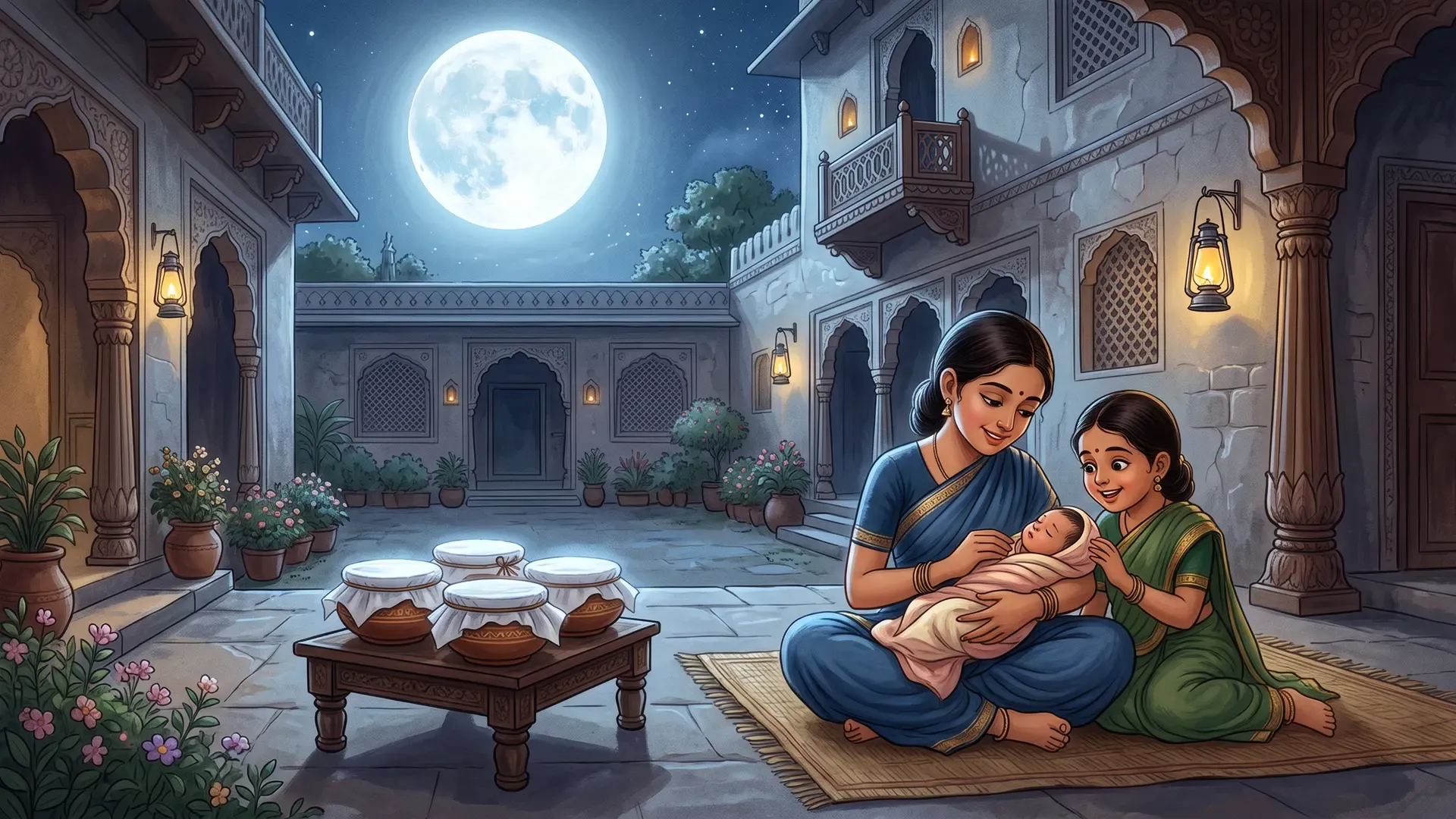
On Sharad Purnima the folk tale of a moneylender’s two daughters is told: the elder kept the Purnima fast fully and the younger left it half done, so the younger’s children did not live; when she keeps the full fast, her baby comes back to life through her elder sister’s merit. In the Kojagara vrat katha, Valit, a poor brahmin of Magadha, is found awake on this night and becomes rich by Lakshmi’s grace; this story is printed in the Vrataraja as from the “Sanatkumar Samhita”.
Each morning the tithi, Rahu Kaal and coming festivals, in one short WhatsApp message.Follow the channel
Sharad Purnima is the full moon of the month of Ashwin, also called Kojagari or Kojagara Purnima. People fast on this day; at night Lakshmi is worshipped, a vigil is kept and kheer is offered. Two kathas are told on the occasion.
The first, the story of the moneylender’s two daughters, is a folk tale; no source names a scripture for it, and Webdunia itself calls it a lok katha. Most sources tell it of the Purnima fast in general, kept every full moon, while Drik Panchang and Times Now Navbharat tie it to the Sharad Purnima fast.
The second, the story of the brahmin Valit, is the katha of the Kojagara vrat. It is printed in the Vrataraja, a digest of vratas, as from the “Sanatkumar Samhita”; we have not seen that Samhita ourselves. The Kojagara verses, in which Lakshmi asks at midnight “ko jagarti?” (“who is awake?”), are also in the Nirnaya Sindhu, which cites them from the Linga Purana by way of the Tithitattva.
How the vrat and katha are kept
- It is the custom to hold thirteen grains of wheat while hearing the katha, and to offer water to the moon from a lota (Times Now Navbharat; a “Vrat Katha” booklet).
- Newly married women begin the year-long Purnima fast from this full moon (Drik Panchang; a “Vrat Katha” booklet).
- By Hindi Wikipedia and a “Purnima Vrat Katha” booklet, a hundred ghee lamps are lit at moonrise, kheer is set out in the moonlight in many vessels, and after one prahar (about three hours) it is offered to Lakshmi and shared with the needy; then the night is spent in vigil.
- The Kojagara vrat as the Vrataraja and the Gita Press “Vrat-Parichay” give it: fast by day; at night worship Mahalakshmi and Indra seated on Airavata; light ghee lamps by one’s means, from a hundred to a lakh (the Vrataraja also allows sesame oil), in temples, gardens, lanes, crossroads and homes; and keep vigil with song and music, for which the texts also name a game of dice (aksha-krida). Next morning, bathe and worship Indra, feed brahmins kheer made with ghee and sugar, give clothes and dakshina, and then break the fast.
The moneylender’s two daughters
A folk tale in common telling. This form is given in nearly the same words by Hindi Wikipedia, Webdunia, Amar Ujala (2025) and a “Purnima Vrat Katha” booklet; Drik Panchang, Times Now Navbharat and Prabhat Khabar tell it in their own way.
A moneylender had two daughters, and both kept the Purnima fast. The elder kept it with all her heart and by every rule, but the younger always left it unfinished.
Time passed and both were married. The elder sister’s children were healthy, but every child born to the younger died as soon as it was born. In her grief she asked the pandits why. They said, “You have been keeping the Purnima fast only halfway, and that is why your children do not live. If you keep the Purnima fast fully and by its rules, your children can live.”
The younger daughter took the pandits’ advice and this time kept the Purnima fast fully, by its rules. A son was born to her, but he too died within a few days.
Then she laid the child on a pidha, a low wooden seat, and covered him with a cloth. She went and brought her elder sister, and offered her that same seat to sit on.
As the elder sister was about to sit, her ghaghra touched the child, and at its touch the baby began to cry. Startled, she said, “You wanted to put a stain on my name! If I had sat down, this child would have died.”
The younger sister said, “Sister, he was already dead. It is by your good fortune and your merit that he has come back to life.”
After that the younger sister had it proclaimed by drum through the whole town that everyone should keep the Purnima fast fully, by its rules, and not leave it half done.
The Kojagara vrat katha: the brahmin Valit
Printed in the Vrataraja (Vishvanath Sharma; Khemraj Shrikrishnadas edition with Hindi commentary, pp. 627–630) as from the “Sanatkumar Samhita”. Drik Panchang and Webdunia (2024) give it in Hindi and English.
The rishis asked the Valakhilya sages about the lesser vratas that belong to Kartik. The Valakhilyas said that on the night of Ashwin Shukla Purnima one should stay awake and worship Lakshmi, drink coconut water and play at dice. At midnight Lakshmi, the giver of boons, roams the world asking “ko jagarti?”, “who is awake?”, and gives wealth to whoever she finds awake. All who fear poverty should keep this vrat; by it even Valit became rich. When the rishis asked who Valit was, the Valakhilyas told this story.
In the land of Magadha lived a brahmin named Valit. He was learned in many branches of knowledge and kept his daily sandhya and bath. If someone came and gave him something at home he accepted it, but asking anyone for anything felt to him like death, and so he was very poor.
His wife was hot-tempered and quarrelsome. Every day she complained that her sisters in rich homes went about decked in gold and silver while she had landed in a pauper’s house. Even before others she scorned her husband’s family and his learning. She had resolved that until Lakshmi smiled on them, she would do the opposite of whatever he said. “Steal wealth from the king’s palace and bring it here,” she would say, “or I will beat you.” Sometimes she wept, sometimes she refused food, sometimes she ate too much, sometimes she beat her head. Valit bore it all but would not go begging; he was content with whatever came.
Once the Pitri Paksha came. Everything needed for his father’s shraddha was in the house, but Valit worried: his wife did the opposite of everything, so how would the shraddha be done? Just then his friend Ganapati came by and asked why he looked troubled. Hearing it all, the friend smiled and said, “That is easy. Tell her the opposite of what you want. She will do the opposite, and your work will be done right.”
In the evening Valit came home and said to his wife, “Chandi, the day after tomorrow is my father’s shraddha, but he left me no wealth at all. So cook nothing, and if you do cook, invite gamblers and brahmins of no good conduct, never the good ones.” To do the opposite, his wife made grand preparations, cooked many dishes and invited the best brahmins of the town. And so the shraddha was done fully by its rules.
After the pinda-dana, Valit spoke to his wife of placing the pindas in the holy waters of the Ganga. Once again she did the opposite, and instead of the Ganga she put them into an unclean pit.
When he learned of it Valit was deeply grieved. In sorrow and anger he left home, vowing to live in the forest on roots, tubers and fruit alone until Lakshmi was pleased with him. Dressed in bark, he lived alone on the bank of the river Dharma. Thirty days went by, and the full moon of Ashwin came.
In that same forest lived Naga maidens of the line of Kaliya, who were keeping a vrat for Lakshmi. Their house was freshly whitewashed and shone like the moon. They worshipped Lakshmi with panchamrit, gems, mirrors and cloth, and spent the first watch of the night in puja.
Then they sat down to play dice, but the game needed four players and they were only three. Looking for a fourth, they noticed Valit sitting on the riverbank, and they could tell from his face that he was a good brahmin. “Come, play dice with us,” they said. “It pleases Lakshmi.”
Valit said, “Gambling destroys both wealth and dharma.” One of the maidens replied, “You talk like a pandit, but you think like a fool. On this full moon, Lakshmi is pleased by a game of dice.” They took him to their shrine and gave him prasad and coconut water.
The game began. The maidens staked gems. Valit had nothing, so first he staked his loincloth and lost it, then his sacred thread, and lost that too. With nothing left, he staked himself.
Just then it was midnight. Lakshmi was passing that way with Lord Narayana, watching over the world. Seeing Valit’s plight, Lord Vishnu said, “This brahmin is keeping your vrat, so why does he sit in such distress? Give him wealth and happiness.”
Lakshmi looked on him with favour, and at that moment Valit became as handsome as Kamadeva. The maidens said, “We have won you; now be our husband.” Valit agreed, married them by gandharva rite, and went home with them and their gems.
At home Valit reflected that his fortune had turned only because of his wife’s scorn, so he treated her with respect. She was pleased, and from that day she heeded her husband. By the Vrataraja, even hearing this story with faith brings the fruit of the vrat.
Other tellings
- Which fast: most sources speak of the Purnima fast in general; Drik Panchang and Times Now Navbharat of the Sharad Purnima fast. In Drik Panchang’s telling the elder sister broke her fast only after offering water to the moon in the evening, while the younger kept it in name only. In Times Now Navbharat both sisters are already married and both keep the Sharad Purnima fast.
- Who explains the cause: in most sources, pandits; in Drik Panchang, a saint; in Prabhat Khabar, brahmins who read her horoscope. In Prabhat Khabar a daughter is born; in every other source, a son. The child dies “soon” in some tellings, “after a few days” in others, and in Drik Panchang right after birth.
- The seat and the ghaghra: in Drik Panchang the child lies on a small bed instead of a pidha. Two Webdunia pages have a lehenga instead of a ghaghra, and Drik Panchang and one booklet simply say her clothes. In Prabhat Khabar the child cries out before the elder sister sits.
- The ending: in Drik Panchang the younger sister says it was the Moon god’s grace and the power of the Purnima fast, and instead of the drum proclamation, the Sharad Purnima fast becomes a tradition from that day. In Prabhat Khabar the fame of the fast spreads through the town; Times Now Navbharat has no proclamation. One booklet adds that the full fast brings the joy of children.
- In the short tellings of Valit’s story (HinduPad, Marathi Webdunia) he does not marry the Naga maidens but simply wins wealth at dice; in the Marathi telling the maidens tell him to keep the Kojagara vrat and he grows rich. HinduPad names the wife Chandini, and Marathi Webdunia has the pindas thrown into a well.
- The Vrataraja names the friend Ganapati; Drik Panchang leaves him unnamed. A footnote in the Vrataraja gives a variant reading of twenty days in the forest instead of thirty.
- In Bengal, Assam and Odisha, Kojagari Lakshmi Puja is performed on this night (Bengali and English Wikipedia). A folk tale told there, of a king who bought an iron image of Alakshmi, we found only on one blog; we are not giving it here until it can be matched with a printed Lakshmi Panchali.
After the katha
Along with the katha, this night has water offered to the moon, Lakshmi puja, the kheer offering and the vigil. The moonrise and the Kojagara puja time for your city are on the Sharad Purnima page.
Lakshmi Aarti: Om Jai Lakshmi MataFrequently asked questions
Why is kheer kept in the moonlight on Sharad Purnima?
It is believed that on this one night of the year the moon is full in all sixteen kalas and that its rays drip amrit, so in North India kheer is made and left in the moonlight all night, then eaten in the morning as prasad. The Gita Press “Vrat-Parichay” says to worship the full moon at midnight, when it stands in mid-sky, offer it kheer of cow’s milk, and eat the kheer the next day; it does not clearly say to leave the kheer out in the open. In Maharashtra spiced milk is drunk in the moonlight instead, and in Mithila makhana kheer is offered.
What does Kojagari mean?
Kojagara comes from the Sanskrit “ko jagarti”, “who is awake?”. By the Vrataraja, the Nirnaya Sindhu and the Gita Press “Vrat-Parichay”, at midnight on this night Lakshmi goes about asking this and gives wealth to whoever she finds awake and at worship; in the “Vrat-Parichay” both Indra and Lakshmi ask the question.
Which texts have the Sharad Purnima kathas?
The story of the moneylender’s two daughters is a folk tale; no source ties it to a text. The Kojagara story of the brahmin Valit is printed in the Vrataraja as from the “Sanatkumar Samhita”. The Vrataraja also quotes a verse on this vrat from the Skanda Purana, and the Nirnaya Sindhu gives the Kojagara verses as from the Linga Purana; we have not checked them in those Puranas ourselves.
Who is worshipped in the Kojagara puja?
By the Vrataraja, the Nirnaya Sindhu and the Gita Press “Vrat-Parichay”, Mahalakshmi, together with Indra seated on the elephant Airavata; Indra is worshipped again the next morning. In Bengal, Assam and Odisha this is the night of Kojagari Lakshmi Puja, and in Mithila Lakshmi is worshipped in her form as Annapurna (Prabhat Khabar, Darbhanga).
Sources
- Vrataraja (Vishvanath Sharma), Khemraj Shrikrishnadas edition with Hindi commentary, pp. 627–630: the Kojagara vrat, given as from the “Sanatkumar Samhita” (scan on archive.org)
- Nirnaya Sindhu (Kamalakara Bhatta), Nirnaya Sagar Press edition: the Kojagara verses, cited from the Linga Purana by way of the Tithitattva
- Gita Press, Vrat-Parichay (Pt. Hanuman Sharma, book no. 610), pp. 149–150: Kojagara vrata and Sharat Purnima
- Hindi Wikipedia: Sharad Purnima
- Drik Panchang: Sharad Purnima Vrat Katha; Kojagara Puja Vrat Katha (Hindi and English)
- Webdunia (hindi.webdunia.com): Sharad Purnima ki katha; Sharad Purnima lok katha; Kojagiri Sharad Purnima ki vrat katha (15 October 2024)
- Amar Ujala: Sharad Purnima vrat katha (Vinod Shukla, 6 October 2025)
- Times Now Navbharat: Sharad Purnima vrat katha (12 October 2019)
- Prabhat Khabar: Sharad Purnima vrat katha (2025); Kojagara, Darbhanga (16 October 2024)
- Acharya Akhilesh Dwivedi, “Purnima Vrat Katha, Pujan Vidhi aur Udyapan Vidhi” (Manav Vikas Foundation, Mumbai); a “Vrat Katha” booklet, pp. 192–193 (both on archive.org)
- HinduPad (hindupad.com): Kojagari Lakshmi Puja Katha; Marathi Webdunia: Kojagiri Purnima vrat katha
- English Wikipedia: Sharada Purnima, Kojagra; Bengali Wikipedia: Kojagori Lakshmi Puja
Something wrong? Report a mistake