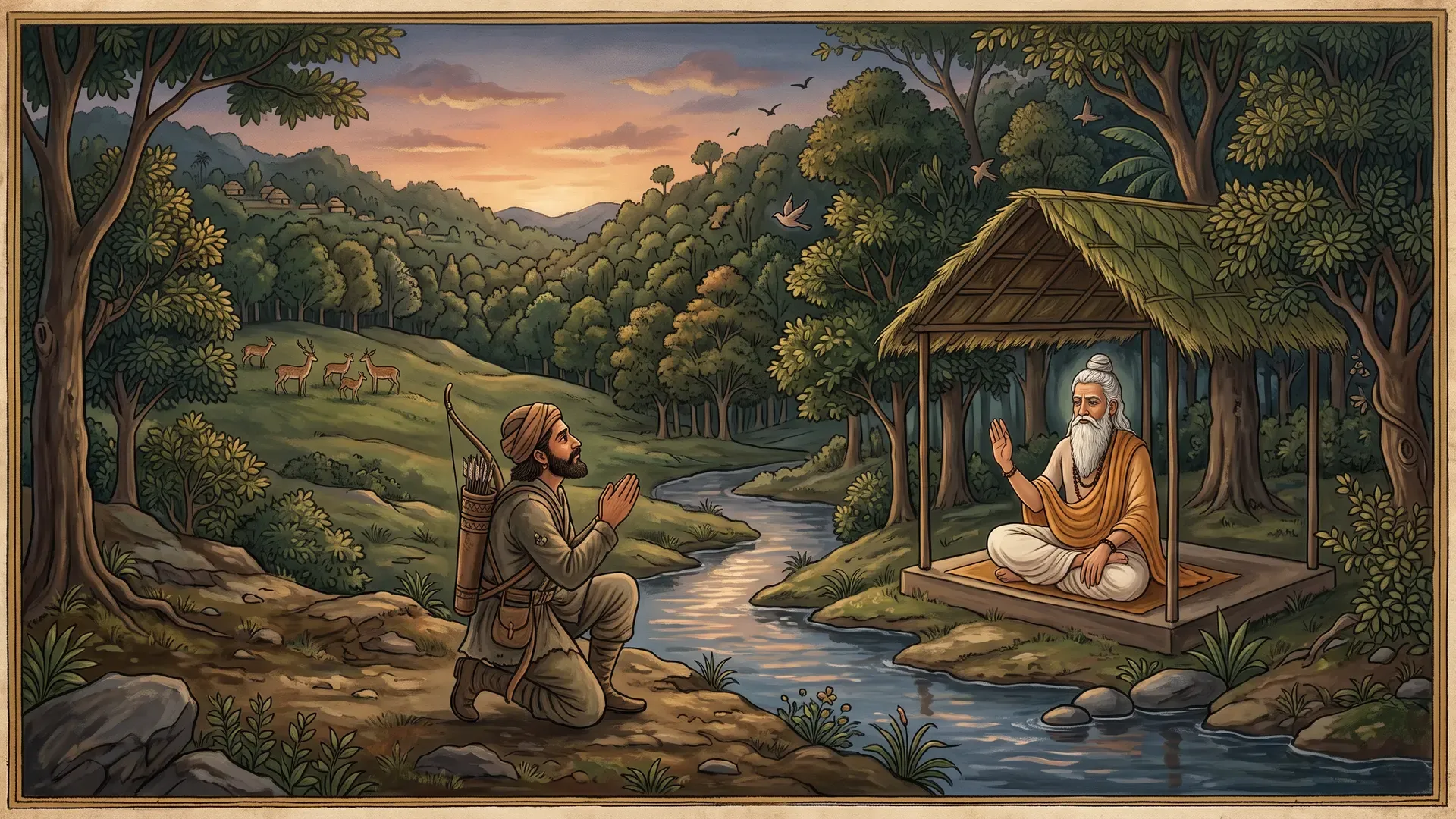
The Padma Purana (Uttara Khanda) tells no story for Papankusha Ekadashi; there Krishna only tells Yudhishthira the merits of the vow: it takes away all sins, Lord Vishnu is worshipped as Padmanabha on the day, and ten generations each of the observer’s mother’s, father’s and wife’s lines are uplifted. The tale popularly told on this day is of Krodhana the hunter, who, a day before his death, keeps this fast on the sage Angira’s advice and is freed of his sins; that tale is not in the Padma Purana.
Each morning the tithi, Rahu Kaal and coming festivals, in one short WhatsApp message.Follow the channel
Papankusha Ekadashi falls on Ashwin Shukla Ekadashi, after Vijayadashami (Dussehra). Vrat-katha books and Webdunia explain the name from “papa” (sin) and “ankusha” (the goad that controls an elephant): this Ekadashi pierces sins as a goad does. Lord Vishnu is worshipped and a fast is kept on the day, and the katha is read or heard after the puja.
The Uttara Khanda of the Padma Purana has a full chapter on this Ekadashi. The whole Uttara Khanda is framed as a dialogue between Lord Shiva and the sage Narada, and within it Krishna tells Yudhishthira, at his request, the glory of each Ekadashi. But the Papankusha chapter has no story: Krishna only sets out the merits of the vow. So this page first gives those merits in our own words, and then the tale that is popularly told on this day.
How the vrat and katha are kept
- By the Padma Purana, Lord Vishnu is worshipped on this day as Padmanabha, with a fast by day and a vigil at night.
- The Padma Purana praises gifts of gold, sesame, land, a cow, food, water, sandals, an umbrella or clothes on this day, and says that even the poor should bathe and give as far as they can.
- In Krodhana’s tale the sage Angira asks only this: keep the fast with true devotion and worship Lord Vishnu as prescribed.
Padma Purana: the glory of Papankusha Ekadashi
As given in the Padma Purana, Uttara Khanda, chapter 59 (61 in the Gita Press edition). The chapter tells no story, only the merits of the vow; below is its substance in our own words.
Yudhishthira asked Krishna, “Madhusudana, please tell me: which Ekadashi comes in the bright half of Ashwin?” Krishna said, “Listen, lord of kings. That Ekadashi is known as Papankusha, and it takes away every sin. On that day let a person worship me by the name Padmanabha. It fulfils every wish, and grants heaven and liberation too.”
In the Padma Purana Krishna goes on: the fruit that comes from long, hard austerity with the senses held in check comes on this day simply from bowing to the Lord whose banner bears Garuda. Even one who has sinned much in delusion does not go to hell if he bows to Hari, who takes away all sin. The merit of every tirtha and holy shrine on earth is gained by singing Vishnu’s names, and those who take refuge in Janardana, bearer of the Sharnga bow, never suffer the torments of Yama’s world.
Even if a single Ekadashi fast happens for some other reason, one who has done grave wrong is spared Yama’s torment. In the same passage the text warns against reviling either Shiva or Vishnu: a devotee of Vishnu who reviles Shiva does not reach Vishnu’s world, and for a worshipper of Shiva who reviles Vishnu the text names a severe punishment too.
Nothing in the three worlds purifies like this vow of Padmanabha; sins stay in the body until one fasts on his blessed day. The text says that a thousand Ashvamedha and a hundred Rajasuya sacrifices are not worth a sixteenth of an Ekadashi fast, and that no vow in the world equals it. Those who keep it even on some pretext do not go to Yama.
This Ekadashi grants heaven and liberation, keeps the body healthy, and gives wife and sons, wealth and friends. Not Ganga, Gaya, Kashi, Pushkar or Kurukshetra is called as holy as this day of Hari. Fasting by day and keeping vigil by night, one reaches Vishnu’s abode without strain.
The one who keeps the fast uplifts ten generations of the mother’s line, ten of the father’s and ten of the wife’s. They take on a divine four-armed form and, garlanded and in yellow garments, under banners marked with Garuda, go to the abode of Hari.
In childhood, youth or old age, one who fasts on Ekadashi does not come to a bad end. Whoever fasts on Papankusha in the bright half of Ashwin is freed of all sins and goes to Hari’s world.
One who gives gold, sesame, land, a cow, food, water, sandals, an umbrella or clothes does not see Yama. The text offers a comparison: a person whose days come and go without any good deed breathes like a blacksmith’s bellows but does not truly live. So even the poor should make each day count, bathing and giving as far as they can.
Those who do good works such as homa, bathing, japa, meditation and sacrifice do not see Yama’s dreadful torment; the long-lived, the wealthy, the well-born and the healthy whom one sees in the world are such doers of good. In short, adharma leads to a bad end and dharma to heaven. Krishna closes: “O king, I have told you the glory of Papankusha that you asked about. What else would you like to hear?”
Krodhana the hunter and the sage Angira: a popular tale
This story is not in the Padma Purana. It is found in Hindi vrat-katha books (the oldest print we found is from 1979) and on Webdunia, Amar Ujala and Aaj Tak; none of them names a Purana for it.
As the popular tale goes, long ago a hunter named Krodhana lived on the Vindhya mountains. He was very cruel. His whole life had gone in killing creatures, theft and robbery, drink, lies and quarrels.
When his end drew near, Yama told his messengers, “Bring Krodhana here tomorrow.” The messengers went and told Krodhana that tomorrow would be the last day of his life.
Hearing this, Krodhana shook with fear. In a panic he ran to the ashram of the sage Angira, fell at his feet and wept: “Master, my hands have done nothing but wrong all my life, and tomorrow is my end. Have mercy on me. Tell me what I can do to wash my sins away.”
The sage was moved by his plight. “Tomorrow is the Ekadashi of the bright half of Ashwin, called Papankusha,” he said, “and it destroys sins. Keep its fast tomorrow with true devotion and worship Lord Vishnu as prescribed.”
Krodhana did just that. He fasted with his whole heart and worshipped Lord Vishnu.
According to the katha, the power of this fast destroyed all his sins. In the 1979 vrat book, Vishnu’s attendants seat him in a beautiful celestial chariot and carry him to the world of the gods while Yama’s messengers look on; by Webdunia, Amar Ujala and Aaj Tak he attained liberation, and by the 2019 “Vrat evam Parv Samhita” he went to Vishnu’s world.
Other tellings
- In Drik Panchang’s telling Krishna gives these merits to Arjuna; in the Padma Purana, Gita Press, the ISKCON book and Webdunia, to Yudhishthira.
- The numbers in the comparison with sacrifices vary: the Sanskrit Padma Purana has a thousand Ashvamedhas and a hundred Rajasuyas; the ISKCON book a hundred of each; Hindi Wikipedia thousands of Vajapeyas and Ashvamedhas; and Amar Ujala “a hundred Surya yajnas”.
- Webdunia (and Hindi Wikipedia, which has the same text) adds ten generations of the friend’s line to those of the mother, father and wife; this is not in the Sanskrit Padma Purana or in Gita Press.
- Drik Panchang, Hindi Wikipedia and the 1979 vrat book add building ponds, gardens, rest houses and water stalls to the gifts; this is not in the Sanskrit Padma Purana.
- In Krodhana’s tale the 1979 vrat book (and another book with the same text) calls him a “vyadha”, the other sources a “baheliya” (both mean hunter). In that book Angira tells him the Ekadashi falls tomorrow; in Webdunia, Amar Ujala and Aaj Tak he simply tells him to keep the Papankusha fast.
- Some news sites (Webdunia 2025, Amar Ujala 2023) print the Padma Purana’s points, such as the uplift of generations and the merit of gifts, together with Krodhana’s tale without saying that the two come from different sources.
After the katha
After the katha the aarti of Lord Vishnu and the Ekadashi Mata aarti are sung, and a vigil is kept at night. The fast is broken the next day, Dwadashi, at the parana time; the parana time for your city is on the Papankusha Ekadashi page.
Ekadashi Aarti: Om Jai Ekadashi MataFrequently asked questions
Which Purana has the Papankusha Ekadashi katha?
The Uttara Khanda of the Padma Purana has a chapter on this Ekadashi (chapter 59 on Sanskrit Wikisource and in Deshpande’s translation, 61 in the Gita Press edition), but it tells no story, only the merits of the vow. The tale of Krodhana the hunter is a popular one; the books and sites that print it name no Purana, and it is not in the Padma Purana.
When is the Papankusha Ekadashi katha read?
By tradition, on the Ekadashi after the worship of Lord Vishnu and before the aarti. The Padma Purana prescribes worship of the Lord as Padmanabha, a fast and a night vigil on this day.
Who is worshipped on Papankusha Ekadashi?
By the Padma Purana, Lord Vishnu, under the name Padmanabha. There Krishna says that on this day simply bowing to the Lord of the Garuda banner brings the fruit of long austerity.
What is given in charity on Papankusha Ekadashi?
The Padma Purana praises gifts of gold, sesame, land, a cow, food, water, sandals, an umbrella or clothes, and says that even the poor should give as far as they can.
Sources
- Padma Purana, Uttara Khanda, chapter 59, Sanskrit Wikisource (chapter numbers vary by edition; the Gita Press edition has it as 61)
- Padma Purana, Uttara Khanda, chapter 59, N. A. Deshpande’s English translation (Motilal Banarsidass; wisdomlib.org)
- Gita Press, Gorakhpur: Ekadashi-vrat ka Mahatmya (the stories of 26 Ekadashis), compiled by Radheshyam Khemka, pp. 62–63
- ISKCON’s Ekadasi book text: Papankusha Ekadasi (iskcondesiretree.com)
- Drik Panchang: Papankusha Ekadashi Vrat Katha (Hindi and English), drikpanchang.com
- Webdunia (hindi.webdunia.com): Papankusha Ekadashi vrat katha (2021 and 2025); Hindi Wikipedia carries the same text of the merits
- Amar Ujala: Papankusha Ekadashi 2023, puja vidhi and katha
- Aaj Tak: the Papankusha Ekadashi 2024 katha (13 October 2024)
- Barahon Mahinon ke Sampurn Vrat aur Tyohar (Mathura, 1979), section 83 “Papankusha Ekadashi”, pp. 123–124 (archive.org)
- Vrat evam Parv Samhita (Akhil Bharatiya Jyotish Sanstha Sangh / Future Point, 2019; archive.org)
Something wrong? Report a mistake